
Cats are enigmatic creatures. One moment they’re sprinting across the living room like tiny, furry racecars; the next, they’re crammed into a shipping box barely large enough to hold a loaf of bread. This peculiar behavior—squeezing into containers far too small for their frames—is so common it’s become a meme. But beyond the humor lies a deeper truth rooted in feline psychology, evolutionary biology, and environmental adaptation. Understanding why cats choose these tight spaces isn’t just amusing—it offers valuable insights into how they perceive safety, manage stress, and regulate body temperature.
The phenomenon transcends breed, age, and domestication level. Whether it’s a stray cat curled up in a discarded cereal box or a pedigreed Persian wedged into a gift container, the instinct remains consistent. Scientists and animal behaviorists have studied this behavior extensively, revealing that what may seem like whimsy is actually a calculated response to innate needs. This article explores the behavioral science behind the box obsession, unpacking the psychological drivers, physiological benefits, and practical implications for cat owners.
The Evolutionary Roots of Confinement Preference
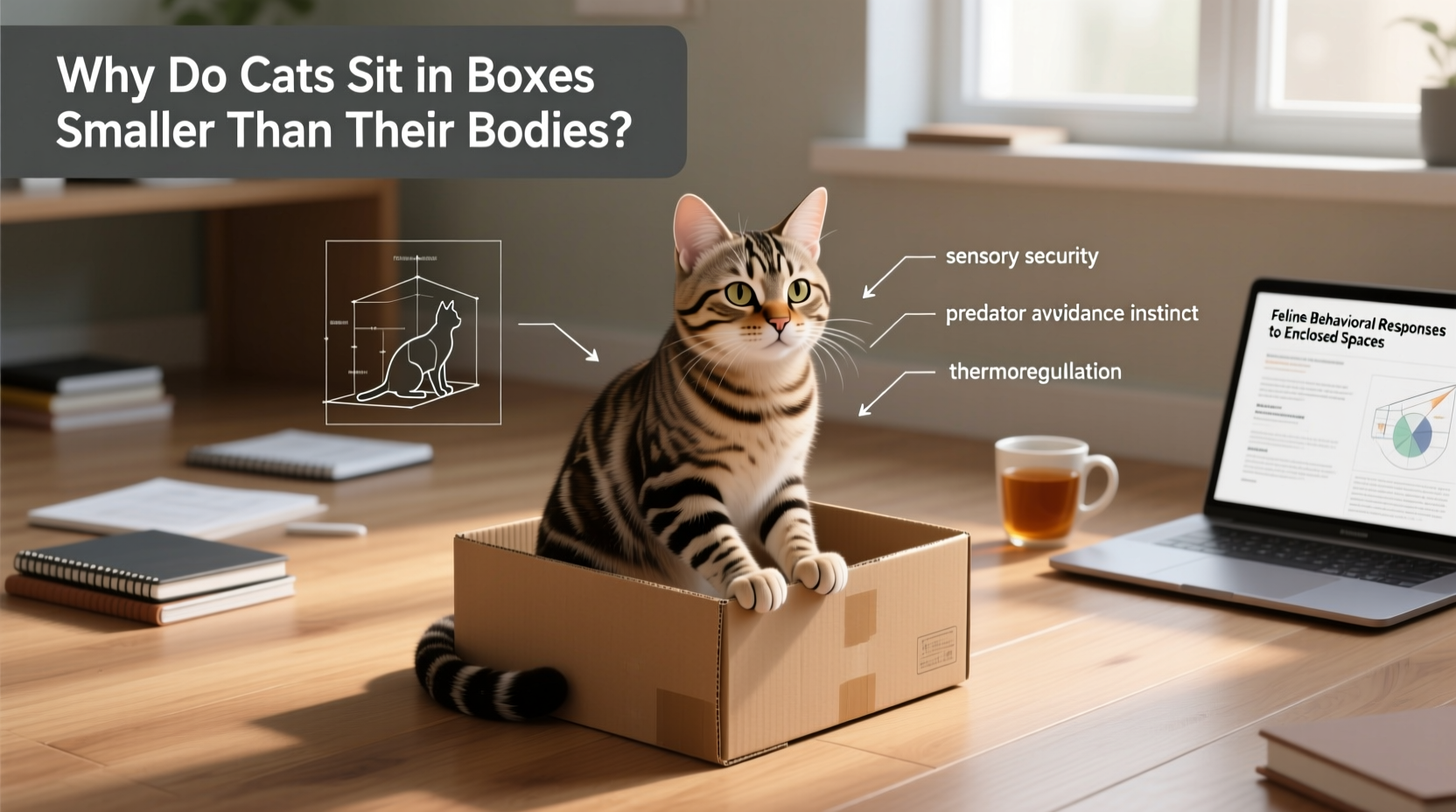
To understand why cats favor confined spaces, we must first consider their ancestry. Domestic cats (Felis catus) evolved from solitary desert-dwelling hunters who relied on stealth and concealment to survive. In the wild, exposure meant vulnerability—to predators, extreme temperatures, and competition. Natural shelters such as rock crevices, hollow logs, and dense brush provided protection and thermal insulation. These environments offered limited visibility from outside threats while maintaining stable internal conditions.
Modern indoor cats retain these ancestral instincts. A cardboard box mimics the enclosed, den-like structures their wild relatives would seek. Even though today’s housecats face no real danger from eagles or jackals, their brains still respond to spatial cues that signal safety. The walls of a box create a psychological barrier, reducing visual stimuli and auditory distractions. This sensory reduction helps lower stress levels, which is especially important in multi-pet households or noisy urban apartments.
“Enclosed spaces provide cats with a sense of control over their environment—an essential component of feline well-being.” — Dr. Sarah Ellis, Feline Behavior Scientist, University of Lincoln
Studies conducted at Utrecht University in the Netherlands found that shelter cats given access to hiding boxes adapted to new environments significantly faster than those without. The researchers concluded that the availability of enclosed spaces reduced cortisol levels, indicating lower stress. This suggests that confinement isn’t merely a preference—it’s a coping mechanism deeply embedded in feline neurobiology.
Thermoregulation and Comfort: The Warmth Factor
Another compelling reason cats gravitate toward small boxes is thermoregulation. Cats maintain a higher core body temperature than humans—around 101–102.5°F (38.3–39.2°C). To conserve heat, they naturally seek out insulated micro-environments where warmth doesn’t dissipate easily. Cardboard, despite its flimsy appearance, is an excellent insulator due to the air pockets trapped within its corrugated layers.
When a cat curls into a tight ball inside a snug box, its body heat reflects off the interior surfaces, creating a self-warming chamber. This effect is amplified when the box has a lid or partial cover, further minimizing airflow. The smaller the space relative to the cat’s size, the more efficiently heat is retained. This explains why cats often ignore spacious cat beds in favor of cramped packaging.
Interestingly, this behavior aligns with research showing that cats prefer ambient temperatures between 86°F and 97°F (30–36°C)—much warmer than typical human comfort zones. Since most homes are kept cooler, around 68–72°F (20–22°C), cats actively seek ways to compensate. Boxes, baskets, and even laundry piles serve as makeshift thermal sanctuaries, allowing them to maintain optimal body temperature with minimal energy expenditure.
Predatory Instincts and Environmental Control
Beyond warmth and security, boxes fulfill a third critical function: enabling predatory surveillance. Cats are ambush predators by nature. Even well-fed domestic cats exhibit hunting behaviors such as stalking, pouncing, and sudden bursts of activity. An elevated or partially enclosed box provides an ideal vantage point—a “base camp” from which they can observe household movement without being fully exposed.
In multi-cat homes, this becomes particularly relevant. Dominant cats may claim open perches, forcing subordinates to find alternative observation posts. A low-profile box tucked beside a sofa or under a desk allows a shy cat to monitor activity while remaining hidden. This dual role—as both refuge and lookout—makes boxes uniquely functional in a cat’s mental map of their territory.
Neurological studies using eye-tracking technology show that cats spend significantly more time scanning their surroundings when positioned in semi-enclosed spaces compared to open areas. Their pupils dilate less frequently, suggesting reduced anxiety. This state of alert relaxation is rare in exposed locations, where constant vigilance is required to detect potential threats.
Do’s and Don’ts of Providing Safe Spaces for Cats
| Action | Recommended | Not Recommended |
|---|---|---|
| Offer multiple hiding spots | Yes – ensures choice and reduces competition | No – limits options and increases stress |
| Use sturdy cardboard boxes | Yes – safe, insulating, and replaceable | No plastic bins with sharp edges |
| Place boxes in quiet areas | Yes – supports rest and recovery | Near loud appliances (e.g., washing machines) |
| Line boxes with soft fabric | Yes – enhances comfort and warmth | Avoid loose threads or frayed materials |
| Force a cat into a box | No – undermines trust and causes stress | Always allow voluntary entry |
Behavioral Benefits in Stressful Environments
The importance of accessible hiding spaces becomes especially evident in high-stress situations such as veterinary visits, travel, or home renovations. A landmark study published in *Applied Animal Behaviour Science* demonstrated that cats introduced to new shelters showed markedly lower signs of fear and aggression when provided with cardboard boxes within the first hour of arrival. Those without boxes exhibited prolonged freezing, hiding under furniture, and avoidance of human interaction.
This principle applies equally at home. When guests arrive, construction noise occurs, or a new pet is introduced, cats benefit immensely from having designated “safe zones.” A simple box placed in a quiet corner can act as an emotional anchor, helping them regain composure. Unlike complex cat trees or expensive igloo beds, boxes require no assembly and are instantly recognizable as shelters due to their shape and enclosure.
“When a cat chooses a box, it’s not choosing convenience—it’s choosing control.” — Dr. Mikel Delgado, Cat Behavior Researcher, UC Davis School of Veterinary Medicine
Moreover, the act of entering and settling into a confined space triggers calming neurological responses. The pressure of the sides against the cat’s body provides gentle tactile feedback similar to swaddling in infants, which has been shown to reduce heart rate and promote relaxation. This deep-touch stimulation may explain why some cats knead or purr once settled inside a box—behaviors associated with contentment and early kittenhood.
Mini Case Study: Reducing Anxiety in a Multi-Cat Household
In a 2022 observational case in Portland, Oregon, a family with three cats noticed escalating tension after adopting a fourth, younger feline. The resident cats began avoiding shared spaces, and one stopped using the litter box altogether. A certified feline behavior consultant recommended placing identical cardboard boxes in each major room, lined with fleece blankets and lightly sprayed with synthetic feline facial pheromones.
Within 48 hours, all four cats were regularly using the boxes. The previously anxious senior cat spent most of her day in a box near the bedroom window. The new kitten used one as a launchpad for play sessions. Aggression incidents dropped from five per week to zero within two weeks. The owners reported improved sleep patterns and increased social grooming among the group. The intervention cost less than $20 and required no permanent modifications.
This example illustrates how a simple, biologically appropriate solution can resolve complex behavioral issues. The boxes didn’t eliminate hierarchy or personality differences—they simply gave each cat a private domain within the shared space, restoring balance.
Practical Tips for Cat Owners
Understanding the science behind box-sitting empowers owners to support their cats’ emotional health proactively. Rather than viewing the behavior as odd, it should be seen as a healthy expression of natural instincts. Here’s how to make the most of it:
Cat-Friendly Space Checklist
- Provide at least one enclosed space per cat in the household
- Position boxes away from foot traffic but within sight of activity
- Use non-toxic tape and remove staples or sharp edges
- Replace damaged or soiled boxes promptly
- Introduce new boxes gradually if your cat seems hesitant
- Never use boxes as punishment or forced isolation
- Consider adding crinkly paper or catnip for enrichment
Frequently Asked Questions
Is it normal for my cat to sit in boxes smaller than its body?
Yes, it’s completely normal. Cats often prefer tighter spaces because they provide better insulation and a greater sense of security. As long as the cat can enter and exit freely and shows no signs of distress, this behavior is harmless and even beneficial.
Should I be concerned if my cat suddenly stops using boxes?
A sudden change in behavior can indicate underlying issues such as pain, illness, or environmental stress. If your cat avoids previously favored spots, check for changes in mobility, appetite, or litter box habits. Consult your veterinarian if other symptoms accompany the shift.
Can I use plastic containers instead of cardboard boxes?
Plastic bins can work if they are shallow, have smooth edges, and include easy escape routes. However, cardboard is generally preferred because it’s breathable, quieter, and easier to scratch or manipulate. Avoid sealed containers or those with slippery surfaces.
Conclusion: Embracing the Box Habit for Better Feline Well-Being
The image of a cat squeezed into a box too small to accommodate its tail is universally endearing. But beneath the surface, this behavior reflects profound aspects of feline cognition and emotional regulation. From evolutionary survival strategies to modern-day stress management, the humble cardboard box serves as a multifunctional tool that meets core biological needs.
As cat owners, we don’t need to buy elaborate furniture or designer hideaways to support our pets’ mental health. Sometimes, the best enrichment comes free with online deliveries. By respecting this instinctive drive for enclosure, we create environments where cats feel seen, safe, and in control. So the next time you catch your cat perched in a snack-size shoebox, resist the urge to intervene. Instead, appreciate the intricate blend of science and instinct playing out before your eyes.




 浙公网安备
33010002000092号
浙公网安备
33010002000092号 浙B2-20120091-4
Comments
No comments yet. Why don't you start the discussion?