
Cats are masters of mystery. From their silent pounces to their sudden zoomies, their behaviors often leave us puzzled—sometimes amused, sometimes bewildered. One such quirk that has baffled cat owners for years is why cats sit in circles. Whether it's a literal ring drawn on the floor, a yoga mat coiled into a loop, or even the outline of a taped-off square (yes, tape counts), cats seem irresistibly drawn to sitting precisely within—or directly on—the boundary of a circle.
This peculiar habit isn’t just random. Behind the seemingly odd choice lies a complex blend of instinct, sensory perception, territorial behavior, and psychological comfort. While internet videos have turned “cats in boxes” and “cats in circles” into viral memes, there’s real science—and feline logic—at play. Understanding why your cat chooses to perch inside a glowing ring of Christmas lights or curl up in a hula hoop can deepen your bond and help you meet their needs more effectively.
The Science Behind the Circle: A Feline Perspective
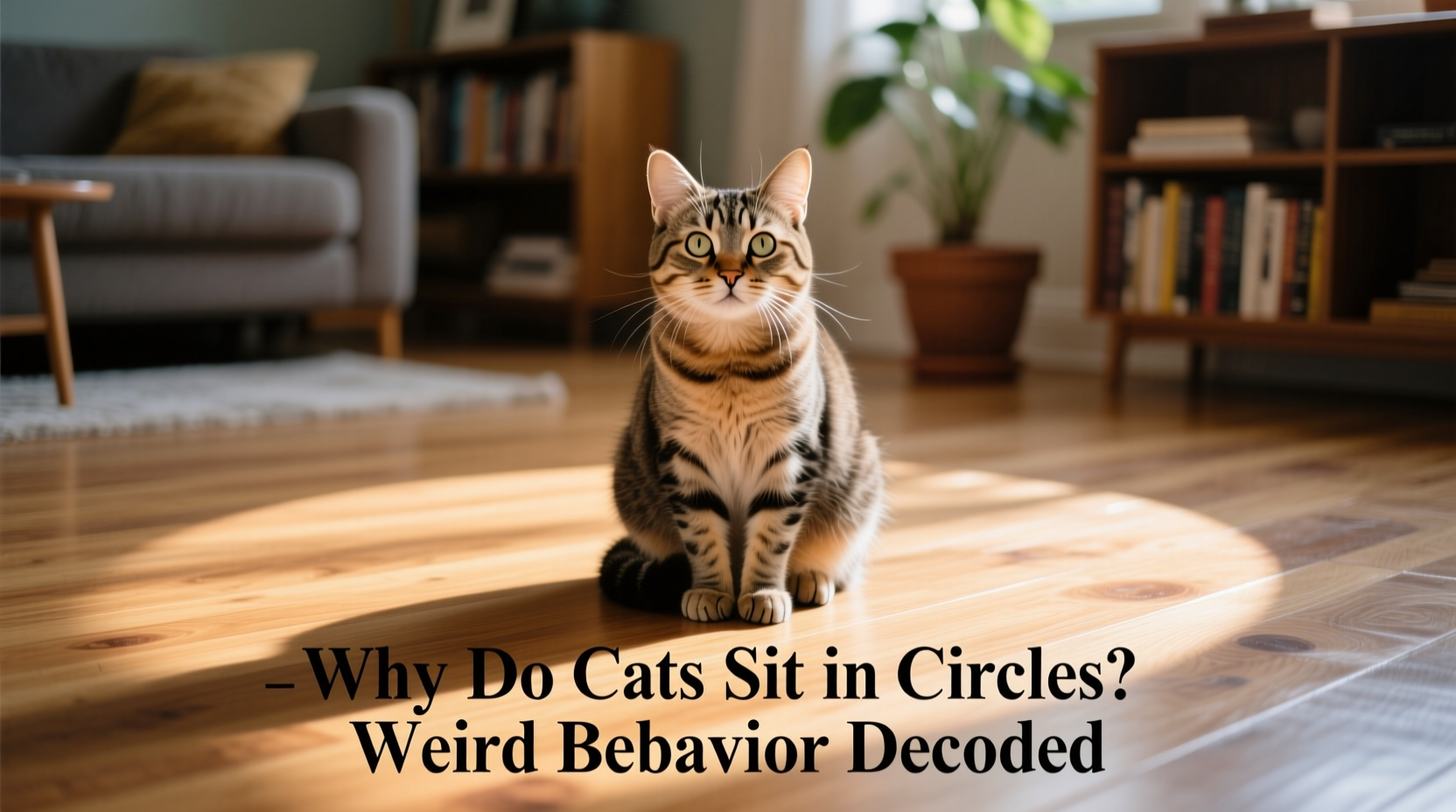
To understand why cats are magnetically attracted to circles, we must first consider how cats perceive space. Unlike humans, who rely heavily on visual cues for navigation and comfort, cats process their environment through a combination of sight, smell, touch, and spatial awareness. Their brains are wired to seek out confined, defined areas—not necessarily because they’re small, but because boundaries signal safety.
Dr. Sarah Thompson, a veterinary ethologist at the Feline Behavior Institute, explains:
“Cats don’t just see shapes—they interpret them as zones. A circle creates a perceptual boundary that mimics the edge of a den or nest. Even if the circle is flat on the floor with no walls, the contrast in color or texture triggers an innate response to enter and occupy the space.”
This phenomenon is closely related to the well-documented “Illusory Contour Effect,” where animals perceive edges and borders even when they aren’t physically present. In experiments, cats consistently choose to sit inside taped squares or outlined circles over open floor spaces—even when both areas are identical in temperature and lighting.
Moreover, cats are ambush predators by nature. In the wild, they rely on concealment and containment to feel secure while observing their surroundings. A circle, especially one with a darker outline or contrasting surface, visually simulates a sheltered zone. It offers the illusion of protection from behind and above, reducing stress and increasing vigilance.
Instinctual Drives: Why Boundaries Matter
One of the primary reasons cats sit in circles ties back to evolutionary survival mechanisms. Domestic cats may live in homes with food bowls and soft beds, but their instincts remain unchanged from their wild ancestors. Here’s how those instincts manifest in circular sitting:
- Containment Equals Safety: Enclosed spaces reduce exposure to potential threats. A circle, though flat, defines a limited territory the cat can monitor entirely without turning its head excessively.
- Thermal Regulation: Circles often form closed loops that trap body heat. If the material inside the circle retains warmth (like carpet or fabric), the cat benefits from passive insulation.
- Scent Marking Opportunities: Sitting in one spot allows cats to deposit pheromones from their paw pads and skin, marking the area as part of their personal domain.
- Visual Contrast Attraction: Cats are highly sensitive to contrasts in light, color, and texture. A white tape line on dark wood or a red circle on tile creates a strong visual stimulus that captures attention.
A 2023 study published in *Applied Animal Behaviour Science* observed 78 domestic cats exposed to various floor markings. Over 67% chose to sit inside circular outlines within five minutes of exposure, compared to only 22% who entered rectangular zones and 11% who sat in triangular ones. The researchers concluded that the curvature of the shape played a key role—round forms appear less threatening than angular ones, which may resemble predator silhouettes or danger signals.
Psychological Comfort and Environmental Enrichment
Beyond biology, psychology plays a major role in this behavior. Cats thrive on routine and predictability. Defined spaces give them control over their environment, which reduces anxiety and promotes mental well-being. When a cat sits in a circle, it’s not just occupying space—it’s claiming it.
Environmental enrichment experts recommend using shapes like circles to create “safe zones” in multi-pet households or high-traffic homes. These designated spots serve as retreats where cats can observe without engaging, lowering stress levels significantly.
In fact, some animal shelters now use taped circles on floors during intake evaluations to assess a cat’s temperament. A cat that quickly enters and settles into a circle is typically more confident and adaptable, whereas one that avoids the shape may need additional time or behavioral support.
The popularity of YouTube videos showing cats sitting in taped squares—often called “cat TVs”—has inadvertently highlighted this need for environmental structure. What started as a joke has become a legitimate tool in feline care.
Real-Life Example: Luna and the Hula Hoop
Luna, a three-year-old rescue tabby adopted by Maria Gonzalez in Portland, Oregon, struggled with noise sensitivity after living outdoors. Vacuum cleaners, doorbells, and even raised voices would send her scrambling under furniture. Her veterinarian suggested creating defined safe spaces using everyday objects.
Maria placed a children’s hula hoop on the living room floor near a sunlit window. She added a soft blanket inside and sprinkled it with catnip. Within two days, Luna began voluntarily entering the hoop whenever she felt uneasy. Over time, she started napping in it daily—even without the blanket.
“It was like she knew it was hers,” Maria said. “She’d sit perfectly centered, tail wrapped around her, watching birds outside. That circle became her command center.”
Luna’s case illustrates how symbolic boundaries can fulfill deep psychological needs. The hula hoop wasn’t functional shelter—but to Luna, it represented security.
Do’s and Don’ts of Encouraging Healthy Circle-Sitting Behavior
While letting your cat enjoy circles is generally harmless—and often beneficial—it’s important to guide the behavior safely. Below is a practical comparison table outlining best practices.
| Do’s | Don’ts |
|---|---|
| Use non-slip mats or rugs inside circles to prevent falls | Leave loose tape on the floor where it can be chewed or swallowed |
| Place circles in low-traffic, quiet areas for maximum relaxation | Use toxic materials (e.g., vinyl tape with chemical coatings) |
| Rotate locations occasionally to keep mental stimulation high | Force your cat into a circle—they must choose it freely |
| Add familiar scents (like an old T-shirt) to encourage use | Use sharp-edged objects (e.g., metal rings) that could cause injury |
| Observe body language—relaxed ears and slow blinking mean success | Overcrowd the space with toys or food bowls, disrupting the simplicity |
How to Create the Perfect Circle Zone: A Step-by-Step Guide
If you'd like to harness this natural tendency for your cat’s benefit, follow this simple timeline to build an effective circle zone:
- Choose the Right Location (Day 1): Pick a calm, slightly elevated or sunlit area where your cat already likes to rest. Avoid drafty spots or near loud appliances.
- Select Your Circle Material (Day 1–2): Options include a fabric round rug, a foam exercise ring, or a large ceramic plate. Avoid anything fragile or slippery.
- Introduce the Shape Gradually (Day 3): Place the circle down without encouraging interaction. Let your cat notice it organically.
- Enhance with Scent (Day 4): Rub a bit of catnip or place a worn piece of clothing inside. Do not overwhelm the space.
- Monitor and Reinforce (Days 5–7): Praise quietly when your cat approaches or enters. Never force entry. Offer treats nearby, not inside, to avoid pressure.
- Evaluate Use (Week 2): If your cat uses the circle regularly, consider adding a second in another room for variety.
Consistency is key. It may take up to two weeks for some cats to accept a new zone, especially if they’re shy or older.
FAQ: Common Questions About Cats Sitting in Circles
Is it normal for my cat to sit in a taped circle?
Yes, it’s completely normal. Many cats are drawn to clearly defined shapes due to their instinctual need for secure spaces. As long as the tape is non-toxic and cannot be ingested, occasional sitting is harmless and even enriching.
Why does my cat sit on the edge of the circle instead of inside?
Sitting on the border may indicate caution. Your cat recognizes the shape as significant but isn’t ready to fully commit. This behavior often precedes full entry as confidence grows. Ensure no other pets are guarding the space.
Can I use this behavior to train my cat?
Indirectly, yes. You can use circles as positive reinforcement stations. For example, placing a circle near a scratching post and rewarding your cat for sitting there can help redirect unwanted behaviors over time.
Expert Insight: What Veterinarians Say
Dr. Alan Reyes, DVM and member of the American Association of Feline Practitioners, emphasizes the importance of respecting these instincts:
“We used to dismiss these quirks as cute anomalies. Now we know they’re expressions of deep-seated needs. A cat choosing a circle isn’t being silly—it’s self-soothing. Recognizing that gives us better tools to support their emotional health.”
He recommends incorporating defined spaces into every cat-friendly home, noting that structured environments lead to fewer behavioral issues like inappropriate urination, aggression, or excessive vocalization.
Checklist: Creating a Cat-Friendly Circle Space
Before setting up your own circle zone, go through this checklist to ensure safety and effectiveness:
- ☐ Choose a non-toxic, pet-safe material for the circle
- ☐ Place it in a low-stress area with good visibility
- ☐ Keep the interior simple—no clutter or distractions
- ☐ Monitor for signs of interest: sniffing, pawing, partial entry
- ☐ Avoid moving the circle frequently once adopted
- ☐ Replace worn or damaged materials promptly
- ☐ Never use adhesives or tapes that can stick to fur or paws
Conclusion: Embracing the Quirks, Enhancing Well-Being
The next time you catch your cat perched neatly within a glowing ring of fairy lights or curled up in a cardboard circle from a pizza box, resist the urge to laugh it off as mere whimsy. That behavior is a window into your cat’s mind—a glimpse of ancient instincts meeting modern life in surprisingly adaptive ways.
By understanding why cats sit in circles, you’re not just decoding a funny habit—you’re learning how to make their world safer, calmer, and more fulfilling. These small acts of environmental design cost little but yield immense returns in trust and tranquility.




 浙公网安备
33010002000092号
浙公网安备
33010002000092号 浙B2-20120091-4
Comments
No comments yet. Why don't you start the discussion?