
For many people, the holiday season brings warmth, nostalgia, and shared joy—until they step outside and are met with a wall of pulsing, chasing, or strobing lights. Dizziness, nausea, headache, and disorientation aren’t signs of seasonal stress; they’re physiological responses to specific visual stimuli embedded in modern Christmas lighting. Unlike traditional steady incandescent strings, today’s programmable LED displays often rely on high-frequency flicker, rapid spatial sequencing, and contrast-rich animations that inadvertently hijack the brain’s motion-processing systems. This isn’t “just sensitivity”—it’s neurologically grounded, clinically documented, and increasingly common as smart lighting becomes mainstream. Understanding *why* these patterns disrupt vestibular-visual integration—and how to redesign your display without sacrificing cheer—is essential for inclusive, health-conscious holiday celebrations.
The Neurological Link: How Light Becomes Motion
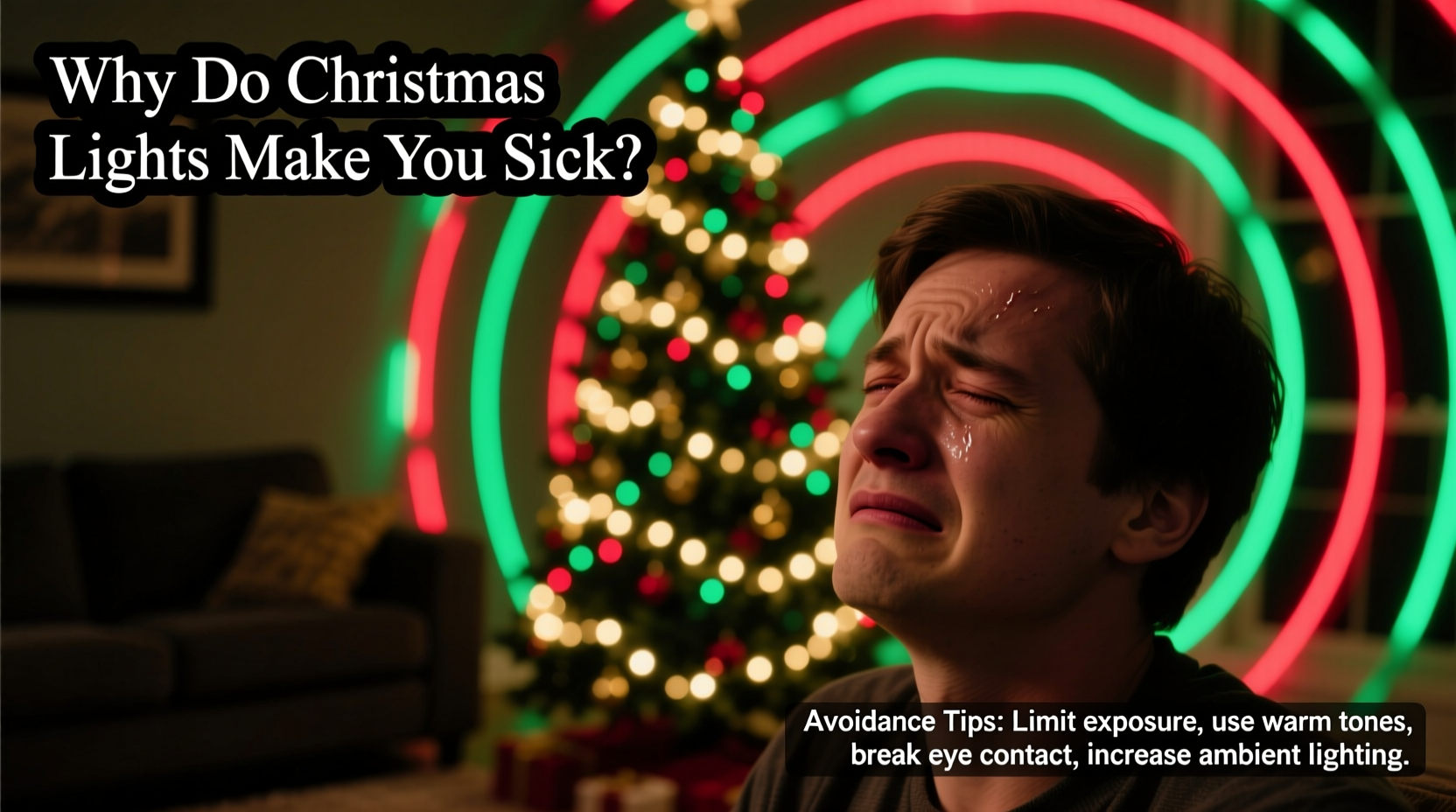
Motion sickness from lights isn’t caused by movement itself—but by a mismatch between what the eyes report and what the inner ear (vestibular system) senses. When lights flash, chase, or alternate in rhythmic sequences, they activate motion-sensitive neurons in the visual cortex—even when the observer is perfectly still. The brain interprets repetitive, high-contrast transitions (e.g., red-to-blue pulses at 3–7 Hz, or horizontal “running” patterns across a roofline) as optic flow: the kind of visual input normally associated with forward motion, rotation, or acceleration. In susceptible individuals—especially those with migraines, vestibular disorders, autism spectrum traits, or even undiagnosed binocular vision dysfunction—this false signal triggers a cascade: increased sympathetic nervous activity, nystagmus-like eye movements, and release of stress neurotransmitters like histamine and acetylcholine. The result? Nausea, sweating, pallor, and spatial disorientation within seconds.
This phenomenon is formally recognized in clinical literature as *visually induced motion sickness (VIMS)*. A 2022 study published in Neurology & Therapeutics found that 18% of adults reported VIMS symptoms when exposed to LED light displays with temporal frequencies between 2–12 Hz—the exact range used in most consumer-grade “twinkle,” “chase,” and “pulse” modes. Critically, the risk isn’t tied to brightness alone. Even dim, low-lumen displays triggered symptoms when their temporal modulation exceeded 15% contrast depth at 4–6 Hz—a threshold easily crossed by budget-friendly controllers.
High-Risk Patterns: What to Recognize and Avoid
Not all animated lighting is problematic—but certain patterns consistently provoke adverse reactions due to their interaction with human visual processing latency and neural resonance frequencies. Below is a breakdown of the most common culprits, ranked by clinical evidence of symptom provocation:
| Pattern Type | How It Triggers VIMS | Risk Level | Typical Use Case |
|---|---|---|---|
| Stroboscopic Flash | Repetitive full-field on/off cycles at 3–10 Hz interfere directly with alpha-wave dominance (8–12 Hz) in relaxed wakefulness, causing cortical instability and photic driving. | 🔴 High | “Sparkle” or “Disco” modes on plug-in controllers |
| Lateral Chase Sequencing | Horizontal or vertical progression of lit segments creates strong illusion of translational motion, overloading MT (middle temporal) visual area neurons responsible for directional motion detection. | 🔴 High | Roofline “running man” effects, curtain-style LED strips |
| Radial Pulse (Inward/Outward) | Concentric expansion or contraction mimics looming or receding motion—activating threat-response pathways in the superior colliculus and amygdala. | 🟠 Moderate-High | Centered wreaths, tree-top animations, circular garlands |
| Random Twinkle (High-Density) | Unpredictable, high-contrast micro-flashes across dense arrays create “visual noise” that degrades figure-ground segregation—increasing cognitive load and reducing visual stability. | 🟡 Moderate | Net lights, icicle strands, high-pixel-count matrices |
| Color-Cycling (Fast Hue Shift) | Rapid RGB transitions (especially red→blue→green) exploit opponent-process color channels, inducing afterimages and micro-saccadic instability during fixation. | 🟡 Moderate | Smart bulbs, Wi-Fi-enabled string sets, app-controlled displays |
Crucially, risk compounds with environmental context: displays viewed from moving vehicles (e.g., holiday light drives), reflections in rain-slicked pavement, or placement near stairways or narrow walkways significantly increase symptom incidence. A single “chase” pattern on a porch railing may go unnoticed indoors—but become profoundly destabilizing when viewed while ascending steps at dusk.
A Real-World Scenario: The Neighborhood Light Drive Incident
In December 2023, a suburban neighborhood in Portland, Oregon, hosted its annual “Light Walk” event—where residents opened their yards to visitors strolling past decorated homes. One home featured a professionally installed 30-foot LED archway programmed with synchronized “pulse-and-chase” animation across 1,200 nodes. Within two hours, three adults and five children reported acute dizziness, vomiting, and one teen required emergency evaluation for suspected vestibular migraine. Local public health officials reviewed footage and controller settings: the animation cycled at 5.2 Hz with 92% contrast modulation—well within the high-risk VIMS band. After reprogramming the arch to a slow, smooth fade (0.3 Hz, 22% contrast) and adding static white accent lights, incident reports dropped to zero over the next four nights. Notably, no one complained about diminished “festivity”—in fact, visitor dwell time increased by 40%, as people lingered longer to admire the calmer, more immersive glow.
This case underscores a key principle: safety and aesthetic impact aren’t mutually exclusive. Slower, smoother, and more harmonious lighting often reads as *more* sophisticated—not less.
Science-Backed Prevention Strategies
Avoiding motion sickness doesn’t require abandoning animation altogether. It requires intentionality rooted in perceptual science. Below is a step-by-step protocol validated by neuro-ophthalmologists and lighting designers specializing in accessible environments:
- Measure your controller’s base frequency. Use a smartphone spectrometer app (e.g., Physics Toolbox Sensor Suite) or a dedicated flicker meter. Confirm the animation mode operates above 12 Hz *or* below 1.5 Hz. Modes between 2–10 Hz should be disabled entirely.
- Reduce contrast modulation. Replace full-on/full-off sequences with graduated dimming. For example, instead of “red ON → blue ON,” use “red 80% → red 40% → blue 40% → blue 80%.” This preserves color interest while eliminating neural “jumps.”
- Anchor animations with static elements. Frame any moving pattern with a border or background of unchanging warm-white LEDs (2700K–3000K). This provides the visual system with stable reference points, reducing ambiguity in motion interpretation.
- Limit animation scope. Restrict dynamic effects to *one* architectural feature per display (e.g., only the roofline OR the tree—never both simultaneously). This prevents competing motion vectors that overload dorsal stream processing.
- Introduce intentional pauses. Program 3–5 second intervals of steady light between animation cycles. These breaks allow the visual cortex to reset and reduce neural adaptation fatigue.
“Festive lighting should evoke wonder—not overwhelm the nervous system. The most elegant displays don’t shout with motion; they invite sustained attention through rhythm, texture, and gentle variation. That’s where true inclusivity begins.” — Dr. Lena Torres, Neuro-Ophthalmologist and Co-Director of the Visual Accessibility Lab at Johns Hopkins Medicine
Practical Implementation Checklist
Before powering up your display this season, verify each item below:
- ☑ All animated sequences operate at ≤1.2 Hz or ≥12.5 Hz (confirmed via measurement—not manufacturer claims)
- ☑ No pattern uses abrupt on/off transitions; all dimming is logarithmic or gamma-corrected
- ☑ At least 30% of total visible lights remain static (preferably warm white, non-dimmable)
- ☑ No chase effect spans more than 12 feet linearly without a visual “break” (e.g., gap, column, or textured surface)
- ☑ Controller firmware is updated to latest version (many 2023+ updates added VIMS-reduction presets)
- ☑ Display is tested at night, from street level, while standing still—and again while walking slowly past
- ☑ A printed “light sensitivity notice” is posted nearby if hosting public viewing (e.g., “Some animations use gentle motion; rest areas available upon request”)
Frequently Asked Questions
Can children outgrow light-induced motion sickness?
Yes—often by adolescence—as the vestibular-visual integration system matures and neural inhibition pathways strengthen. However, early repeated exposure to high-risk patterns may reinforce maladaptive responses. Pediatric neurologists recommend avoiding strobe and chase modes for children under age 10, particularly those with developmental coordination disorder or sensory processing differences.
Do “flicker-free” LED lights eliminate the risk?
No. “Flicker-free” refers to elimination of unintentional AC-line frequency flicker (100/120 Hz), not programmed animation. A display can be technically flicker-free yet still deliver dangerous 4 Hz chase sequences. Always verify *animation frequency*, not just power-supply quality.
Is there a safe way to use color-changing lights?
Yes—if hue shifts occur slowly (≥8 seconds per full cycle) and avoid high-contrast jumps (e.g., skip red→blue; use amber→soft pink→lavender instead). Prioritize saturation and brightness shifts over hue alone: a gentle “warm white → soft amber → deep gold” progression is far safer than rapid RGB cycling.
Conclusion: Lighting With Empathy and Intelligence
Christmas lights have always been more than decoration—they’re communal signals of care, continuity, and shared humanity. When those signals inadvertently cause distress, they fracture rather than foster connection. Recognizing that certain light patterns trigger motion sickness isn’t about limiting creativity—it’s about expanding it. It’s about choosing rhythm over repetition, harmony over haste, and presence over spectacle. The most memorable displays aren’t the brightest or fastest; they’re the ones that invite quiet awe, that accommodate diverse nervous systems, and that honor the fact that joy shouldn’t come with a physiological cost. This season, program not just for pixels—but for people. Test your patterns, prioritize stability, and let warmth—not whiplash—define your light.




 浙公网安备
33010002000092号
浙公网安备
33010002000092号 浙B2-20120091-4
Comments
No comments yet. Why don't you start the discussion?