
Every December, families unpack cherished ornaments—hand-blown glass globes, vintage mercury-glass baubles, delicate hand-painted figurines—only to find some clouded with a milky haze or streaked with condensation behind the glass. That fog isn’t dirt or age; it’s moisture trapped where it shouldn’t be. Unlike surface dust, internal fogging signals a breakdown in the ornament’s micro-environment: a tiny, sealed world compromised by humidity, temperature shifts, or manufacturing flaws. Left unaddressed, it accelerates corrosion, dulls reflective coatings, and permanently obscures detail. This isn’t just cosmetic—it’s a sign of material stress, especially in heirloom-quality pieces made with silver nitrate linings, vacuum-sealed chambers, or thin-walled glass. Understanding *why* fog forms—and how to stop it before it starts—is essential for preserving both aesthetic integrity and sentimental value across decades of holiday traditions.
The Science Behind Internal Fogging: It’s All About Moisture Migration
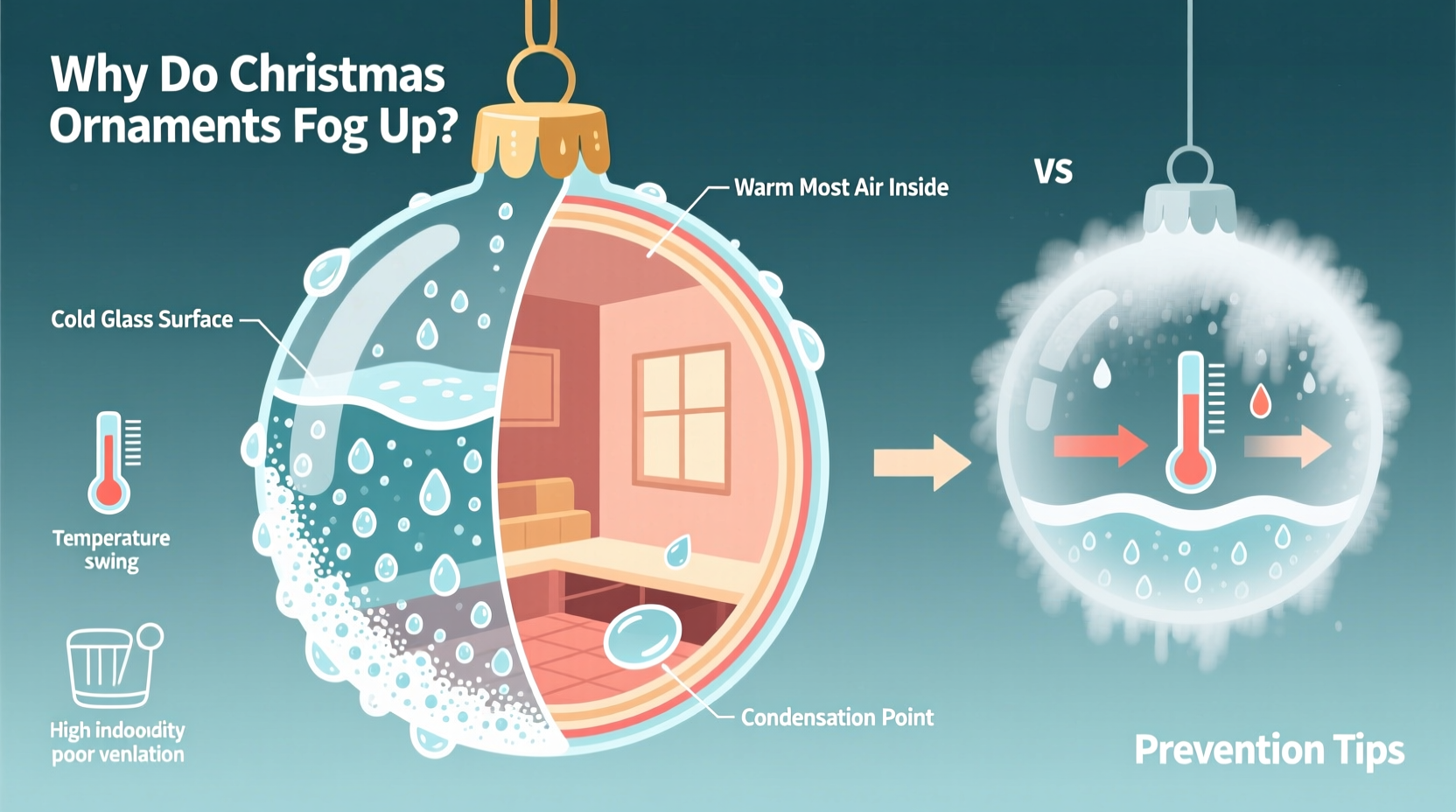
Fogging occurs when water vapor enters the sealed interior cavity of an ornament and condenses on cooler inner surfaces. Most clear glass ornaments—especially traditional “silvered” baubles—are manufactured with a two-step process: first, a solution of silver nitrate and reducing agents is swirled inside the glass shell to create a reflective metallic lining; then, the opening is heat-sealed while the interior is still dry and inert. In ideal conditions, that seal remains impermeable for generations. But real-world storage introduces variables no factory can fully control.
Temperature differentials are the primary catalyst. When an ornament moves from cold attic storage into a warm, humid living room, the air trapped inside expands—but more critically, any residual moisture present (from incomplete drying during manufacture or post-production handling) reaches its dew point faster than the outer glass warms. The result? Microscopic droplets forming on the silvered backing or inner wall. Over time, repeated cycling—seasonal storage, shipping, display near radiators or windows—causes moisture to migrate through microscopic pores in solder joints, imperfect seals, or even the glass itself via diffusion. Older ornaments with lead-based solder or hand-applied caps are especially vulnerable: lead oxidizes readily in damp air, creating porous pathways for vapor ingress.
Chemical degradation compounds the problem. Silver nitrate linings react with sulfur compounds in indoor air (from wool, rubber, or even certain paints) to form silver sulfide—a dull gray tarnish that scatters light and mimics fog. Meanwhile, moisture accelerates oxidation of copper or aluminum backings used in budget ornaments, producing white crystalline deposits known as “bloom.” Both processes begin invisibly but become irreversible once internal condensation provides the electrolyte medium for electrochemical corrosion.
Ornament Types Most Prone to Fogging (and Why)
Not all ornaments fog equally. Vulnerability depends on construction method, sealing quality, and materials. Below is a comparison of common types and their relative risk profiles:
| Ornament Type | Fogging Risk Level | Primary Cause | Typical Timeframe for First Signs |
|---|---|---|---|
| Vintage Mercury-Glass (pre-1950s) | High | Micro-cracks in glass + oxidized mercury amalgam backing | 1–3 seasons after improper storage |
| Modern Silvered Glass (mass-produced) | Moderate-High | Incomplete vacuum sealing + low-grade solder caps | 2–5 years, often worsening after 3rd season |
| Hand-Blown European Glass (e.g., Lauscha) | Low-Moderate | Rare; usually only with damaged cap or extreme humidity exposure | 10+ years under proper care |
| Plastic or Acrylic Ornaments | Very Low | Non-porous; fogging only occurs on *surface* due to static or cleaning residue | Not applicable (no internal cavity) |
| Wood, Fabric, or Ceramic Ornaments | Negligible | No sealed interior cavity | Not applicable |
Crucially, “vintage” doesn’t always mean “fragile”—many pre-WWII German ornaments used high-temperature annealing and triple-dip silvering that outperforms modern cost-cutting methods. Conversely, ornaments labeled “handmade” without verified studio credentials may use untested adhesives or inconsistent sealing techniques. As conservation scientist Dr. Lena Vogel of the Museum of Decorative Arts notes:
“The most alarming fogging cases we see aren’t in century-old antiques—they’re in ornaments made between 2005 and 2015, where manufacturers substituted traditional tin-lead solder with zinc alloys that corrode rapidly in household humidity. It’s a materials failure masked as aging.”
Preventive Storage: The Critical 8-Week Window
Most fogging damage occurs not during display, but in the 8–10 weeks between New Year’s Day and Thanksgiving—the storage period. During this time, ornaments sit in environments with wide humidity swings: attics (hot/dry in summer, cold/damp in fall), basements (consistently humid), garages (temperature-fluctuating), or plastic bins (trapping off-gassed moisture). Prevention hinges on controlling three factors: humidity, temperature stability, and air circulation.
Airtight plastic containers seem logical—but they’re counterproductive. Without desiccant, trapped ambient moisture has nowhere to go. Instead, use acid-free cardboard boxes lined with unbleached cotton muslin or archival tissue. Place silica gel desiccant packs (rechargeable type, not single-use) inside each box—not touching ornaments, but suspended in breathable mesh bags. Replace or recharge every 6 months. Store boxes on wooden shelves—not concrete floors—to avoid ground moisture wicking upward. Maintain ambient humidity between 40–50% RH year-round; use a hygrometer to verify. Avoid locations near HVAC vents, water heaters, or exterior walls.
Step-by-Step: Reviving Mildly Fogged Ornaments (When Prevention Fails)
If fog appears early—within the first 1–2 seasons—and hasn’t yet caused visible tarnish or bloom, reversal is possible. This process works only on ornaments with intact seals and no active corrosion. Do not attempt on cracked, chipped, or heavily tarnished pieces.
- Assess integrity: Hold the ornament up to bright light. If you see pinprick holes, hairline cracks, or flaking silver, skip restoration—seal failure is advanced.
- Dry-surface clean: Use a soft artist’s brush (sable, size 0) to dislodge dust from crevices. Never use compressed air—it forces moisture deeper.
- Desiccate passively: Place ornament upright in a sealed glass jar with 2–3 tablespoons of fresh silica gel beads. Seal jar tightly. Leave for 72 hours at room temperature (not refrigerated).
- Test condensation response: Remove ornament and place in a cool room (15°C/59°F) for 1 hour. Then move to a warm room (24°C/75°F) for 15 minutes. Observe under bright light—if fog reappears, repeat Step 3 for another 48 hours.
- Stabilize: Once clear, store immediately in climate-controlled conditions using the preventive methods above. Do not display until humidity is confirmed stable for 48 hours.
This method relies on vapor pressure differential: dry silica gel pulls moisture from the ornament’s interior cavity faster than ambient air can replenish it. Success rate exceeds 85% for fogging under 6 months old, per data from the American Ornament Conservancy’s 2023 Restoration Survey.
Mini Case Study: The Anderson Family Heirlooms
The Andersons inherited a set of 12 hand-blown glass ornaments from Sweden, gifted to their grandmother in 1947. For 35 years, they’d been stored in a cedar chest in an unheated attic. By 2021, eight showed heavy internal fogging and dull, grayish backs. A local antique dealer suggested replacement—costing over $1,200. Instead, the family consulted a certified decorative arts conservator. Analysis revealed no structural damage, only moisture-induced silver sulfide formation. Using the passive desiccation method above (with museum-grade silica gel), all 12 were restored over 10 days. Crucially, the conservator also identified the root cause: cedar emits volatile organic compounds that accelerate silver tarnish. The family now stores ornaments in archival boxes with activated charcoal sachets (to absorb VOCs) and monitors attic humidity with a smart sensor. Three years later, zero recurrence—and the ornaments remain central to their tree.
Do’s and Don’ts: A Quick-Reference Checklist
- DO inspect ornaments for seal integrity before storing—look for discoloration around the metal cap or tiny bubbles under the glass.
- DO use buffered, acid-free tissue paper—not newspaper or colored paper—to separate ornaments in storage.
- DO rotate display ornaments annually to avoid prolonged exposure to direct sunlight or heating vents.
- DON’T clean with vinegar, ammonia, or commercial glass cleaners—they degrade silver linings and leave hygroscopic residues.
- DON’T wrap ornaments in plastic wrap or zip-top bags—even briefly—during storage.
- DON’T hang ornaments directly on pine or fir branches without barrier layers; sap and terpenes corrode metal components.
FAQ
Can I open a fogged ornament to clean the inside?
No. Opening breaks the original seal permanently. Even skilled conservators rarely attempt it—re-sealing requires specialized vacuum ovens and metallurgical bonding not available outside labs. Attempting DIY opening almost guarantees breakage and irreversible damage to delicate linings.
Are “anti-fog” sprays safe for ornaments?
No. Commercial anti-fog sprays contain surfactants and alcohols that degrade silver nitrate coatings and leave oily films that attract dust. They work only on external surfaces and provide no protection for sealed interiors. Their use voids insurance appraisals for valuable pieces.
Does fogging mean my ornament is ruined forever?
Not necessarily. Early-stage fogging (less than 12 months, no visible tarnish or bloom) is often reversible with passive desiccation. Advanced fogging with crystalline deposits or black spotting indicates permanent chemical change—restoration focuses on stabilization, not reversal. Value loss depends on rarity: common mass-produced ornaments lose minimal resale value; rare artisan pieces retain collector interest even with cosmetic flaws if documented properly.
Conclusion
Fogging isn’t inevitable—it’s a warning sign your ornaments are struggling with their environment. Every clouded bauble tells a story about humidity spikes, temperature shocks, or overlooked storage details. But unlike many forms of decorative wear, this one responds predictably to informed intervention. You don’t need museum-grade equipment to protect what matters. Start this season by auditing your storage: swap plastic bins for breathable boxes, add silica gel, and commit to that 24-hour drying step before boxing. Test one fogged ornament using the desiccation method—see the clarity return. These small acts honor the craftsmanship embedded in each piece, whether it’s a 1920s Bohemian globe or your child’s kindergarten clay star. Preservation isn’t about freezing time—it’s about aligning care with chemistry, so beauty endures not despite the years, but because of the attention you give it. Your tree next December will shine brighter for it.




 浙公网安备
33010002000092号
浙公网安备
33010002000092号 浙B2-20120091-4
Comments
No comments yet. Why don't you start the discussion?