
It happens to nearly everyone: a whiff of freshly cut grass, warm cinnamon rolls from the oven, or the sharp tang of chlorine from a summer pool—and suddenly, you’re transported back decades. A vivid scene unfolds—your grandmother’s kitchen, a backyard barbecue, a long-forgotten birthday party. These involuntary mental time machines are powered by smell, one of the most emotionally potent senses we have. Unlike sight or sound, scent bypasses rational filters and strikes directly at the core of memory and emotion. But why? What makes olfaction so uniquely tied to our past? The answer lies deep within the architecture of the human brain, where smell, memory, and feeling intersect in ways no other sense can match.
The Olfactory System: A Direct Line to Memory
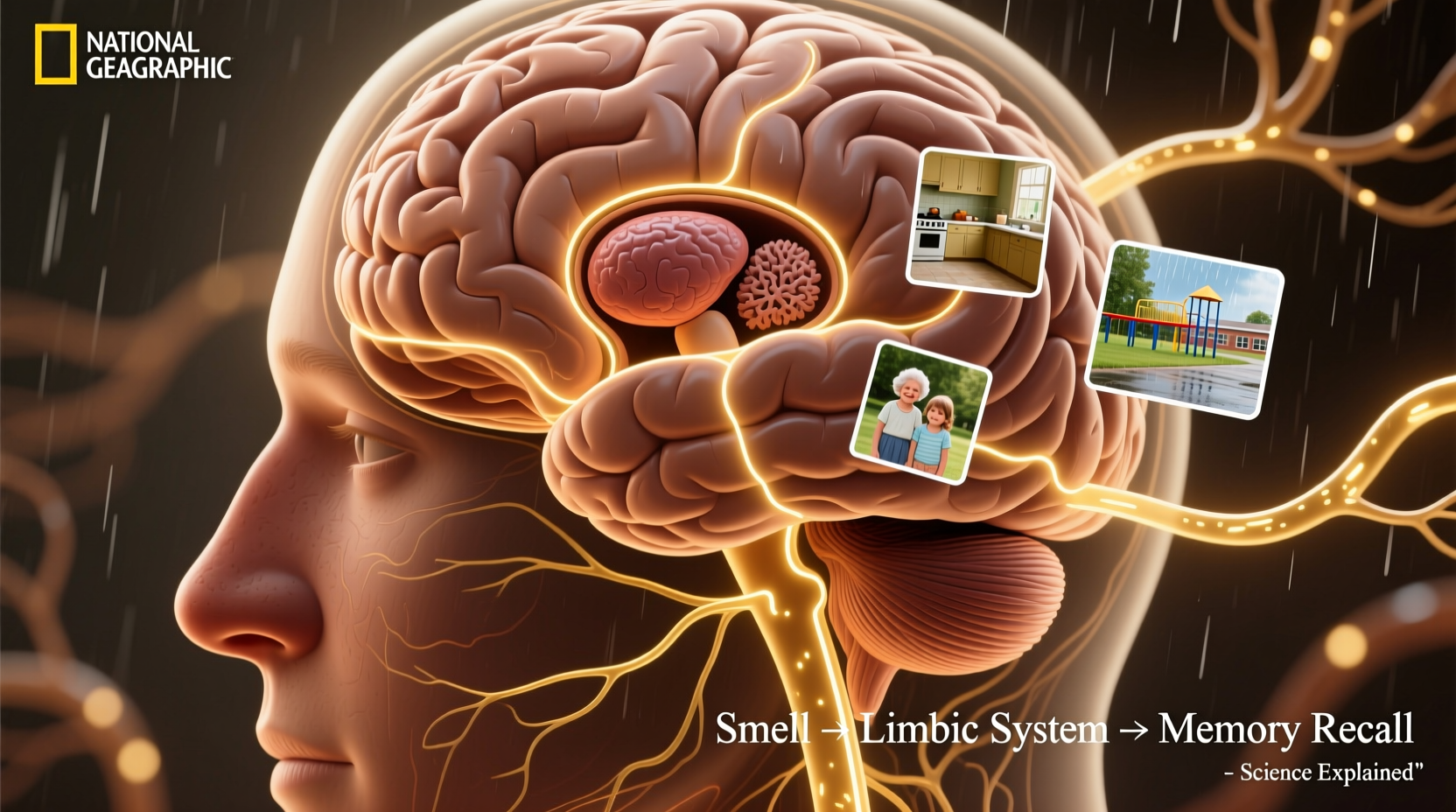
The sense of smell, or olfaction, operates differently from vision, hearing, touch, and taste. When you inhale, odor molecules travel through the nasal cavity and bind to olfactory receptors located high in the nose. These receptors send signals directly to the olfactory bulb, which sits just above the roof of your mouth and beneath the front of the brain. From there, information is relayed to several key regions—including the amygdala and hippocampus—structures central to emotional processing and memory formation.
This direct neural pathway is what sets smell apart. Other senses must pass through the thalamus—a kind of relay station—before reaching higher cortical areas. Smell skips this step entirely. As neuroscientist Dr. Rachel Herz explains:
“Olfaction is the only sense that has a direct synaptic connection to the limbic system. That means scent reaches the emotional centers of the brain before we even consciously recognize what we’re smelling.” — Dr. Rachel Herz, Cognitive Neuroscientist and Author of *The Scent of Desire*
This anatomical shortcut allows odors to evoke memories with startling immediacy and emotional intensity, often without conscious effort.
The Role of the Limbic System in Smell-Memory Links
The limbic system, a network of interconnected brain structures, plays a pivotal role in emotion, motivation, and long-term memory. Two components—the amygdala and hippocampus—are especially crucial when it comes to scent-triggered recollections.
- Amygdala: Processes emotions such as fear, pleasure, and arousal. It assigns emotional significance to sensory input, including smells. When you smell something associated with joy or trauma, the amygdala activates almost instantly.
- Hippocampus: Responsible for forming and retrieving declarative memories—those involving facts and events. Because it receives olfactory input directly, it helps anchor specific experiences to particular scents.
During early childhood, when both the olfactory and limbic systems are rapidly developing, many foundational emotional and autobiographical memories are formed. This developmental overlap creates powerful associations between smells and formative life moments. A child who grows up with the scent of pine trees during family ski trips may, years later, feel a surge of nostalgia upon encountering that same aroma—even if they can’t immediately recall the source.
Why Childhood Memories Are Especially Vulnerable to Scent Triggers
There’s a reason most smell-evoked memories originate in childhood—particularly between the ages of 3 and 10. This period, known as the “reminiscence bump,” is when people encode more lasting autobiographical memories than at any other stage of life. During these years, the brain is highly sensitive to novel experiences, and sensory inputs are often linked to strong emotions: first days of school, holidays, family rituals, fears, and joys.
Because children lack the cognitive maturity to label or analyze their experiences verbally, sensory cues like smell become primary anchors for memory storage. An adult might describe a birthday party using words like “cake,” “balloons,” and “laughter.” A child, however, encodes the event through smell: vanilla frosting, rubbery balloons, candle wax, and the faint perfume of a relative’s hug.
These sensory imprints remain dormant until reactivated by a matching odor later in life. Because the original memory wasn’t stored linguistically, its return feels sudden, visceral, and unmediated by thought.
Case Study: The Power of Baking Bread
Sarah, a 42-year-old teacher from Vermont, hadn’t thought about her childhood home in decades—until she walked into a bakery during a winter trip to Montreal. The moment she inhaled the warm, yeasty aroma of sourdough rising near the oven, she was flooded with images: her mother standing at the counter in a floral apron, flour dusting her hands, the radio playing Christmas carols, snow falling outside the kitchen window.
She hadn’t smelled that exact bread in over 30 years. Yet the memory emerged in full sensory detail—not because she had been thinking about her mother, but because the scent acted as a precise neurological key, unlocking a vault of forgotten experience. Sarah later said, “It wasn’t just a memory—it felt like I was back there, standing beside her.”
This phenomenon, known as **involuntary autobiographical memory**, is far more common with smell than with any other sense. Studies show that odor-cued memories are more emotional, detailed, and older than those triggered by sight or sound.
The Science Behind Proustian Moments
The spontaneous rush of memory triggered by a scent is often called a “Proustian moment,” named after French writer Marcel Proust, who famously described such an experience in his novel *In Search of Lost Time*. In the passage, the narrator dips a madeleine cake into tea, and the flavor unlocks a flood of childhood memories from Combray.
Modern neuroscience validates Proust’s insight. Functional MRI studies reveal that when participants are exposed to personally meaningful odors, there is significantly greater activation in the amygdala and hippocampus compared to neutral smells or visual cues. Furthermore, research published in the journal *Chemical Senses* found that:
- Odor-cued memories date back, on average, to age 5–7.
- Visual or verbal cues typically retrieve memories from ages 10–15.
- Smell-based memories are rated as more emotional and vivid.
This temporal advantage—smells accessing earlier memories—suggests that olfactory pathways are among the first sensory networks to become functionally integrated with memory systems during development.
Do All Smells Trigger Memories Equally?
No. Not every scent has the power to unlock the past. The effectiveness of a smell as a memory trigger depends on several factors:
- Emotional Salience: Was the original experience emotionally charged? Positive (birthday cake) or negative (hospital disinfectant) emotions strengthen memory encoding.
- Novelty: Uncommon or distinctive smells (e.g., campfire smoke, a parent’s unique cologne) are more likely to be remembered than everyday background odors (air freshener, traffic fumes).
- Frequency of Exposure: Repeated pairings between a smell and an event reinforce the association. A weekly ritual like Sunday roasts builds stronger links than a one-time occurrence.
- Personal Relevance: Culturally common scents (pine at Christmas) may trigger shared memories, but idiosyncratic ones (a specific shampoo, a pet’s fur) carry deeper personal weight.
| Sensory Modality | Average Age of Retrieved Memories | Emotional Intensity Rating (1–10) | Detail Richness |
|---|---|---|---|
| Smell | 4.5 years | 8.7 | High (sensory details) |
| Photograph | 12.3 years | 6.2 | Moderate (visual focus) |
| Music | 14.1 years | 7.9 | High (emotional tone) |
| Verbal Cue | 15.6 years | 5.4 | Low (fact-based) |
Data adapted from research by Arshamian et al., *Chemical Senses*, 2013.
Practical Applications: Harnessing Smell for Wellbeing
Understanding the link between scent and memory isn’t just academically fascinating—it has real-world applications in therapy, aging care, and emotional wellness.
Using Scent to Support Cognitive Health
For individuals with dementia or Alzheimer’s disease, memory loss is often one of the most distressing symptoms. However, because olfactory pathways are relatively preserved in early stages of neurodegeneration, familiar scents can serve as gentle prompts for reminiscence.
Nursing homes and memory care facilities increasingly use \"scent therapy\" programs. For example:
- Introducing the smell of coffee during morning routines to stimulate alertness and routine recall.
- Using lavender in evening hours to promote calm and evoke peaceful bedtime memories.
- Presenting personalized scent kits—containing odors from a resident’s youth (pipe tobacco, baking spices, cut grass)—to encourage conversation and emotional connection.
“We’ve seen nonverbal patients light up and begin speaking about their childhood farms just from the smell of hay and manure. It’s access to a self they thought was gone.” — Dr. Lena Torres, Geriatric Neuropsychologist
Creating New Positive Associations
You can intentionally build new scent-memory links to support emotional resilience. For instance:
- Use a specific essential oil while journaling during a peaceful vacation. Later, diffusing that scent can help recreate the calm state.
- Bake cookies with your children using a signature spice blend. Years later, that aroma can become a shared emotional anchor.
- Wear the same subtle fragrance during moments of achievement—graduations, promotions—to create a confidence-boosting cue.
FAQ: Common Questions About Smell and Memory
Can lost memories really be recovered through smell?
While smell cannot \"restore\" forgotten memories in a literal sense, it can reactivate memories that were previously inaccessible. The brain stores vast amounts of information that aren't readily available through conscious recall. A matching odor can provide the contextual cue needed to retrieve these dormant experiences, making them feel newly discovered.
Why don’t all smells bring back memories?
Only smells that were encoded with emotional or experiential significance during memory formation act as strong triggers. Background or neutral odors (like office air or city exhaust) lack the emotional weight needed to form lasting associative bonds. Additionally, modern environments often lack the rich, natural scent diversity of childhood, reducing opportunities for meaningful olfactory imprinting.
Is this phenomenon universal across cultures?
Yes, the basic neurological mechanism is universal. However, the specific smells that trigger memories vary widely based on cultural upbringing. For example, the scent of turmeric and cumin may evoke childhood kitchens in India, while pickled herring might do the same in Scandinavia. The brain’s wiring is consistent; the content depends on lived experience.
Conclusion: Reawakening the Past, One Breath at a Time
The ability of a simple scent to unlock decades-old memories is one of the brain’s most poetic functions. It reveals how deeply intertwined our biology is with personal history. Unlike digital photos or written journals, these olfactory memories are not stored externally—they live within us, waiting for the right molecule to set them free.
By understanding the science behind this phenomenon, we gain more than knowledge—we gain a tool. Whether used to reconnect with joyful moments, support aging loved ones, or simply appreciate the hidden depth of everyday experiences, scent offers a quiet yet powerful way to engage with our inner lives.




 浙公网安备
33010002000092号
浙公网安备
33010002000092号 浙B2-20120091-4
Comments
No comments yet. Why don't you start the discussion?