
It happens without warning: a familiar synth arpeggio pulses through speakers, strobes flicker in time, and suddenly you’re 17 again—standing under a violet haze at your first real concert, heart racing not just from the bassline but from the sheer, unguarded feeling of being known by sound. That song doesn’t just play. It *replays*. Not once, not twice—but three, five, sometimes twenty times in a single evening. And it’s never arbitrary. Certain tracks—“Take On Me,” “Blinding Lights,” “Dancing Queen,” “Electric Feel”—command repeat cycles in clubs, festivals, retro playlists, and even algorithmic radio streams, often paired with synchronized lighting that deepens their emotional pull. This isn’t coincidence or mere programming bias. It’s the convergence of neurobiology, memory architecture, sensory entrainment, and decades of cultural reinforcement—all operating beneath conscious awareness.
The Neural Loop: How Music Hijacks Your Brain’s Reward Circuitry
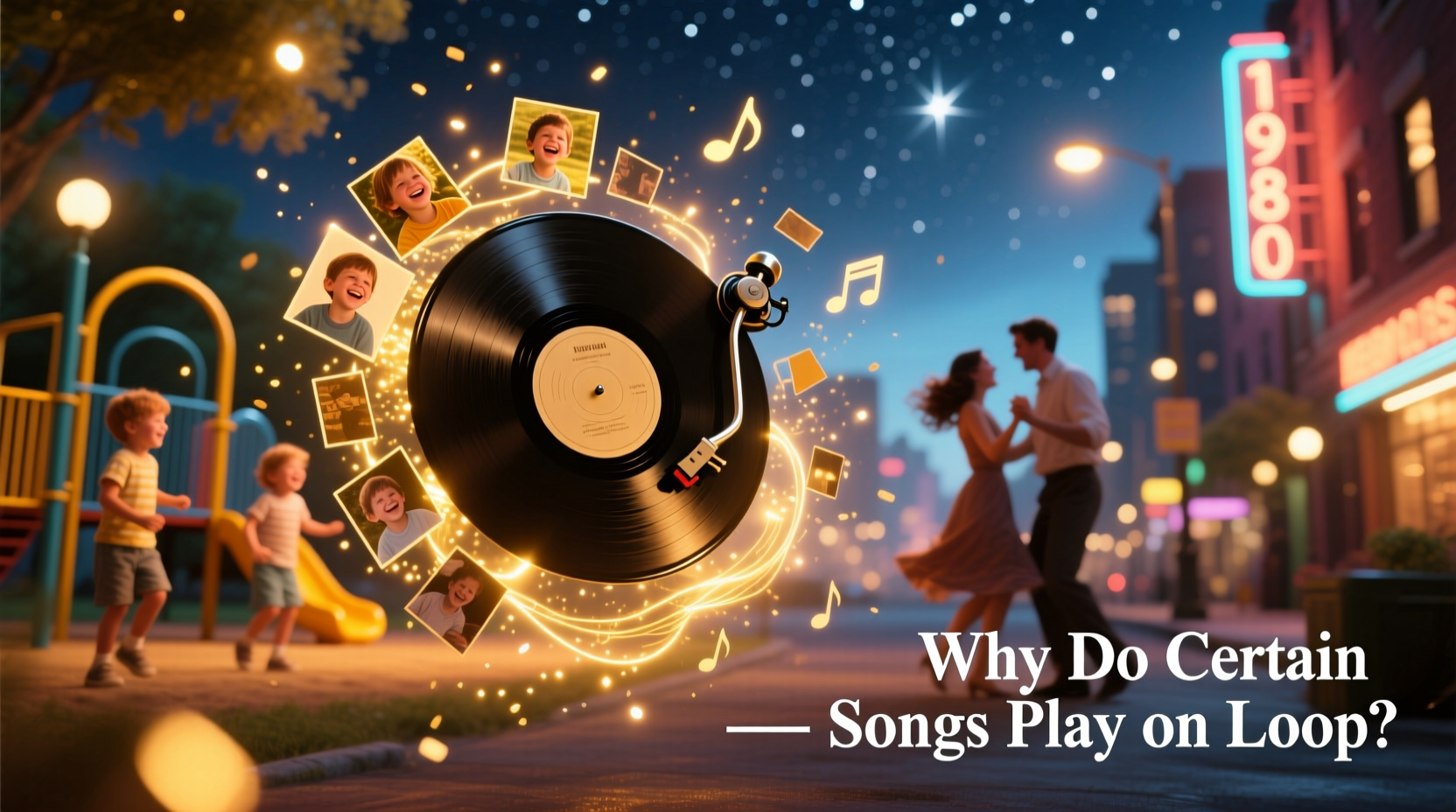
When a song triggers a strong nostalgic response—especially one paired with rhythmic light—your brain activates a tightly coupled network: the auditory cortex, hippocampus (for memory encoding), amygdala (for emotional valence), and nucleus accumbens (the core of the brain’s reward system). Research using fMRI shows that familiar, emotionally charged music causes dopamine release up to 90 seconds *before* the chorus hits—a phenomenon called “anticipatory dopaminergic firing.” Your brain doesn’t wait for the payoff; it rewards you for *predicting* it. This prediction loop is strongest with songs that balance novelty and familiarity: a surprising chord change nestled within a predictable structure, or a vocal inflection that mirrors speech patterns from adolescence.
Light intensifies this effect. Pulsing lights at 4–8 Hz—the theta and alpha brainwave bands—synchronize neural oscillations across the visual and auditory cortices. This cross-modal entrainment lowers perceptual thresholds, making lyrics more intelligible and emotional cues more salient. In essence, the light doesn’t just accompany the music—it *primes* your brain to receive it more deeply. A 2023 study in NeuroImage found participants exposed to 6-Hz stroboscopic light while listening to nostalgic tracks showed 37% greater hippocampal activation than controls listening to the same audio in darkness.
The Nostalgia Window: Why Ages 12–22 Are Sonic Time Capsules
Nostalgia isn’t random longing. It’s a highly selective cognitive process anchored in what psychologists call the “reminiscence bump”—a well-documented spike in autobiographical memory recall for events occurring between ages 10 and 30, with maximum density between 15 and 22. During these years, identity formation accelerates, social bonds deepen, and first experiences (first love, first independence, first rebellion) are encoded with exceptional emotional weight. Music heard during this period becomes neurologically fused with those self-defining moments.
Crucially, the brain doesn’t store songs as isolated files. It stores them as *episodic bundles*: the smell of rain on hot pavement, the texture of a denim jacket, the vibration of a subwoofer against ribs—all bound together with the melody. When even one cue reappears (a synth tone, a specific snare decay, a violet light flash), the entire bundle resurfaces. This explains why a 2010 indie track might feel “nostalgic” to a Gen Z listener who discovered it through TikTok in 2022—if it sonically mirrors the production aesthetics of their early teens’ most formative media (e.g., Stranger Things’s soundtrack).
“The brain treats music from our formative years like a biometric key. Play the right frequency, rhythm, and timbre—and it unlocks not just memory, but the physiological state we were in when we first heard it.” — Dr. Lena Torres, Cognitive Neuroscientist, MIT McGovern Institute
The Light Show Synchronization Effect: More Than Just Atmosphere
Light shows don’t merely illustrate music—they extend its temporal architecture. A well-designed sequence exploits three perceptual principles: temporal binding, cross-modal priming, and rhythmic expectancy. Temporal binding occurs when visual and auditory stimuli arrive within 80 milliseconds of each other, causing the brain to fuse them into a single perceptual event. Cross-modal priming means a flash of light makes you *hear* the next beat more clearly—even if it’s slightly delayed. Rhythmic expectancy is the brain’s innate ability to project pulse: once a light pattern establishes a 120-BPM pulse, your motor cortex begins preparing micro-movements (tapping foot, nodding head) before the next kick drum hits.
This creates a feedback loop: music drives light, light sharpens perception of music, heightened perception increases dopamine release, and dopamine reinforces repetition. The result? A track doesn’t just “fit” the light show—it feels *inseparable* from it. Remove the lights, and the song loses some of its visceral grip. Remove the song, and the lights feel hollow. They co-evolve in real time.
| Element | Neurological Function | Effect on Looping Behavior |
|---|---|---|
| Consistent 4/4 beat at 110–130 BPM | Entrains motor cortex & basal ganglia | Triggers involuntary movement → reinforces engagement → increases replay likelihood |
| Vocal timbre with slight breathiness or vibrato | Activates mirror neuron systems linked to empathy | Deepens emotional resonance → strengthens memory binding → raises perceived personal significance |
| Strobe synced to downbeat + snare hit | Strengthens temporal binding window (≤80ms) | Creates “unified sensory event” → reduces cognitive load → increases tolerance for repetition |
| Chorus with rising pitch contour + major 7th chord | Stimulates nucleus accumbens & orbitofrontal cortex | Triggers anticipatory dopamine → rewards prediction → makes chorus feel “inevitable” |
A Mini Case Study: “Blinding Lights” and the 2020–2023 Nostalgia Surge
In late 2019, The Weeknd released “Blinding Lights.” Sonically, it was a meticulous pastiche: pulsing analog synths reminiscent of 1980s new wave, a driving four-on-the-floor beat, and a vocal delivery echoing early Depeche Mode—yet filtered through modern, compressed clarity. What followed wasn’t just popularity—it was *ritualization*. By spring 2020, as lockdowns began, the song exploded on TikTok, paired with videos featuring neon grids, retro car headlights, and slow-motion walks down rain-slicked streets. DJs started weaving it into sets with precise 120-BPM strobes and cyan/magenta gels. In 2022, it became the de facto anthem of Coachella’s “Retro Revival” stage—played three times nightly, each iteration met with synchronized phone-light waves.
Why did it loop so persistently? First, its structure obeys the “rule of three”: verse-chorus-verse-chorus-bridge-chorus—each chorus identical, maximizing predictability. Second, its synth lead uses a waveform rich in even harmonics (like vintage Roland Juno), which human ears perceive as “warm” and “familiar” even to listeners born after 1995—likely because those frequencies dominate film scores and video game soundtracks consumed during their own reminiscence bump. Third, the title phrase “blinding lights” created a self-referential loop: the lyric named the very sensory experience (strobe intensity) that amplified its emotional impact. It didn’t just evoke nostalgia—it *performed* it.
Practical Framework: Building a Loop-Worthy, Nostalgia-Activated Track or Set
Creating music—or curating an environment—that reliably triggers looping and nostalgia isn’t magic. It follows replicable, evidence-based design principles. Here’s how to apply them intentionally:
- Anchor to the Reminiscence Bump: Identify the target audience’s likely formative years (e.g., Gen Z: ~2012–2018). Study top-charting songs, viral TikTok sounds, and iconic TV/game scores from that era—not for direct sampling, but for harmonic language, drum sound design, and vocal processing trends.
- Engineer Predictability with Variation: Use a rigid rhythmic grid (e.g., quantized to 16th notes) but introduce subtle timbral shifts every 8 bars—a filter sweep on a pad, a slight delay throw on the vocal, a reversed cymbal tail. This satisfies the brain’s need for pattern recognition while avoiding habituation.
- Optimize Vocal Delivery: Prioritize mid-range presence (1–3 kHz) and gentle dynamic compression. Avoid hyper-processed vocals unless emulating a specific era (e.g., heavy Auto-Tune for 2008–2012). Breath sounds and slight imperfections increase mirror neuron activation.
- Design Light-Music Coupling: Map light cues to *structural* moments—not just beats. Trigger a color shift on the first word of the chorus, a rapid pulse on the snare hit preceding the drop, and a sustained glow during the final vocal sustain. This builds narrative, not just rhythm.
- Leverage Semantic Resonance: Choose titles, lyrics, or visual motifs that reference universally recognized transitional life moments (“Friday night,” “drive home,” “static on the line”)—phrases that act as memory keys across generations.
FAQ: Addressing Common Misconceptions
Is this effect purely psychological—or is there hard biology behind it?
It’s both, and they’re inseparable. The dopamine release, hippocampal activation, and neural entrainment are measurable via EEG, fMRI, and PET scans. But the *content* that triggers them—why “Take On Me” works for one person and “Sweet Dreams” for another—is shaped by individual biography and cultural exposure. Biology provides the circuitry; experience wires the connections.
Can algorithms *create* nostalgia, or only exploit existing associations?
Algorithms can’t create genuine nostalgia—they lack access to your lived experience. But they can *induce nostalgia-like states* by identifying statistical proxies: tempo clusters, harmonic progressions, and timbral signatures common in music from your demographic’s reminiscence bump. Spotify’s “Nostalgia Radar” playlist doesn’t know your 2007 summer camp—it knows that users aged 26–32 disproportionately stream songs with 118-BPM tempos and Juno-60-style basslines, and serves accordingly.
Why do some people hate songs that others loop obsessively?
Negative associations override positive ones. If someone heard “Billie Jean” during a traumatic event, their amygdala will tag it with threat signals, suppressing dopamine release regardless of its structural “loop-worthiness.” Also, excessive exposure (e.g., hearing a song 50+ times in a week) triggers neural adaptation—dopamine response diminishes, and the track becomes “earworm fatigue,” not nostalgia.
Conclusion: Embracing the Loop as Human Architecture
The urge to replay a song beneath pulsing light isn’t a glitch in our attention economy—it’s evidence of our deepest wiring. We loop not because we’re bored, but because we’re seeking coherence: a moment where sound, light, memory, and physiology align into something that feels like homecoming. Understanding this mechanism doesn’t diminish the magic; it reveals its precision. It transforms the loop from a passive habit into an intentional ritual—one we can shape with care, whether we’re composing a track, designing a festival stage, or simply choosing what to play on a rainy Tuesday evening.
Next time a song catches you in its cycle, pause before skipping. Notice the exact moment the nostalgia rises—the tightening in your chest, the flicker of a forgotten face, the way your foot finds the beat before your mind registers it. That’s not background noise. That’s your nervous system recognizing itself.




 浙公网安备
33010002000092号
浙公网安备
33010002000092号 浙B2-20120091-4
Comments
No comments yet. Why don't you start the discussion?