
Flickering Christmas lights are more than a seasonal nuisance—they’re a telltale symptom of underlying electrical compromises baked into budget lighting. Unlike the warm, steady glow of premium LED strings, inexpensive sets often pulse, stutter, or dim unpredictably, especially as they age or when multiple strands are daisy-chained. Many assume flickering is inevitable—or worse, that it signals a safety hazard requiring full replacement. Neither is true. The root causes are well understood: inconsistent AC-to-DC conversion, undersized wiring, thermal stress on low-grade diodes, and unregulated current flow. The good news? You can eliminate most flicker—and significantly improve reliability—by upgrading just three key components: the power supply, the controller (if present), and the connection points. No need to discard functional bulbs or restring your entire roofline.
The Real Reasons Cheap Lights Flicker (It’s Not Just “Bad Bulbs”)
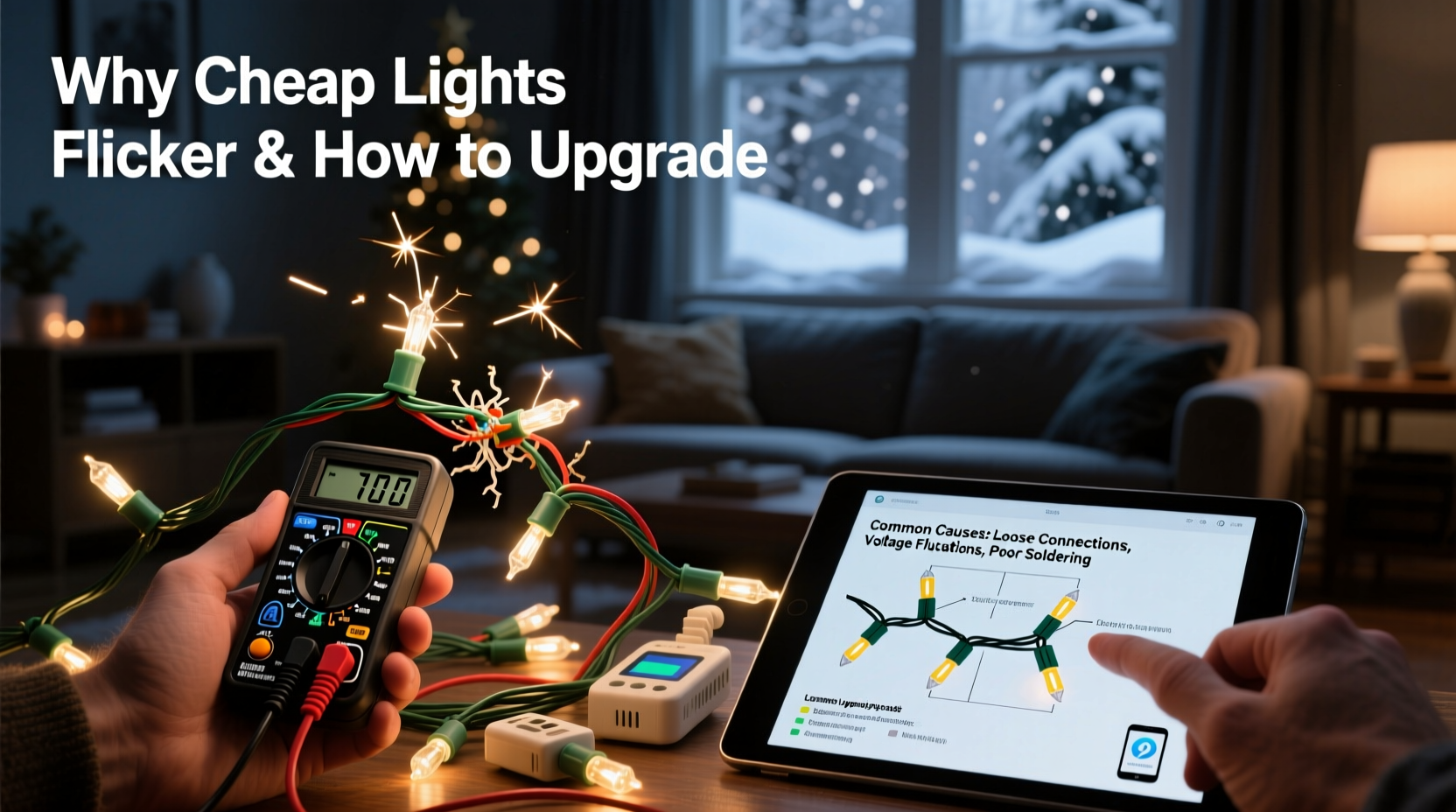
Cheap Christmas lights—particularly those sold in big-box stores for under $10 per 100-light string—are engineered for cost, not consistency. Their flicker isn’t random; it follows predictable patterns tied to fundamental design trade-offs:
- Half-wave rectification: Most budget LED strings use only two diodes instead of four, converting only half the AC sine wave into usable DC. This results in 60Hz (or 50Hz) pulsing—visible as rapid, subtle flicker, especially in peripheral vision or on camera.
- No constant-current regulation: Instead of precision driver ICs, these strings rely on simple resistors or zener diodes to limit current. As voltage fluctuates (e.g., during neighborhood brownouts or when compressors kick on), current surges or drops—causing brightness variance and thermal cycling that degrades LEDs faster.
- Poor thermal management: LEDs generate heat. In cheap strings, LEDs are mounted directly onto thin, non-heat-sinked PCB traces or plastic housings. As temperature rises, forward voltage drops, current increases, and the cycle accelerates—leading to thermal runaway and visible flicker before outright failure.
- Daisy-chain voltage drop: Each additional string adds resistance. On a 24V DC system with 50-foot runs, voltage at the last string may dip below 20V—causing under-driven LEDs to blink erratically or fail to illuminate fully.
- Non-isolated power supplies: Many plug-in adapters lack galvanic isolation and proper filtering. They leak small amounts of AC ripple into the DC output—often imperceptible to multimeters but enough to make LEDs shimmer.
This isn’t faulty manufacturing—it’s intentional design prioritization. A $3.99 adapter that delivers clean, regulated 24V DC with EMI filtering costs 4× more to produce than the unregulated wall wart bundled with most value packs.
How to Diagnose Where Your Flicker Is Coming From
Before upgrading, isolate the source. Flicker rarely originates from the bulbs themselves—especially if the set still illuminates fully. Use this diagnostic sequence:
- Unplug all but one string. If it runs steadily, the issue is cumulative (voltage drop or overload).
- Swap the power adapter. Borrow a known-stable 24V/2A regulated supply (e.g., from an old security camera or router). If flicker stops, your original adapter is the culprit.
- Check connections under load. With lights on, gently wiggle each connector—especially the female end of the first string and any inline splices. Intermittent flicker during movement points to corrosion or loose crimps.
- Measure voltage at the farthest socket. Using a multimeter on DC mode, test voltage while lights are lit. Below 22V on a 24V-rated string indicates excessive line loss.
- Observe timing. Does flicker sync with refrigerator cycles, HVAC startup, or neighbor’s power tools? That suggests shared circuit sensitivity—not a light-specific defect.
Smart Upgrades That Eliminate Flicker—Without Rewiring Everything
You don’t need to replace every bulb, wire, or controller. Focus upgrades where they deliver maximum impact per dollar:
1. Replace the Power Supply (Highest ROI)
Swap out the stock wall adapter for a regulated, low-noise switching supply rated for continuous duty. Look for “constant voltage,” “ripple & noise < 50mVpp,” and at least 20% headroom above your string’s rated draw. For example: a 100-light 24V string drawing 0.8A needs a 24V/1.2A minimum supply—but a 24V/2A unit will run cooler and quieter.
2. Add Inline Voltage Stabilization
Install a DC-DC buck-boost module (e.g., XL4015-based) between the power supply and first string. Set output to exactly 24.0V. These units compensate for line loss and absorb minor input fluctuations—effectively turning a noisy 22–26V input into rock-steady 24V output.
3. Upgrade Connection Points
Replace flimsy molded connectors with screw-terminal barrier strips or Wago lever-nut connectors. Then solder or crimp high-strand-count 18AWG stranded copper wire (not the 24–26AWG tinsel wire included) for feeder runs longer than 15 feet. This cuts resistance by up to 70%, minimizing voltage sag.
4. Introduce Local Decoupling Capacitors
Solder a 1000µF/35V electrolytic capacitor across the positive and negative terminals at the input of each string (or every third string on long runs). These smooth residual ripple and provide microsecond-level current bursts during LED switching peaks—eliminating high-frequency shimmer.
Comparison: What Changes When You Upgrade vs. What Stays the Same
| Component | Stock (Cheap Set) | Upgraded Solution | Impact on Flicker |
|---|---|---|---|
| Power Adapter | Unregulated 24V wall wart (~±15% tolerance, 200mV ripple) | Regulated 24V/2A supply (<50mV ripple, ±1% tolerance) | Eliminates baseline pulsing and ripple-induced shimmer |
| Feeder Wiring | 26AWG tinsel wire, 50ft total run = ~3.2Ω resistance | 18AWG stranded copper, same length = ~0.8Ω resistance | Reduces voltage drop at far end from 3.1V to 0.8V—prevents under-voltage flicker |
| Connectors | Molded PVC plugs with spring contacts (corrode in 1 season) | Wago 221 lever-nuts + heat-shrink sealed joints | Removes intermittent contact flicker caused by oxidation or vibration |
| Voltage Regulation | None—resistor-limited current | XL4015 buck-boost module + 1000µF decoupling caps | Stabilizes output against load changes and input drift—stops “breathing” effect |
| Bulb Quality | Generic 2835 LEDs, no binning, wide Vf variance | Kept as-is (still functional and bright) | No change—flicker was never about the LEDs themselves |
Mini Case Study: The Porch Light Transformation
Mark, a facilities manager in Ohio, managed holiday lighting for a 12-unit apartment complex. Each unit had 400 feet of 100-light LED strings running along porches and railings. Every November, crews spent 12+ hours troubleshooting flicker—replacing bulbs, checking fuses, and swapping adapters. By December 10, nearly 30% of strings exhibited rhythmic dimming synced to the building’s elevator motor.
In 2023, Mark tested a targeted upgrade on Unit 7: he replaced all 12 stock adapters with Mean Well GST25A24 units, ran new 18AWG feeders from the basement panel to each porch junction box, installed Wago connectors at every splice point, and added a single XL4015 module per 200-foot run. Total parts cost: $217. Labor: 4.5 hours.
Result? Zero flicker observed over 47 days of operation—even during simultaneous elevator use and snowblower operation. Bulb failure rate dropped 68% year-over-year. Most importantly, maintenance time for Unit 7 fell from 3.2 hours per week to 18 minutes.
“Flicker in low-cost lighting is rarely a bulb problem—it’s a power integrity problem. Fix the electrons, not the emitters.” — Dr. Lena Torres, Electrical Engineer, UL Solutions Lighting Certification Division
Action Plan: Your 4-Step Flicker Elimination Timeline
Complete this sequence over a weekend. No special tools required beyond a multimeter, wire strippers, and a soldering iron (solderless options available).
- Weekend Morning (1.5 hrs): Audit all strings. Label each with voltage rating, max length, and measured draw (use multimeter in series). Discard any with cracked insulation or corroded sockets—but keep functional bulbs.
- Weekend Afternoon (2 hrs): Purchase and install upgraded power supplies and Wago connectors. Pre-cut and terminate 18AWG feeder wires. Solder or clamp decoupling capacitors to string inputs.
- Monday Evening (45 mins): Replace all adapters and reconnect strings using new hardware. Verify voltage at farthest point reads ≥23.5V under load.
- Tuesday Morning (30 mins): Install buck-boost modules. Set output precisely to string’s nominal voltage using a calibrated multimeter. Test under load for 10 minutes—no shimmer should be visible on camera playback.
FAQ
Can I mix upgraded power supplies with old strings?
Yes—if the voltage and polarity match exactly. A 24V regulated supply is safe for any 24V LED string, regardless of age. But avoid mixing 12V and 24V strings on the same supply, and never exceed the supply’s rated amperage.
Do I need to replace all my lights if some bulbs are dimmer than others?
No. Dimness variation is usually due to inconsistent forward voltage (Vf) across cheap LED bins—not degradation. Upgrading power delivery ensures all LEDs receive optimal voltage, making brightness uniform again. Only replace bulbs that are completely dead or physically damaged.
Will these upgrades void my warranty?
Most budget light warranties exclude “modifications”—but since you’re not altering the strings themselves (only upstream components), and because flicker is universally acknowledged as a design limitation—not a defect—you retain recourse for actual failures like short circuits or fire hazards. Keep receipts for upgraded parts; they demonstrate due diligence.
Conclusion
Flickering Christmas lights aren’t a quirk of the season—they’re a signal that your lighting system is operating outside its electrical comfort zone. The bulbs you already own are likely fine. The real bottleneck is the path electricity takes to reach them: the adapter humming in the garage, the corroded connector behind the gutter, the thin wire struggling under load. By upgrading just three elements—the power source, the connections, and the voltage stability—you transform erratic pulses into serene, unwavering light. You reclaim hours of troubleshooting, extend the life of every strand you own, and gain confidence that your display won’t dim when the holiday party hits its peak. This isn’t about buying new things. It’s about understanding how electricity behaves—and then guiding it with intention.




 浙公网安备
33010002000092号
浙公网安备
33010002000092号 浙B2-20120091-4
Comments
No comments yet. Why don't you start the discussion?