
Every holiday season, thousands of households encounter the same quiet disappointment: a strand of Christmas lights that won’t illuminate—not even partially. You check the outlet, jiggle the plugs, test adjacent bulbs, and still nothing. The culprit is often invisible—and intentionally so: a blown fuse tucked inside the plug housing. Unlike modern circuit breakers or GFCI outlets, traditional incandescent light strings rely on small, replaceable fuses as their first and only line of defense against overcurrent. Understanding why these fuses exist—and how to replace them correctly—isn’t just about restoring twinkle; it’s about preventing fire hazards, extending product life, and exercising informed ownership of seasonal electrical devices.
The Electrical Reality Behind Holiday Light Safety
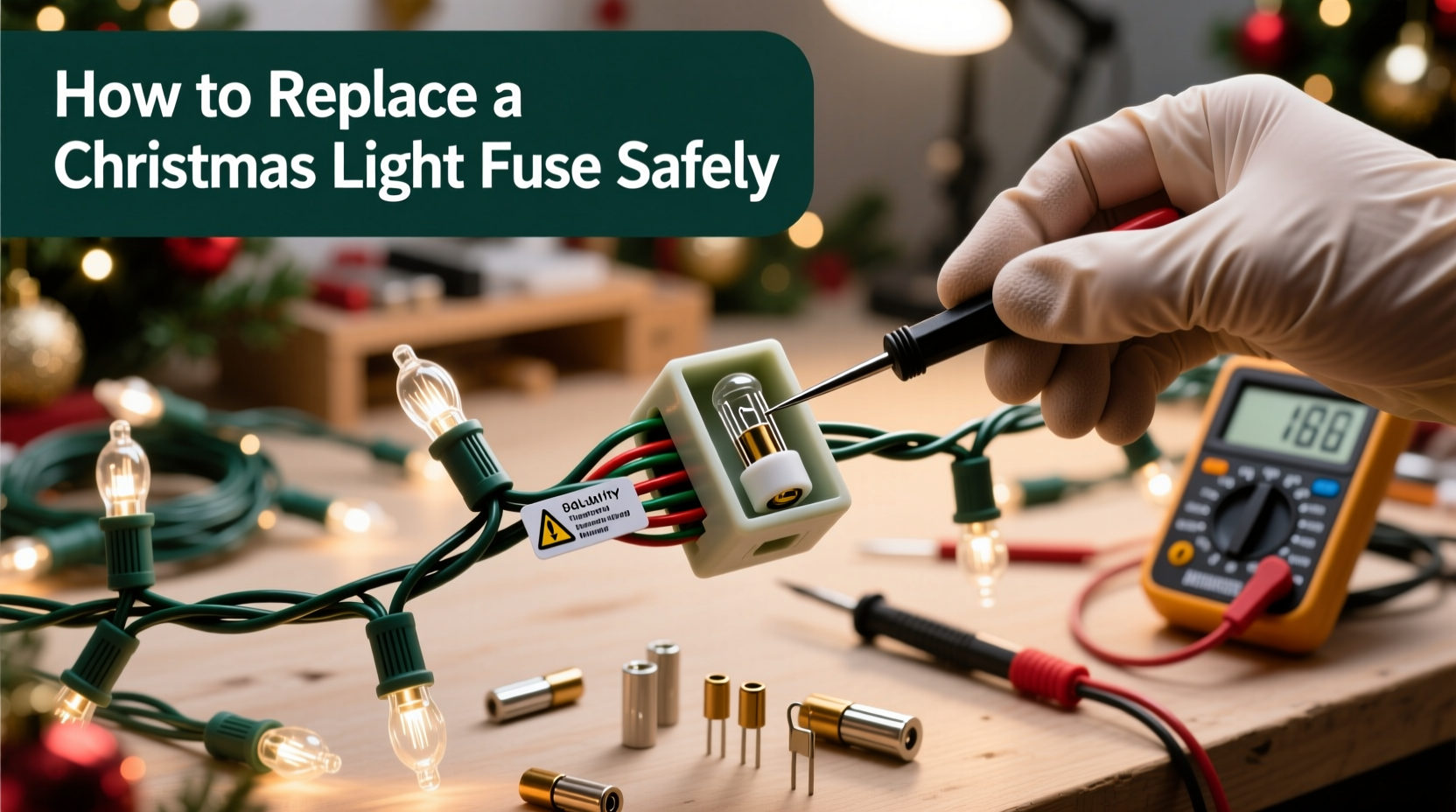
Most pre-2015 incandescent mini-light strings (and many current budget models) are wired in series: electricity flows through each bulb in sequence. If one filament breaks, the entire string goes dark—not because the circuit is “open” in the usual sense, but because the break interrupts the path for current flow. However, when a short occurs—say, from moisture intrusion, frayed insulation, or internal wire contact—the current can surge dramatically. Without intervention, this surge overheats wires, melts sockets, and ignites nearby combustibles like pine boughs, drapery, or dry wood trim.
This is where the fuse intervenes. Positioned at the entry point of the cord—inside the male plug—it acts as a deliberate weak link. When current exceeds the fuse’s rated amperage (typically 3A or 5A for standard 100-light sets), the thin metal strip inside melts, instantly breaking the circuit. It’s a passive, fail-safe design: no moving parts, no software, no delay—just physics protecting your home.
“Fuses in light strings aren’t outdated—they’re precision-engineered redundancy. They respond faster than any household breaker to localized overloads. Removing or bypassing them isn’t ‘fixing’ a problem; it’s disabling the only safeguard between festive cheer and thermal runaway.” — Dr. Lena Torres, Electrical Safety Engineer, UL Solutions
How to Identify Fuse Type, Location, and Compatibility
Fuses are housed in one of two locations: inside the male plug (most common for older or basic sets) or within a small slide-out compartment near the plug base (frequent in mid-tier LED-incandescent hybrids). Never assume compatibility across brands or generations. A 3A fuse from a 1998 GE set may physically fit a 2016 NOMA plug—but its thermal response curve and voltage rating could differ significantly.
Look for these identifiers before replacement:
- Amperage rating: Stamped directly on the fuse body (e.g., “3A”, “5A”) or printed on the plug’s label.
- Voltage rating: Usually “125V AC” for North American sets—never substitute a 250V fuse unless explicitly approved.
- Physical type: Most are AGC-style glass tube fuses (¼” × 1¼”), though some premium lines use ceramic-bodied or slow-blow variants.
- Polarity awareness: Some plugs contain two fuses—one for each blade of the plug. Always inspect both.
Step-by-Step: Safe Fuse Replacement Protocol
Replacing a fuse seems simple—until you overlook grounding, polarity, or residual charge. Follow this verified sequence to eliminate risk:
- Unplug the string completely—not just from the wall, but from any extension cords, timers, or daisy-chained strings.
- Wait 60 seconds after unplugging. Capacitors in timers or LED drivers can retain charge long enough to deliver a mild shock.
- Locate the fuse compartment. On most plugs, this is a small sliding door or removable cover on the underside or side. Use a plastic spudger or fingernail—not a screwdriver—to avoid damaging contacts.
- Remove the old fuse using needle-nose pliers with insulated grips. Hold it up to light: if the metal strip is visibly severed or blackened, it’s blown. If intact but the string remains dead, suspect socket corrosion or a broken wire upstream.
- Insert the new fuse, matching orientation and rating exactly. Do not overtighten or tilt the fuse—misalignment causes arcing and premature failure.
- Reassemble the plug housing fully and securely. A loose cover exposes live terminals and violates UL certification.
- Test incrementally: Plug into a GFCI-protected outlet first. If it trips immediately, stop—there’s likely a short elsewhere in the string. Do not attempt repeated resets.
Do’s and Don’ts of Fuse Management for Holiday Lights
Even experienced users make critical errors when troubleshooting lights. This table distills field-tested best practices and common missteps:
| Action | Do | Don’t |
|---|---|---|
| Fuse Selection | Use only the exact amperage and voltage specified on the plug label or original fuse. | Substitute with automotive fuses, soldered jumpers, or aluminum foil “replacements.” |
| Testing Method | Verify continuity with a multimeter before installing a new fuse. | Rely solely on visual inspection—some blown fuses show no external damage. |
| Daisy-Chaining | Check manufacturer’s max-string limit (e.g., “Connect up to 3 sets end-to-end”). | Chain more than the rated number—even with working fuses—overloading the first set’s wiring. |
| Storage & Maintenance | Store coiled loosely in climate-controlled space; inspect fuses annually before use. | Leave strings plugged in year-round or store damp/wet strands without drying first. |
| Post-Replacement Check | Run lights for 15 minutes unattended, then recheck plug temperature—should be barely warm. | Assume success after one brief test—intermittent shorts often manifest under thermal load. |
A Real-World Scenario: The Overlooked Outdoor Short
In December 2022, a homeowner in Portland, Oregon, replaced a blown fuse in her vintage C7 outdoor light string—only to have it blow again within 90 seconds. She repeated the process three times, finally inserting a 10A fuse “just to see.” The plug grew hot to the touch, emitting a faint acrid odor. She disconnected it and inspected the cord: a 3-inch section near the gutter mount showed cracked insulation, exposing copper to rain-saturated wood. Moisture had created a resistive short, drawing ~7.2A—well above the 5A fuse’s threshold but below the dangerous trip point of her home’s 15A breaker. Had she persisted, the sustained overload would likely have ignited the cedar fascia board. A licensed electrician later confirmed the fault and recommended replacing the entire run with UL-listed wet-location-rated LED stringing—eliminating the fuse dependency entirely while cutting energy use by 85%.
This case underscores a crucial truth: a repeatedly blowing fuse is never just an inconvenience. It’s a diagnostic signal—a clear, unambiguous warning that something in the circuit has degraded beyond safe operation.
Frequently Asked Questions
Can I use LED replacement bulbs in an incandescent string with fuses?
Yes—but cautiously. LED bulbs draw significantly less current, which *usually* prevents nuisance blowing. However, mixing bulb types (e.g., one LED + nine incandescent) creates uneven resistance and can cause erratic behavior. Worse, some early-generation LED bulbs emit high-frequency noise that interferes with fuse thermal response. Always use a full set of compatible LEDs rated for series operation, and monitor the plug temperature during initial use.
Why do some newer light strings have no accessible fuses?
Many modern LED-only strings use electronic current regulation instead of fuses—either built-in constant-current drivers or polymeric positive temperature coefficient (PPTC) resettable fuses. These self-reset after cooling but require no user intervention. That said, “no visible fuse” doesn’t mean “no protection”—it means the protection is integrated, non-replaceable, and designed for the specific LED load. Never assume a fuseless string is inherently safer; poor-quality drivers can fail silently, allowing thermal runaway.
Is it safe to replace a fuse while the string is plugged in?
No—under any circumstances. Even low-voltage holiday lighting operates at full line voltage (120V in North America) at the plug. Contact with live terminals risks severe shock, arc flash, or involuntary muscle contraction leading to secondary injury. Treat every plug as energized until verified otherwise with a non-contact voltage tester.
Conclusion: Responsibility, Not Ritual
Replacing a Christmas light fuse takes under two minutes—but doing it correctly reflects a deeper commitment: to safety, to diligence, and to honoring the engineering behind everyday objects. Those tiny glass cylinders aren’t relics of obsolete technology. They’re calibrated guardians, placed deliberately where heat and current converge, asking only that we respect their purpose. When you next unspool lights, pause before plugging in. Check the fuse compartment. Verify the rating. Feel the cord for brittleness or cracks. Consider upgrading to UL-listed, fuseless LED strings for permanent installations—but never treat the older ones as disposable. Their fuses exist because electricity, however festive, demands respect.
Start this season with intention. Test your GFCI outlets. Store cords without kinks. Label spare fuses by amperage. And if a fuse blows repeatedly? Don’t reach for the duct tape or the “stronger” fuse. Trace the fault. Consult a professional. Because the most beautiful light display is the one that shines safely—year after year.




 浙公网安备
33010002000092号
浙公网安备
33010002000092号 浙B2-20120091-4
Comments
No comments yet. Why don't you start the discussion?