
Every holiday season, millions of households wrestle with a familiar frustration: a string of lights where half the bulbs glow brightly while the other half remains stubbornly dark—or worse, flickers unpredictably. You reach for your trusty Christmas light tester, press it against each bulb socket, and it chirps “good” on every single one. Yet the strand still doesn’t fully illuminate. What’s happening? The tester says everything’s fine—but your lights tell a different story. This isn’t user error or faulty equipment—it’s a fundamental limitation built into most consumer-grade testers. Understanding why they fail reveals not just an electronics quirk, but a deeper mismatch between marketing claims and real-world circuit behavior.
The Hidden Physics of Miniature Light Strands
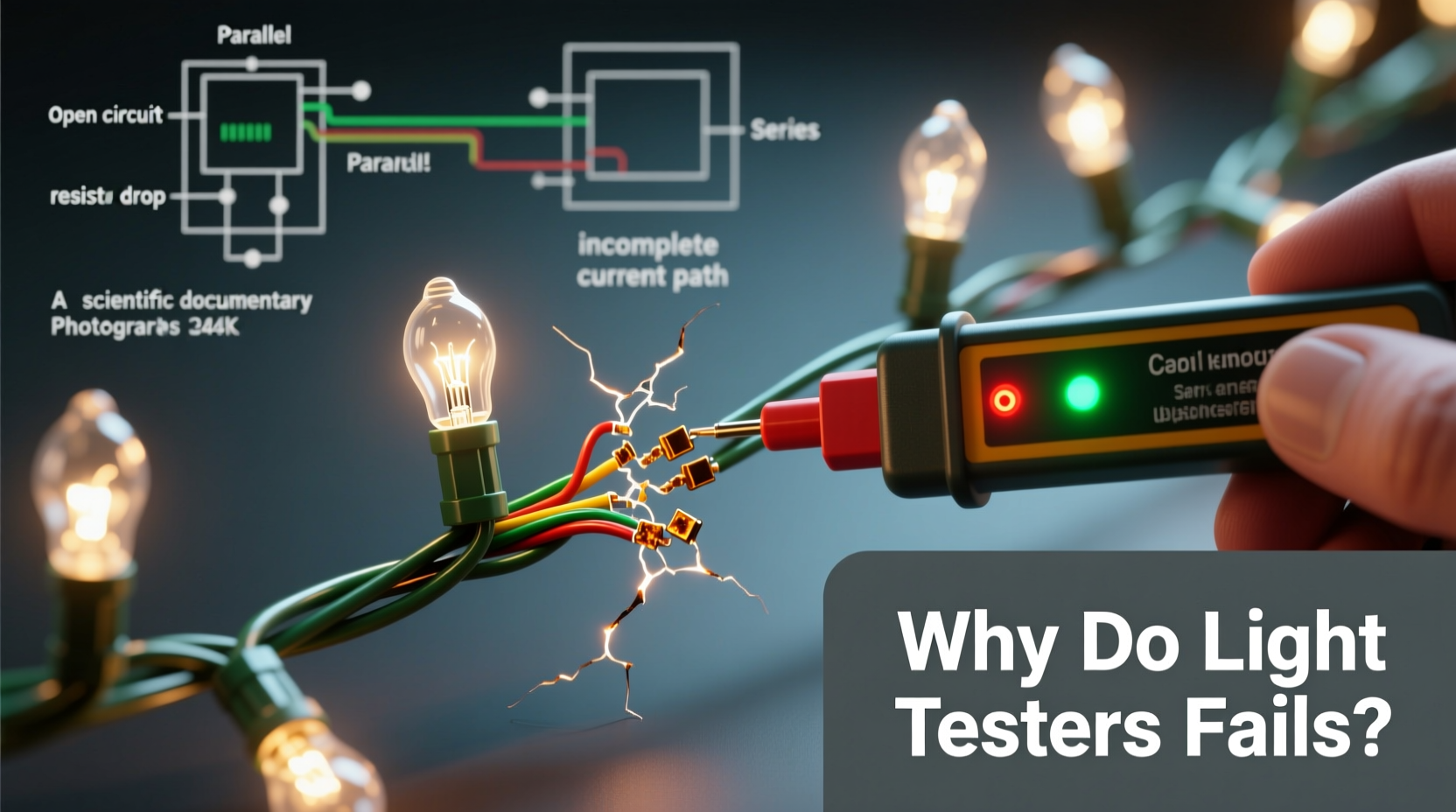
Modern incandescent and LED mini-light strands rarely operate as simple series circuits with uniform voltage distribution. Instead, they use segmented wiring architectures designed for safety, efficiency, and fault tolerance. Most common 100-light strings are divided into two or more independent sub-circuits—often 50-light sections wired in series *within* each segment, but connected *in parallel* across the plug. Each segment receives full line voltage (120V AC in North America), and each bulb in that segment typically drops only 2.4–3.5 volts. That means if one bulb burns out in a 50-light series section, the entire section goes dark—unless the bulb has a shunt.
Shunts—tiny wire-wrapped resistive bridges inside the bulb base—are engineered to activate when filament failure occurs. When the filament breaks, voltage spikes across the open gap, heating the shunt’s coating and causing it to fuse closed, restoring continuity. But shunts degrade over time. They can become intermittent, corrode, or weld partially—creating high-resistance paths that pass enough current for the tester to register “continuity,” yet insufficient current to light adjacent bulbs or sustain stable operation under load.
This is the first critical point: Continuity ≠ functionality. A tester checks for a low-resistance path—typically below 10–50 ohms—between contacts. It does not measure voltage drop under load, current draw, or thermal stability. So a failing shunt may read 8 ohms cold (passing the test) but jump to 300+ ohms when energized, collapsing the voltage available to downstream bulbs.
How Most Consumer Testers Actually Work—and Where They Fall Short
Over 90% of handheld Christmas light testers sold at big-box retailers use one of two methods: either a low-voltage DC continuity check (1.5–9V from a battery) or a non-contact voltage detector (NCV) that senses electromagnetic fields near live wires. Neither replicates real operating conditions.
A DC continuity tester applies minimal current—usually under 1 mA—to assess whether a path exists. It cannot detect:
- Intermittent opens that only occur under thermal stress or vibration
- High-resistance faults masked by parallel leakage paths (e.g., moisture tracking across a cracked socket)
- Partial shorts that bleed current away from the intended path
- LED polarity mismatches or driver capacitor degradation (common in older LED strings)
- Ground-fault leakage invisible to low-voltage probes
An NCV tester, meanwhile, detects AC fields—not current flow. It confirms power is reaching the socket but says nothing about whether the bulb is drawing current, whether the shunt is functional, or whether downstream components are intact. If the first bulb in a dead section has a fused shunt but the second bulb’s filament is open *and* its shunt failed to activate, the NCV will still sense voltage at the socket—leading users to wrongly assume the problem lies elsewhere.
The Critical Role of Load Testing and Voltage Drop Analysis
True diagnostics require measuring behavior *under load*. Consider this scenario: a 50-light section should deliver roughly 2.4V per bulb. If you measure 110V at the input socket but only 0.8V at the third socket downstream, that indicates excessive voltage drop—pointing to high resistance somewhere upstream. That resistance could be a corroded contact, a partially welded shunt, or carbonized insulation inside the wire.
A quality digital multimeter (DMM) set to AC voltage mode is the most reliable tool for this. With the strand plugged in and switched on, measure voltage between the two contacts of each socket along the dark section. In a healthy segment, voltage should remain near zero across functional bulbs (indicating proper current flow), then jump sharply across an open—e.g., 0V across bulbs 1–4, then 110V across bulb 5’s socket. But if you see progressive decay—25V, then 12V, then 5V—that signals distributed resistance: likely degraded shunts or compromised wiring.
Advanced users go further: using the DMM’s diode-test or continuity mode *while the strand is unplugged*, but also checking resistance from the hot lead to neutral at the plug end. A healthy 50-light incandescent section measures ~200–300 ohms cold. If it reads 1.2kΩ or higher, shunt degradation or broken filaments are probable—even if every socket passes the $5 tester’s “beep.”
Real-World Case Study: The “Half-Lit Garland” That Defied Diagnosis
Janice M., a high school physics teacher in Portland, OR, spent three evenings troubleshooting her 2018 LED garland before calling a local electrician. The 300-light rope had 150 lights glowing steadily; the remaining 150 were completely dark. Her $12 tester confirmed all 300 sockets showed continuity. She replaced every bulb in the dark section—twice—with new ones. Still no light. She checked fuses, swapped outlets, even tried a different controller. Nothing worked.
The electrician arrived with a Fluke 87V multimeter. Within 90 seconds, he measured 120V at the input of the dark section—but only 3.2V at the first socket. He then disconnected the section and measured resistance: 4.7kΩ instead of the expected 800Ω for that LED configuration. Tracing backward, he found a single water-damaged connector junction buried under insulation tape—corrosion had increased contact resistance to over 3kΩ. The $12 tester’s 3V DC probe couldn’t overcome that resistance, so it falsely reported “open” (no beep), but Janice misread the silence as “good” because she’d never heard the beep on that socket before. In reality, the tester was failing *to detect* the fault—not confirming functionality.
After cleaning the junction with electrical contact cleaner and resealing it, the entire strand lit uniformly. Janice later learned her tester’s manual stated clearly: “Not suitable for diagnosing high-resistance faults or corroded connections.” She’d missed it—because the packaging promised “finds bad bulbs in seconds.”
What Works—and What Doesn’t: A Diagnostic Tool Comparison
| Tool Type | Measures | Detects Partial Strand Failures? | Limitations |
|---|---|---|---|
| Basic $5–$15 Beep Tester | Low-voltage DC continuity (<50Ω threshold) | No — fails on high-resistance shunts, corrosion, thermal opens | Blind to voltage drop, load behavior, polarity, and intermittent faults |
| Non-Contact Voltage (NCV) Pen | Presence of AC field near conductor | No — confirms power delivery only, not circuit integrity | Cannot distinguish live-but-dead circuit from fully functional one; false positives near bundled wires |
| Digital Multimeter (DMM) | Voltage under load, resistance cold, continuity, diode drop | Yes — when used methodically across sockets and sections | Requires basic electrical knowledge; safety precautions essential with live circuits |
| Dedicated Strand Analyzer (e.g., LightKeeper Pro) | Capacitive discharge pulse + current sensing | Yes — designed specifically for shunt activation and weak-path detection | Higher cost ($25–$40); less effective on modern constant-current LED drivers |
| Visual/Thermal Inspection | Physical damage, discoloration, heat signatures | Partially — identifies obvious corrosion, melted bases, or hot spots | Labor-intensive; misses internal shunt degradation or micro-fractures |
Step-by-Step: Diagnosing Partial Strand Failure Like a Technician
- Unplug and inspect physically: Look for cracked sockets, bent contacts, melted plastic, or green corrosion—especially at connection points and plug housings.
- Divide and isolate: If the strand has multiple sections (e.g., two 50-light groups), unplug one section. Does the other light? If yes, the issue is isolated to the disconnected group.
- Test under load with a DMM: Plug in the suspect section. Set DMM to AC voltage. Measure across the first socket: should read ~120V. Then measure across each subsequent socket. A sudden jump from near-zero to full voltage indicates the open is *at* that socket.
- Check for progressive decay: If voltage drops gradually (e.g., 120V → 85V → 42V → 12V), suspect distributed resistance—clean all contacts with isopropyl alcohol and a soft brush.
- Cold resistance verification: Unplug. Set DMM to Ω mode. Measure resistance between hot and neutral at the plug. Compare to manufacturer specs (or known-good identical strand). A reading >2× expected value confirms cumulative shunt or wiring degradation.
- Shunt activation test (incandescent only): For suspected dead bulbs, gently wiggle the bulb while powered. If lights flash, the shunt is intermittent. Replace that bulb—even if the tester “passed” it.
“Most ‘mystery’ light failures aren’t about dead bulbs—they’re about the illusion of continuity. A circuit can pass a 5V continuity test and still starve downstream components of usable voltage. Real troubleshooting means measuring behavior where it matters: under load.” — Carlos Mendez, Senior Applications Engineer, Holiday Lighting Technologies Inc.
FAQ
Can a failing LED driver cause partial strand failure even if all bulbs test “good”?
Yes. Many LED strings use constant-current drivers that regulate output based on total load. If one section draws abnormally high current due to shunt leakage or a shorted LED, the driver may throttle output or shut down intermittently—causing half the strand to dim or blink. A continuity tester won’t detect this; only voltage and current measurements under load will.
Why do some testers claim to “fix” shunts—and do they really work?
Tools like the LightKeeper Pro send a brief high-voltage pulse (up to 140V) to attempt shunt activation. They work on incandescent bulbs with intact but oxidized shunts—but fail on LEDs, corroded contacts, or bulbs where the shunt has physically detached. Success rates average 60–70% on strands under 3 years old; drop to <20% on units over 5 years.
Is it safer to replace the entire strand than troubleshoot?
For LED strands under warranty, yes—replacement is faster and avoids shock risk. For vintage or specialty incandescent strands, troubleshooting preserves functionality and reduces e-waste. However, never bypass fuses, modify wiring, or use extension cords rated below the strand’s amperage. When in doubt, retire strands older than 10 years—insulation embrittlement poses fire risk regardless of tester results.
Conclusion
Christmas light testers don’t “fail” in the way we imagine—they perform exactly as designed. Their job is to answer one narrow question: “Is there a low-resistance path here?” They weren’t built to diagnose the subtle, layered realities of aging holiday lighting: micro-corrosion, thermal fatigue, shunt hysteresis, or driver-level instability. Recognizing this distinction transforms frustration into empowerment. You’re not fighting faulty tools—you’re working with tools designed for a different job. Armed with a multimeter, systematic observation, and an understanding of how real-world circuits behave under load, you reclaim control over your holiday lighting. No more guessing. No more replacing bulbs blindly. Just precise, confident diagnosis—and lights that shine fully, reliably, and safely.




 浙公网安备
33010002000092号
浙公网安备
33010002000092号 浙B2-20120091-4
Comments
No comments yet. Why don't you start the discussion?