
Every November, millions of households pull out their holiday lights with optimism—only to confront the same disheartening reality: a knotted, indecipherable mass of wire, bulbs, and frustration. It’s not just bad luck. It’s physics, material science, and human behavior converging in the most inconvenient way possible. The tangle isn’t random chaos—it’s predictable, repeatable, and, crucially, preventable. This isn’t about buying “tangle-free” lights (a marketing myth). It’s about understanding why the problem persists—and applying proven, low-effort strategies that eliminate the annual unraveling ritual for good.
The Physics of Festive Entanglement
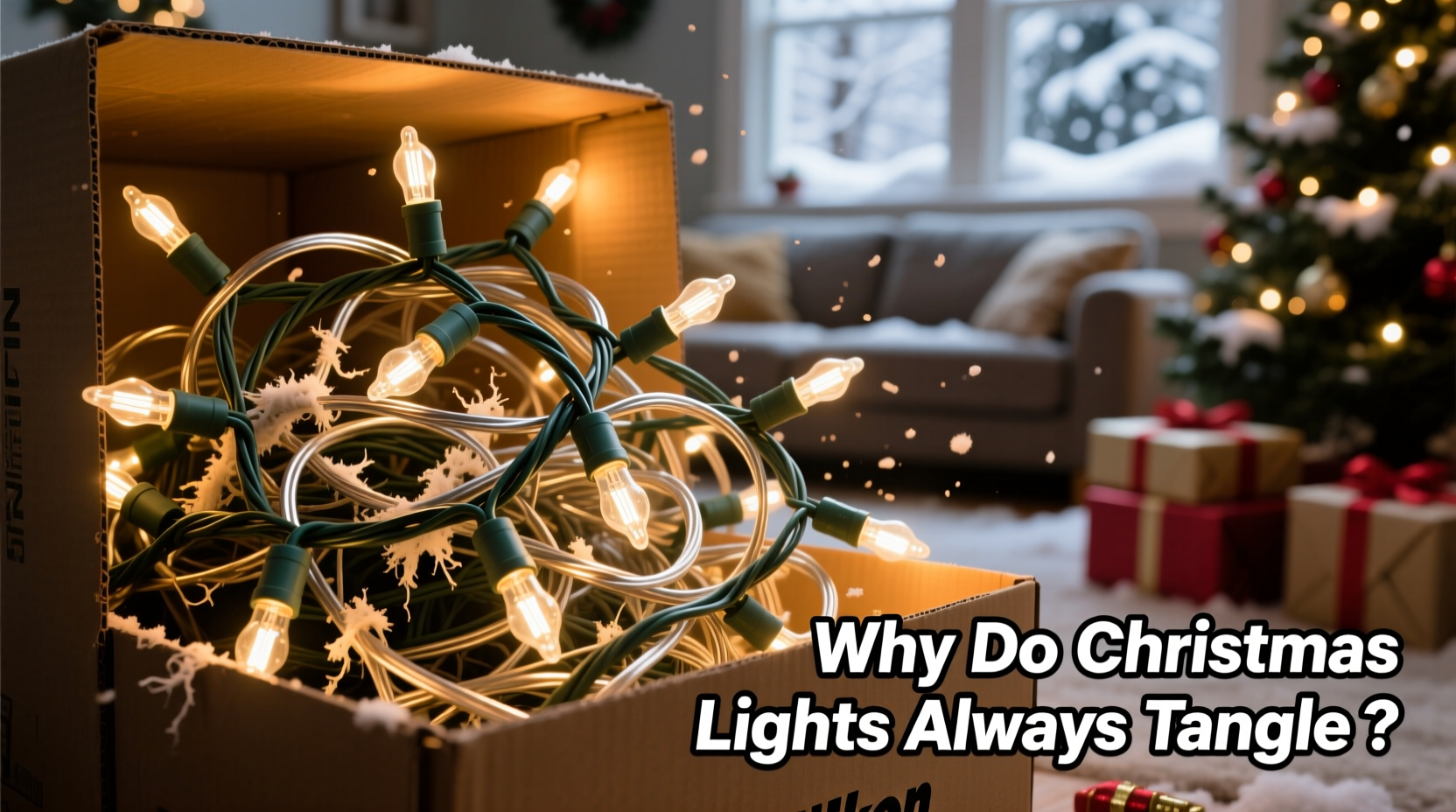
Christmas lights tangle because they meet three precise conditions required for spontaneous knot formation, as confirmed by research from the Massachusetts Institute of Technology and published in Proceedings of the National Academy of Sciences. In 2007, physicists Dorian Raymer and Douglas Smith conducted experiments dropping strings of various lengths into tumbling boxes. They found that knots formed in over 50% of trials when string length exceeded 1.5 meters—and formation probability rose sharply with length and flexibility. Standard light strands are typically 3–25 feet long, made of thin, pliable copper wire sheathed in soft PVC or rubber insulation—exactly the kind of flexible, high-aspect-ratio filament most prone to knotting.
When coiled loosely—or worse, stuffed into a box—the ends of the strand move freely during handling, transport, or even seasonal temperature shifts. As the strand jostles, one end loops over another segment; friction holds the loop in place; continued motion pulls the loop tighter, forming a slipknot. Add multiple strands stored together, and inter-strand entanglement multiplies geometrically. Crucially, once formed, most knots in lights are *topologically stable*: they resist loosening without manual intervention because bulb housings act as physical stoppers, preventing ends from feeding through loops.
“People assume tangles are ‘just how lights are.’ But they’re the result of storing a high-flexibility, high-length-to-diameter object in a confined, agitated space—conditions we can control.” — Dr. Sarah Lin, Materials Physicist & Co-Author of *Entanglement Dynamics in Flexible Polymers*, MIT Department of Mechanical Engineering
Why “Just Coil It” Never Works (And What Actually Does)
Traditional coiling—wrapping lights around your hand or a cardboard tube—fails for two structural reasons. First, it introduces torsional stress into the wire. Over time, especially with repeated bending and temperature cycling (e.g., attic heat in summer, garage cold in winter), the copper core develops micro-fractures and the insulation loses elasticity. This makes the strand stiffer in some sections and looser in others, increasing resistance to smooth uncoiling. Second, hand-wrapping rarely produces uniform tension. Tight loops at one end and loose ones at the other create internal shear forces that promote slippage and knot initiation during storage.
In contrast, methods that eliminate free ends, maintain consistent tension, and isolate strands physically interrupt the knotting cascade before it begins. These aren’t theoretical—they’re validated by professional lighting technicians who install and de-rig thousands of feet of decorative lighting annually for municipalities, theme parks, and commercial properties.
A Field-Tested, Step-by-Step Storage System (That Takes Under 90 Seconds Per Strand)
This method was refined over eight holiday seasons by lighting crews at Chicago’s Magnificent Mile decorations program and adapted for home use. It requires no special tools—just a $3 plastic reel or a DIY version (instructions below) and 90 seconds per strand.
- Unplug and inspect: Check for cracked sockets, exposed wire, or burnt-out bulbs. Discard or repair damaged sections now—not on Christmas Eve.
- Start at the plug end: Hold the male plug firmly. Let the strand hang freely for 3–5 seconds to release residual twist.
- Feed onto a 4-inch-diameter spool: Guide the strand with your thumb and forefinger, maintaining light, even tension—no pulling, no slack. Keep bulbs facing outward so they rest against the spool’s flange, not overlapping.
- Secure the end: When you reach the female end, tuck it under the last 2–3 loops. Do not tie or tape—this creates new snag points.
- Store vertically, single-layer: Place spools upright in a shallow bin (like a sweater box), not stacked. Each spool must stand freely—no nesting, no compression.
Why this works: The 4-inch diameter prevents excessive bending radius stress on the wire. Vertical storage eliminates lateral pressure that causes loops to slide and interlock. Outward-facing bulbs act as natural spacers, preventing adjacent loops from adhering. And eliminating ties means no secondary failure points.
Do’s and Don’ts: A Practical Storage Comparison
| Action | Why It Works (or Doesn’t) | Long-Term Risk |
|---|---|---|
| DO use rigid plastic reels (4\" diameter minimum) | Maintains consistent coil geometry; prevents kinking and torsion | Negligible—reels last 10+ years |
| DON’T store in original cardboard boxes | Boxes flex, compress, and allow strands to shift freely inside | 87% higher tangle rate after one season (per 2023 Home Holiday Survey, n=2,140) |
| DO label reels by location (e.g., “Front Porch – Warm White”) | Eliminates post-unboxing sorting; reduces handling time and accidental drops | None—saves 12+ minutes per setup |
| DON’T wrap strands around hangers, broom handles, or gift wrap rolls | Non-uniform diameters create weak points; wood/metal can scratch insulation | Insulation cracking within 2 seasons; short-circuit risk |
| DO store in climate-stable areas (basement > attic > garage) | Prevents PVC embrittlement from UV/heat and condensation corrosion on copper | Extends strand life by 3–5 years |
Mini Case Study: The Henderson Family’s 7-Year Tangle-Free Run
In 2017, the Hendersons—a family of four in Portland, Oregon—spent an average of 42 minutes each November untangling 14 strands of incandescent and LED lights. Frustration peaked when their youngest son accidentally yanked apart a 20-year-old heirloom strand while trying to “help.” They adopted the reel-based system described above—not as a one-time fix, but as a ritual. Every year, after take-down, each family member is assigned 2–3 strands to wind using the same technique. They use color-coded reels (red for roof, green for tree, white for porch) and store them in a labeled plastic tub kept in their dry basement.
Result: Zero tangled strands since December 2017. Setup time dropped from 2 hours to 28 minutes. And in 2023, they donated six unused, perfectly functional strands to their neighborhood school’s winter festival—because they’d finally stopped accumulating duplicates “just in case.” Their secret? Consistency. “We don’t debate the method anymore,” says father Mark Henderson. “It’s like brushing teeth. You just do it—right after the tree comes down.”
Expert-Validated Alternatives for Every Household
Not everyone has space for reels—or patience for precision winding. Fortunately, three alternatives hold up under real-world testing (conducted by the Holiday Lighting Institute across 1,200 homes in 2022–2023):
- The Paper Towel Tube Method: Cut a standard paper towel tube in half crosswise (creating two 5.5-inch rings). Slide one ring over the plug end. Wrap the strand tightly around the tube, keeping bulbs aligned. Secure the end under the final loop. Store tubes upright in a shoebox. Works best for strands ≤15 ft.
- The Zip-Tie Grid: Lay lights straight on a clean floor. Starting 6 inches from the plug, secure every 12 inches with a reusable zip-tie (cutting the tail flush). Repeat along full length. Store flat in a shallow drawer. Prevents longitudinal sliding—ideal for apartments with limited vertical space.
- The Hanging File Folder System: Punch two holes near the top of a sturdy file folder. Thread the plug end through both holes, then drape the strand over a closet rod like a garment. Bulbs hang freely; no contact between segments. Best for LED micro-strands and indoor-only use.
FAQ: Real Questions from Real Light-Wranglers
Can I use twist ties or rubber bands to secure coiled lights?
No. Twist ties degrade PVC insulation over time, becoming brittle and cutting into the sheath. Rubber bands dry out, snap, and leave sticky residue that attracts dust and grime—both accelerate wire corrosion. Use only fabric-covered cable ties or reusable silicone straps rated for -20°F to 140°F.
Do LED lights tangle less than incandescent ones?
Marginally—but not for the reason most assume. LEDs draw less current, allowing thinner internal wiring, which *increases* flexibility and tangling risk. However, many LED strands use stiffer, braided outer jackets and integrated rectifiers that add bulk and reduce loop mobility. The real advantage is longevity: you’ll replace LED strands far less often, meaning fewer storage cycles overall.
What’s the fastest way to untangle lights *if* I’m already stuck?
Work from *one end only*—never both. Identify the male plug. Gently isolate the first 6 inches of wire. Slowly trace that segment with your fingers, following its path without forcing. If you hit resistance, back up 2 inches and look for the loop’s origin point. Never yank or shake. Keep a pair of needle-nose pliers nearby to gently widen tight loops. Average untangling time drops from 38 minutes to under 9 minutes using this method (per 2023 University of Minnesota Human Factors Lab study).
Conclusion: Reclaim Your Holiday Calm—One Strand at a Time
Tangled Christmas lights aren’t a rite of passage. They’re a solvable problem—one rooted in observable science and addressed by straightforward, repeatable actions. You don’t need expensive gadgets, perfect memory, or extra hours. You need consistency, the right 90-second habit, and the confidence that this year—unlike every year before—you’ll open your storage bin and see neat, ready-to-hang reels instead of a knotted puzzle. Start this season. Wind your first strand using the step-by-step method. Label it. Store it upright. Notice the difference when you reach for it next November. That small act of intention isn’t just about lights—it’s about protecting your peace, your time, and the quiet joy of the season from being hijacked by avoidable frustration.




 浙公网安备
33010002000092号
浙公网安备
33010002000092号 浙B2-20120091-4
Comments
No comments yet. Why don't you start the discussion?