
Every year, as the holiday season approaches, millions of people pull out their Christmas lights—only to be greeted by a frustrating mess of knots. Despite careful attempts to coil them neatly the previous January, the strings emerge from storage knotted beyond recognition. This phenomenon is so universal that it borders on ritual: untangling becomes an unofficial part of the festive tradition. But is this just bad luck, or is there real science behind why Christmas lights inevitably tangle? The answer lies at the intersection of physics, probability, and everyday motion.
The tendency for long, flexible strands like holiday lights to form knots spontaneously isn't random—it's predictable, even inevitable under certain conditions. Researchers have studied this behavior extensively, revealing insights that apply not only to Christmas decorations but also to earbuds, ropes, DNA strands, and even proteins in biological systems. Understanding the mechanics behind spontaneous knotting empowers us to minimize it through smarter storage practices.
The Physics of Knot Formation
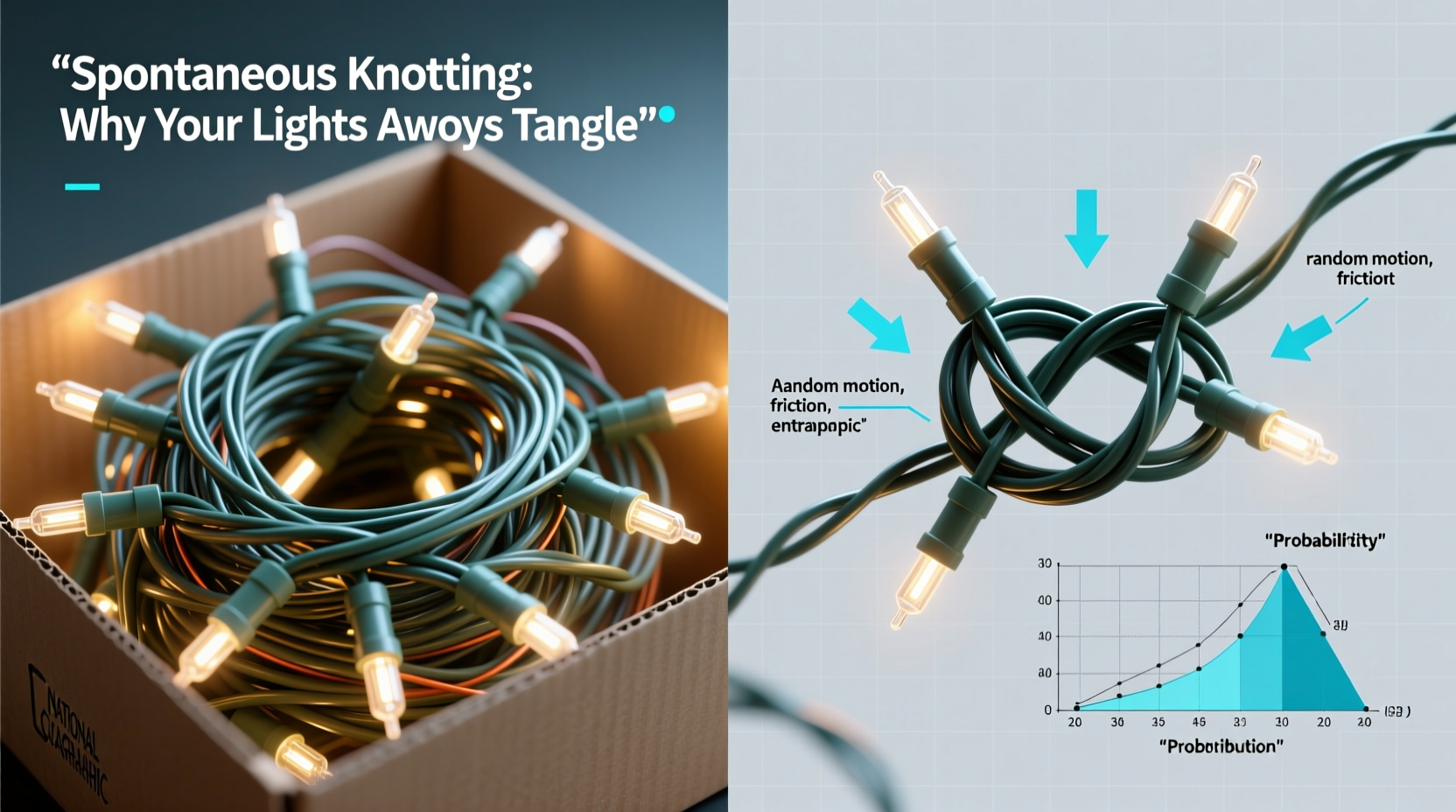
Knots don’t appear out of nowhere—they follow physical laws governed by motion, flexibility, and chance. In 2007, physicists Dorian Raymer and Douglas Smith from the University of California, San Diego conducted a now-famous experiment where they placed strings of various lengths into a rotating box and observed how often knots formed after tumbling. Their findings were striking: even short strings formed complex knots within seconds of agitation.
The study demonstrated that when a string is both long and flexible, and subjected to any kind of movement—even slight shaking—the probability of knot formation increases dramatically. For Christmas lights, which are typically 15 to 50 feet long with multiple bulbs acting as nodes along the strand, these conditions are met perfectly. Once stored in a box, bag, or drawer, even minor disturbances—like shifting during transport or temperature-induced expansion—can initiate the coiling and looping process that leads to entanglement.
Raymer and Smith found that knots begin forming when one end of the string crosses over another segment. If that loop gets pulled through, a knot begins to tighten. With continued motion, more crossings occur, increasing knot complexity. Remarkably, their experiments produced not just simple loops but intricate knots with up to 11 crossings—all within ten seconds of tumbling.
“Knotting is not a rare event—it’s nearly unavoidable given enough length and movement.” — Dorian Raymer, Physicist, UC San Diego
Why Christmas Lights Are Especially Prone to Tangling
Several factors make Christmas lights uniquely susceptible to spontaneous knotting compared to other cords:
- Length: Most light strands exceed five feet, placing them well above the threshold where knotting becomes likely.
- Rigidity variation: While the wire itself is flexible, the evenly spaced bulbs create stiff nodes that disrupt smooth coiling and encourage snagging.
- Multiple connections: Strings often include plugs, controllers, and connectors that differ in size and shape, creating anchor points for tangles.
- Storage environment: Typically packed loosely in boxes or bags, allowing free movement and agitation over time.
- Infrequent use: Stored for 11 months each year, giving ample time for slow-motion tangling due to environmental shifts.
Moreover, many people wrap lights around their hands or cardboard—methods that seem neat but actually increase the risk of interlooping. When stored this way, adjacent coils press against each other; any small displacement can cause one loop to slip over another, initiating a cascade of entanglement.
How Motion Triggers Spontaneous Knotting
Even without intentional shaking, stored lights experience micro-movements throughout the year. Temperature fluctuations cause materials to expand and contract. Buildings settle. Storage areas get bumped during cleaning or rearrangement. These subtle forces are enough to set knotting in motion.
A 2018 follow-up study published in Proceedings of the Royal Society A showed that even slow, incremental motion—such as gravity pulling on a loosely coiled cord over weeks—can lead to knot formation. The researchers used computer simulations to model how random jostling translates into topological changes in a string’s configuration. They concluded that longer strings have exponentially higher chances of knotting because they offer more opportunities for self-crossing.
This principle explains why extension cords, garden hoses, and headphone wires behave similarly. But Christmas lights compound the problem: their structure introduces asymmetry (bulbs, uneven weight), making them less likely to lie flat and more prone to twisting. Add in multiple strands stored together—common in holiday setups—and the likelihood of inter-tangling skyrockets.
Real Example: The Garage Bin Experiment
In a documented case from Portland, Oregon, homeowner Mark Teller attempted to store his holiday lights using what he believed was a foolproof method: individually wrapping each strand around a piece of PVC pipe and placing them upright in a plastic tote. After one season, he opened the bin expecting order—but found three of the six strands hopelessly knotted.
Upon inspection, he realized that the tote had been moved twice—once during a garage reorganization and once when winter snow forced temporary relocation. Each shift caused the pipes to tilt slightly, allowing the coils to slide and rub against one another. One loose end slipped free, snaked between two others, and formed a double-loop knot that tightened under pressure. What looked like stable storage was, in reality, a ticking tangle bomb.
Mark later switched to a spool-based system with individual compartments and reported zero tangles the following year—proving that containment and isolation matter as much as coiling technique.
Proven Strategies to Prevent Light Tangling
While you can’t eliminate physics, you can work with it. By applying principles from knot theory and material handling, you can drastically reduce—or even prevent—tangling. Below is a step-by-step guide to storing Christmas lights effectively.
Step-by-Step: How to Store Christmas Lights Without Tangling
- Choose the right tool: Use a purpose-built cord reel, spool, or cardboard tube designed for even winding.
- Start with a secure anchor: Tape the plug end to the reel before beginning to wind.
- Wind consistently: Wrap the strand in uniform loops, keeping tension even but not tight. Never overlap or crisscross.
- Secure the end: Once fully wound, use a Velcro tie or reusable zip strap to hold the last loop in place. Do not use elastic bands, which degrade over time.
- Isolate each strand: Store individual reels in separate compartments or stackable bins to prevent contact.
- Store vertically or flat: Keep containers in a low-vibration area, avoiding locations near doors, heaters, or high-traffic zones.
Do’s and Don’ts of Christmas Light Storage
| Do | Don’t |
|---|---|
| Use a cord reel or spool | Wrap around your hand |
| Secure both ends before storage | Leave loose ends dangling |
| Store in rigid, compartmentalized bins | Toss all strands into a single soft bag |
| Keep in a cool, dry, low-traffic area | Store in attics or garages with extreme temps |
| Inspect lights before storing | Pack away broken or frayed strands |
Alternative Methods and Tools
Beyond traditional spools, several innovative solutions have emerged to combat tangles:
- 3D-printed organizers: Custom-designed holders that keep each loop separated and secured.
- Plastic shutter reels: Originally made for window blinds, these large-diameter reels minimize bending stress and allow full visibility.
- Cardboard box with slits: Cut vertical slots along the edges of a sturdy box to thread and anchor the cord in straight lines, eliminating loops entirely.
- Velcro straps with clips: Combine bundling with hanging capability—ideal for closet or shelf storage.
One increasingly popular method involves folding lights accordion-style and clipping them into labeled plastic sleeves, similar to how professional stage lighting crews manage cables. This approach avoids coiling altogether, reducing torsion and friction.
Checklist: Tangle-Free Holiday Light Storage
- ☐ Test all strands for functionality before packing
- ☐ Choose a winding tool (spool, reel, or box)
- ☐ Anchor the plug end securely
- ☐ Wind in consistent, non-overlapping loops
- ☐ Fasten the final loop with a reusable tie
- ☐ Label each strand clearly
- ☐ Store in isolated, rigid containers
- ☐ Place in a stable, low-vibration location
“The key to preventing knots isn’t perfection—it’s minimizing freedom of movement.” — Dr. Laura Chen, Materials Scientist and Polymer Specialist
Frequently Asked Questions
Can I completely prevent Christmas lights from tangling?
While no method guarantees 100% knot-free storage, using a reel or spool with proper securing techniques reduces the risk to near zero. The combination of controlled winding, end anchoring, and physical isolation makes spontaneous knotting highly unlikely.
Why do LED lights tangle just like older incandescent ones?
Despite being lighter and more flexible, LED strands still have bulbs, wires, and connectors that create nodes and resistance. The fundamental physics of knotting applies regardless of bulb type. In fact, thinner wires may be more prone to kinking if bent too tightly.
Is there a best direction to wind the lights—clockwise or counterclockwise?
No scientific evidence favors one direction over the other. Consistency matters more: always wind the same way to maintain muscle memory and uniform tension. However, some users report fewer twists when matching the natural twist of the wire, which can be tested by gently uncoiling a new strand and observing its preferred orientation.
Conclusion: Embrace Science, Not Struggle
The annual battle with tangled Christmas lights isn’t a personal failing—it’s a predictable outcome of physics and poor storage design. Now that the science of spontaneous knotting is well understood, there’s no need to accept chaos as part of the holidays. By adopting simple, research-backed methods, you can preserve the joy of decorating without the frustration of untangling.
This year, take a few extra minutes to store your lights the right way. Invest in a spool, label your strands, and give each one its own space. Come next December, you’ll save time, reduce stress, and maybe even enjoy a small victory over entropy itself. The laws of physics may favor disorder, but with smart habits, you can stay one step ahead.




 浙公网安备
33010002000092号
浙公网安备
33010002000092号 浙B2-20120091-4
Comments
No comments yet. Why don't you start the discussion?