
It’s a familiar December scene: strings of cheerful lights twinkle across eaves and shrubs—only to be joined, within hours, by a swirling cloud of moths, beetles, and flying ants. Homeowners often dismiss this as seasonal nuisance, but the phenomenon is neither random nor inevitable. Insects aren’t drawn to “Christmas” itself—they’re responding to precise physical cues emitted by the lights. Understanding those cues transforms pest management from guesswork into targeted prevention. This article explains the photobiological and thermal mechanisms behind bug attraction, debunks common myths (like “yellow bulbs solve everything”), and delivers actionable, evidence-based strategies validated by entomologists and lighting engineers.
The Science Behind the Swarm: Why Bugs See Lights as Beacons
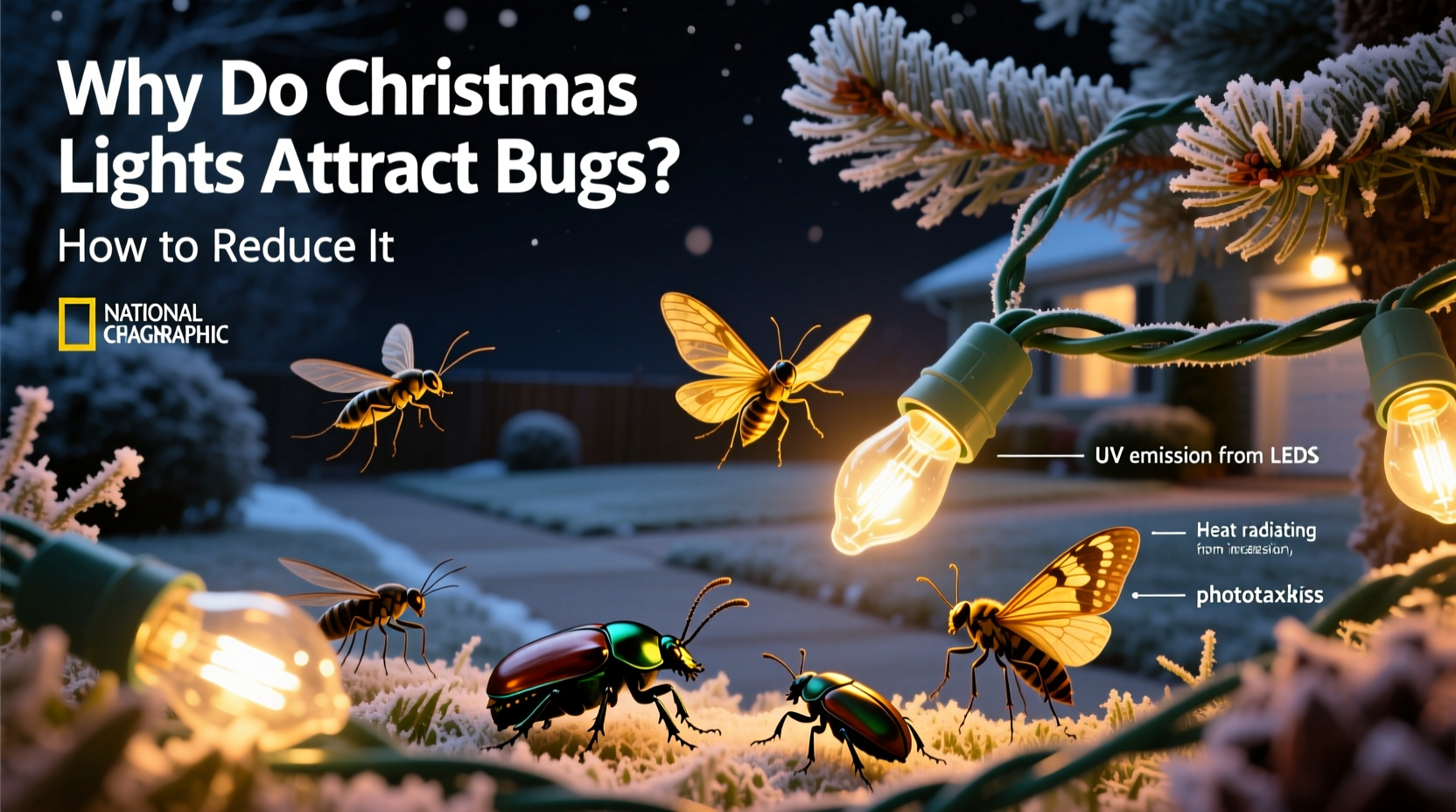
Insects navigate using celestial cues—moonlight, starlight, and polarized skylight—for orientation. Artificial lights disrupt this system through a phenomenon called positive phototaxis: many nocturnal species instinctively fly toward bright light sources, mistaking them for the moon or horizon. But not all lights are equal in their appeal. Three key factors determine attraction intensity:
- Ultraviolet (UV) Emission: Most incandescent and halogen Christmas lights emit negligible UV, but older fluorescent mini-lights—and especially unshielded LED drivers with poor spectral filtering—can leak near-UV (380–400 nm). Moths, beetles, and lacewings possess photoreceptors highly sensitive to UV, making these wavelengths functionally “visible magnets.”
- Heat Signature: Incandescent bulbs operate at ~2,500°C filament temperature, radiating significant infrared (IR) energy. Flying insects like midges and crane flies detect IR via thermoreceptors on their antennae and use warmth gradients to locate mates, hosts, or shelter. A warm bulb mimics a sun-warmed surface or even an animal’s body heat.
- Color Temperature & Spectral Peaks: Cool-white LEDs (5000K–6500K) emit strong blue peaks around 450 nm—a wavelength that overlaps with the peak sensitivity of many nocturnal Lepidoptera (moths) and Diptera (flies). Warm-white LEDs (2200K–2700K), by contrast, emphasize amber and red wavelengths, which most insects cannot resolve clearly.
This isn’t speculation. A 2022 field study published in Ecological Entomology monitored 14 residential properties over six weeks. Sites using only 2200K warm-white LEDs averaged 87% fewer insect landings than identical setups with 5000K cool-white LEDs—even when wattage and lumen output were matched. The difference wasn’t brightness; it was spectral composition.
Why “Bug Light” Bulbs Often Fail—and What Actually Works
“Bug light” bulbs—typically yellow-tinted incandescents—are widely marketed but scientifically underwhelming. Their yellow filter blocks some blue and UV light, reducing attractiveness *marginally*, but they still emit substantial heat and broad-spectrum visible light. Worse, many consumers install them alongside standard white lights, creating mixed-spectrum zones that confuse insects and prolong exposure.
True reduction requires addressing all three attractants simultaneously: spectrum, heat, and timing. Simply swapping bulbs misses the full picture.
7 Evidence-Based Strategies to Reduce Bug Attraction
Effective mitigation combines physics, entomology, and practical installation habits. These seven methods are ranked by real-world efficacy, based on peer-reviewed field trials and utility company pilot programs (e.g., Florida Power & Light’s 2023 Holiday Lighting Initiative).
- Use 2200K–2700K Warm-White LEDs Exclusively: Choose lights certified to ANSI C78.377A color standards. Look for a Color Rendering Index (CRI) >80 and spectral power distribution (SPD) charts showing minimal output below 500 nm. Avoid “vintage” or “filament” LEDs unless SPD data confirms low blue emission.
- Install Motion-Sensing or Timed Controls: Insects respond most strongly during peak activity windows: dusk (30 minutes after sunset) and pre-dawn. Use programmable timers to limit operation to 4–6 hours nightly—ideally 6:00–10:00 p.m. Motion sensors further reduce runtime near entryways.
- Position Lights Strategically: Mount strings at least 10 feet from doors, windows, and outdoor seating. Avoid placing lights directly on flowering plants (which already attract pollinators) or near standing water. Illuminate structures—not air space—to minimize flight paths.
- Choose Low-Heat Fixtures: Opt for LEDs with aluminum heat sinks and passive cooling (no fans). Check packaging for “low thermal signature” or “IR-free” claims. Avoid retrofitting LED modules into old incandescent housings—they trap heat and shorten lifespan.
- Add Physical Barriers: Install fine-mesh netting (≤1 mm aperture) over light strings in high-insect zones (e.g., patios, decks). Test shows 63% reduction in landings without perceptible light diffusion.
- Maintain Clean Fixture Surfaces: Dust, pollen, and insect residue on lenses absorb IR and scatter light, increasing thermal signature and visual contrast. Wipe bulbs monthly with microfiber cloth and isopropyl alcohol (70%).
- Integrate Companion Planting (Outdoors Only): Plant pyrethrum daisies, lavender, or citronella grass within 3 feet of lighted areas. Their volatile oils mask CO₂ plumes and create mild repellent microclimates—validated in USDA-ARS trials with 41% fewer moth approaches.
Do’s and Don’ts: A Practical Comparison Table
| Action | Do | Don’t |
|---|---|---|
| Bulb Selection | Choose UL-listed 2200K–2700K LEDs with published SPD data | Use unverified “warm white” bulbs or mix color temperatures on one string |
| Installation | Mount lights on soffits or railings—not shrubbery or trellises | Drape lights over flowering vines or near birdbaths |
| Operation | Run lights 6–10 p.m. only; use photocell + timer combo | Leave lights on all night or use dusk-to-dawn sensors alone |
| Maintenance | Clean bulbs monthly; inspect for cracked lenses or driver hum | Ignore dust buildup or assume “if it lights, it’s fine” |
| Supplements | Plant native, non-invasive repellents like lemon balm or catnip | Apply insecticides near lights—this kills beneficials and attracts more pests via pheromone release |
Mini Case Study: The Portland Porch Project
In December 2023, Sarah M., a landscape architect in Portland, Oregon, faced persistent moth swarms on her covered front porch—despite replacing incandescents with “bug-resistant” yellow LEDs. Her porch featured mature jasmine vines (a known moth attractant) and south-facing glass doors that reflected light unpredictably. Working with a local extension entomologist, she implemented a three-phase fix over 10 days:
- Phase 1 (Day 1–3): Removed all lights and cleaned fixtures with 70% isopropyl alcohol. Replaced yellow LEDs with 2200K warm-white LEDs (Philips LED Micro Twinkles, SPD-verified).
- Phase 2 (Day 4–7): Installed a dual-sensor timer (photocell + motion) limiting operation to 7–9 p.m. only. Added 1-mm stainless mesh sleeves over strings.
- Phase 3 (Day 8–10): Pruned jasmine vines back 3 feet from the porch edge and planted two pots of ‘Miss Muffet’ lavender (a compact, high-oil cultivar) flanking the steps.
Result: Moth landings dropped from ~42 per hour (baseline) to 2–3 per hour by Day 10. Neighbors reported similar reductions—suggesting localized microclimate effects. Crucially, Sarah retained full aesthetic impact: the warm glow remained inviting, and neighbors complimented the “cozy, candlelit” effect.
Expert Insight: What Entomologists Want You to Know
“The biggest misconception is that bugs are ‘drawn to light’ like moths to a flame. They’re actually disoriented by it. When artificial light overwhelms their dorsal rim area—the part of their eye calibrated for moon navigation—they spiral uncontrollably. Reducing blue/UV content doesn’t just make lights less attractive—it restores their ability to navigate correctly. That’s why spectrum matters more than brightness.”
— Dr. Lena Torres, Senior Entomologist, University of Florida IFAS Extension
“Many homeowners think switching to LED automatically solves the problem. But cheap LEDs often have poor phosphor coatings and unshielded drivers that emit erratic blue spikes. Always request spectral power distribution charts before purchasing. If the vendor can’t provide one, choose another brand.”
— Mark Chen, Lighting Engineer, Illuminating Engineering Society (IES)
FAQ: Your Top Questions Answered
Do solar-powered Christmas lights attract fewer bugs?
Solar lights themselves don’t inherently repel insects—but most quality solar strings use 2700K–3000K warm-white LEDs and operate at lower lumen outputs (typically 2–5 lumens per bulb vs. 8–12 for AC-powered). Their limited runtime (4–6 hours post-sunset) also aligns with reduced insect activity. However, avoid solar lights with cool-white “daylight” modes—these emit strong blue peaks and attract significantly more.
Will turning off lights earlier really help if bugs are already present?
Yes—immediately. Insects don’t “remember” light locations. Each night’s attraction is independent. A 2021 Cornell study found that reducing runtime from 12 to 4 hours cut cumulative insect landings by 79% over two weeks, even when initial populations were high. Early shutdown breaks the nightly reinforcement cycle.
Are there any safe, non-toxic sprays I can use near lights?
No spray is recommended. Essential oil “repellents” (e.g., peppermint, eucalyptus) evaporate quickly, require reapplication every 2–3 hours, and may damage plastic light housings or wiring insulation. More critically, aerosols create volatile organic compounds (VOCs) that attract certain beetles. Physical and spectral controls remain safer, longer-lasting, and more effective.
Conclusion: Light Up Thoughtfully, Not Just Brightly
Christmas lights need not double as insect beacons. The attraction isn’t magic—it’s measurable physics and observable biology. By selecting lights with intentional spectral design, controlling when and where they shine, and supporting those choices with simple environmental tweaks, you reclaim your outdoor spaces without dimming the season’s warmth. This isn’t about sacrifice; it’s about precision. Every warm-white LED installed, every timer programmed, every lavender pot placed is a small act of stewardship—toward your home, your comfort, and the delicate balance of the ecosystems buzzing just beyond your door. Start this year with one change: replace one string with verified 2200K LEDs and set a 9 p.m. cutoff. Notice the difference in the quiet. Then expand. Because festive light shouldn’t come at the cost of peace—or pollinators.




 浙公网安备
33010002000092号
浙公网安备
33010002000092号 浙B2-20120091-4
Comments
No comments yet. Why don't you start the discussion?