
Every holiday season, homeowners across neighborhoods string up festive lights to create warm, glowing displays. But one common frustration keeps returning: the last few bulbs on a long light strand appear noticeably dimmer than those at the beginning. This isn’t a defect in the lights themselves—it’s a symptom of voltage drop, an electrical phenomenon that affects performance over distance. Understanding why this happens and how to correct it ensures your display stays bright, safe, and consistent from start to finish.
The Science Behind Dimming Lights: Voltage Drop Explained
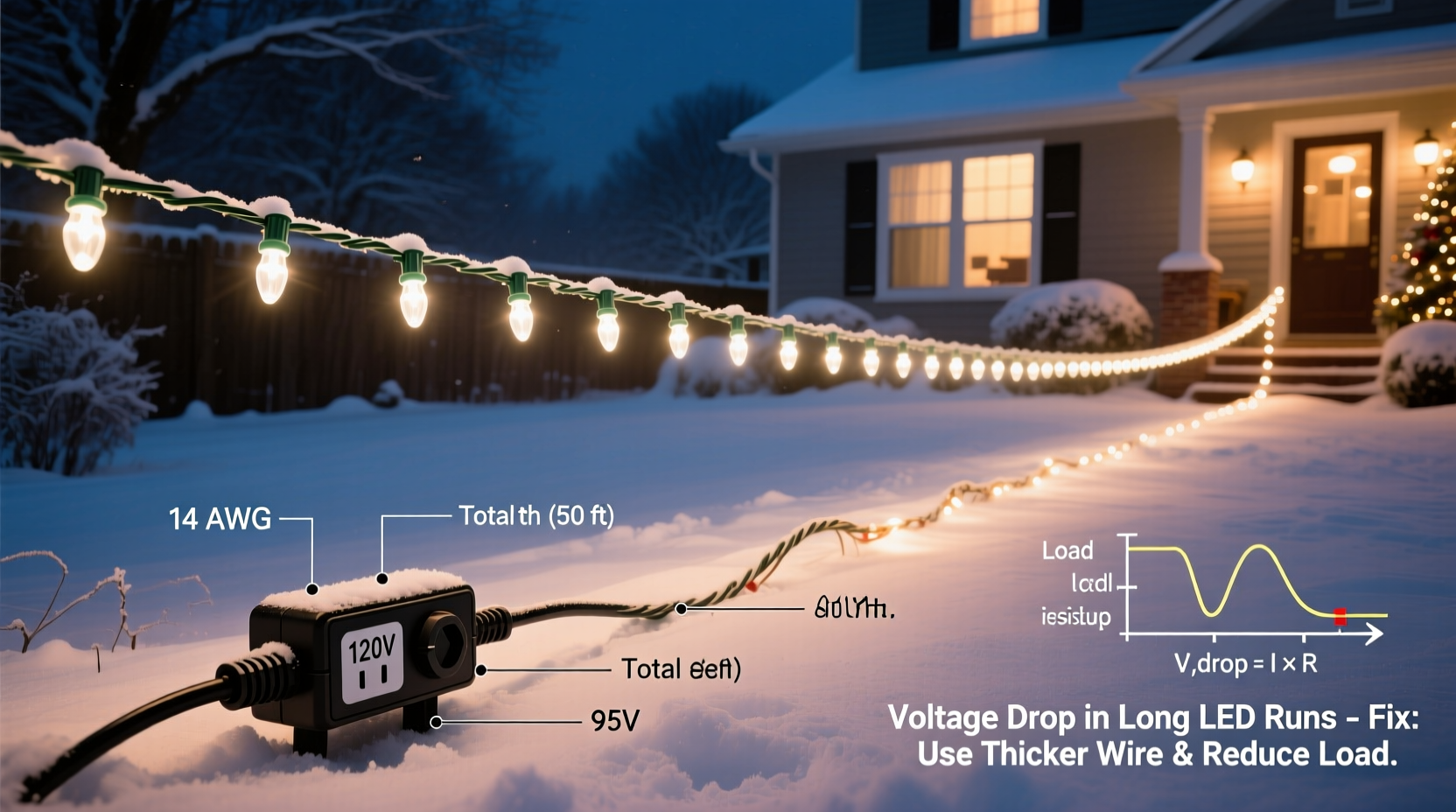
Voltage is the electrical \"pressure\" that pushes current through a circuit. In a string of Christmas lights—especially older incandescent or lower-gauge LED sets—each bulb acts as a small resistor, consuming a portion of that voltage. As electricity travels along the wire from the plug to the far end of the strand, resistance in the copper wire itself causes a gradual loss of voltage. By the time the current reaches the final bulbs, there's simply less power available, resulting in reduced brightness.
This phenomenon is known as voltage drop. It occurs in all electrical systems but becomes especially visible in long runs of low-voltage or high-resistance circuits like holiday lighting. The longer the wire and the higher the total wattage of the connected devices, the more pronounced the effect.
According to the National Electrical Code (NEC), voltage drop should ideally not exceed 3% for branch circuits to ensure efficient operation. While decorative lighting may not fall under strict NEC enforcement, staying within this threshold helps maintain both performance and longevity.
“Voltage drop isn’t just about dim lights—it can shorten bulb life and increase heat buildup in wires, creating potential fire hazards if ignored.” — Mark Reynolds, Licensed Electrician & Home Safety Consultant
Factors That Worsen Voltage Drop in Light Strings
Several variables influence how severely voltage drop impacts your Christmas lights. Recognizing these factors allows you to plan smarter installations:
- Wire Gauge (AWG): Thinner wires (higher AWG numbers like 22 or 24) have more resistance, leading to greater voltage loss over distance.
- Total Length of Run: Most standard mini-light strings are designed to be daisy-chained only up to a certain length—often 200–300 feet maximum for LEDs, much less for incandescents.
- Type of Bulbs: Incandescent bulbs draw significantly more current than LEDs, increasing load and accelerating voltage drop.
- Number of Bulbs per String: More bulbs mean higher cumulative resistance and power demand.
- Ambient Temperature: Cold weather increases wire resistance slightly, exacerbating the problem outdoors.
How to Measure and Calculate Voltage Drop
You don’t need advanced tools to estimate voltage drop, though a multimeter makes verification easier. Here’s a simplified method using basic electrical formulas:
The formula for calculating approximate voltage drop is:
Voltage Drop (V) = 2 × Length (ft) × Current (A) × Resistance per foot (Ω/ft)
For typical 20-gauge copper wire used in light strings, resistance is approximately 0.0101 Ω per foot. Let’s say you’re running a 100-foot strand drawing 0.5 amps:
VD = 2 × 100 × 0.5 × 0.0101 = 1.01 volts dropped
If your input voltage is 120V, the far end receives about 118.99V—a minor drop. But with longer runs or higher current, the difference grows quickly.
A more practical approach? Use a digital multimeter:
- Set the meter to AC voltage.
- Measure voltage at the first socket near the plug.
- Measure again at the last socket in the chain.
- A difference exceeding 3–5 volts indicates significant voltage drop.
Practical Fixes to Prevent Dimming at the End of the Line
Once you understand the root cause, correcting dimming becomes a matter of reducing resistance, shortening runs, or supplementing power. Below are proven strategies to keep every bulb shining brightly.
1. Limit Daisy-Chaining to Manufacturer Limits
Most light strings specify how many can be safely connected end-to-end. Exceeding this limit overloads the circuit and worsens voltage drop. For example:
| Bulb Type | Max Connected Strands | Total Recommended Length |
|---|---|---|
| Mini Incandescent (20W/strand) | 3–4 strands | 150 ft max |
| LED Mini Lights (4W/strand) | Up to 45 strands | 1,000 ft max* |
| Multicolor C9 LEDs | 10–15 strands | 500 ft max |
*Assumes proper gauge wiring and adequate power supply.
2. Power Multiple Sections from Separate Outlets
Instead of running one extremely long chain, divide your display into shorter segments powered directly from wall outlets or heavy-duty extension cords. This eliminates cumulative voltage loss by giving each section full line voltage.
Use outdoor-rated GFCI outlets and waterproof connectors. If outlets are limited, consider installing temporary power hubs around your home’s perimeter using commercial-grade extension systems.
3. Upgrade to Lower-Gauge Wire or Commercial-Grade Lights
Commercial Christmas lighting often uses 18- or 16-gauge wire instead of the thinner 22–24 gauge found in consumer sets. The thicker conductor reduces resistance and maintains voltage over longer distances.
While more expensive upfront, these lights last longer, stay brighter, and support larger installations without dimming issues.
4. Use a Mid-Run Power Injection System
In professional displays, electricians inject power midway through a long run. This involves splicing in a secondary power feed at the halfway point (or later segment), effectively resetting the voltage back to 120V halfway down the line.
Caution: Only attempt this if you’re experienced with electrical work. Mismatched polarity or incorrect wiring can damage lights or create shock risks. Pre-made power injection kits are available for safer DIY use.
5. Switch to Higher-Voltage Systems (e.g., 24V or 48V DC with Transformers)
Some modern landscape lighting uses low-voltage DC systems (like 24V or 48V) with centralized transformers. These allow precise control, better efficiency, and reduced voltage drop due to higher initial voltage and regulated output.
While not standard for traditional Christmas strings, they’re ideal for permanent rooftop outlines or architectural accents where consistency matters.
Mini Case Study: Fixing a Frustrating Front Porch Display
Tom, a homeowner in Ohio, installed a new 300-foot LED light string along his roofline. Despite buying “commercial grade” lights advertised for long runs, the last 50 feet were visibly dimmer—almost flickering in cold wind.
After testing voltage at both ends, he found 119V at the start but only 107V at the end—a 10% drop well beyond acceptable limits. He reviewed his setup and realized he’d daisy-chained five 60-foot strands, relying on thin 22-gauge interconnects.
His solution?
- He disconnected the chain and split it into two 150-foot sections.
- Ran separate 16-gauge extension cords from two different GFCI outlets.
- Used weatherproof Y-splitters to maintain clean connections.
Result: Full brightness across both sections, no dimming, and a display that earned him the neighborhood holiday award.
Checklist: How to Avoid Voltage Drop in Your Christmas Lights
Follow this step-by-step checklist before installing your next holiday lighting display:
- ✔ Check manufacturer specs for maximum daisy-chain length.
- ✔ Choose LED lights over incandescent to reduce current draw.
- ✔ Use the shortest possible extension cords with thick gauge wire (16 AWG or lower).
- ✔ Divide long runs into independent circuits powered from separate outlets.
- ✔ Test voltage at beginning and end of each run with a multimeter.
- ✔ Consider mid-run power injection for displays over 300 feet.
- ✔ Inspect all connectors for corrosion or loose fits—these add resistance.
- ✔ Avoid coiling excess cord tightly; heat buildup increases resistance.
Frequently Asked Questions
Can I mix different types of Christmas lights on the same run?
No. Mixing LED and incandescent strings—even if physically compatible—creates uneven current draw and accelerates voltage drop. LEDs require less power, so when paired with higher-draw incandescents, the circuit becomes unbalanced, potentially damaging the LEDs or causing premature failure.
Why do my lights get brighter when I turn off other appliances?
This suggests your household circuit is overloaded. When multiple devices run simultaneously, overall voltage sags slightly. Holiday lights, being sensitive to small changes, reflect this dip. To fix it, plug lights into a dedicated circuit or reduce competing loads during display hours.
Will using a surge protector prevent dimming?
No. Surge protectors guard against voltage spikes but don’t compensate for voltage drop caused by resistance in wiring. They may even add slight internal resistance. Use them for safety, but rely on proper wiring practices to maintain brightness.
Conclusion: Brighter Displays Start with Smarter Wiring
Dimming Christmas lights aren’t inevitable—they’re a solvable engineering challenge rooted in basic electrical principles. By respecting voltage drop limits, choosing the right materials, and designing your layout strategically, you can achieve a uniformly bright, energy-efficient, and safe holiday display.
Don’t let the last bulb on your string fade into darkness. Apply these fixes this season and enjoy a radiant, professional-quality glow from the first outlet to the farthest rooftop corner.




 浙公网安备
33010002000092号
浙公网安备
33010002000092号 浙B2-20120091-4
Comments
No comments yet. Why don't you start the discussion?