
As holiday decorations go up each winter, one of the most common frustrations homeowners face is flickering Christmas lights. Whether it’s a single strand dimming intermittently or an entire outdoor display pulsing like a strobe light, flickering disrupts the festive ambiance and can signal deeper electrical issues. While some flicker may seem harmless, persistent or erratic blinking often points to unstable current, poor connections, or incompatible lighting systems. Understanding the root causes—and knowing how to fix them—can transform your holiday lighting from frustrating to flawless.
The Science Behind Flickering: How AC Current Affects Lights
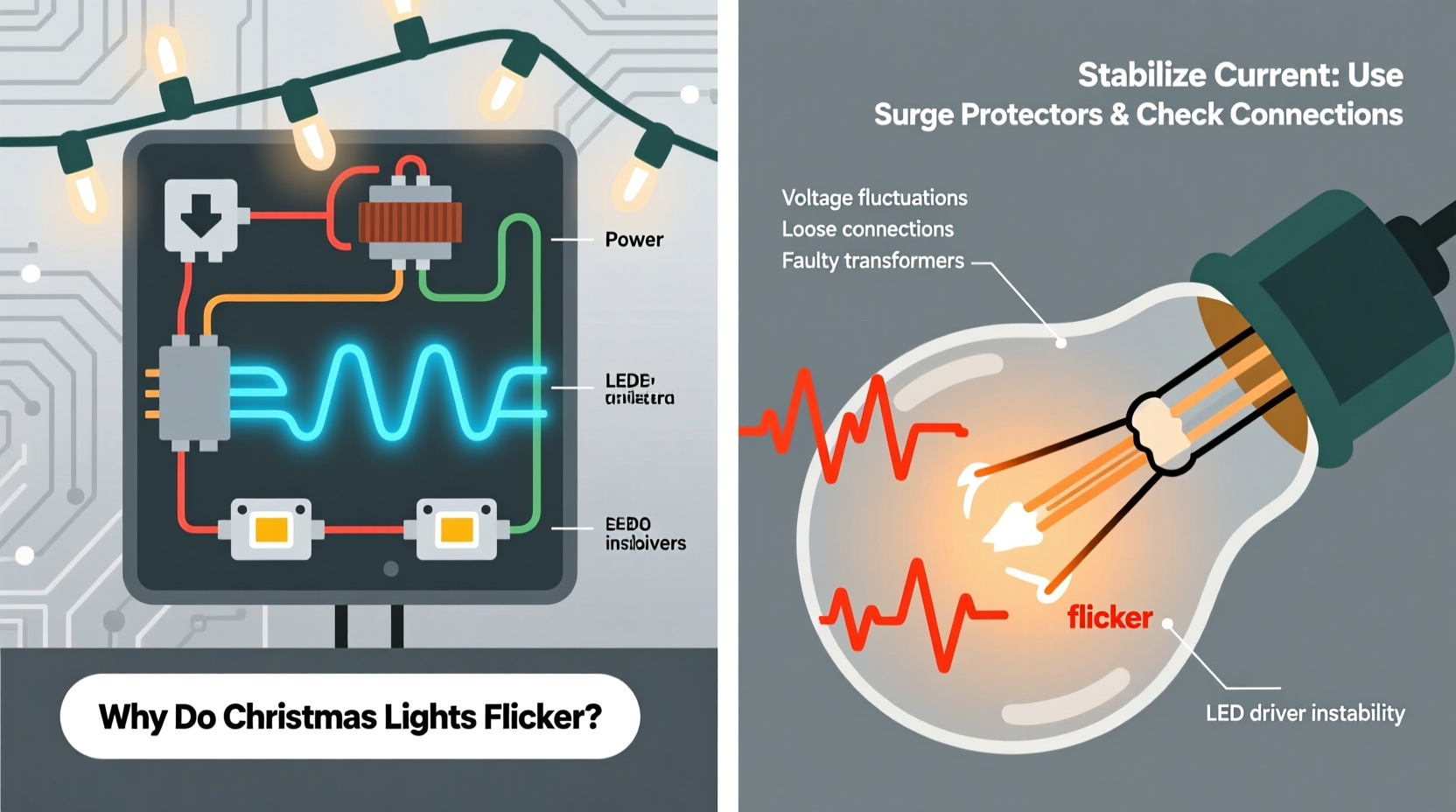
Most household electricity operates on alternating current (AC), which reverses direction 50 to 60 times per second depending on regional standards (60 Hz in North America, 50 Hz in Europe). This constant oscillation means that voltage isn’t steady—it peaks and dips rhythmically. Incandescent bulbs, once common in Christmas strands, heat up their filaments quickly enough to maintain visible glow through these dips, minimizing noticeable flicker. However, LED lights respond almost instantly to changes in voltage. If not properly regulated, LEDs can visibly blink at the frequency of the current, especially when dimmed or under low load.
This inherent behavior of AC power explains why some flickering is technically normal, particularly with older or lower-quality LED strings. But excessive or irregular flickering—where lights pulse slowly, go dark entirely, or behave unpredictably—is not part of standard operation. It usually indicates a problem with voltage stability, circuit loading, or component failure.
Common Causes of Christmas Light Flickering
Flickering rarely has a single cause. More often, it results from a combination of factors ranging from simple wear-and-tear to systemic electrical imbalances. Identifying the source requires careful observation and systematic troubleshooting.
1. Loose or Corroded Connections
A poor connection anywhere in the circuit—whether at the outlet, plug, socket, or wire junction—can interrupt current flow. These micro-interruptions cause lights to flicker or go out momentarily. Outdoor lights are especially vulnerable due to moisture exposure, leading to corrosion over time.
2. Overloaded Circuits
Plugging too many light strands into a single circuit draws more current than it's designed to handle. As the circuit struggles to maintain stable voltage, lights may dim or flicker, particularly when other appliances turn on nearby (e.g., refrigerators or heaters).
3. Incompatible Dimmer Switches
Many homes use dimmer switches to control indoor lighting. Standard dimmers designed for incandescent bulbs don't always work well with LEDs. They can chop the AC waveform unevenly, causing visible flickering. Using non-dimmable LED strings on a dimmed circuit worsens this effect.
4. Voltage Fluctuations
If your home experiences inconsistent voltage—due to aging wiring, utility supply issues, or long extension runs—lights will reflect those instabilities. Voltage drops over distance are common with outdoor displays using undersized extension cords.
5. Faulty or Low-Quality Bulbs and Drivers
Cheaply manufactured LED strings may lack proper internal regulation. Poorly designed drivers (the components that convert AC to DC and regulate current) fail to smooth out voltage variations, making flicker more likely. One bad bulb in a series-wired string can also disrupt the entire strand.
“LED technology demands clean, stable power. Without proper current regulation, even minor fluctuations become visible.” — Dr. Alan Reyes, Electrical Engineer & Lighting Systems Specialist
Step-by-Step Guide to Stabilize Your Christmas Light Current
Fixing flickering isn’t just about aesthetics—it’s about safety and longevity. Follow this structured approach to diagnose and resolve current instability in your holiday lighting.
- Unplug all light strands and inspect each one visually. Look for cracked sockets, frayed wires, corroded contacts, or missing bulbs.
- Test each strand individually by plugging it directly into a wall outlet (not via extension cord or power strip). Observe whether it flickers. If it does, replace or repair the strand.
- Check your circuit breaker panel. Note which outlets share the same circuit. Avoid daisy-chaining more than three light strands unless they’re rated for it and the circuit can handle the load.
- Use a multimeter to measure outlet voltage. With no load, voltage should be around 120V (±5%). Turn on major appliances and retest. If voltage drops below 110V, you may have an overloaded circuit or wiring issue.
- Replace old or incompatible dimmer switches with LED-compatible models labeled “trailing-edge” or “ELV” (electronic low voltage).
- Install a dedicated circuit for outdoor lighting if you run large displays annually. This prevents interference from household appliances.
- Use heavy-gauge extension cords (14 AWG or lower) for long runs. Thinner cords (like 18 AWG) cause significant voltage drop over distances greater than 25 feet.
- Add a surge protector with voltage regulation to smooth incoming power and protect against spikes.
- Consider upgrading to smart LED strings with built-in stabilizers, such as those using constant-current drivers or buffered power inputs.
- Group lights by type and age. Mixing old and new strands—even within the same brand—can create impedance mismatches that lead to flickering.
Tips and Best Practices for Stable Holiday Lighting
Prevention is far easier than troubleshooting mid-season. Implement these habits every year before hanging your lights.
Use Power Distribution Boxes for Large Displays
If you manage an extensive setup—say, over 500 bulbs—invest in a weatherproof distribution box. These split one main line into multiple regulated outputs, ensuring even voltage delivery and isolating faults.
Keep Outdoor Plugs Elevated and Covered
Water intrusion is a top cause of intermittent connections. Use GFCI outlets and cover plugs with inverted plastic boxes or specialized outlet covers designed for holiday use.
Store Lights Properly Off-Season
Wrap lights around cardboard spools or use reel organizers to prevent tangling and wire stress. Store in a dry, temperature-stable location. Heat and cold cycles degrade insulation and solder joints over time.
Choose High-Quality LEDs with Low Flicker Ratings
Look for certifications like IEEE 1789 compliance or \"flicker-free\" labeling. Reputable brands often publish flicker percentage and frequency data. Aim for less than 5% flicker at full brightness.
Comparison Table: Common Solutions for Flickering Lights
| Solution | Effectiveness | Cost | Best For |
|---|---|---|---|
| Replace faulty strands | High | Low | Isolated flickering in one section |
| Upgrade to LED-compatible dimmer | High | Medium | Indoor dimmable installations |
| Use heavier extension cords | Moderate–High | Low–Medium | Long outdoor runs |
| Install voltage regulator/surge protector | Moderate | Medium | Areas with known power fluctuations |
| Add dedicated circuit | Very High | High | Large annual displays |
| Switch to battery-powered LEDs | Low–Moderate | Medium | Short decorative runs, no outlets nearby |
Mini Case Study: The Neighborhood Display That Wouldn’t Stay On
In suburban Ohio, homeowner Mark T. installed a 3,000-bulb Christmas display across his roofline, trees, and driveway. Each night, the lights would start strong but begin flickering erratically after 30 minutes. Neighbors joked about a “disco house,” but Mark was concerned about fire risk.
After ruling out faulty strands, he measured voltage at the end of his 100-foot extension cord run and found it dropped from 118V to 104V under load—well below safe operating range. The culprit? A thin 18 AWG extension cord meant for indoor lamps, not outdoor lighting arrays.
He replaced it with a 14 AWG outdoor-rated cord and added a surge-protected power strip near the display midpoint. He also rewired half the display to a second circuit. The flickering stopped immediately. Since then, he’s used a circuit map and load calculator every year—no issues in four seasons.
Checklist: Eliminate Flickering Before Hanging Lights
- ☐ Inspect all strands for damage or corrosion
- ☐ Test each strand individually on a known-good outlet
- ☐ Verify total wattage doesn’t exceed 80% of circuit capacity
- ☐ Use only LED-compatible dimmers indoors
- ☐ Select heavy-gauge extension cords (14 AWG or thicker)
- ☐ Install GFCI protection for all outdoor outlets
- ☐ Group lights by type and avoid mixing old/new models
- ☐ Plan circuit distribution to balance load evenly
- ☐ Consider a voltage regulator for sensitive or large displays
- ☐ Label and store properly for next year
Frequently Asked Questions
Is it dangerous if my Christmas lights flicker?
Occasional flicker due to voltage fluctuation may not be dangerous, but persistent or severe flickering can indicate loose wiring, overheating, or circuit overload—all of which pose fire risks. Always investigate the cause rather than ignoring it.
Can I mix different types of Christmas lights on the same circuit?
You can, but it’s not recommended. Mixing incandescent and LED strings creates uneven current draw and can cause flickering or premature failure. Even among LEDs, differences in driver design and power needs can lead to instability. Stick to one type per circuit when possible.
Do smart Christmas lights flicker less?
Generally, yes. Many smart LED strings include advanced drivers and buffering capacitors that smooth out current fluctuations. Brands like Philips Hue, LIFX, and Govee design their systems specifically to minimize flicker, even when dimmed or animated.
Conclusion: Shine Bright Without the Blink
Flickering Christmas lights aren’t just annoying—they’re a signal. Whether it’s a failing bulb, an overloaded circuit, or incompatible hardware, the solution lies in understanding and managing electrical current. By applying the right tools, choosing quality components, and planning your setup carefully, you can enjoy a steady, radiant display that enhances the season without surprises.
Don’t wait until mid-December to troubleshoot. Take action now: test your strands, evaluate your circuits, and upgrade what’s outdated. A little preparation ensures your holiday lights shine consistently—from the first night of December to the last sparkler in January.




 浙公网安备
33010002000092号
浙公网安备
33010002000092号 浙B2-20120091-4
Comments
No comments yet. Why don't you start the discussion?