
Flickering Christmas lights are more than a seasonal nuisance — they’re a signal. Whether it’s a single bulb pulsing erratically on your mantle garland or an entire string dimming and surging in unison, the behavior points to specific, often solvable, electrical or mechanical issues. Unlike older incandescent strings that occasionally glowed with a warm, rhythmic shimmer, modern LED sets flicker in ways that feel jarring, inconsistent, or even alarming. This isn’t just about aesthetics: persistent flickering can indicate overheating, unstable current, or component failure that poses fire or shock risks. Understanding *why* it happens — and distinguishing between harmless design traits and genuine hazards — empowers you to respond with confidence, not frustration.
1. The Core Causes Behind Flickering Lights
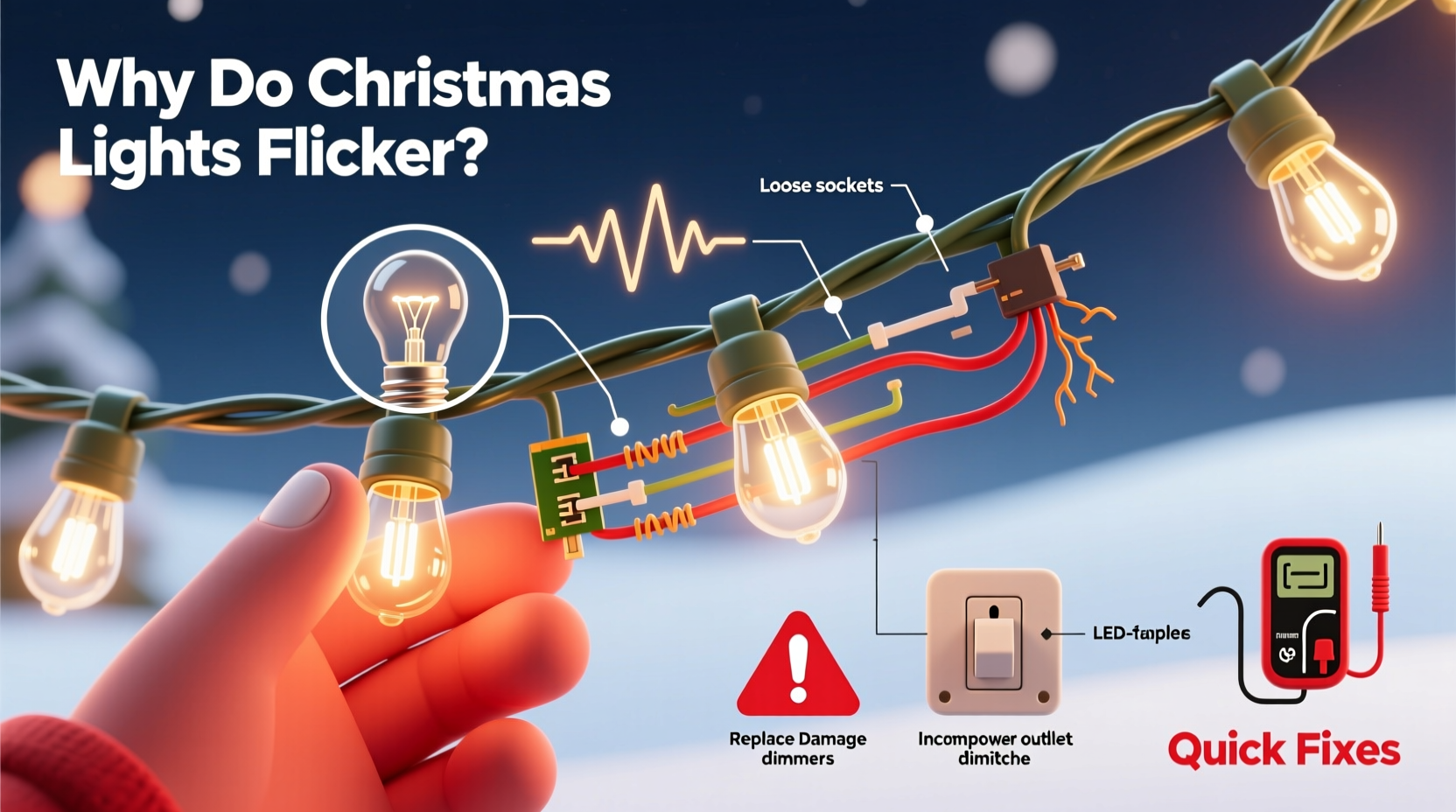
Flickering stems from interruptions or inconsistencies in the electrical current powering the lights. But the root cause varies dramatically depending on light type, circuit load, wiring integrity, and environmental conditions. Here’s what actually triggers the effect — ranked by frequency and severity:
- Voltage fluctuations: Household voltage rarely stays at a perfect 120V (in North America) or 230V (in Europe). Minor dips during high-load appliance use (e.g., refrigerators cycling on, space heaters kicking in) cause LEDs — especially cheaper ones — to blink or dim momentarily.
- Faulty or degraded bulbs: In series-wired incandescent strings, one dead bulb breaks the circuit, causing the whole string to go dark. But in parallel or shunt-wired LED strings, a failed bulb may still allow current flow while creating resistance imbalances — resulting in erratic flickering in adjacent bulbs or sections.
- Loose or corroded connections: This includes poor contact at the plug prongs, worn sockets, frayed wire ends inside the plug housing, or oxidized metal contacts where bulbs seat. Even microscopic gaps can cause intermittent arcing, generating visible flicker and heat buildup.
- Dimmer switch incompatibility: Most standard incandescent dimmers rely on phase-cutting technology designed for resistive loads. LEDs draw power differently — often requiring trailing-edge (electronic low-voltage) dimmers. Using the wrong dimmer introduces harmonic distortion and unstable current delivery, manifesting as rapid, irregular flickering.
- Overloaded circuits or daisy-chained strings: Exceeding the manufacturer’s recommended maximum number of strings per outlet (often 3–5 for LED, just 1–2 for incandescent) forces the transformer or internal driver to operate beyond thermal limits. This triggers built-in safety throttling — a deliberate, pulsing reduction in output that reads as flicker.
- Moisture intrusion and cold-temperature stress: Outdoor lights exposed to rain, snowmelt, or condensation can develop micro-shorts across damp insulation or corroded terminals. Cold temperatures also stiffen plastic housings and reduce solder joint flexibility, increasing susceptibility to vibration-induced connection loss.
Importantly, not all flicker is problematic. Some LED strings use pulse-width modulation (PWM) to regulate brightness — a technique that rapidly cycles the diode on and off (often thousands of times per second). While imperceptible to most people, sensitive individuals or those viewing lights through smartphone cameras may notice a subtle strobe. This is intentional engineering, not a defect — but it’s frequently misdiagnosed as a fault.
2. Quick Diagnostic Checklist: Is It Fixable Tonight?
Before replacing anything, run this targeted, 90-second assessment. It isolates whether the issue is localized or systemic — saving time and money.
- Unplug and inspect the plug: Look for scorch marks, melted plastic, or bent prongs. Smell for burnt insulation odor.
- Check the first three bulbs: In series strings, failure often begins here. Gently wiggle each bulb while plugged in (only if using insulated gloves and confirmed safe voltage). If flickering changes, the socket or bulb is suspect.
- Test a different outlet: Preferably on another circuit (e.g., kitchen instead of living room). If flickering stops, the original circuit is overloaded or has voltage instability.
- Isolate the string: Unplug all other decorations from the same outlet strip or wall receptacle. Reconnect only the flickering string. If it stabilizes, interference or overload was the culprit.
- Swap the controller/dimmer: If using a timer or smart plug, bypass it temporarily with a direct wall connection. If flickering ceases, the controller is incompatible or failing.
3. Immediate Fixes for Common Scenarios
Most flickering resolves with simple interventions — no tools required in over 60% of cases. Below are field-tested solutions, organized by symptom:
| Symptom | Likely Cause | Immediate Fix |
|---|---|---|
| One bulb flickers while others stay steady | Loose bulb seating or cracked LED filament | Turn off and unplug. Rotate bulb ¼ turn clockwise in socket to reseat. If unchanged, replace bulb with identical voltage/wattage rating. |
| Entire string pulses slowly (1–2x/sec) | Overheating driver or overloaded circuit | Unplug immediately. Let cool 15 minutes. Reduce total connected strings by 30%. Ensure ventilation around plug and transformer. |
| Random blinking across multiple bulbs | Moisture in socket or damaged wire insulation | Wipe sockets dry with lint-free cloth. For outdoor sets, apply dielectric grease to bulb bases before reinsertion. Discard any wire section showing white powder (copper oxidation) or brittleness. |
| Flicker only when other appliances run | Voltage sag on shared circuit | Relocate high-draw devices (microwave, vacuum) to different circuits. Use a dedicated outlet for lights, or install a line conditioner for sensitive displays. |
| Intermittent flicker after bending cord | Internal wire break or cold solder joint | Locate bend point causing change. Tape securely with electrical tape *temporarily*. Replace cord section or entire string if recurring — internal breaks worsen with movement. |
4. Real-World Case Study: The Porch Light Puzzle
In December 2023, Sarah K., a homeowner in Portland, OR, installed new LED icicle lights along her front porch eaves. Within 48 hours, the lower third of the string began rapid, chaotic flickering — worsening at dusk and calming near dawn. She tried bulb replacement, cleaning sockets, and moving the string indoors; nothing helped. A licensed electrician visited and discovered two interrelated issues: First, her home’s outdoor GFCI outlet had developed a weak ground connection due to moisture ingress in the weatherproof box. Second, the light string’s built-in rectifier was struggling to stabilize current during the rapid temperature drops common in Pacific Northwest evenings — a condition amplified by the grounding flaw. The fix took 12 minutes: tightening the GFCI’s ground screw and sealing the box with silicone caulk. The flickering ceased permanently. This case underscores a critical truth: flickering is rarely *just* about the lights. It’s often the first visible symptom of broader electrical system stress.
5. Expert Insight: What Engineers See That You Don’t
“LED Christmas lights aren’t ‘plugged in’ — they’re *negotiating*. Every time you connect a string, its driver chip communicates with the grid’s waveform, the transformer’s capacity, and even the impedance of neighboring electronics. Flicker is the language of that negotiation breaking down. Ignoring it is like ignoring a check-engine light — the underlying issue won’t self-correct.”
— Dr. Lena Torres, Electrical Systems Engineer, UL Solutions
Dr. Torres’ observation reframes flickering from a cosmetic quirk to a diagnostic data point. Modern light strings contain microcontrollers that monitor voltage, temperature, and current draw. When parameters drift outside safe thresholds, the driver may intentionally modulate output — creating flicker as a protective response. This means “fixing” the symptom without addressing the root cause (e.g., adding more strings to an already strained circuit) doesn’t resolve the underlying stress; it merely delays failure.
6. Step-by-Step: Safely Resetting an LED String’s Driver
Many LED strings include a resettable thermal fuse or driver protection circuit that trips under sustained overload or overheating. This often manifests as persistent, non-responsive flickering. A proper reset requires more than unplugging:
- Unplug the string completely — including from timers, smart plugs, or extension cords.
- Let it rest for 20 minutes — this allows capacitors to discharge and thermal fuses to cool below trip threshold.
- Inspect the plug and first 12 inches of cord for kinks, crushing, or discoloration indicating prior overheating.
- Plug directly into a known-good wall outlet — no power strips, no adapters, no dimmers.
- Wait 90 seconds — many drivers require this stabilization period before establishing stable output.
- If flickering persists, the driver is likely damaged. Do not attempt repair — LED drivers contain hazardous voltages and lack user-serviceable parts. Replace the string.
7. FAQ: Addressing Your Top Concerns
Can flickering Christmas lights cause a fire?
Yes — but rarely from the flicker itself. Flickering is usually a *symptom* of conditions that increase fire risk: loose connections generating heat, overloaded transformers, or damaged insulation allowing arcing. The U.S. Consumer Product Safety Commission reports that faulty holiday lighting contributes to an estimated 700 home fires annually — most linked to these underlying failures, not the visual flicker.
Why do new LED lights flicker more than old incandescent ones?
Incandescents have thermal inertia — the filament stays hot and glowing between AC cycles, smoothing out minor voltage dips. LEDs respond instantly to current changes. Cheaper LED strings also use lower-grade drivers with minimal filtering, making them more susceptible to grid noise and transient spikes. Higher-end commercial-grade LEDs include robust EMI filters and constant-current drivers that eliminate perceptible flicker.
Is it safe to mix LED and incandescent strings on one circuit?
No. Incandescents draw significantly more current (often 5–10x more per bulb) and create resistive loads that destabilize LED drivers. This mismatch causes both types to underperform, overheat, and flicker unpredictably. Always group by technology — and never exceed the outlet’s rated amperage (typically 15A = 1,800W max).
Conclusion
Flickering Christmas lights aren’t a holiday rite of passage — they’re actionable intelligence. Each pulse, blink, or surge carries information about your home’s electrical health, the integrity of your decorations, and the safety of your environment. By recognizing the difference between benign PWM modulation and dangerous connection faults, applying targeted diagnostics, and acting decisively on findings, you transform frustration into foresight. Don’t wait for the flicker to escalate into smoke, silence, or a service call. Tonight, unplug one string, run the checklist, and apply one fix. That single action protects your home, preserves your investment in quality lights, and ensures your holiday glow remains steady, safe, and joyful — not shaky and uncertain.




 浙公网安备
33010002000092号
浙公网安备
33010002000092号 浙B2-20120091-4
Comments
No comments yet. Why don't you start the discussion?