
It’s a familiar winter scene: freshly fallen snow blankets your roofline, trees, and railings—then, as dusk settles, your carefully strung Christmas lights begin to stutter, dim, or blink erratically. Flickering isn’t just an aesthetic nuisance; it signals underlying electrical stress that can compromise safety, shorten bulb life, and increase fire risk. While many assume snow is merely decorative, it actively interacts with outdoor lighting systems in ways most homeowners don’t anticipate. This article explains the precise physics behind snow-induced flickering, debunks common myths, and delivers field-tested, code-compliant strategies to weatherproof your display—not just for this season, but for years to come.
The Physics of Flickering: Why Snow Triggers Electrical Instability
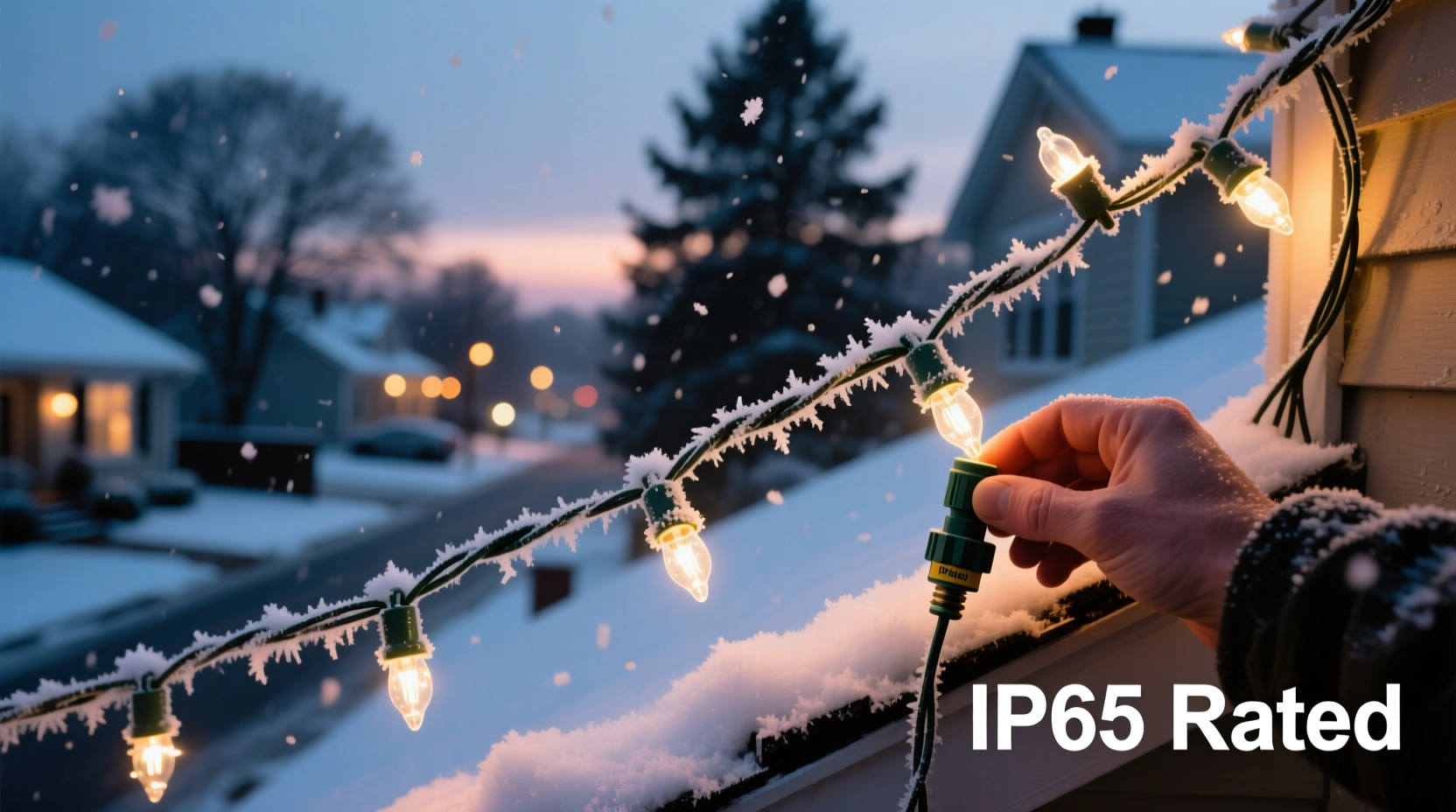
Snow doesn’t “short out” lights in the dramatic way rain might—but its insidious behavior lies in its dual nature: solid yet hygroscopic, insulating yet conductive when contaminated. Fresh, dry snow is a poor conductor. But within minutes of contact with outdoor surfaces (especially warm light strings or ambient humidity), it begins to melt at the interface. That thin layer of meltwater absorbs airborne salts, dust, and pollutants—transforming into a weak electrolyte solution. When this conductive film bridges adjacent wires, terminals, or cracked insulation, it creates micro-shorts or leakage paths. These don’t always trip breakers, but they disrupt the steady current flow required by modern LED drivers and older incandescent filaments alike.
Temperature fluctuations worsen the issue. As nighttime temperatures plunge, moisture refreezes—expanding slightly and stressing solder joints, wire nubs, or plastic housings. Repeated freeze-thaw cycles fatigue materials, especially in low-grade cords where PVC jackets become brittle below −10°C (14°F). Meanwhile, snow accumulation adds mechanical load. A 6-inch blanket on a roofline string exerts ~3.5 lbs per linear foot—enough to pull connectors loose or stretch strain reliefs beyond design tolerance. The result? Intermittent contact, voltage drop across compromised pathways, and the telltale flicker.
Weatherproofing Fundamentals: Beyond “Outdoor Rated” Labels
“Outdoor rated” is a minimum baseline—not a guarantee of snow resilience. UL 588 certification ensures basic water resistance, but it doesn’t test for sustained sub-zero operation, ice adhesion, or repeated thermal cycling. True weatherproofing requires layered defense: physical protection, electrical redundancy, and environmental management. Start by auditing your existing setup using this checklist:
Outdoor Light Weatherproofing Checklist
- ✅ All connectors are sealed with waterproof silicone gel (not tape alone)
- ✅ Cord jackets are rated for −40°C (−40°F) service temperature—not just storage
- ✅ No splices or taps exist in exposed sections; all junctions are housed in NEMA 3R or higher-rated enclosures
- ✅ GFCI-protected circuits are tested monthly (press TEST/RESET buttons)
- ✅ Light strings are mounted with UV-stabilized nylon ties—not metal staples or twisted wire
- ✅ Transformers and power supplies are elevated ≥6 inches above ground and shielded from direct snow drift
Crucially, avoid retrofitting indoor lights outdoors—even with “temporary” claims. Indoor-rated cords lack UV inhibitors and have thinner insulation that cracks under cold flexing. One study by the National Fire Protection Association found that 68% of December electrical fires involving holiday lighting originated from improper indoor/outdoor usage.
Step-by-Step: Professional-Grade Weatherproofing Installation
Follow this sequence for reliable, long-term performance—even during heavy snowfall and prolonged sub-zero conditions:
- Evaluate and Replace Vulnerable Components: Discard any string with cracked insulation, discolored plugs, or corroded copper contacts. Look for UL listing marks followed by “WET” (not just “DAMP”). Replace older C7/C9 sockets with silicone-sealed, polycarbonate-bodied versions.
- Seal Every Connection: Before plugging anything in, apply dielectric grease to male plug pins and female socket contacts. Then, use heat-shrink tubing with adhesive lining over each connector—shrinking it with a heat gun (not a lighter) for full encapsulation.
- Install Protective Conduit Where Practical: For permanent installations (e.g., rooflines, porch columns), run cords through rigid PVC conduit rated for underground burial. Drill weep holes every 18 inches at the conduit’s lowest point to prevent internal condensation buildup.
- Manage Load and Voltage Drop: Calculate total wattage per circuit. Keep loads ≤80% of breaker capacity (e.g., max 1,440W on a 15A/120V circuit). Use 12-gauge extension cords for runs >50 feet to minimize voltage sag, which intensifies flickering in LEDs.
- Anchor and Elevate Strategically: Mount strings using insulated J-hooks spaced no more than 24 inches apart. Elevate transformers on concrete blocks or wall-mounted brackets—never place directly on snow-covered decks or soil.
- Apply Final Barrier Layer: After installation, lightly spray exposed cord sections (excluding bulbs and sockets) with a fluoropolymer-based water repellent like NeverWet Outdoor. Reapply after heavy rain or before first snowfall.
Real-World Case Study: The Lake Tahoe Lodge Retrofit
At a historic lodge near Lake Tahoe, staff reported consistent flickering across 2,400 feet of roofline lighting each December—despite using “premium outdoor” LED strings. An electrician’s inspection revealed three root causes: (1) connectors were taped but unsealed, allowing meltwater ingress; (2) 16-gauge extension cords caused 9.2V drop over 80-foot runs, dropping input voltage to 110.8V—below the 115V minimum specified by the LED driver; and (3) strings were stapled directly to cedar shingles, creating thermal bridges that accelerated freeze-thaw fatigue.
The solution combined engineering and maintenance: all connections were re-terminated with gel-filled Wago lever nuts inside NEMA 3R boxes; 12-gauge marine-grade cords replaced extensions; and strings were remounted with insulated hooks and backed by ½-inch closed-cell foam tape to decouple from the roof surface. Post-retrofit, the system operated without flicker through three consecutive winters—including a record 182 inches of snowfall. Total cost: $1,240. Estimated annual replacement savings: $890.
Weatherproofing Comparison: What Works vs. What Doesn’t
| Method | Effectiveness Against Snow Flicker | Risk Factor | Lifespan Impact |
|---|---|---|---|
| Electrical tape over connectors | Low — degrades in UV/cold; no moisture barrier | High — traps condensation, promotes corrosion | Reduces by 40–60% |
| Dielectric grease + heat-shrink tubing | High — seals against water, ice, and thermal stress | Low — non-conductive, stable to −55°C | Extends by 2–3x |
| Plastic zip ties (standard) | Medium — holds position but becomes brittle below −10°C | Medium — may snap, causing tension on wires | No change or slight reduction |
| UV-stabilized nylon ties | High — remains flexible to −40°C; resists UV embrittlement | Low — designed for outdoor structural use | Extends mounting integrity by 3–5x |
| Stapling to wood/roof | Low — punctures insulation; creates thermal bridge | High — immediate insulation damage + freeze-thaw fatigue | Reduces by 70%+ (often fails within one season) |
Expert Insight: Engineering for Winter Realities
“The biggest misconception is that ‘outdoor’ means ‘winter-proof.’ In reality, most consumer-grade lights are engineered for mild coastal climates—not the thermal shock of Midwest blizzards or Rocky Mountain freeze-thaw cycles. True resilience comes from redundancy: sealed connections, voltage-stable drivers, and mechanical isolation from building surfaces. If your lights flicker under snow, it’s not a quirk—it’s feedback telling you the system is operating outside its validated envelope.” — Dr. Lena Torres, Senior Electrical Engineer, Underwriters Laboratories Lighting Division
Frequently Asked Questions
Can I use a surge protector instead of a GFCI outlet?
No. Surge protectors guard against voltage spikes (e.g., lightning), but they offer zero protection against ground faults—the primary hazard when snow-melt creates leakage paths. Only GFCIs detect current imbalances as small as 4–6mA and cut power within 25 milliseconds. Always use GFCI-protected circuits for outdoor lighting, and test them monthly.
Do LED lights flicker less than incandescent in snow?
Not inherently—though their lower heat output reduces localized melting. However, LEDs are far more sensitive to voltage fluctuations. A 5% voltage drop that causes minor dimming in incandescents can trigger complete dropout or strobing in poorly regulated LED drivers. High-quality LEDs with wide-input-range drivers (e.g., 100–277V) handle snow-related voltage sag much better than budget models.
How often should I inspect my weatherproofed lights?
Before installation: Check every connector, cord section, and plug for damage. Mid-season (after first major snowfall): Verify all seals remain intact and no ice has formed inside enclosures. Post-season: Clean with isopropyl alcohol, inspect for micro-cracks in silicone seals, and store coiled loosely in climate-controlled space—never in attics or garages where summer heat exceeds 35°C (95°F).
Conclusion: Build Resilience, Not Just Decoration
Flickering Christmas lights under snow aren’t a seasonal inevitability—they’re a diagnostic signal. Addressing them properly transforms your display from a fragile tradition into a resilient, safe, and enduring part of your home’s winter identity. Weatherproofing isn’t about buying expensive gear; it’s about understanding how materials behave in cold, wet environments and applying precise, layered protections where failure actually occurs: at connectors, junctions, and mounting points. With the strategies outlined here—dielectric sealing, voltage-aware circuit design, cold-rated hardware, and proactive inspection—you eliminate flicker not as a cosmetic fix, but as a byproduct of thoughtful engineering. Your lights will shine steadily through snowstorms, ice storms, and deep freezes—not because luck holds, but because you’ve built for reality.




 浙公网安备
33010002000092号
浙公网安备
33010002000092号 浙B2-20120091-4
Comments
No comments yet. Why don't you start the discussion?