
Every holiday season, millions of people pull out their Christmas lights only to face a familiar frustration: a knotted mess that takes longer to untangle than it does to hang. Despite careful intentions, even neatly stored strands often emerge from storage hopelessly twisted. The culprit isn’t bad luck—it’s physics, human behavior, and improper wrapping techniques. Understanding why this happens is the first step toward preventing it. More importantly, learning how to wrap Christmas lights the right way can save hours of stress and extend the life of your decorations.
The Science Behind Tangled Lights
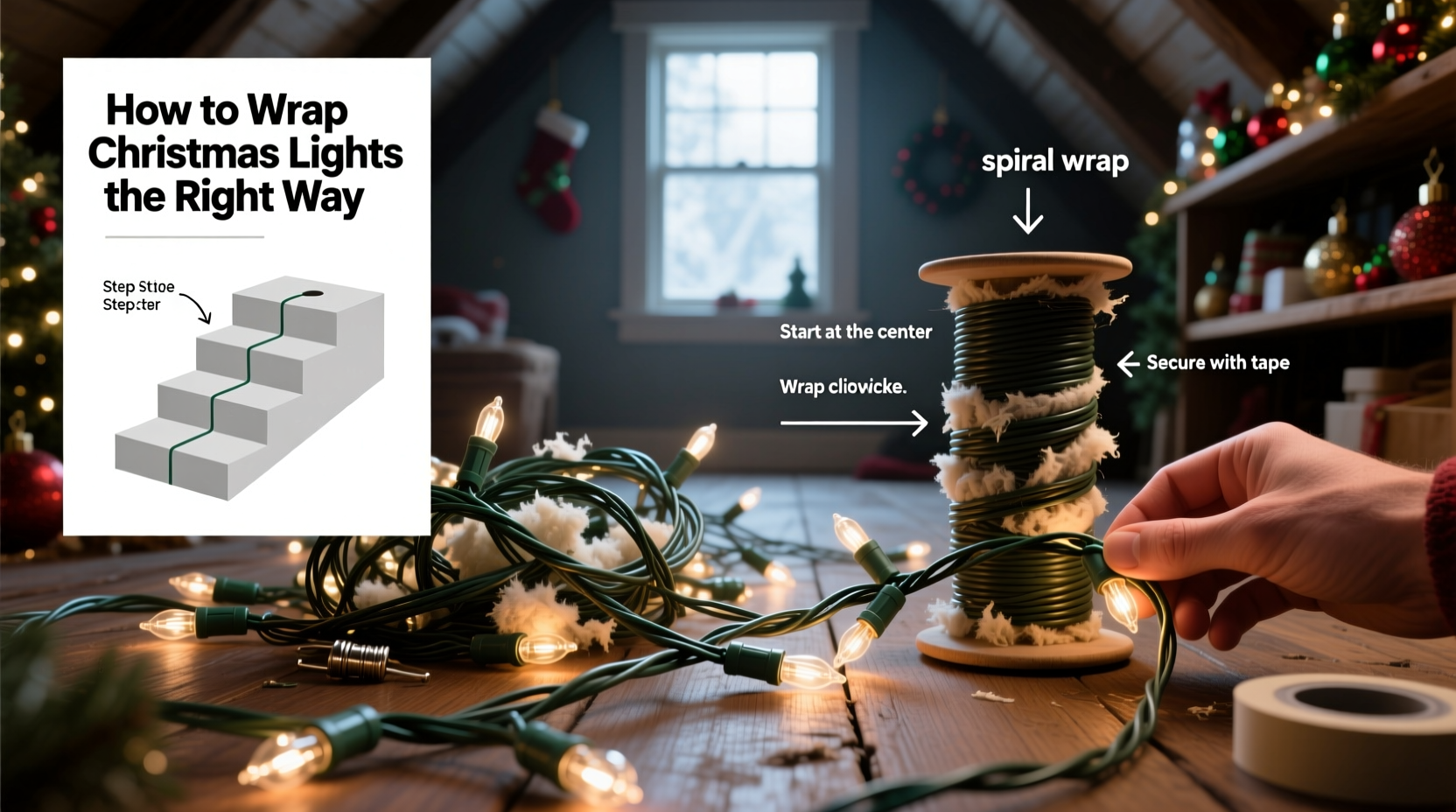
Tangling isn’t random—it follows predictable physical principles. In 2007, physicists Dorian Raymer and Douglas Smith conducted a study at the University of California, San Diego, where they dropped strings into a box and tumbled them. Within seconds, complex knots formed spontaneously. Their research concluded that any string longer than about 1.5 feet has a high probability of knotting when agitated or loosely coiled. Christmas light cords, typically ranging from 15 to 100 feet, fall squarely into this danger zone.
The primary factors contributing to tangling are:
- Length and flexibility: Long, thin, flexible cords easily twist and loop around themselves.
- Random motion during storage: Shifting boxes, temperature changes, and movement in storage cause micro-motions that encourage knot formation.
- Improper coiling methods: Overhand loops (the common “throw-it-on-a-hook” method) create twists with each wrap, leading to internal torsion and inevitable snarls.
Even if you carefully coil lights one year, improper storage or jostling over time can undo your work. The result? A chaotic web that feels like it was engineered by mischievous elves.
“Knots form rapidly in agitated strings due to the natural tendency of flexible linear objects to entangle. It’s not user error—it’s entropy.” — Dorian Raymer, PhD, Physicist and Co-author of *Spontaneous Knotting of an Agitated String*
Why Common Wrapping Methods Fail
Most people use one of two popular but flawed techniques: the hand-wrap method or the cardboard-reel method. While both seem logical, they have critical weaknesses.
Hand-Wrapping (Overhand Coiling)
This involves wrapping the cord around your hand and forearm, then securing it with a twist tie or rubber band. The problem? Each loop introduces a half-twist. After dozens of loops, these accumulate into full rotations along the cord. When unwrapped, the built-up torsion causes the wire to twist back on itself, creating kinks and tangles.
Cardboard Reels or DIY Spools
Some use cut cardboard or plastic reels to wind lights evenly. While better than hand-wrapping, this method still fails if the cord isn’t guided straight onto the reel. If the wire bends at an angle or overlaps haphazardly, friction points develop, increasing the chance of snagging and knotting during unspooling.
The Right Way to Wrap Christmas Lights: The Over-Under Method
The most effective technique for preventing tangles is the over-under method, also known as the figure-eight or alternating loop method. This approach cancels out twist with every other loop, preserving the cord’s natural lay and eliminating torque buildup.
Step-by-Step Guide: How to Use the Over-Under Method
- Start with the plug end: Hold the male plug in one hand. This ensures the heaviest part stays anchored and won’t dangle during wrapping.
- Create your first loop (over): With your other hand, bring the cord over your fingers to form a loop. Keep tension gentle but consistent.
- Alternate the second loop (under): For the next segment, instead of going over again, pass the cord under your fingers before forming the loop. This reverses the twist direction.
- Continue alternating: Repeat steps 2 and 3—over, under, over, under—until the entire strand is wrapped.
- Secure the bundle: Once complete, use soft fabric ties, Velcro straps, or a reusable zip-tie to fasten the coil. Avoid twist ties or anything that could pinch or damage insulation.
- Label if needed: Use a small tag to note color, length, or location (e.g., “Front Porch – Warm White”) for easier setup next year.
This method works because each “over” loop introduces a clockwise twist, while the “under” loop adds a counterclockwise twist. These cancel each other out, resulting in a neutral, twist-free coil that unrolls smoothly.
| Wrapping Method | Twist Accumulation | Tangle Risk | Time to Unwrap |
|---|---|---|---|
| Hand-wrap (overhand) | High | Very High | 10–25 minutes |
| Cardboard reel (straight feed) | Moderate | Medium | 5–10 minutes |
| Over-under method | Negligible | Low | 1–2 minutes |
| Pre-wound spool (commercial) | None | Very Low | Instant |
Better Storage Solutions for Long-Term Protection
Even perfect wrapping can be undone by poor storage conditions. To keep lights tangle-free year after year, pair the over-under method with smart storage practices.
Use Protective Containers
Store wrapped lights in rigid containers or specialized light savers—plastic reels with built-in winding guides. These prevent crushing, moisture exposure, and rodent damage. Clear bins allow quick visual identification without unpacking.
Avoid Heat and Humidity
Attics and garages may seem convenient, but extreme temperatures degrade wire insulation and solder joints. Moisture promotes corrosion, especially on older sets. Ideal storage is a climate-controlled closet or basement shelf inside a sealed bin.
Separate by Type and Use
Keep indoor and outdoor lights separate. Outdoor lights are thicker and more durable, while indoor strands are delicate. Mixing them increases abrasion risk. Also, store spare bulbs and connectors nearby in labeled bags.
Real Example: Sarah’s Holiday Transformation
Sarah, a homeowner in Vermont, used to spend nearly two full days each December untangling her extensive light collection. She had dozens of strands stored in old shoeboxes, wrapped haphazardly after last-minute post-holiday cleanup. One year, she decided to rewrap everything using the over-under method and invested in stackable plastic bins with dividers.
The difference was immediate. Her first test: unwrapping a 50-light strand meant for the roofline. Instead of fighting knots for 15 minutes, she unclipped the Velcro tie and laid the cord out in under 60 seconds—completely tangle-free. Over the next few years, she added labels and pre-checked each set before storage. Now, her entire display goes up in a single weekend, with time left over for hot cocoa and carols.
“It felt like a small change,” she said, “but it completely changed my relationship with holiday decorating. I actually look forward to it now.”
Checklist: How to Store Christmas Lights Properly
Follow this checklist every post-holiday season to ensure your lights stay pristine:
- ✔ Test all strands before storing—replace burned-out bulbs or faulty fuses.
- ✔ Clean off dust and debris with a dry cloth; avoid water unless manufacturer-approved.
- ✔ Use the over-under method to wrap each strand.
- ✔ Secure with soft ties—no metal twist ties or elastic bands.
- ✔ Label each set by location, color, and length.
- ✔ Store in sturdy, sealable containers away from heat and moisture.
- ✔ Keep spare bulbs, clips, and extension cords organized in a dedicated compartment.
Frequently Asked Questions
Can I use the over-under method on pre-lit trees or garlands?
Yes, but with caution. Pre-lit trees require careful branch compression and should be stored in a tree bag with support rings. For garlands, treat the wire core like a standalone strand and apply the over-under principle as you coil the length.
What if my lights are already tangled?
Begin at the plug end—the heaviest and most identifiable point. Gently trace the cord outward, loosening loops without pulling tightly. Use your fingers to open knots from the outside in. For severe tangles, lay the strand flat on a bed or table and work section by section. Patience prevents breakage.
Are there tools that help prevent tangling?
Yes. Commercial products like LightKeeper Pro reels, CordReel, or even DIY PVC spools with handles make winding faster and more consistent. Some include built-in testers and bulb replacers, adding extra value.
Expert Insight: What Professionals Do Differently
Professional decorators and event stylists rarely deal with tangled lights—not because they have magic skills, but because they follow strict protocols. Many use industrial-grade winding machines, but for home users, the principles remain the same: consistency, twist control, and protection.
“We treat every cord like a guitar cable—because once you introduce twist, you’re fighting physics. The over-under method is standard across our crew. It’s the only way to guarantee smooth deployment on tight timelines.” — Marcus Tran, Lead Lighting Technician, Holiday Display Co.
Tran’s team decorates over 200 homes each season. They report a 90% reduction in setup delays since standardizing wrapping procedures. Their rule: if it plugs in, it gets over-under wrapped—no exceptions.
Conclusion: Stop Fighting Knots—Start Preventing Them
The annual battle with tangled Christmas lights isn’t inevitable. It’s the result of outdated habits meeting immutable laws of physics. By understanding why cords tangle—and adopting a simple, proven wrapping technique—you reclaim time, reduce stress, and protect your investment.
The over-under method takes only slightly longer than traditional coiling, but the payoff lasts for years. Combine it with proper storage, and you’ll transform a frustrating chore into a seamless part of your holiday rhythm. No more yanking, cursing, or cutting knots with scissors. Just smooth, flowing strands ready to bring light to the darkest time of year.




 浙公网安备
33010002000092号
浙公网安备
33010002000092号 浙B2-20120091-4
Comments
No comments yet. Why don't you start the discussion?