
Every year, millions of households string up festive lights only to face the same frustrating mystery: one section goes dark while the rest stays lit—or worse, the entire strand fails with no obvious cause. The culprit is rarely faulty bulbs or tangled wires. More often than not, it’s a blown fuse—small, unassuming, and easily overlooked. Yet that tiny cylindrical component is a critical safety and performance safeguard built into most plug-in incandescent and some older LED light sets. Understanding why fuses exist, where to find them, and how to verify their integrity isn’t just about restoring holiday cheer—it’s about preventing overheating, electrical stress, and potential fire hazards.
The Engineering Logic Behind Fuses in Christmas Lights
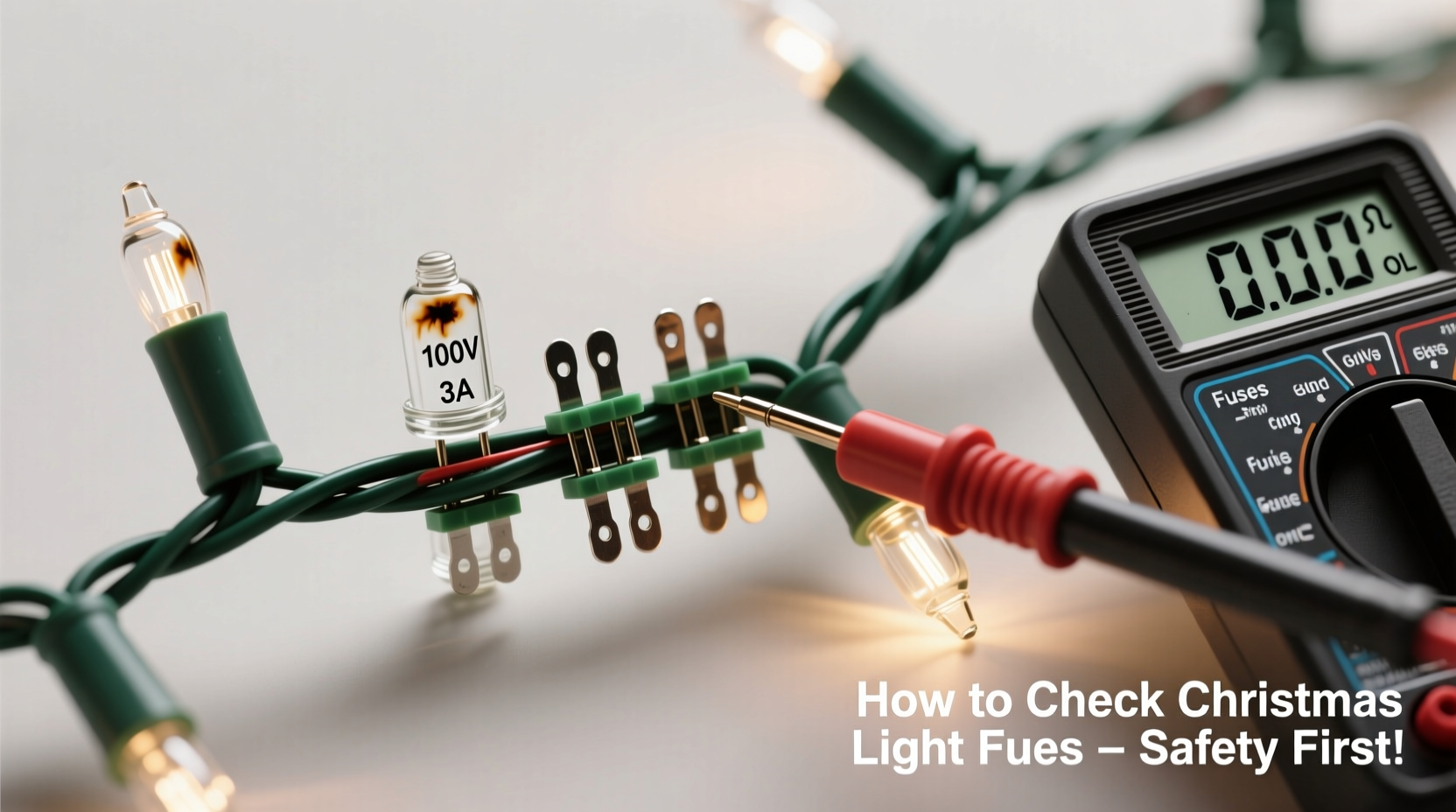
Christmas light strings—especially traditional incandescent ones—are wired in series or series-parallel configurations. In a basic series circuit, current flows through each bulb sequentially. If one bulb burns out or becomes loose, the circuit breaks and the whole strand goes dark. To avoid this, manufacturers use shunted bulbs (with internal bypass wires) and incorporate fuses at the plug end. These fuses act as deliberate weak links: they’re designed to melt and interrupt current flow before wiring insulation overheats, transformers overload, or damaged sockets spark.
Fuses protect against three primary risks:
- Overcurrent from short circuits—caused by frayed wires, moisture intrusion, or crushed insulation;
- Sustained overloading—when too many strands are daisy-chained beyond manufacturer specifications;
- Power surges—from lightning strikes, grid fluctuations, or faulty outlets.
Unlike circuit breakers in your home panel—which reset—the fuses in light plugs are single-use. Once they blow, they must be replaced. This design reflects a practical trade-off: simplicity, low cost, and reliability in an outdoor, seasonal product exposed to temperature swings, rain, dust, and physical handling.
Where Fuses Are Located—and Why Location Matters
Fuses sit inside the male plug—the part you insert into the wall outlet. On most standard 120V U.S. light sets, the plug has a small, removable rectangular or oval cover on its underside or side. Slide or pry it open gently with a flathead screwdriver or fingernail. Beneath lies a fuse holder containing one or two glass tube fuses, typically rated at 3A, 5A, or occasionally 7A depending on the strand’s wattage and length.
Why place them here? Because the plug is the first point of contact with household voltage. A fault downstream—say, a cracked socket near the base of your tree—creates backpressure on current flow. Without a fuse at the entry point, heat builds along the cord before reaching any other protective device. Placing it at the plug ensures immediate interruption at the source.
How to Identify and Test a Blown Fuse—Step-by-Step
Visual inspection is the fastest first step—but not always reliable. Here’s a precise, repeatable method:
- Unplug the strand completely—never test or handle fuses while connected to power.
- Locate and open the fuse compartment—use gentle pressure. Note whether your set uses one or two fuses (many have redundant pairs).
- Remove both fuses carefully—they’re fragile. Hold them up to a bright light: a blown fuse shows a visibly broken filament or darkened, charred glass.
- Use a multimeter for confirmation—set to continuity or lowest ohms setting. Touch one probe to each metal end cap. A functional fuse reads near 0Ω (or emits a beep); an open circuit (OL or no beep) confirms failure.
- Check for corrosion or discoloration—on the fuse holder’s metal contacts. Greenish residue or pitting indicates moisture exposure and may require cleaning with isopropyl alcohol and a cotton swab before reinserting new fuses.
This process takes under 90 seconds—and eliminates guesswork. Many people replace bulbs unnecessarily when the real issue is a $0.15 fuse.
Fuse Ratings, Compatibility, and Common Mistakes
Using the wrong fuse is dangerous. A higher-rated fuse (e.g., swapping a 3A for a 5A) allows excessive current to flow, risking melted wire insulation and fire. A lower-rated fuse (e.g., 1.5A in a 5A circuit) will blow repeatedly under normal load—frustrating and misleading.
| Fuse Rating | Typical Strand Type | Max Recommended Length per Strand | Risk of Mismatch |
|---|---|---|---|
| 3 Amp | Mini incandescent (100–150 bulbs) | 25–35 feet | Overheating if oversized; nuisance blowing if undersized |
| 5 Amp | Larger incandescent or C7/C9 sets | 50–100 feet | Fire hazard if replaced with >5A; frequent interruption if <5A |
| No fuse / Internal IC protection | Most modern LED sets with UL 2580 certification | Varies—check packaging | Fuses not user-replaceable; attempting replacement may void safety listing |
Always match the amperage and physical size (common: 1/4\" x 1-1/4\" or 5mm x 20mm). Never substitute automotive or appliance fuses unless explicitly cross-listed for lighting use. And never bypass a fuse with foil, wire, or tape—a practice still seen online despite being a leading cause of seasonal electrical fires, according to the U.S. Consumer Product Safety Commission (CPSC).
A Real-World Example: The Garage Light Cascade Failure
In December 2022, Mark R., a facilities manager in Ohio, reported a recurring issue: his warehouse’s outdoor perimeter lights—12 identical 100-light incandescent strands—would go dark every 3–4 days. Maintenance staff replaced dozens of bulbs and checked outlets, but the problem persisted. An electrician was called. Within five minutes, he opened the first plug’s fuse cover and found a blackened 3A fuse. He replaced it, tested continuity on the others, and discovered two more were borderline—showing high resistance due to repeated thermal cycling.
Further investigation revealed the root cause: all 12 strands were plugged into a single 15A circuit via multiple power strips, drawing ~1,440 watts—near the circuit’s safe continuous limit. Voltage drop and minor surges during HVAC cycling stressed the fuses. The fix wasn’t more bulbs or new cords—it was redistributing loads across three circuits and installing a dedicated GFCI-protected outlet for seasonal use. One fuse inspection prevented potential equipment damage and eliminated four hours of monthly troubleshooting.
Expert Insight: Safety Standards and Evolving Design
“Fuses in light plugs aren’t outdated—they’re a proven, fail-safe layer in a multi-tiered protection strategy. UL 588 mandates fuse inclusion for all plug-connected decorative lighting sold in North America unless the set uses Class 2 low-voltage power supplies. What’s changed is intelligence: newer LED sets use polymeric positive temperature coefficient (PPTC) resettable fuses or integrated current-limiting ICs. But for legacy and budget-friendly incandescents, the glass tube remains the gold standard for reliability and cost control.” — Dr. Lena Torres, Electrical Safety Engineer, Underwriters Laboratories (UL)
What to Do When You Find a Blown Fuse—Beyond Replacement
Replacing the fuse is necessary—but it’s only half the solution. A blown fuse signals an underlying condition. Before re-plugging, perform these checks:
- Inspect the entire cord for cuts, kinks, or chew marks (especially near pets or storage boxes);
- Examine each socket for bent contacts, melted plastic, or signs of arcing (tiny black specks);
- Verify daisy-chaining compliance—most incandescent sets allow only 3–5 strands linked; exceed that, and cumulative draw overwhelms the first fuse;
- Test the outlet with another device to rule out GFCI trips or tripped breakers;
- Check for moisture—if used outdoors, ensure connections are elevated and covered, and inspect for condensation inside the plug housing.
If fuses blow repeatedly—even after confirming correct rating and no visible damage—the strand likely has an internal short and should be retired. Continuing to replace fuses invites risk.
FAQ: Your Top Questions Answered
Can I use LED replacement bulbs in an incandescent string with fuses?
Yes—but with caveats. LED bulbs draw far less current, reducing thermal stress on fuses. However, non-shunted LED bulbs may prevent the circuit from completing in older series-wired sets, causing intermittent outages. Use only LED bulbs labeled “compatible with incandescent strings” and confirm the fuse rating still aligns with total wattage (e.g., 100 LEDs @ 0.5W = 50W ≈ 0.42A—well below a 3A fuse’s threshold).
Why do some light sets have two fuses?
Dual fuses provide redundancy. One protects the hot leg; the other guards the neutral. If either blows, the circuit opens. It also allows manufacturers to meet stricter UL requirements for fault tolerance. Always replace both—even if only one appears blown—as the companion fuse may be degraded.
Do battery-operated lights have fuses?
Rarely. Most use low-voltage DC (typically 3–6V) and current-limiting resistors instead. However, premium battery packs—especially those with USB-C input or rechargeable lithium cells—may include micro-fuses or PPTC devices for overcharge/overcurrent protection. These are not user-serviceable.
Conclusion: Treat Fuses Like the Safety Guardians They Are
A fuse in a Christmas light plug is neither an inconvenience nor a design flaw—it’s quiet, unglamorous engineering doing vital work. It represents decades of lessons learned from real-world failures, regulatory scrutiny, and fire investigations. Knowing how to locate it, test it accurately, and interpret what its failure means transforms you from a passive consumer into an informed steward of your holiday setup. That knowledge saves time, prevents hazards, and extends the life of your lights—not just this season, but for years to come. Don’t wait for the lights to go dark. This weekend, unplug every strand you’ll use, open each fuse cover, and verify integrity. Keep spare fuses rated exactly to spec in your ornament box. Share this practice with neighbors, family, and community groups—because holiday safety isn’t seasonal. It’s foundational.




 浙公网安备
33010002000092号
浙公网安备
33010002000092号 浙B2-20120091-4
Comments
No comments yet. Why don't you start the discussion?