
Every holiday season, millions of homes light up with strings of festive Christmas lights. But few frustrations rival coming home after a long day, plugging in the lights, and seeing only half the strand flicker to life. The other end remains stubbornly dark. This common issue isn’t random bad luck—it’s usually a symptom of an underlying electrical flaw in the circuit. Understanding why this happens and how to fix it can save time, money, and seasonal cheer.
Unlike modern LED strips or smart lighting systems, traditional incandescent Christmas lights are typically wired in series circuits. This design choice makes them cost-effective to produce but vulnerable to single-point failures. When one bulb burns out or becomes loose, the entire circuit downstream can go dark—especially on older strands where redundancy is minimal.
How Series Circuits Work in Christmas Lights
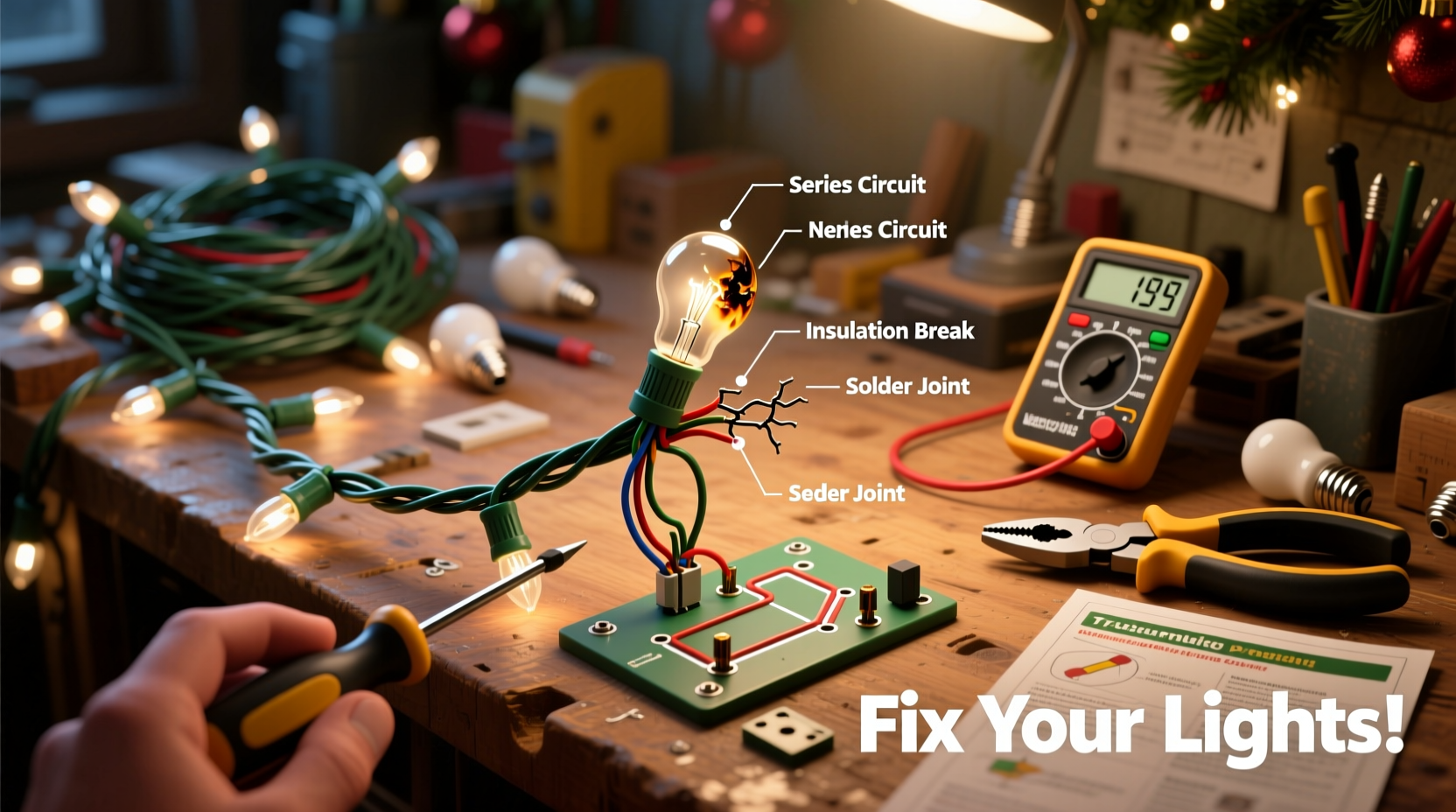
Most conventional Christmas light strands use a series circuit configuration. In this setup, electricity flows through each bulb in sequence, like a relay race where the baton must be passed from one runner to the next. If one runner drops the baton—or in this case, a bulb fails—the current stops, and all bulbs beyond that point won’t illuminate.
Each bulb acts as both a light source and a conductor. Inside the socket, two wires connect to a filament. When intact, the filament completes the path for electricity. When it breaks, the circuit opens, halting the flow. On many older light sets, especially those with 50 or 100 bulbs, this means failure at any point can black out an entire section.
Manufacturers have attempted to mitigate this issue with shunt wires—tiny conductive pathways inside the bulb that activate when the filament fails. In theory, the shunt bypasses the broken filament, allowing current to continue. However, shunts don’t always work reliably, especially if the bulb base corrodes or the shunt itself degrades over time.
Common Causes of Partial Failure in Light Strands
When only part of a Christmas light strand works, the cause is rarely a power supply issue. Instead, several recurring problems disrupt the circuit:
- Blown or loose bulb: A single faulty bulb can break the circuit, especially if it's not making proper contact in the socket.
- Loose socket connection: Vibration or improper insertion can cause a bulb to sit crooked, interrupting conductivity.
- Frayed or damaged wiring: Outdoor exposure, foot traffic, or rodent activity can compromise wire insulation and internal conductors.
- Corrosion in sockets: Moisture ingress leads to oxidation, particularly in outdoor sets stored improperly.
- Failed shunt: Even if a bulb burns out, a non-functional shunt won't reroute current, leaving downstream bulbs dark.
- Damaged plug or end connector: Many strands link together; a compromised male or female end can prevent full continuity.
These faults often cluster toward one end because the failed component lies upstream of the dark section. For example, if the 37th bulb in a 50-light string has a broken filament and no working shunt, lights 38 through 50 will remain off—even if they’re perfectly functional.
Step-by-Step Guide to Diagnose and Repair the Circuit
Fixing a partially dead strand requires patience and methodical testing. Follow this timeline to identify and resolve the fault efficiently.
- Unplug the strand immediately. Safety first—always disconnect before handling.
- Inspect visually. Look for cracked bulbs, discolored sockets, bent metal contacts, or chewed wires.
- Check connections between strands. If linking multiple sets, test each separately to isolate the faulty one.
- Use a light tester or multimeter. Insert a non-contact voltage tester into each socket starting from the live end. Alternatively, set a multimeter to continuity mode and check for breaks.
- Replace suspect bulbs one by one. Start with visibly damaged ones, then work through adjacent sockets. Use bulbs of matching voltage and wattage.
- Test after each replacement. Reconnect the strand briefly to see if the downstream section lights up.
- Examine the end plug and fuses. Some strands have replaceable fuses inside the male plug. Use a fuse tester or swap with a known good one.
- Re-seat all bulbs firmly. Even if they look seated, gently press each down to ensure contact.
If no individual bulb resolves the issue, the problem may lie in internal wiring or a complete break within the strand. In such cases, cutting out the damaged section and splicing may be necessary—but only if you're experienced with electrical repairs.
“Over 80% of partial strand failures I see stem from just one faulty bulb or poor socket contact. A $3 tester saves more than half the repair time.” — Mark Reynolds, Residential Electrician & Holiday Lighting Specialist
Do’s and Don’ts of Christmas Light Maintenance
| Action | Do | Don’t |
|---|---|---|
| Bulb Replacement | Use manufacturer-recommended bulbs with correct voltage (usually 2.5V) | Substitute with higher-wattage bulbs—this increases heat and risks fire |
| Storage | Coil loosely around a cardboard reel; store in a dry, temperature-stable area | Crush lights into tight bins—this damages filaments and wires |
| Testing | Plug in new or stored strands before installation to catch issues early | Leave faulty strands connected unattended—risk of overheating exists |
| Repair | Solder and insulate splice joints properly if repairing wire breaks | Use tape alone to join cut wires—this creates a fire hazard |
| Installation | Use insulated clips instead of nails or staples to avoid piercing wires | Run cords under rugs or across high-traffic areas where they can be damaged |
Real Example: Fixing a 75-Light Strand After Three Seasons
Consider Sarah, who decorates her porch annually with three strands of 75-bulb mini lights. Last year, one strand lit only the first 25 bulbs. She unplugged it, inspected visually, and found nothing obvious. Using a Christmas light tester, she discovered the 26th socket had no continuity. She removed the bulb—visibly intact—and tested it in a working socket. It lit fine. Back at the original socket, she noticed slight corrosion on the metal tab.
She cleaned the contact with a cotton swab dipped in isopropyl alcohol, reinserted the bulb, and plugged in the strand. The entire string lit up. The root cause wasn’t a dead bulb but degraded conductivity due to moisture exposure over multiple winters. A five-minute cleaning restored full function, avoiding the need to buy a replacement.
This scenario illustrates that sometimes, the issue isn’t component failure but environmental wear. Regular maintenance can extend strand life significantly.
Preventive Strategies for Long-Term Reliability
Prevention is far more efficient than repair. Taking proactive steps ensures your lights perform consistently year after year.
- Label and organize by location. Keep indoor and outdoor sets separate. Outdoor lights are built to withstand weather; using indoor-only sets outside accelerates failure.
- Invest in LED mini lights. Modern LED strands often use parallel-wired segments or built-in redundancies. Even if one bulb fails, others stay lit. They also consume less power and generate less heat.
- Use a surge-protected timer. Voltage spikes during storms or grid fluctuations can damage delicate filaments. A quality timer reduces risk.
- Retire old strands proactively. Incandescent strands older than 5–7 years show increased failure rates. Consider upgrading to newer, safer models.
- Keep spare bulbs and fuses on hand. Most light packages include extras. Store them in a labeled bag taped to the storage container.
Additionally, consider modular lighting systems that allow segment replacement rather than discarding an entire string. Some brands now offer “sectional” designs where a failed segment can be unplugged and swapped without tools.
FAQ
Why do only half my Christmas lights work?
This usually happens because of a broken filament in a series-wired strand, where the failure interrupts current to downstream bulbs. It could also result from a loose bulb, corroded socket, or damaged wire in the middle of the strand.
Can I fix a dead section without replacing the whole string?
Yes, if the issue is a single bulb or socket, replacing or cleaning it often restores function. For severed wires, you can splice and insulate the connection—if done safely and correctly. Otherwise, cutting out the dead section and reconnecting may work for decorative purposes, though it shortens the strand.
Are there Christmas lights that don’t go out when one bulb fails?
Yes. Many modern LED strings use shunted sockets or parallel circuitry so that one failed bulb doesn’t affect others. Look for labels like “StayLit” or “LightKeeper Pro compatible,” which indicate enhanced fault tolerance.
Conclusion: Take Control of Your Holiday Lighting
A darkened end on a Christmas light strand doesn’t mean the season is ruined. With basic knowledge of series circuits and simple troubleshooting techniques, most failures can be diagnosed and repaired in under an hour. The key is understanding that these lights are interconnected systems—each bulb plays a role in maintaining the flow of electricity.
By adopting preventive habits—like annual inspection, proper storage, and using reliable testers—you reduce frustration and extend the lifespan of your decorations. Upgrading to LED or modular systems offers even greater resilience, but even traditional lights can serve well with care.




 浙公网安备
33010002000092号
浙公网安备
33010002000092号 浙B2-20120091-4
Comments
No comments yet. Why don't you start the discussion?