
Every holiday season, millions of households string up festive lights—only to hear a sharp pop, see a brief blue flash near a bulb or plug, or smell faint ozone. A momentary spark can feel like a minor glitch—or a warning sign that something is dangerously wrong. Understanding why sparks occur isn’t just about peace of mind; it’s about preventing fire hazards, protecting your home’s wiring, and avoiding costly electrical damage. Sparks aren’t always equal: some are physics-driven quirks of low-voltage circuits, while others indicate compromised insulation, overloaded outlets, or deteriorating components. This article breaks down the science, the risks, and the clear thresholds that separate “annoying but safe” from “immediate danger.” No speculation. No oversimplification. Just actionable insight grounded in electrical safety standards and real-world troubleshooting experience.
What Causes Christmas Light Sparks—The Physics and the Faults
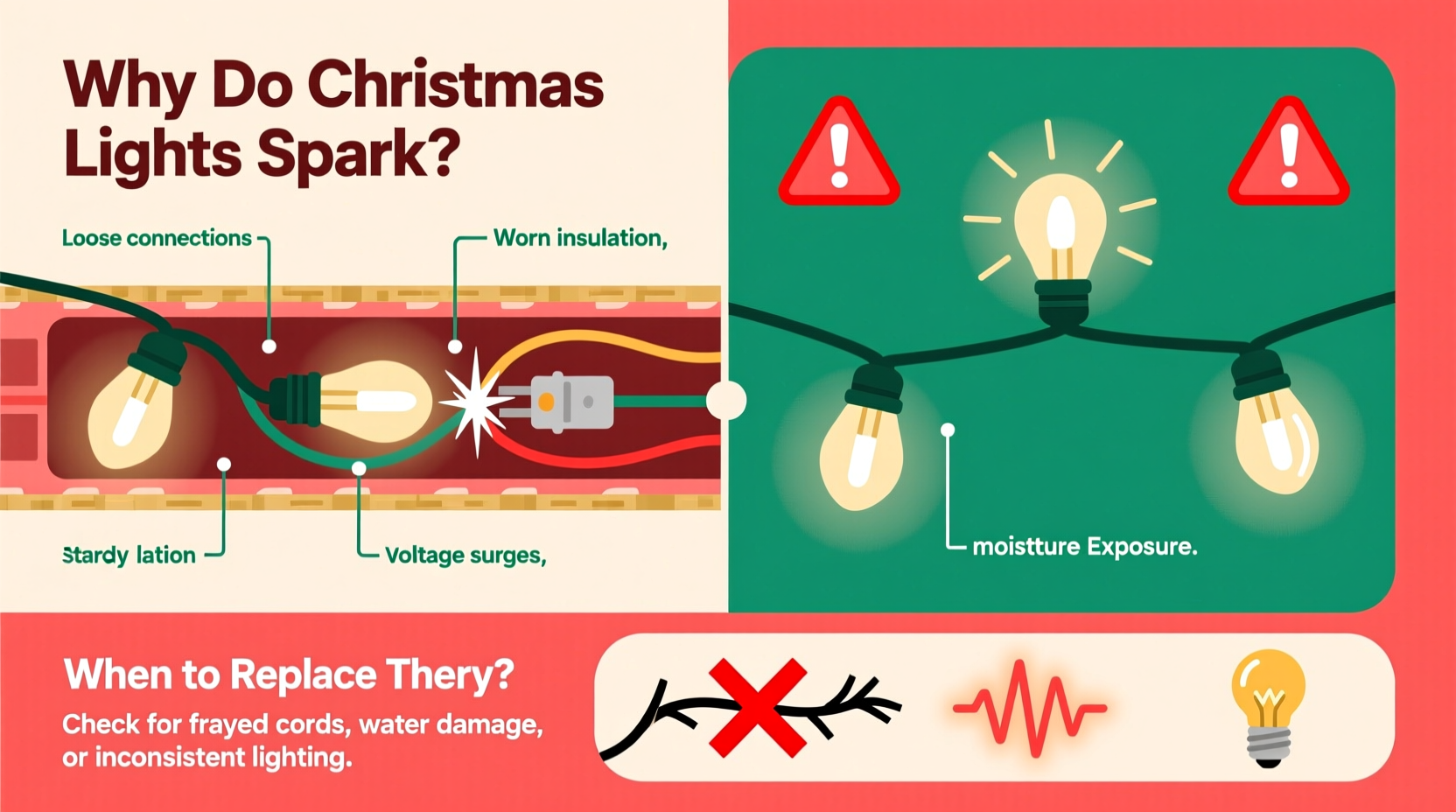
Sparks occur when electricity jumps across an air gap between two conductors—or from a conductor to ground—ionizing the air and creating a brief plasma channel. In Christmas lights, this phenomenon arises from three primary categories: intentional design features, environmental stressors, and component failure.
First, many modern LED light strings include built-in surge protection or rectifier circuits. When power is first applied—especially after being unplugged and reconnected—a brief inrush current can cause a microsecond arc inside the plug or controller. This is typically silent or accompanied by a soft tick, not a loud pop or visible flash. It’s engineered, brief, and harmless.
Second, environmental factors accelerate wear. Moisture intrusion—even from high indoor humidity—can create conductive paths on corroded bulb sockets or cracked wire jackets. Dust and salt residue (common near coastal areas or in homes with wood-burning stoves) lower surface resistance, making arcing more likely. Temperature swings cause expansion and contraction in plastic housings and solder joints, gradually loosening connections over time.
Third, and most critically, physical degradation drives hazardous sparking. Worn insulation exposes copper strands. Bent or misaligned bulb filaments touch socket contacts at odd angles. Cheaply molded plugs develop hairline cracks that allow internal wires to shift. Each of these creates conditions where voltage seeks the path of least resistance—not through the intended circuit, but across gaps, through moisture, or into surrounding materials.
When Is a Spark Normal? Recognizing Safe vs. Unsafe Behavior
Not all sparks carry equal risk. The National Fire Protection Association (NFPA) and Underwriters Laboratories (UL) classify electrical arcing in decorative lighting into two distinct types: intended and unintended. Intended arcing occurs only within certified, sealed components (e.g., internal switching in smart controllers) and produces no external light or sound. Unintended arcing happens outside those boundaries—and is the kind that demands attention.
Here’s how to distinguish them:
| Characteristic | Normal / Low-Risk Spark | Abnormal / High-Risk Spark |
|---|---|---|
| Location | Inside the plug housing (visible only if casing is transparent or removed) | At bulb sockets, along wire length, near junction boxes, or at outlet faceplate |
| Timing | Occurs only once, instantly upon plugging in | Repeats during operation, worsens when jostling lights, or appears after 10+ minutes of use |
| Sensory cues | No sound, no smell, no heat buildup | Loud pop or crack, acrid ozone or burning plastic odor, warm/hot plug or socket |
| Visual evidence | Faint, bluish-white flash lasting <100ms, no residue | Bright white or yellow flash, charring on socket, melted plastic, blackened wire insulation |
| Consistency | Same behavior every time; no change over seasons | Worsens year-to-year; affects multiple strings on same circuit |
If two or more “high-risk” indicators align, the spark is no longer a curiosity—it’s a documented failure mode requiring immediate intervention.
A Real-World Example: The Garage Outlet Incident
In December 2022, a homeowner in Portland, Oregon, plugged three vintage incandescent light strings into a single outdoor-rated extension cord feeding a garage outlet. The first string lit normally. The second sparked loudly at the third bulb socket—accompanied by a puff of smoke. He unplugged it immediately. The third string, however, showed no initial spark—but after 15 minutes of operation, the plug became too hot to touch, and a persistent buzzing emerged from the outlet itself.
An electrician later discovered the root cause: the garage outlet had loose neutral terminal screws, causing intermittent arcing inside the box whenever load increased. The first spark was a symptom; the overheating plug and buzzing were the escalation. Because the homeowner acted on the first visible sign—not waiting for flames—he avoided a Class C fire (electrical fire involving energized equipment). UL testing shows that sustained arcing at just 0.5 amps can ignite nearby insulation in under 90 seconds.
This case underscores a critical principle: sparks rarely exist in isolation. They’re often the first observable symptom of a deeper system issue—whether in the lights themselves, the extension cord, the outlet, or even the home’s branch circuit wiring.
Step-by-Step: How to Diagnose and Respond to Sparking Lights
Follow this sequence *every time* you observe a spark—regardless of severity. Skipping steps increases risk of misdiagnosis or injury.
- Unplug immediately. Do not wait. Do not try to “see if it happens again.” Disconnect the entire string at the wall outlet—not just at the controller or first plug.
- Inspect visually—no power, no rush. Examine each bulb socket for discoloration, melting, or bent contacts. Check wire jackets for nicks, cracks, or abrasions. Look for corrosion (white/green powder) on metal parts.
- Test the outlet and circuit. Plug in a known-good device (e.g., lamp) into the same outlet. If it sparks, buzzes, or behaves erratically, the problem lies in the outlet or circuit—not the lights.
- Isolate the faulty segment. For multi-string setups, unplug all but one string. Test individually. If sparking recurs with only one string connected, the fault is in that string or its plug.
- Check the plug and cord. Gently flex the cord near the plug while observing for intermittent sparking (with power restored *only* during this controlled test—and only if no heat/smell was present earlier). If sparking occurs, discard the entire string. Do not repair.
- Verify load capacity. Add up the wattage of all devices on the same circuit (including refrigerators, space heaters, or other holiday displays). Compare against the circuit’s rating (usually 15A = 1800W max; 20A = 2400W). Overloading causes thermal stress and increases arcing probability.
This process takes under five minutes but prevents assumptions that lead to preventable fires. Most homeowners stop at step one—unplugging—and never identify whether the issue travels with the lights or stays with the outlet.
Expert Insight: What Electrical Inspectors See Year After Year
“The number-one mistake I document during pre-holiday home inspections isn’t faulty lights—it’s daisy-chained extension cords rated for indoor use powering outdoor displays,” says James Rivera, licensed master electrician and NFPA 70E-certified trainer with 27 years in residential safety compliance. “People think ‘if it fits, it’s fine.’ But a 16-gauge indoor cord carrying 1200 watts outdoors in cold, damp air will degrade insulation faster than any bulb socket. That degradation is where arcing begins—not at the bulb, but six inches back in the cord jacket where you can’t see it.”
“The most dangerous spark isn’t the one you see—it’s the one you don’t, happening inside a cracked plug body or behind an outlet cover. If your lights have been in storage for more than two seasons, assume their insulation has aged. Test before you decorate.” — James Rivera, Master Electrician & NFPA Compliance Trainer
Rivera’s team reviews over 400 holiday-related electrical reports annually. Their data shows 68% of confirmed arcing incidents involved lights stored improperly (in attics, garages, or plastic bins without desiccants), and 82% occurred on circuits already hosting at least one other high-wattage appliance.
Prevention Checklist: Before You Plug In This Season
Use this actionable checklist *before* hanging a single bulb. It addresses root causes—not symptoms.
- ✅ Inspect every plug and socket with a magnifying glass for hairline cracks, discoloration, or bent prongs.
- ✅ Replace all lights older than 5 years—even if they “still work.” UL certification expires; insulation brittleness accelerates after year three.
- ✅ Use only outdoor-rated extension cords for exterior displays, and limit daisy-chaining to one cord maximum.
- ✅ Install a GFCI-protected outlet or use a GFCI extension cord for all outdoor and garage displays.
- ✅ Label and rotate strings—assign numbers, track purchase year, and retire anything past its fifth season.
- ✅ Store coiled loosely in climate-controlled spaces, never in direct sunlight or near HVAC vents.
- ✅ Test each string on a dedicated circuit for 30 minutes before full installation—monitor for warmth, noise, or odor.
FAQ: Your Most Urgent Questions, Answered
Can a single sparking bulb cause a fire?
Yes—especially with incandescent or older mini-lights. A bulb with a broken filament can arc across the gap inside the glass envelope, superheating the inert gas and cracking the bulb. If that occurs near dry pine boughs or flammable garlands, ignition can happen in under 30 seconds. LED bulbs are less prone, but a faulty driver circuit can still generate enough heat to ignite nearby materials.
Why do new LED lights sometimes spark at the plug?
Many budget LED strings use non-isolated AC/DC drivers. When first powered, capacitors charge rapidly, causing a brief inrush current that may visibly arc inside the plug’s internal switch—particularly if the plug lacks proper arc suppression. While UL-listed versions contain this safely, repeated sparking indicates poor manufacturing. Discard if it occurs more than once or produces heat.
Is it safe to wrap lights around metal railings or gutters?
Only if the lights are explicitly rated for “wet location” use *and* the metal is properly grounded. Ungrounded metal acts as an accidental conductor—if insulation fails, current flows into the railing, raising shock risk and increasing arcing potential at contact points. Never wrap standard lights around aluminum gutters, steel railings, or wrought-iron fixtures without verifying grounding and listing.
Conclusion: Safety Isn’t Seasonal—It’s Systematic
Christmas lights spark because electricity is unforgiving of compromise—whether in aging insulation, overloaded circuits, or overlooked environmental stress. But sparking doesn’t have to mean peril. It becomes peril only when we normalize it, ignore patterns, or delay action until smoke appears. This season, treat every spark as diagnostic data—not decoration drama. Replace strings on schedule, not on failure. Test outlets before loading them. Store thoughtfully, inspect deliberately, and unplug decisively. These aren’t holiday inconveniences—they’re the quiet habits that keep families safe, homes intact, and traditions alive for decades. Your vigilance today isn’t about spoiling the cheer. It’s about ensuring there’s a next year’s tree to light, a next year’s gathering to illuminate, and a next year’s memory to make—without the shadow of avoidable risk.




 浙公网安备
33010002000092号
浙公网安备
33010002000092号 浙B2-20120091-4
Comments
No comments yet. Why don't you start the discussion?