
That brief blue flash, the sharp pop, the faint ozone smell—many of us have experienced it: Christmas lights sparking the moment they’re plugged into an outlet. For decades, this has been dismissed as “just how they are,” especially with older incandescent strings. But as LED technology dominates the market and home electrical systems age, understanding what that spark means—and whether it signals danger—is no longer optional. It’s essential. This isn’t about holiday superstition or seasonal anxiety. It’s about recognizing the subtle language of electricity: when it’s behaving normally, and when it’s issuing a quiet, urgent warning.
The Physics Behind the Spark: Why It Happens (and Why It’s Often Normal)
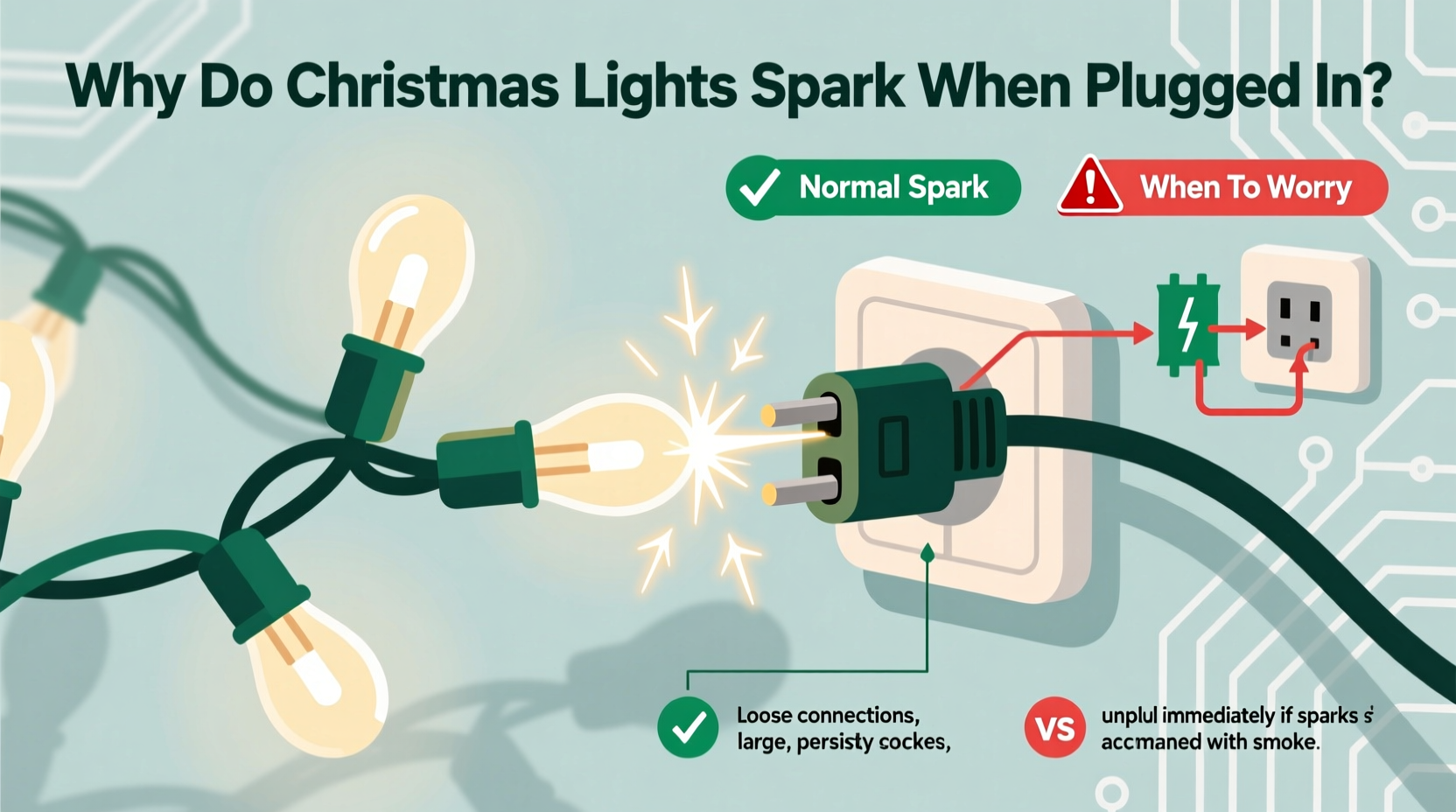
A spark at plug-in is technically an *electric arc*—a sudden, brief discharge of current across a small air gap between two conductors. In the case of Christmas lights, it most commonly occurs between the prongs of the plug and the metal contacts inside the receptacle just as connection is made or broken. This phenomenon is called *inrush current arcing*, and it’s rooted in basic electrical principles.
When you insert a plug, the final millimeter of contact happens unevenly. One prong may touch before the other—or microscopically rough surfaces make contact at only a few points. At that instant, resistance spikes, voltage concentrates, and if the load demands significant initial current (like dozens of cold filaments or capacitors charging), electrons can literally jump the tiny remaining air gap. That jump ionizes the air, creating a visible spark and audible snap.
This is especially pronounced with older incandescent light strings. Each bulb contains a tungsten filament that, when cold, has far lower resistance than when hot. The resulting surge—up to 10× the steady-state current—triggers arcing. Modern LED strings include internal driver circuits with capacitors that also draw a brief, high inrush current during startup. So even energy-efficient lights aren’t immune.
Critical nuance: A single, brief (<100ms), blue-white spark occurring *only at the exact moment of insertion*—with no sizzling, no sustained glow, no heat buildup, and no repeated sparking on the same outlet—is almost always benign. It’s physics, not pathology.
When Sparking Crosses the Line: 5 Red Flags That Demand Immediate Action
Not all sparks are created equal. What begins as normal arcing can escalate into evidence of serious, potentially hazardous conditions. Here’s how to distinguish routine behavior from real risk:
- Sustained or Repeated Arcing: If the spark lingers longer than a fraction of a second, flickers repeatedly while the lights are on, or occurs every time you wiggle the plug or cord near the outlet, it indicates poor contact—either from worn-out plug prongs, corroded socket contacts, or loose internal wiring.
- Orange, Yellow, or White-Orange Sparks: Blue-white is typical for clean, brief arcs. Orange or yellow hues suggest higher temperatures and possible burning insulation, overheated metal, or carbon tracking—a dangerous precursor to fire.
- Accompanying Heat, Smell, or Sound: Any warmth radiating from the plug, outlet faceplate, or cord junction; a distinct acrid, fishy, or burning plastic odor; or a persistent buzzing, sizzling, or crackling sound means active degradation is underway.
- Sparking at Multiple Points: If you see arcing not just at the wall outlet but also at a light string’s male/female connector, at a damaged section of cord, or inside a controller box, it confirms compromised insulation or conductor integrity.
- Outlet or Plug Damage: Visible scorch marks, melted plastic around the outlet slots, discolored or warped plug housings, or bent/burnt prongs are non-negotiable red flags. These components must be replaced—not repaired with tape or glue.
Root Causes: From Simple to Serious
Understanding the underlying cause helps determine urgency and next steps. Below is a breakdown of common triggers, ranked by severity and likelihood:
| Cause | Typical Signs | Risk Level | Action Required |
|---|---|---|---|
| Cold filament inrush (incandescent) | Single blue spark only at plug-in; no heat/smell; works normally afterward | Low | None—monitor for changes |
| Capacitor charging (LED strings) | Faint, quick blue spark; may occur with controllers or timers | Low–Moderate | Ensure lights are UL-listed; avoid daisy-chaining >3 strings |
| Loose/worn outlet contacts | Spark only in one specific outlet; other devices spark there too; outlet feels warm | Moderate–High | Replace outlet (by licensed electrician); don’t overload circuit |
| Damaged cord or connector | Spark localized to a kink, cut, or frayed section; visible wire exposure; intermittent operation | High | Retire lights immediately; do not repair with tape or solder |
| Moisture intrusion | Spark accompanied by hissing; occurs outdoors or in damp basements; white powder residue on plugs | High | Unplug, dry thoroughly, inspect for corrosion; replace if compromised |
| Overloaded circuit | Sparking coincides with other appliances turning on; breaker trips frequently; outlets warm to touch | High–Critical | Reduce load; consult electrician to assess circuit capacity and wiring |
A Real-World Example: When “Normal” Became a Near-Miss
In December 2022, Sarah M., a teacher in Portland, Oregon, noticed her vintage 1990s incandescent light string sparked slightly each time she plugged it into her living room outlet. She’d heard “it’s just the bulbs” and didn’t think twice—until the third night, when the spark lasted nearly half a second, emitted a sharp “crack,” and left a faint burnt-plastic smell. She unplugged it instantly. The next morning, she inspected the outlet: the brass contacts were visibly pitted and discolored, and the plastic faceplate had subtle brown streaks radiating from the slots. She called an electrician, who confirmed severe contact erosion and replaced the outlet. He also tested the circuit and discovered the home’s 1950s-era aluminum wiring was undersized for modern loads. Two weeks later, a neighbor’s identical outlet—ignored for years—caught fire after a similar spark escalated. Sarah’s attention to that one extra second of arcing likely prevented a hazard in her own home.
Step-by-Step: Safe Troubleshooting & Prevention Plan
If you observe sparking, follow this sequence—never skip steps or assume the lowest-risk cause applies:
- Unplug Immediately: Do not attempt to “test again.” Remove the light string from power completely.
- Inspect the Plug & Cord: Examine every inch for cuts, abrasions, exposed wires, melted sections, or bent prongs. Hold the plug up to light; look for dark spots or warping.
- Test the Outlet Independently: Plug in a known-good device (e.g., lamp, phone charger). Does it spark? If yes, the issue is the outlet—not the lights.
- Check Environmental Factors: Are lights damp? Is the outlet near a sink or window? Was the string stored in a humid garage? Dry thoroughly before retesting—if appropriate.
- Verify Compatibility & Load: Count total watts of all connected strings. Compare to outlet’s circuit rating (typically 15A = 1800W max; 20A = 2400W). Subtract other loads on the same circuit (refrigerator, TV, etc.).
- Perform a Controlled Test (Only If All Above Pass): Plug lights into a different, known-safe outlet—preferably on another circuit. Observe closely. If sparking repeats *only* with these lights, retire them. If it repeats *only* in that original outlet, replace the outlet.
“Arcing at plug-in isn’t inherently dangerous—but it’s nature’s way of highlighting a point of weakness. Ignoring it is like ignoring a cough that won’t go away. Most cases are simple fixes, but the ones that aren’t demand immediate intervention.” — James R. Delaney, P.E., Senior Electrical Safety Engineer, National Fire Protection Association (NFPA)
FAQ: Your Top Concerns Answered
Can I fix a sparking light string myself?
No. Splicing, soldering, or taping damaged cords or connectors violates UL safety standards and creates unpredictable failure points. Even “minor” damage compromises insulation integrity. Replacement is the only safe option. For vintage or sentimental strings, consult a certified lighting restoration specialist—not a general handyman.
Why do new LED lights sometimes spark more than old ones?
Counterintuitively, many budget LED strings use cheaper driver circuits with less sophisticated inrush current limiting. They may also lack proper surge suppression, making them more prone to brief, visible arcing during capacitor charge. Look for strings certified to UL 588 (U.S.) or EN 60598 (EU) and labeled “low inrush” or “soft-start.” Avoid no-name brands sold exclusively online without verifiable certification marks.
Is it safe to use extension cords with Christmas lights?
Yes—but only if the cord is rated for outdoor use (if used outside), is 14-gauge or thicker (not 16- or 18-gauge), and is fully unwound during operation. Coiling a loaded extension cord traps heat, accelerating insulation breakdown and increasing arc risk. Always plug the light string into the cord—not the cord into the lights—to minimize strain on the light’s built-in plug.
Prevention Checklist: Before You Hang a Single Bulb
- ✅ Test every outlet with a simple nightlight or lamp before plugging in lights.
- ✅ Inspect every light string for damage—even if stored carefully last year. Cords degrade with time and temperature swings.
- ✅ Use a dedicated circuit for major light displays. Avoid sharing with refrigerators, space heaters, or microwaves.
- ✅ Install AFCI (Arc-Fault Circuit Interrupter) breakers if your panel supports them. These detect dangerous arcing patterns and cut power faster than standard breakers.
- ✅ Label outlets used for seasonal lighting so you know their load history and condition year after year.
Conclusion: Respect the Spark—Don’t Ignore It
A spark is electricity’s punctuation mark—it ends one state and begins another. When it appears with Christmas lights, it’s rarely random. It’s feedback: from aging infrastructure, from material fatigue, from overlooked moisture, or from simple physics asserting itself. Dismissing it as “just holiday magic” risks confusing wonder with warning. But neither should you panic at the first blue flash. Knowledge transforms ambiguity into agency. Now you know the difference between a harmless inrush event and the early tremor of a system failure. You know where to look, what to listen for, and exactly when to walk away and call a professional. Holiday lights should evoke joy, nostalgia, and warmth—not anxiety or uncertainty. That peace of mind starts with paying attention to the smallest details: the color of the spark, the scent in the air, the temperature of the plug. Don’t wait for smoke to validate your concern. Act on the spark itself.




 浙公网安备
33010002000092号
浙公网安备
33010002000092号 浙B2-20120091-4
Comments
No comments yet. Why don't you start the discussion?