
Every holiday season begins the same way: you pull out last year’s Christmas lights, full of festive anticipation—only to find them knotted beyond recognition. Untangling strands becomes a frustrating ritual, eating up time and patience before the decorations even go up. But this doesn’t have to be your December tradition. The truth is, tangled lights aren’t bad luck—they’re physics, poor storage habits, and predictable chaos at work. The good news? With a little understanding and the right techniques, you can prevent tangles for good.
The Science Behind the Snarl
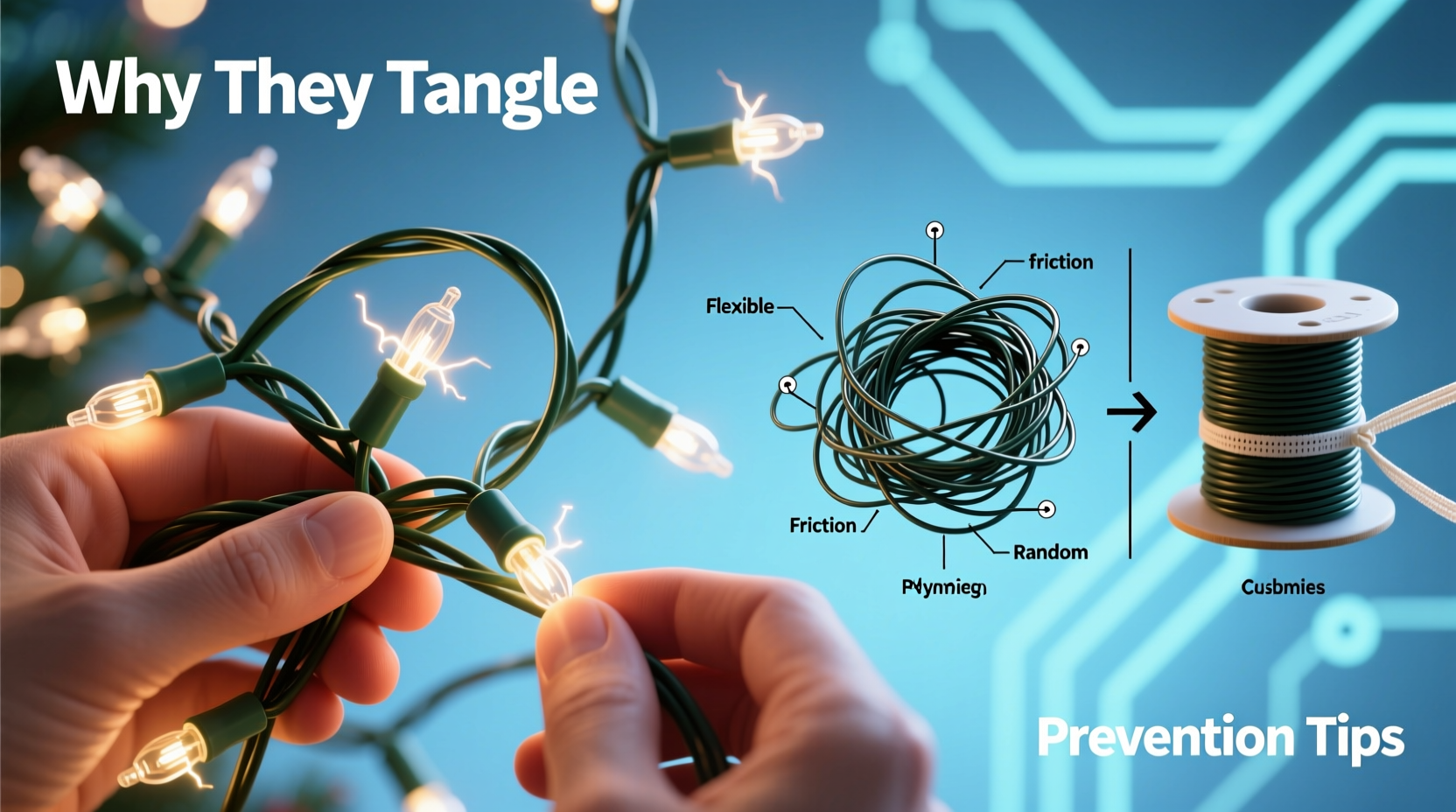
Christmas lights tangle not because of carelessness alone, but due to fundamental principles in physics and probability. When flexible, elongated objects like wires are placed in confined spaces and subjected to motion—like being tossed into a box or shifted on a shelf—they naturally form knots. This phenomenon has been studied extensively. In fact, researchers at the University of California, San Diego conducted experiments showing that even short lengths of string will spontaneously knot themselves when agitated.
The longer and more flexible the strand, the higher the chance of tangling. Christmas lights, often ranging from 25 to 100 feet, are prime candidates. Each twist, bend, and loop increases entropy—the natural progression toward disorder. Once a single loop forms, nearby segments can slip through it during movement, creating overhand or figure-eight knots within seconds.
“Any string-like object longer than about two feet, when jostled randomly, has a surprisingly high probability of forming knots.” — Dorian M. Raymer, co-author of the 2007 study *Spontaneous Knotting of an Agitated String*, published in PNAS.
This isn’t just anecdotal; it’s mathematical. The number of possible knot configurations grows exponentially with length. A 50-light strand may seem simple, but with dozens of connection points and bends, the potential for complex snarls is enormous.
Why We Keep Repeating the Mistake
Despite annual frustration, most people repeat the same storage errors:
- Wrapping lights haphazardly around cardboard or arms
- Stuffing multiple strands into one bin
- Using tight rubber bands or twist ties that cut insulation
- Storing lights while still warm or damp
These habits accelerate wear and increase tangle risk. Even if lights appear neatly wrapped when stored, shifting during transport or stacking boxes introduces motion—enough to trigger spontaneous knotting. Add in multiple strands touching each other, and cross-wire entanglement becomes inevitable.
Step-by-Step Guide to Tangle-Free Storage
Preventing tangles isn’t magic—it’s method. Follow this six-step process every time you take down your lights, and you’ll save hours next season.
- Unplug and Cool Down: Wait at least 30 minutes after turning off the lights before handling. Warm wires are more pliable and prone to kinks.
- Inspect Each Strand: Check for broken bulbs, frayed wires, or corrosion. Replace faulty sections now to avoid mid-season failures.
- Straighten Gently: Lay the strand flat on the floor or table. Run your hands along its length to remove small twists and loops.
- Use the Over-Under Coiling Method: Instead of consistently looping in one direction, alternate: one loop over your fingers, the next under. This cancels twist buildup.
- Secure with Soft Fasteners: Use fabric twist ties, Velcro straps, or soft ribbon—never metal or elastic bands that degrade plastic coatings.
- Store Individually in Rigid Containers: Place each coiled strand in a dedicated compartment—like a sectioned storage box or PVC pipe casing—to prevent contact with others.
This routine takes only slightly longer than careless wrapping, but the payoff is immediate: lights that unroll smoothly, bulb after bulb, without a single knot.
Best Storage Tools and Methods Compared
Not all storage solutions are equal. Below is a comparison of common methods based on effectiveness, cost, and ease of use.
| Method | Tangle Prevention | Durability | Cost | Space Efficiency |
|---|---|---|---|---|
| Cardboard Reels | Low-Medium | Low (warp over time) | $ | Medium |
| Plastic Storage Reels | High | High | $$ | High |
| PVC Pipe Sections | Very High | Very High | $$ | Medium |
| Zippered Light Bags | Medium | Medium | $$ | High |
| DIY Toilet Paper Roll Wrap | Low | Low | $ | Low |
| Over-Under + Box Compartment | Very High | High | $ | Medium |
For long-term reliability, plastic reels or PVC pipes offer the best protection. However, budget-conscious users can achieve excellent results using the over-under method combined with labeled compartments in a sturdy plastic tote.
Real Example: How One Family Solved Their Lighting Nightmare
The Thompsons of Portland, Oregon, had spent nearly eight hours untangling lights over three Christmases. Their collection included 14 strands of various lengths, all dumped into two large bins. Every November, their children groaned at the “light day” chore.
In 2022, they implemented a new system: each strand was coiled using the over-under technique, secured with Velcro straps, and stored in labeled, compartmentalized plastic drawers. They also color-coded strands by location (e.g., red for roof, green for tree). Last year, setup took less than 45 minutes—no cutting, no cussing, no scissors needed to free a jammed loop.
“It felt like we got our holidays back,” said Sarah Thompson. “We used to dread pulling out the decorations. Now it’s actually fun.”
Checklist: Tangle-Free Holiday Lighting Plan
Use this checklist annually to ensure your lights stay neat, functional, and ready to shine.
- ☐ Unplug and cool lights before handling
- ☐ Test each strand for working bulbs and damage
- ☐ Straighten fully before coiling
- ☐ Use over-under coiling method (not continuous loops)
- ☐ Secure with soft, non-abrasive ties
- ☐ Store each strand separately
- ☐ Label containers by location or color code
- ☐ Store upright in a dry, temperature-stable area
- ☐ Avoid stacking heavy items on light boxes
- ☐ Review and refresh storage method each year
Expert Tips for Long-Term Wire Management
Beyond seasonal storage, consider these advanced strategies to extend the life of your lights and eliminate tangles permanently.
If you use extension cords alongside decorative lighting, apply the same principles. Coil them using the over-under method and hang them on wall-mounted reels in your garage or shed. Consistency across all cords builds a maintenance culture that pays off year-round.
For commercial displays or large residential setups, consider investing in modular connector systems. These allow you to link shorter, standardized strands instead of managing one ultra-long wire. Fewer connection points mean fewer failure zones and easier troubleshooting.
“Organization starts the moment you take the lights down—not when you put them up.” — Mark Linville, Professional Holiday Display Designer with 18 years of experience
Frequently Asked Questions
Can I use zip ties to secure Christmas lights?
No. Standard plastic zip ties are too rigid and can compress or cut into the insulation over time, especially in cold storage areas. This leads to exposed wires and fire hazards. Use reusable fabric ties, Velcro wraps, or soft twist-ties instead.
What’s the best way to store lights if I don’t have much space?
Use flat, stackable organizers like divided storage bins or repurpose old DVD cases with Velcro closures. Wind lights using the over-under method and slide them into compartments vertically. You can also use empty tissue boxes—feed the end through the hole and coil inside to keep dust-free and tangle-resistant.
Do LED lights tangle less than incandescent ones?
Not inherently. While LED strands are often lighter and more flexible, which might reduce resistance to bending, they’re equally susceptible to knotting if stored improperly. The real advantage of LEDs is durability—fewer replacements mean consistent coil patterns over time.
Conclusion: Make Next Christmas Easier—Starting Today
The battle against tangled Christmas lights isn’t won with stronger scissors or more patience. It’s won with foresight, consistency, and a few smart habits applied at the right time—right after the holidays end. By understanding the science behind tangles and adopting proven storage techniques, you reclaim time, reduce stress, and preserve your decorations for years.
Don’t wait until next November to fix this. Take action now. As you pack away this season’s cheer, treat each strand with care. Label, coil, and store with intention. Turn what was once a chaotic chore into a quiet act of preparation—one that echoes through future Decembers with smooth unwraps and instant sparkle.




 浙公网安备
33010002000092号
浙公网安备
33010002000092号 浙B2-20120091-4
Comments
No comments yet. Why don't you start the discussion?