
Every year, as the holidays approach, millions of people pull out their Christmas lights—only to be met with a knotted mess that feels more like punishment than celebration. Despite careful storage—or so they thought—the strands emerge from boxes hopelessly entwined, requiring minutes or even hours of patient untangling. This recurring frustration raises a simple but maddening question: Why do Christmas lights tangle so easily? And more importantly, is there a truly reliable way to prevent it?
The answer lies at the intersection of physics, human behavior, and practical design. Understanding the science behind tangling can transform how you handle your lights—and adopting the right method can save time, reduce stress, and preserve the lifespan of your decorations.
The Science Behind Tangled Lights
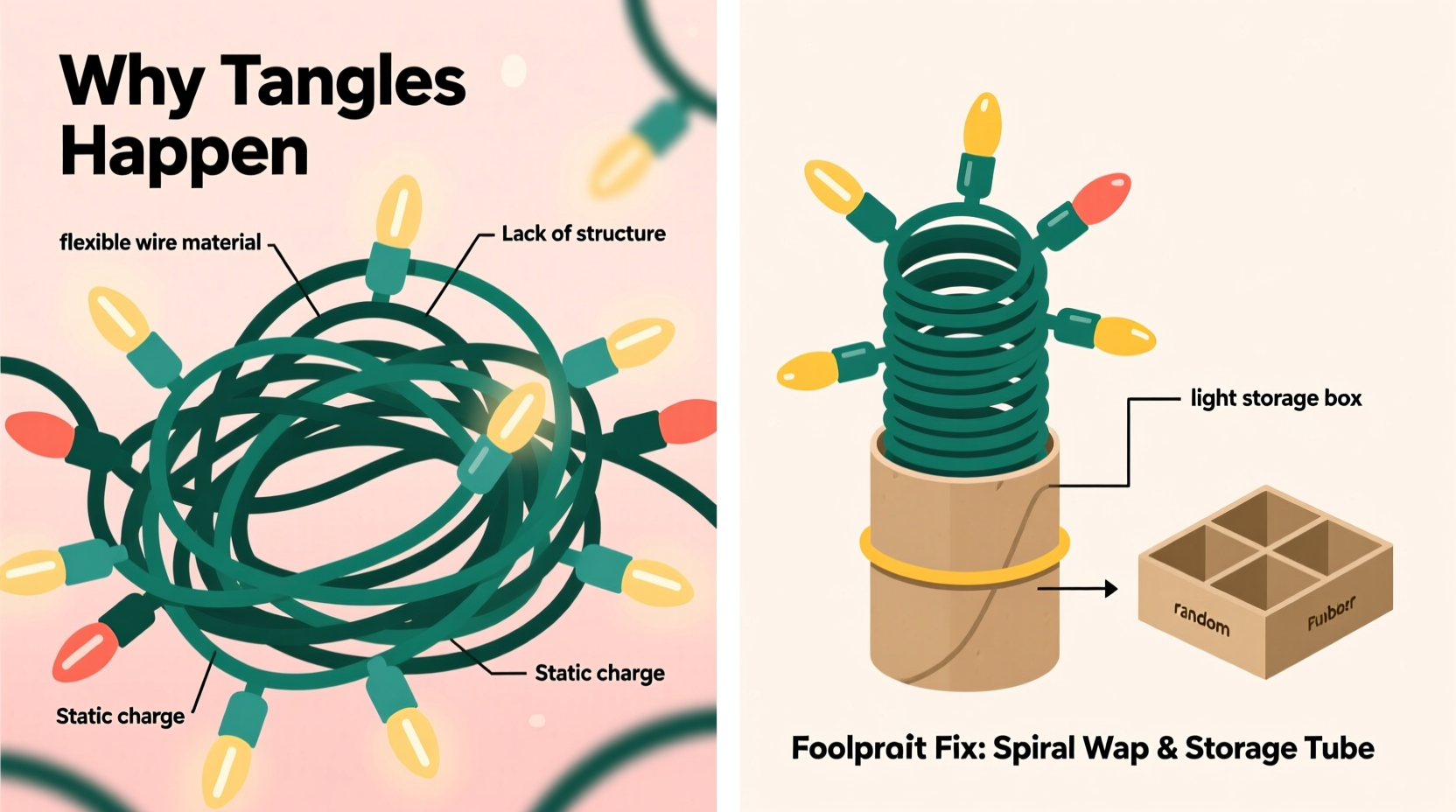
At first glance, it might seem like bad luck or poor storage causes tangles. But research shows that cords naturally tend to knot themselves under certain conditions. A landmark 2007 study by physicists Dorian Raymer and Douglas Smith from the University of California, San Diego demonstrated that when a string is tumbled inside a confined space—even briefly—it has a high probability of forming knots. The longer and more flexible the cord, the greater the chance of complex tangles.
Christmas lights are especially prone because they combine several risk factors:
- Length and flexibility: Most light strands range from 25 to 100+ feet, offering plenty of opportunity for loops to catch on each other.
- Rigid endpoints: The plug and end cap create fixed points that resist smooth coiling, increasing torque and twist during storage.
- Bulb protrusions: Each bulb acts as a snag point, catching adjacent sections of wire when jostled.
- Random motion in storage: Boxes get moved, stacked, or dropped, creating agitation similar to the tumbling effect in the UCSD experiment.
In essence, leaving a strand of Christmas lights loose in a box is practically inviting chaos. Without structured winding, entropy takes over—nature’s tendency toward disorder ensures that random movement leads to knots.
“Given enough time and movement, any flexible cord will find a way to tangle. It's not magic—it's mathematics.” — Dr. Louis Kauffman, Mathematician specializing in knot theory
A Foolproof Method: The Over-Under Coiling Technique
While no method eliminates risk entirely, one approach consistently outperforms others in preventing tangles: the over-under coiling technique. Commonly used by stagehands, electricians, and audio engineers, this professional-grade method balances twist distribution and prevents loops from nesting into each other.
How It Works
Standard coiling—wrapping the cord in the same direction over and over—builds up torsional stress. When released, the stored energy causes the cord to twist back violently, promoting kinks and snags. The over-under method alternates the direction of each loop, canceling out twist and keeping the strand flat and stable.
Step-by-Step Guide to Over-Under Coiling
- Start at the plug end: Hold the plug in one hand. Begin coiling from this end to ensure consistency.
- Create the first loop (over): Use your opposite hand to form a loop by bringing the cord over itself (like making a rainbow shape).
- Second loop (under): For the next loop, bring the cord under itself instead—reversing the motion.
- Alternate consistently: Continue switching between “over” and “under” with each new loop. After two loops, the pattern repeats.
- Maintain even tension: Don’t pull too tight. Aim for loops about 6–8 inches wide—large enough to avoid bending bulbs.
- Secure the bundle: Once fully coiled, use a twist tie, Velcro strap, or reusable zip to fasten the middle and ends. Avoid metal ties that can damage insulation.
- Store flat or vertically: Place the coil in a shallow bin or hang it on a hook. Avoid stacking heavy items on top.
Best Storage Tools and Alternatives
Even with proper coiling, the container matters. Many people use cardboard boxes or plastic bins, but these often allow shifting and compression. Consider specialized solutions designed specifically for light storage.
| Storage Method | Pros | Cons |
|---|---|---|
| Over-under coil + cardboard tube | Low cost; prevents crushing; allows airflow | Tubes can split if packed tightly |
| Light keeper reels | Designed for over-under winding; built-in clip system | Can be expensive for multiple strands |
| PVC pipe with end caps | Durable; protects from moisture and pests | Bulky; harder to label |
| Hanging shoe organizer | Maximizes vertical space; visible access | Cords can drape and tangle if not secured |
| Plastic storage reel with crank | Fast winding; consistent tension | May apply too much pressure on delicate wires |
For those with limited space, repurposing household items works well. A sturdy paper towel roll, cut-down oatmeal container, or even a piece of foam board with notches punched along the edge can serve as an effective DIY reel.
Real Example: From Frustration to Flow
Sarah Thompson, a homeowner in Portland, Oregon, used to spend nearly two full days each December untangling her outdoor display—three long strands of C9 lights, net lights for bushes, and icicle lights for the eaves. “I’d throw them in a bin after New Year’s, thinking ‘this time I’ll be neater,’” she recalls. “But every year, it was worse than the last.”
After watching a demonstration of the over-under method online, she decided to try it with her largest strand. She wound it carefully using a homemade cardboard spool, alternating directions with each loop. She repeated the process for all her sets and stored them in labeled bins on a high shelf.
Last November, she pulled them down expecting the usual hassle. Instead, she unclipped the twist tie, gave the coil a gentle shake, and the entire strand unfurled smoothly across her lawn. “It felt like magic,” she says. “I saved at least three hours that season—and my hands didn’t cramp from picking at knots.”
Common Mistakes That Cause Tangles
Even with good intentions, many people unknowingly sabotage their efforts. Here are the most frequent errors—and how to avoid them:
- Throwing lights loosely into a box: This maximizes movement and tangling. Always coil intentionally.
- Using the “hand-wrap” method around forearm: While common, this builds up twist and often results in a tangled center when removed.
- Coiling while wearing gloves: Reduced dexterity increases the chance of uneven loops and missed snags.
- Storing lights while damp: Moisture promotes corrosion and makes wires stick together, increasing resistance during unwinding.
- Stacking multiple strands together: Never wrap different sets into one bundle. They’ll inevitably cross and knot.
Checklist: Tangle-Free Christmas Light Storage
Follow this checklist each year before putting your lights away:
- ✔ Clean dust and debris off wires and bulbs with a dry cloth.
- ✔ Test all strands and repair or replace faulty ones.
- ✔ Choose one consistent coiling method (preferably over-under).
- ✔ Wind slowly and evenly, maintaining consistent loop size.
- ✔ Secure with soft ties—never twist ties or rubber bands that degrade.
- ✔ Label each strand (length, color, location used) for easy retrieval.
- ✔ Store in a cool, dry place away from rodents and temperature extremes.
- ✔ Keep away from sharp objects or heavy items that could crush the coil.
Frequently Asked Questions
Can I use a drill to rewind Christmas lights quickly?
While some DIYers attach lights to a drill chuck for rapid winding, this method is risky. High speed can over-twist the cord, damage connectors, or break bulbs. If you must use power tools, do so at the lowest setting and only with durable commercial-grade reels designed for the purpose.
What should I do if my lights are already tangled?
Start by laying the strand flat on a clean surface—grass, carpet, or a large table works best. Identify the loose end, then gently follow the path of the cord. Loosen major knots with your fingers, working from the outside in. Never pull hard; instead, nudge loops apart incrementally. For severe tangles, place the mass in a laundry bag and tumble it gently in the dryer on no heat for 3–5 minutes—sometimes vibration helps loosen knots.
Are LED lights less likely to tangle than incandescent ones?
Not inherently. While LED strands are often lighter and slightly more flexible, they still have the same structural risks—bulbs, length, and endpoint rigidity. However, thinner insulated wiring in some LED models may reduce snagging slightly. The key factor remains storage method, not bulb type.
Final Thoughts: Make Next Season Easier Today
The annual battle with tangled Christmas lights isn’t inevitable. It’s the result of predictable physical forces acting on poorly managed cords. By applying a disciplined coiling technique—especially the over-under method—you shift from reacting to chaos to controlling order.
It takes only a few extra minutes at the end of the season to coil your lights properly, but that small investment saves hours later. Beyond convenience, proper handling extends the life of your lights, reduces waste, and preserves the joy of decorating rather than turning it into a chore.
Think of it as a gift to your future self—one that arrives wrapped in neat loops and tied with care.




 浙公网安备
33010002000092号
浙公网安备
33010002000092号 浙B2-20120091-4
Comments
No comments yet. Why don't you start the discussion?