
Every holiday season, millions of people pull out their boxes of Christmas lights—only to be greeted by a knotted mess that seems almost malicious in its complexity. No matter how carefully you stored them the year before, the cords emerge twisted, looped, and hopelessly entangled. But this isn’t bad luck or cosmic irony. There’s real science behind why Christmas lights tangle so easily—a blend of physics, probability, and material behavior that turns even the most organized person into a frustrated knot-unraveler.
The phenomenon isn’t unique to holiday decor. Headphone wires, garden hoses, extension cords—anything long, flexible, and coiled is prone to spontaneous knotting. But Christmas lights are especially vulnerable due to their length, stiffness, and the presence of bulbs and plugs that act as natural snag points. Understanding the root causes can help us not only untangle them more efficiently but also prevent the chaos before it begins.
The Physics of Knot Formation
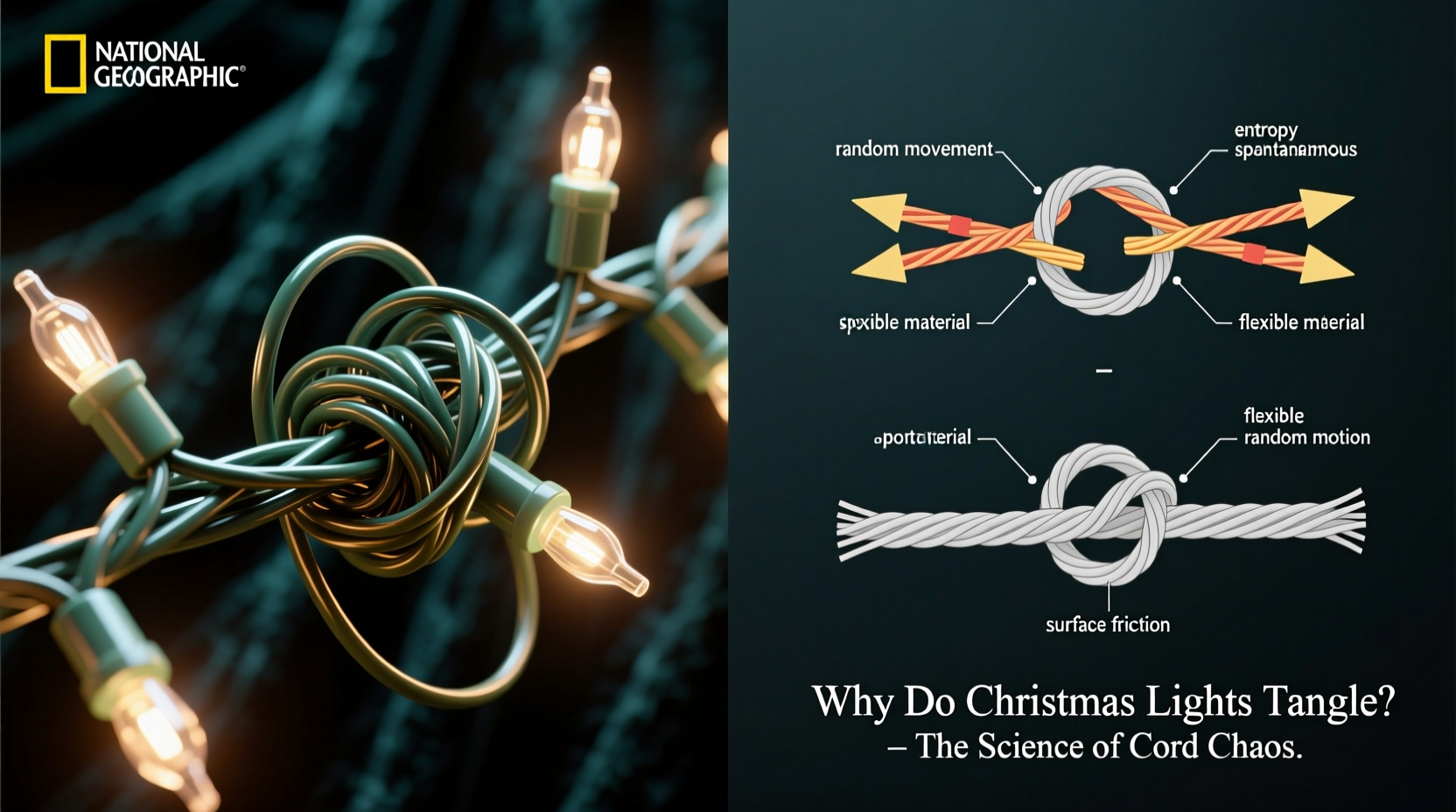
Knots don’t form by magic. They follow predictable physical laws rooted in topology, thermodynamics, and motion dynamics. In 2007, physicists Dorian Raymer and Douglas Smith from the University of California, San Diego conducted a now-famous experiment where they placed strings of varying lengths into a rotating box. After tumbling for just 10 seconds, the strings frequently emerged with complex knots—sometimes within seconds.
Their findings revealed a startling truth: knots form rapidly and almost inevitably when a flexible string is agitated in a confined space. The longer and more flexible the cord, the higher the probability of knotting. Christmas lights, which often stretch 50 to 100 feet and are stored in relatively small containers, meet both criteria perfectly.
Raymer and Smith discovered that random motion—like shaking a box or tossing lights into a bin—causes the ends of the cord to move through loops formed in the middle. Once an end passes through a loop, a knot is born. This process, known as “self-entanglement,” happens faster than most people realize. Even gentle jostling during storage or transport can trigger it.
“Given enough time and movement, nearly any long, flexible object will eventually become knotted.” — Dorian Raymer, Physicist, UC San Diego
Why Christmas Lights Are Especially Prone to Tangles
While all cords can tangle, Christmas lights have several features that make them uniquely susceptible:
- Length and flexibility: Most sets exceed 50 feet, providing ample opportunity for loops and crossings.
- Bulbs and sockets: These act as “knot promoters” by catching on other segments of the cord, preventing smooth sliding.
- Rigid sections: Wires between bulbs are stiffer than headphone cables, making them less likely to lie flat and more likely to spring into new configurations.
- Multiple endpoints: With a plug on one end and often a connector on the other, there are two active ends that can wander and initiate knotting.
- Storage conditions: Often stuffed into boxes, bags, or under furniture, subjecting them to compression and shifting.
Additionally, many people wrap their lights haphazardly—around cardboard, their hands, or even tree branches—without securing the ends. This method creates loose coils that easily collapse and interlock during storage. The result? A tangled web that can take 10 to 30 minutes to undo before a single bulb is hung.
The Mathematics of Cord Chaos
Believe it or not, there’s a branch of mathematics dedicated to studying knots: knot theory. Mathematicians classify knots by their crossing patterns and determine whether one knot can be transformed into another without cutting the strand. While this may sound abstract, it has direct implications for everyday tangles.
In practical terms, the number of possible knot configurations increases exponentially with cord length. A 10-foot cord might have dozens of potential tangles. A 50-foot strand of Christmas lights? Millions. And because each bulb adds friction and resistance, once a knot forms, it’s harder to undo than it would be in a smooth rope.
Researchers have modeled cord behavior using entropy—the tendency of systems to move toward disorder. Just as a tidy room naturally becomes messy over time, a neatly coiled light strand tends toward chaos unless energy (i.e., careful storage) is applied to maintain order. The universe, it seems, favors tangles.
Do’s and Don’ts of Christmas Light Storage
| Action | Recommended? | Reason |
|---|---|---|
| Wrapping around your hand | No | Creates loose coils that collapse and tangle easily |
| Using a cardboard reel | Yes | Provides structure; prevents coil collapse if secured properly |
| Tying with tight rubber bands | No | Can damage insulation and trap moisture |
| Using fabric twist ties | Yes | Soft, non-abrasive, and reusable |
| Stuffing into a plastic bin | No | Agitation during handling leads to knots |
| Storing vertically on a wall-mounted spool | Yes | Minimizes pressure and movement |
How to Store Christmas Lights to Prevent Tangles
Prevention is far more effective than untangling. With the right technique, you can drastically reduce—or even eliminate—cord chaos year after year. The key is to minimize movement, secure the ends, and use supportive tools.
Step-by-Step Guide: The Reel-and-Tie Method
- Gather supplies: A plastic or wooden reel (available at hardware stores), fabric twist ties or soft Velcro straps, and a labeled storage container.
- Start at the plug end: Hold the plug firmly and begin wrapping the cord clockwise around the reel. Keep tension even but not excessive.
- Avoid overlapping: Lay each loop side by side rather than stacking them. Overlapping encourages snags.
- Secure the final loop: Once fully wound, use two fabric ties to fasten the coil at opposite sides of the reel.
- Protect the bulbs: If using a reel with flanges, ensure bulbs don’t press against the edges. Consider padding with foam strips.
- Store upright: Place the reel in a sturdy bin or mount it on a wall to prevent rolling or crushing.
Alternative: The Bag-and-Segment Method for Indoor Use
If reels aren’t practical, another effective method involves dividing the strand into manageable sections:
- Cut a pool noodle to about 12 inches long and slice it lengthwise.
- Lay the light strand straight and divide it into 4–5 equal sections.
- Slide each segment into a pool noodle sleeve—this keeps loops separated.
- Use soft ties to bind each section individually.
- Place the bundled segments into a compartmentalized storage box.
This method prevents cross-coiling and makes it easier to inspect bulbs before use.
Real Example: From Frustration to Flow
Consider Sarah, a homeowner in Portland who decorates her house annually with over 1,500 lights. For years, she spent entire weekends untangling cords pulled from garbage bags in her garage. One November, after losing three hours on a single strand, she decided to change her approach.
She invested in four plastic reels and spent one afternoon rewinding each set using the reel-and-tie method. She labeled each one and stored them upright in a climate-controlled closet. The following December, she retrieved the first reel, unfastened the tie, and unwound the lights smoothly in under a minute—zero tangles.
Over five seasons, Sarah estimates she’s saved over 15 hours of labor and reduced broken bulb replacements by 40%, since careful handling minimized stress on the wiring. Her system now includes a checklist and photos posted in her storage area to guide family members.
“The first year I used reels, I thought it was overkill. Now I can’t imagine going back. It’s like upgrading from dial-up to broadband.” — Sarah Thompson, Home Decor Enthusiast
Expert-Backed Tips to Minimize Tangling
Based on research and professional organizing practices, here are actionable strategies supported by experts in physics and home organization:
- Never wrap lights around sharp corners: This kinks the wire and weakens internal connections.
- Use consistent winding direction: Always wrap clockwise or counterclockwise to avoid introducing twist-induced stress.
- Inspect before storing: Fix broken bulbs or exposed wires before packing away—this reduces future handling.
- Avoid extreme temperatures: Heat can soften insulation; cold makes wires brittle. Store in a stable environment.
- Keep original packaging when possible: Many modern light sets come with plastic spools designed for reuse.
Checklist: Pre-Storage Preparation
- ✅ Test all lights for functionality
- ✅ Replace burned-out bulbs or fuses
- ✅ Clean dust and debris with a dry cloth
- ✅ Choose appropriate storage tool (reel, noodle, box)
- ✅ Wind slowly and evenly without stretching
- ✅ Secure ends and label the set
- ✅ Store in a dry, cool, accessible location
Frequently Asked Questions
Can I prevent tangles entirely?
While no method guarantees 100% tangle-free storage, using a reel with proper securing techniques reduces the risk to near zero. The combination of structural support, minimal movement, and end protection disrupts the conditions needed for knot formation.
Are LED lights less prone to tangling than incandescent ones?
Not inherently—but LEDs often have thinner, more flexible cords and fewer bulky bulbs, which can make them slightly easier to manage. However, their lighter weight also means they shift more easily in storage, potentially increasing tangling risk if not secured properly.
What’s the fastest way to untangle lights without damaging them?
Begin by laying the strand flat on a clean surface like a driveway or large table. Locate the two ends and gently trace them inward, loosening obvious loops first. Avoid pulling hard—instead, use your fingers to “walk” knots apart. For stubborn tangles, isolate the section and rotate it to undo twists gradually.
Conclusion: Take Control of Cord Chaos
The tangle of Christmas lights isn’t a seasonal curse—it’s a predictable outcome of physics, poor storage habits, and overlooked details. By understanding the science behind cord chaos, we gain the power to stop it before it starts. Simple changes in how we wind, secure, and store our lights can save hours of frustration and extend the life of our decorations.
This off-season, dedicate one afternoon to reorganizing your holiday lighting collection. Invest in reels, labels, and soft ties. Follow a proven method. Share the system with your household. Turn what was once a dreaded chore into a smooth, repeatable process.




 浙公网安备
33010002000092号
浙公网安备
33010002000092号 浙B2-20120091-4
Comments
No comments yet. Why don't you start the discussion?