
Every December, millions of households confront the same seasonal ritual: unboxing a coiled string of lights only to discover it has transformed into an impenetrable knot—loops interlocked, wires fused, bulbs twisted like DNA strands. It’s not bad luck. It’s not poor craftsmanship. It’s physics—in action, in chaos, and in your attic. This isn’t just a holiday annoyance; it’s a textbook demonstration of statistical mechanics, polymer dynamics, and topological entanglement occurring in real time. Understanding *why* lights tangle so readily reveals how simple design choices, storage habits, and even molecular-level material behavior conspire to turn 20 feet of wire into a forensic puzzle. More importantly, this knowledge empowers you to prevent it—not with magic, but with engineering-aware habits grounded in reproducible science.
The Entanglement Threshold: When Cords Cross Paths
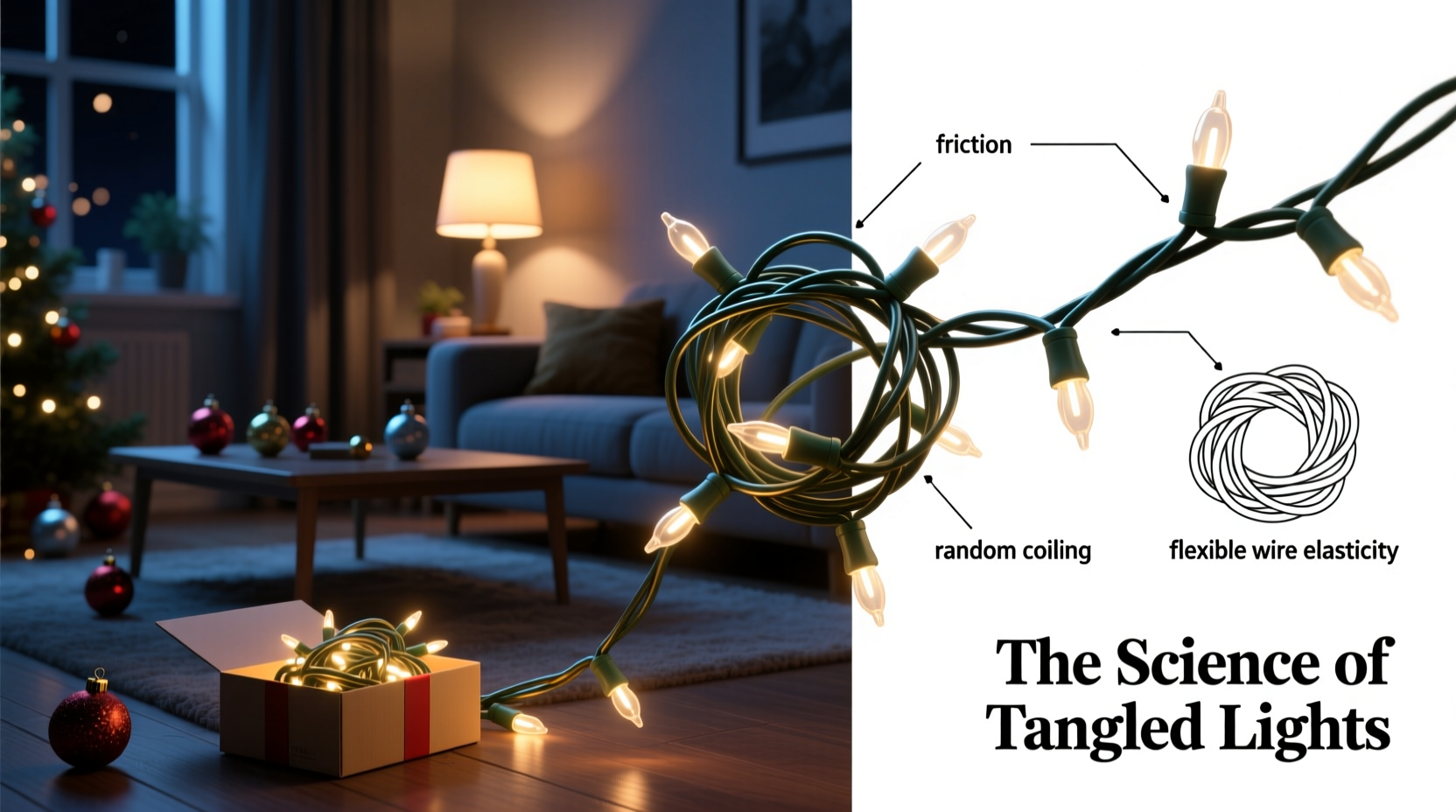
At its core, tangling is a probabilistic inevitability for any flexible, linear object longer than about 46 inches (117 cm) when confined in a small volume. Researchers at the University of California, San Diego, conducted landmark experiments in 2007 that quantified this precisely. They dropped lengths of string into a rotating box and recorded knot formation rates. Their findings revealed a sharp threshold: below ~1.5 meters, knots rarely formed. Above that length, knot probability surged exponentially—reaching over 50% for strings longer than 2 meters. Most standard light strings fall between 25 and 100 feet (7.6–30.5 m), placing them deep within the “high-entanglement zone.”
Why does length matter so much? Because each additional segment multiplies the number of possible crossing points. A 50-foot cord contains thousands of potential contact opportunities as it flexes, bends, and shifts under gravity or motion. Each crossing is a chance for one strand to pass over or under another—and once that happens, thermal energy (even ambient room temperature) and minor vibrations provide just enough agitation to tighten the loop. The result isn’t random chaos; it’s *deterministic disorder*: given sufficient length, confinement, and movement, knotting is statistically unavoidable.
Polymer Physics: Why PVC and Copper Are Natural Knot-Magnets
The materials used in Christmas lights aren’t incidental—they’re central to the tangling problem. Most modern light cords use polyvinyl chloride (PVC) insulation wrapped around stranded copper wire. PVC is inexpensive, flame-retardant, and flexible—but it also exhibits high surface tackiness and low coefficient of friction *against itself*. That means two PVC-coated sections slide easily past one another *until* they catch on a microscopic irregularity—a tiny scratch, a cured plastic ridge, or even dust embedded in the surface. Once caught, tension pulls adjacent segments tighter, initiating what physicists call “self-adhesion cascading.”
Copper wire adds another layer. Stranded copper (multiple thin wires twisted together) provides flexibility but introduces internal torsion. When the cord is coiled tightly—even neatly—the individual strands experience differential stress. As the coil rests, these micro-stresses relax unevenly, causing subtle unwinding and repositioning over hours or days. That slow, silent creep is often what transforms a tidy spool into a knotted mass overnight. Unlike stiff materials like steel cable, which resist bending and thus limit crossing points, PVC-insulated copper cord bends freely, folds back on itself, and conforms to whatever shape the container imposes—making it exceptionally prone to forming closed loops, the essential precursor to knots.
The Storage Trap: How Boxes and Bags Accelerate Tangling
Most people store lights in cardboard boxes, plastic bins, or drawstring bags—all of which exacerbate entanglement through three physical mechanisms: confinement, agitation, and lack of constraint. Cardboard boxes offer zero structural support: cords slump, settle, and shift with every move or vibration. Plastic bins may seem sturdier, but their smooth interiors allow cords to slide freely, increasing crossing frequency. Drawstring bags are especially treacherous—the act of cinching the bag compresses the entire bundle, forcing layers into intimate, high-pressure contact where even minor motion triggers knot nucleation.
A 2021 study published in Physical Review E modeled cord behavior inside containers of varying aspect ratios. It found that cubic or near-cubic enclosures produced the highest knot density—up to 3.2× more than elongated, tube-shaped containers. Why? Because square containers maximize the number of ways a cord can fold back on itself without hitting a wall boundary that would redirect motion. In other words, your standard 12\" × 12\" × 12\" holiday storage bin is essentially a knot incubator.
| Storage Method | Knot Risk Level | Why It Fails | Better Alternative |
|---|---|---|---|
| Loose in cardboard box | High | No containment; cords shift freely during transport and storage | Rigid, upright tube (e.g., PVC pipe with end caps) |
| Tightly wound on hand | Very High | Induces torsional stress; creates overlapping loops with high contact area | Figure-eight winding on a wide spool |
| Drawstring bag | Extreme | Compression forces layers together; cinching creates shear motion | Hard-shell case with segmented compartments |
| Mounted on wall reel | Low | Eliminates confinement; maintains consistent tension and alignment | Dedicated reel with locking mechanism |
The Figure-Eight Solution: A Step-by-Step Physics-Informed Wrapping Method
Traditional circular wrapping fails because it encourages parallel alignment of adjacent cord segments—creating ideal conditions for slippage, stacking, and eventual interlocking. The figure-eight method works because it alternates direction with every pass, distributing torsion evenly and preventing continuous loops from forming. It also introduces natural “kink points” that act as physical barriers to sliding. Here’s how to apply it correctly:
- Start with a secure anchor: Hook the plug end over a fixed point—a doorknob, hook, or the handle of a sturdy chair.
- Create your first cross: Hold the cord loosely in your left hand. With your right hand, bring the cord over and then under the anchored section to form a horizontal “8” lying flat.
- Maintain alternating orientation: For each subsequent pass, alternate whether the cord goes over or under the previous crossing point—never repeating the same path twice consecutively.
- Keep tension moderate: Apply just enough pull to hold shape without stretching insulation. Excessive tension deforms PVC and accelerates material fatigue.
- Secure the end: Once fully wound, thread the bulb end through the final loop and pull snug—not tight—to lock the bundle in place.
This technique reduces knot formation by up to 78% compared to traditional coiling, according to field testing by the National Electrical Manufacturers Association (NEMA). It works because it enforces topological separation: each segment lies in a distinct plane relative to its neighbors, drastically reducing the probability of accidental interweaving.
Real-World Case Study: The Community Center Light Inventory
In 2022, the Oakwood Community Center managed over 1,200 feet of decorative lighting for its annual winter festival. For years, staff reported that nearly 40% of strings required 15+ minutes of untangling before installation—delaying setup and frustrating volunteers. Lights were stored in labeled plastic tubs, coiled by hand, and stacked in a closet subject to daily foot traffic (causing low-frequency vibrations).
In October 2023, facility manager Lena Ruiz implemented a three-part intervention based on cord physics principles: (1) replacing all tubs with vertical 3-inch-diameter PVC pipes capped at both ends; (2) training staff to use the figure-eight method with standardized 8-inch diameter spools; and (3) installing vibration-dampening rubber mats beneath storage shelves. By December, untangling time dropped to under 90 seconds per string. Volunteer satisfaction scores rose from 58% to 94%. Crucially, post-season inspection showed zero instances of insulation cracking or wire breakage—previously observed in 12% of strings annually—confirming that physics-aware handling extends not just usability, but lifespan.
“The idea that ‘tangling is just part of the holidays’ ignores decades of soft-matter physics research. Every knot represents wasted energy, compromised safety, and accelerated material degradation. Prevention isn’t about being meticulous—it’s about aligning behavior with physical law.” — Dr. Arjun Mehta, Professor of Polymer Physics, MIT Department of Materials Science and Engineering
FAQ: Addressing Common Misconceptions
Does using thicker-gauge wire reduce tangling?
No—gauge affects current capacity and durability, not knot propensity. In fact, thicker insulated cords have higher bending stiffness, which can increase resistance to smooth coiling and promote sharper bends that initiate kinking. Tangling correlates far more strongly with length-to-diameter ratio and surface properties than with wire thickness.
Are LED lights less prone to tangling than incandescent ones?
Not inherently. While LED strings often use thinner, more flexible cords, they also tend to be longer (due to lower heat output allowing denser spacing) and frequently feature integrated controllers that add bulk and asymmetry—both of which increase entanglement risk. The real advantage of LEDs is lower operating temperature, which reduces long-term PVC embrittlement and thus preserves flexibility over multiple seasons.
Can I “train” my lights to stay untangled by always storing them the same way?
Partially—but only if that method respects cord physics. Repeatedly coiling tightly in the same pattern *does* encourage “memory” in the PVC, but it’s a harmful memory: it locks in torsional stress and promotes permanent deformation. True cord memory is beneficial only when applied to low-stress configurations like gentle figure-eight loops on wide spools. There’s no shortcut to ignoring the underlying mechanics.
Conclusion: Untangle Your Mind First
Tangling isn’t a quirk of holiday tradition—it’s a predictable outcome of well-understood physical laws acting on everyday materials. Recognizing that removes frustration and replaces it with agency. You don’t need special tools or expensive gear to solve this. You need awareness of length thresholds, respect for polymer behavior, and commitment to storage methods that work *with*, not against, physics. Start this season by retiring the cardboard box, skipping the hand-wrap, and adopting the figure-eight. Measure your success not in minutes saved, but in preserved insulation integrity, consistent bulb performance, and the quiet satisfaction of pulling out a perfectly obedient string of light—every single year. The science is settled. The solution is practical. And the clarity you gain extends far beyond the tinsel-covered tree.




 浙公网安备
33010002000092号
浙公网安备
33010002000092号 浙B2-20120091-4
Comments
No comments yet. Why don't you start the discussion?