
Every holiday season, millions of households wrestle with a quiet but persistent electrical puzzle: why do seemingly simple strings of LED or incandescent lights force us to hunt for every available outlet—often tripping breakers, overheating extension cords, or triggering GFCI resets? The answer isn’t just about convenience or poor planning. It’s rooted in fundamental electrical principles, outdated wiring in older homes, and the cumulative effect of modern lighting loads—even when those lights are marketed as “energy-efficient.” Understanding this isn’t optional for safety; it’s essential. Overloaded circuits cause over 40% of home electrical fires during December, according to the U.S. Fire Administration. This article unpacks the physics behind outlet proliferation, decodes National Electrical Code (NEC) requirements, and delivers actionable, code-compliant strategies to distribute your holiday load safely—without sacrificing sparkle.
The Physics Behind the Plug: Why One Outlet Isn’t Enough
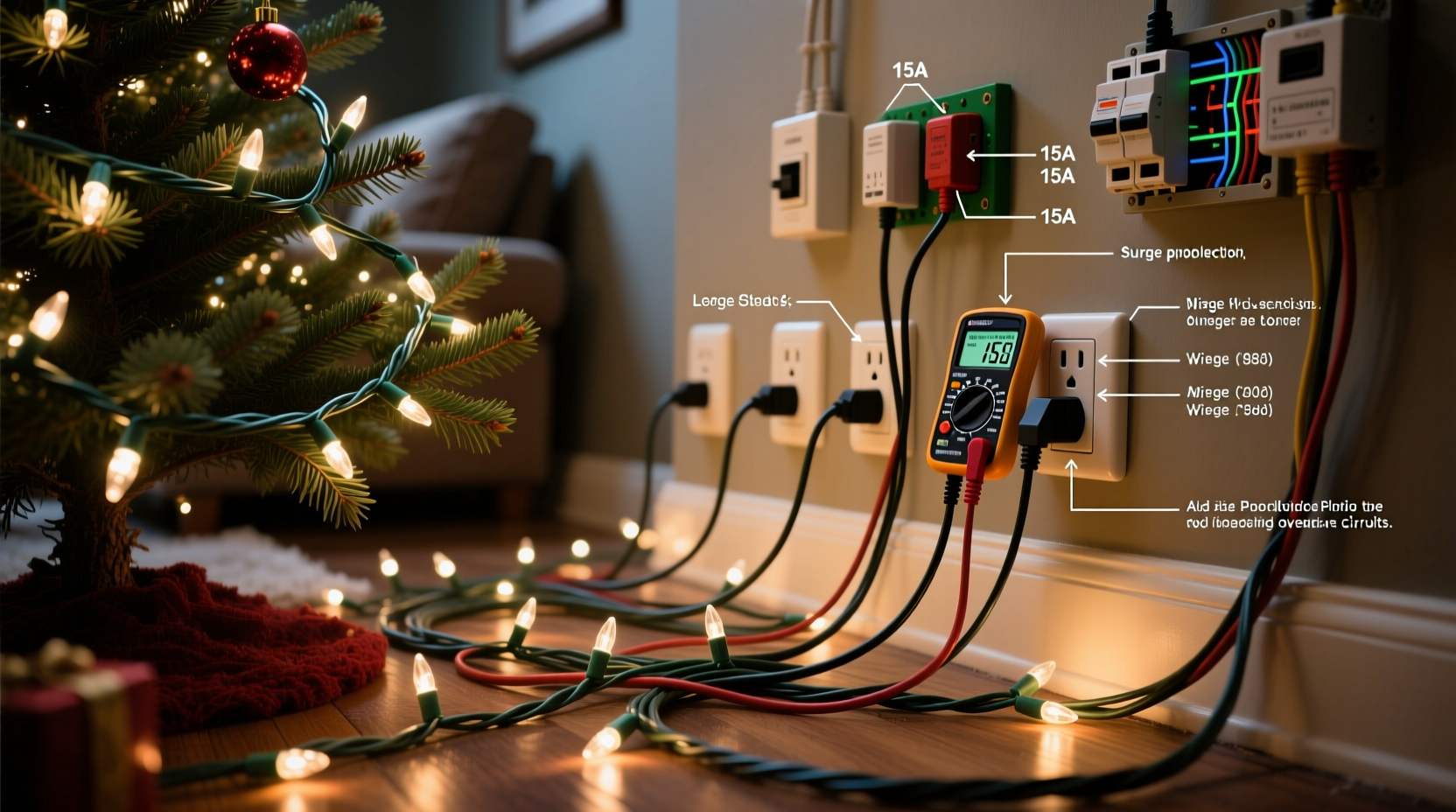
Christmas light strings appear lightweight, but their collective draw adds up fast—especially when layered across rooflines, windows, trees, and interior mantels. A single 15-amp residential circuit in North America is rated for 1,800 watts (15 amps × 120 volts). But the NEC mandates a continuous-load derating of 80%, meaning only 1,440 watts should be sustained for more than three hours—a critical threshold for holiday displays left on overnight.
Consider real-world wattage: a 100-light incandescent string consumes ~40 watts, while a comparable LED string uses just 4–7 watts. At first glance, that suggests you could plug 360 LED strings into one circuit. Reality intervenes quickly. Most homes have multiple devices sharing circuits—refrigerators, Wi-Fi routers, security systems, and always-on electronics. Even a modest kitchen circuit may already carry 300–500 watts before lights are added. Add a 200-foot LED garland (≈12 watts), 12 window outlines (≈60 watts), and a 6-ft pre-lit tree (≈25 watts), and you’re at 97 watts—seemingly harmless. But now factor in voltage drop across long extension cords, heat buildup at receptacles, and the hidden load of power adapters for smart controllers or animated displays. That “97-watt” setup can easily become a 120-watt thermal load at the outlet due to resistance losses—pushing aging receptacles past safe operating temperatures.
Moreover, most residential outlets are daisy-chained—not isolated. In a typical 1970s-era home, a single 15-amp circuit may serve eight to ten receptacles across two bedrooms and a hallway. Plugging four light strings into four different outlets on that same circuit offers zero load relief. They all feed back to the same breaker.
How Outlets Multiply: The Hidden Role of Power Strips, Splitters, and Adapters
The proliferation of outlets during the holidays isn’t accidental—it’s a reactive workaround to physical and regulatory constraints. When homeowners lack sufficient dedicated outlets near display zones (e.g., exterior walls, garage eaves, stairwells), they reach for power strips, multi-outlet adapters, and heavy-duty extension cords. Each introduces new failure points:
- Power strips rarely list true continuous-load ratings. A strip labeled “15A” may overheat at 10A if used indoors with poor ventilation or stacked under furniture.
- “Y” splitters and octopus cords concentrate current at a single receptacle point, increasing contact resistance and localized heating—especially with older, worn-out outlets where brass contacts have lost spring tension.
- Extension cords rated for indoor use (often 18 AWG) are unsafe for outdoor displays, even with LED lights. Voltage drop across a 100-ft 16 AWG cord can reduce output by 8–12%, causing flickering and driver stress in LED strings.
This cascading dependency explains why one “extra” outlet often spawns three more downstream: a homeowner plugs a 12-outlet power strip into a garage outlet, then connects six light strings, a fog machine, and a speaker system—all drawing from a single 20-amp circuit originally intended for tools and lighting.
Code Compliance vs. Convenience: What the NEC Actually Requires
The National Electrical Code doesn’t ban holiday lighting—but it sets strict boundaries. NEC Article 400.5(A)(2) limits flexible cords (i.e., extension cords) to “temporary use,” defined as ≤90 days. While the holidays fall within that window, repeated seasonal use qualifies as *repetitive temporary use*, triggering inspection requirements in rental properties and HOAs. More critically, NEC 210.21(B)(2) governs outlet loading: a single 15-amp receptacle must not supply more than 12 amps (1,440W) continuously—a hard cap few homeowners calculate.
Here’s what compliance looks like in practice:
| Scenario | Permissible Load (Watts) | Real-World Risk Factor | Code Violation? |
|---|---|---|---|
| 15A circuit powering 12 LED strings (6W each) + TV + game console | 1,440W max (continuous) | TV + console ≈ 250W; strings ≈ 72W → total ≈ 322W — safe | No |
| Same circuit with 200 ft of 16 AWG extension feeding 8 incandescent roof lines (40W each) | 1,440W max, but voltage drop raises effective load | Voltage drop increases amperage draw to compensate → 10% drop = ~11% higher current → risk of overheating | Yes — violates 400.5 on cord suitability and 210.19 on conductor ampacity |
| Using a 15A-rated power strip to feed 10 smart light controllers (each drawing 0.5A surge) | Strip must handle 5A continuous + surges | Controllers often draw 1.2A at startup; 10 × 1.2A = 12A instantaneous — exceeds strip’s thermal rating | Yes — violates 400.7 and manufacturer labeling |
Compliance isn’t about austerity—it’s about predictability. A properly loaded circuit runs cool, silent, and reliable. An overloaded one hums, warms the faceplate, and trips unpredictably.
A Real-World Load Audit: The Thompson Family Garage Display
In suburban Ohio, the Thompsons installed a 300-light animated LED display on their garage facade in 2022. They used three 15-foot 14 AWG outdoor-rated extension cords plugged into a single garage outlet wired to a shared 15-amp circuit (also serving two overhead lights and a garage door opener). On night three, the breaker tripped at 7:14 p.m.—precisely when their programmable controller activated the “twinkling roofline” sequence. An electrician’s audit revealed:
- The garage outlet was rated for 15A but had 0.8Ω contact resistance (vs. ideal <0.1Ω), causing 12°C temperature rise at 10A load.
- Each extension cord introduced 1.4V drop per 50 ft, forcing the LED drivers to draw 18% more current to maintain brightness.
- The controller’s startup surge peaked at 13.2A for 0.8 seconds—within spec, but repeated 12 times per minute during animation.
The fix wasn’t more outlets—it was circuit segmentation. The electrician installed a dedicated 20-amp GFCI-protected circuit to the garage exterior, ran 12 AWG THWN-2 wire in conduit, and added two weatherproof outlets spaced 8 ft apart. Load was redistributed: roofline to Outlet A (6 strings), facade animation to Outlet B (4 strings + controller), and ground-level accents to a third outlet on a separate interior circuit. Total display runtime increased from 4.2 hours/night to 10+ hours—with no trips, no warmth at receptacles, and verified 0.3°C temperature rise under full load.
“The biggest misconception is that ‘LED = low load.’ Yes, per string—but modern displays add controllers, amplifiers, motors, and wireless hubs. A 500-light ‘smart’ display often draws more than a 2,000-light incandescent one did in 1995—just in different places.” — Rafael Mendoza, P.E., Senior Electrical Inspector, International Association of Electrical Inspectors (IAEI)
Optimizing Your Circuit Load: A 5-Step Action Plan
Follow this field-tested sequence before plugging in a single light:
- Map your circuits. Turn off Breaker #1. Walk through the house testing every outlet, light, and appliance. Label each outlet with its breaker number using painter’s tape. Repeat for all breakers. Note which circuits serve exterior outlets.
- Calculate actual load—not just light wattage. Use a Kill A Watt meter ($25) to measure real-world draw of each string, controller, blower, or projector. Record startup surge (press “MAX”) and continuous draw (press “HOLD”). Add 15% for extension cord losses.
- Assign displays by circuit capacity. Reserve one dedicated circuit (preferably 20A) for high-draw items: animatronics, fog machines, large projectors. Use separate circuits for rooflines, trees, and interior. Never exceed 1,200W continuous per 15A circuit or 1,600W per 20A circuit.
- Select hardware for longevity—not just price. Use only UL-listed, outdoor-rated extension cords (14 AWG minimum for >50 ft; 12 AWG for >100 ft). Choose power strips with individual circuit breakers (not just one master breaker) and thermal cutoffs. Avoid daisy-chaining more than two strips.
- Test under real conditions. Run your full display for 90 minutes at night. Check every receptacle faceplate for warmth (should be <35°C / 95°F). Verify no breaker trips, GFCI resets, or audible buzzing. If any occur, reduce load by 20% and retest.
Essential Holiday Electrical Safety Checklist
- ☑ All outdoor outlets are GFCI-protected (test monthly with TEST button)
- ☑ No extension cords run under rugs, through doors, or across walkways
- ☑ All cords are rated for outdoor use (look for “W-A” or “W” suffix on jacket)
- ☑ No receptacle feels warm to the touch after 30 minutes of operation
- ☑ LED strings are grouped by manufacturer—mixed brands cause driver incompatibility and erratic dimming
- ☑ Spare fuses/breakers are on hand (same amperage and type as panel)
- ☑ A fire extinguisher (Class C rated) is accessible near main electrical panel
FAQ: Your Top Circuit Questions—Answered
Can I plug multiple LED light strings into one power strip safely?
Yes—if the strip is rated for continuous duty (look for “Continuous Duty” or “12A/1440W” label), the total measured load stays below 80% of its rating, and the strip is mounted vertically with airflow. Never exceed 10A continuous on a standard 15A strip, even if labeled “15A.” Heat buildup degrades internal connections faster than voltage drop.
Why does my breaker trip only when the lights are on for more than an hour?
This signals thermal overload—not instantaneous short-circuit failure. Breakers respond to heat accumulation in bimetallic strips. A marginal load (e.g., 13.5A on a 15A breaker) may hold for 45 minutes, then trip as internal temperature crosses the trip threshold. This is a clear warning: reduce load immediately. Do not replace with a higher-amp breaker—it creates a fire hazard by exceeding wire capacity.
Do smart plugs help manage circuit load?
Only if they include real-time energy monitoring (e.g., TP-Link Kasa HS110). Basic timers or voice-controlled plugs offer zero load insight. A smart plug showing “11.2A continuous” tells you to unplug something—before the breaker decides for you.
Conclusion: Light Responsibly, Not Just Brightly
Holiday lighting should evoke wonder—not worry. Every outlet you use, every cord you unspool, and every breaker you reset sends data about your home’s electrical health. Treating circuit optimization as a technical chore misses the point: it’s an act of care—for your family, your home, and the quiet reliability that makes December feel safe and joyful. You don’t need to become an electrician. You do need to measure, map, and respect the invisible boundaries that keep electrons flowing smoothly. Start tonight: grab a notebook, flip your breakers, and trace one circuit. Then another. In under an hour, you’ll know more about your home’s electrical reality than most contractors learn in a week. That knowledge is your most powerful decoration—and the only one that truly lasts beyond New Year’s Eve.




 浙公网安备
33010002000092号
浙公网安备
33010002000092号 浙B2-20120091-4
Comments
No comments yet. Why don't you start the discussion?