
Every December, thousands of homes across North America and Europe transform living rooms, basements, and sunrooms into miniature winter wonderlands: snow-dusted cottages, glowing train stations, frosted evergreens, and hand-painted figurines—all illuminated by dozens, sometimes hundreds, of low-voltage LED lights, animated motors, and synchronized controllers. Yet behind the magic lies a critical electrical reality most hobbyists overlook until something fails: the village isn’t just decorative—it’s an engineered load. And like any serious electrical system, it demands intentional infrastructure. A Christmas village isn’t a string of holiday lights draped over a mantel; it’s a distributed, layered, often time-sensitive lighting ecosystem that can draw more continuous power than a microwave or space heater. When plugged into shared household circuits—especially older ones with outdated wiring or multiple high-draw devices—the risks escalate quickly: tripped breakers, flickering displays, damaged transformers, overheated outlets, and in worst cases, fire hazards. This isn’t seasonal cautionary folklore. It’s grounded in National Electrical Code (NEC) standards, thermal physics, and decades of real-world troubleshooting from lighting designers, electricians, and seasoned collectors.
The Hidden Power Demand of a Modern Village
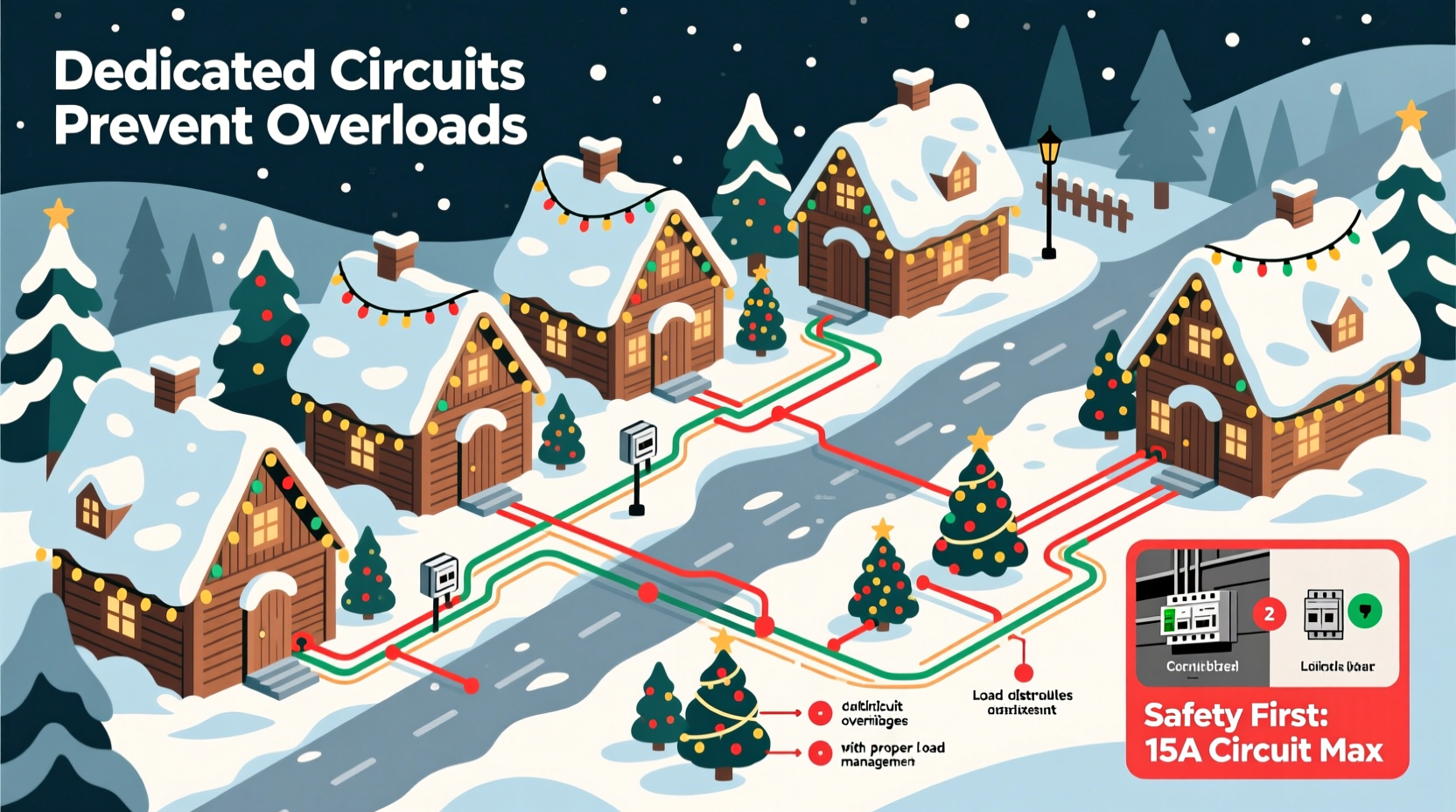
It’s easy to underestimate how much electricity a seemingly quaint village consumes. While individual LED micro-bulbs use only 0.04–0.08 watts, scale changes everything. A modest 4’ × 3’ layout with 12 buildings, 3 animated elements (a rotating windmill, a moving train, a blinking lighthouse), and perimeter path lighting may include:
- 24–36 building-mounted LEDs (0.06 W × 30 = 1.8 W)
- 8–12 pathway lights (0.12 W × 10 = 1.2 W)
- 3 low-voltage AC transformers (each drawing 5–12 VA input, depending on efficiency)
- 1 programmable controller (2–4 W)
- 1 animated motor module (3–7 W under load)
- Optional fog machine, sound board, or fiber-optic snowfall (15–45 W)
That adds up fast—even before accounting for inefficiencies. Transformers, especially older or unregulated models, draw “phantom load” (standby power) and suffer voltage drop across long wire runs. A typical 12V DC transformer rated for 3A output may pull 45–60W from the wall at 120V due to conversion losses. Multiply that by three transformers, and you’re already at 135–180W—equivalent to running two 75W incandescent bulbs continuously. Add a 30W animated train set and a 25W fogger, and total sustained draw exceeds 250W. That may sound modest, but consider this: most standard 15-amp residential circuits are rated for 1,800W (120V × 15A), yet NEC mandates a maximum continuous load of just 1,440W (80% of capacity). In practice, however, those circuits rarely operate in isolation. A living room circuit often also powers floor lamps, entertainment centers, smart speakers, gaming consoles, and charging stations. One overloaded outlet strip feeding both your TV and village is not just inconvenient—it’s noncompliant and unsafe.
Why Shared Circuits Fail—Thermally, Electrically, and Logically
Shared circuits fail villages not because they lack raw amperage, but because they lack stability, redundancy, and thermal headroom. Here’s what actually happens when a village shares a circuit with other loads:
- Voltage sag: When a vacuum cleaner kicks on in the adjacent room—or even a refrigerator compressor cycles—the voltage on the shared circuit dips momentarily. For sensitive LED drivers and microcontrollers, this causes visible flicker, reset loops, or erratic animation timing. Some controllers interpret brownouts as command errors and halt sequences entirely.
- Heat accumulation: Standard 14-gauge NM-B (Romex) wiring in older homes heats up under sustained 80–90% load. Add dust buildup inside outlet boxes, loose back-stab connections (common in builder-grade receptacles), and daisy-chained power strips—and resistance rises. Heat degrades insulation, oxidizes contacts, and increases fire risk exponentially over weeks of continuous December operation.
- Ground fault interference: Many modern villages incorporate moisture-resistant features and outdoor-rated components—but if GFCI outlets trip repeatedly due to cumulative leakage current from multiple low-voltage supplies, the entire display goes dark mid-evening. GFCIs are life-saving devices, but they’re not designed for the aggregate micro-leakage of five independent transformer systems.
- Breaker fatigue: Standard thermal-magnetic breakers wear with repeated cycling. A breaker tripping nightly for three weeks weakens its internal bimetallic strip. By New Year’s Eve, it may nuisance-trip at 1,200W instead of its rated 1,800W—disrupting family gatherings and damaging trust in the setup.
This isn’t theoretical. The U.S. Consumer Product Safety Commission logs an average of 790 home fires annually linked to holiday lighting—nearly half involving extension cords or overloaded outlets. While villages represent a small fraction of overall holiday lighting, their density, duration of use (often 12+ hours daily for six weeks), and proximity to flammable décor (wooden bases, cotton snow, dried moss) make them disproportionately high-risk when improperly powered.
A Real-World Scenario: The Elm Street Collector Incident
In December 2022, Sarah M., a collector in Portland, Oregon, spent eight months curating a 6’ × 4’ Lionel-themed village featuring 22 structures, three synchronized trains, and custom-programmed LED sequencing. She used high-quality 12V LED kits, UL-listed transformers, and a commercial-grade controller. Everything worked flawlessly during testing in November. But on December 10th, during a family open house, her village went dark at 7:15 p.m.—precisely when her husband turned on the kitchen garbage disposal. The circuit breaker didn’t trip. Instead, the GFCI outlet upstream—shared with the dining room chandelier and two smart plugs—had developed increased leakage over days of continuous operation. Voltage fluctuation caused the controller’s microprocessor to lock up. Resetting required a full power cycle and re-uploading firmware. Two nights later, the same outlet grew warm to the touch. An electrician found carbon tracking on the receptacle’s brass terminals and measured 112°F surface temperature during village operation—well above the NEC-recommended 90°C (194°F) insulation limit for standard wiring.
Sarah upgraded to a dedicated 20-amp circuit with AFCI/GFCI dual protection, installed a single-point distribution panel with isolated transformer banks, and added a whole-house surge protector. Her village now runs uninterrupted for 14 hours daily—and she no longer hears the hum of stressed electronics.
Electrical Best Practices: A Step-by-Step Implementation Guide
Installing a dedicated circuit isn’t a DIY project for beginners—but understanding the process ensures informed collaboration with licensed professionals. Follow this sequence:
- Assess your village’s total load: Use a power meter to record peak wattage over 10 minutes of full operation. Include all transformers, controllers, motors, and effects. Add 20% headroom.
- Select circuit capacity: For villages under 300W, a 15-amp circuit suffices. Above 300W, upgrade to 20-amp with 12-gauge copper wiring. Never exceed 1,440W (15A) or 1,920W (20A) continuous load.
- Choose location & routing: Run the new circuit directly from the main panel to a single, wall-mounted outlet box near the village—avoid ceiling outlets or floor boxes prone to dust/moisture. Keep wire runs under 50 feet to minimize voltage drop.
- Install intelligent distribution: Use a dedicated outlet strip with individual switched outlets and built-in surge suppression (e.g., Tripp Lite Isobar). Avoid daisy-chaining power strips.
- Label and isolate: Mark the new breaker “CHRISTMAS VILLAGE – DO NOT SHARE.” Install a locking cover if children or guests access the panel.
Dedicated Circuit Essentials: Do’s and Don’ts
| Action | Do | Don’t |
|---|---|---|
| Transformer Selection | Use UL-listed, regulated 12V DC switching supplies with soft-start and over-current protection | Use unbranded “wall wart” adapters or vintage 120V-to-12V step-down transformers without thermal cutoffs |
| Wiring | Run 12-gauge THHN in conduit for 20A circuits; use stranded wire for flexibility near controllers | Extend circuits using lamp cord, speaker wire, or aluminum wiring (fire hazard) |
| Outlets & Receptacles | Install commercial-grade, tamper-resistant (TR) outlets rated for 20A; use hospital-grade if moisture is present | Plug into GFCI outlets shared with kitchens/bathrooms or use cheap plastic outlet strips |
| Monitoring | Install a whole-home energy monitor (e.g., Emporia Vue) to track real-time load and detect anomalies | Rely solely on breaker trips as your only warning system |
| Maintenance | Inspect all connections annually for corrosion, discoloration, or warmth before powering up | Leave transformers plugged in year-round or ignore frayed insulation on aging cords |
Expert Insight: What Licensed Electricians Emphasize
“Holiday displays are the #1 cause of after-hours emergency calls between December 10th and January 5th—not because the equipment is faulty, but because homeowners treat them like temporary decorations instead of permanent electrical loads. A dedicated circuit isn’t luxury. It’s code-compliant risk mitigation. If your village runs more than four hours a day for over ten days, it meets the NEC definition of ‘continuous load’—and must be treated accordingly.”
— Miguel Ruiz, Master Electrician & NEC Code Committee Advisor, IBEW Local 1245
“I’ve replaced over 200 charred outlet boxes caused by shared-circuit village setups. The pattern is always the same: a $300 controller fried by voltage spikes, a $1,200 train set damaged by inconsistent DC regulation, and a $400 wooden base scorched by a 140°F outlet. All preventable with one properly sized circuit.”
— Lena Cho, Residential Lighting Safety Consultant, NFPA Certified
Frequently Asked Questions
Can I use a heavy-duty extension cord instead of rewiring?
No. Even 12-gauge outdoor-rated extension cords introduce resistance, voltage drop, and connection points prone to arcing. They violate NEC 400.8(1) for permanent installations and void most equipment warranties. Dedicated wiring is the only compliant solution.
My village has battery-powered buildings—do I still need a dedicated circuit?
Yes—if any part of your display uses AC power (transformers, controllers, fog machines, sound boards). Batteries add complexity but don’t eliminate AC load. Also, many “battery” buildings use AC adapters for rechargeable packs, creating hidden draw.
How much does installing a dedicated circuit cost?
Professional installation typically ranges from $250–$650, depending on panel access, wall construction, and local labor rates. This includes permit fees, AFCI/GFCI breaker, 12-gauge NM-B cable, outlet box, and inspection. Consider it insurance: one avoided fire claim saves thousands.
Conclusion: Power Your Magic—Safely and Sustainably
A Christmas village is more than decoration. It’s storytelling in miniature—a curated expression of nostalgia, craftsmanship, and seasonal joy. Its longevity depends not on the delicacy of porcelain roofs or the precision of hand-painted windows, but on the integrity of the current flowing through it. Ignoring electrical fundamentals doesn’t make your display more charming—it makes it fragile, unpredictable, and potentially dangerous. A dedicated circuit isn’t an indulgence reserved for commercial displays or museum exhibits. It’s the responsible foundation for every serious collector, whether you’re arranging your first Snow Village set or maintaining a 20-year heirloom collection. It ensures your lights shine evenly at midnight, your trains run on schedule during holiday parties, and your family gathers safely—not around the smell of burnt insulation, but around the quiet hum of well-engineered wonder. Take the time this season to evaluate your setup. Consult a licensed electrician. Invest in the infrastructure that lets your village breathe, perform, and endure. Because the most beautiful light is the kind that stays on—without compromise, without risk, and without regret.




 浙公网安备
33010002000092号
浙公网安备
33010002000092号 浙B2-20120091-4
Comments
No comments yet. Why don't you start the discussion?