
Walk into a modern kitchen, office, or minimalist living room—and you’ll likely spot them: sleek, transparent glass bulbs glowing with crisp, unfiltered light. Unlike their frosted or coated counterparts, clear bulbs offer unmatched visual clarity and color fidelity. But that transparency comes at a cost: they betray every speck of dust, fingerprint, and airborne residue within days. It’s not that clear bulbs attract more grime—it’s that they expose it. And while many assume this is merely an aesthetic nuisance, the reality is deeper: accumulated debris on clear bulbs reduces light output by up to 25%, increases surface temperature, and accelerates filament or LED degradation. Understanding *why* they show dirt so readily—and how to intervene effectively—is essential for both performance longevity and visual integrity.
The Physics of Visibility: Why Clear Bulbs Are Ruthless Truth-Tellers
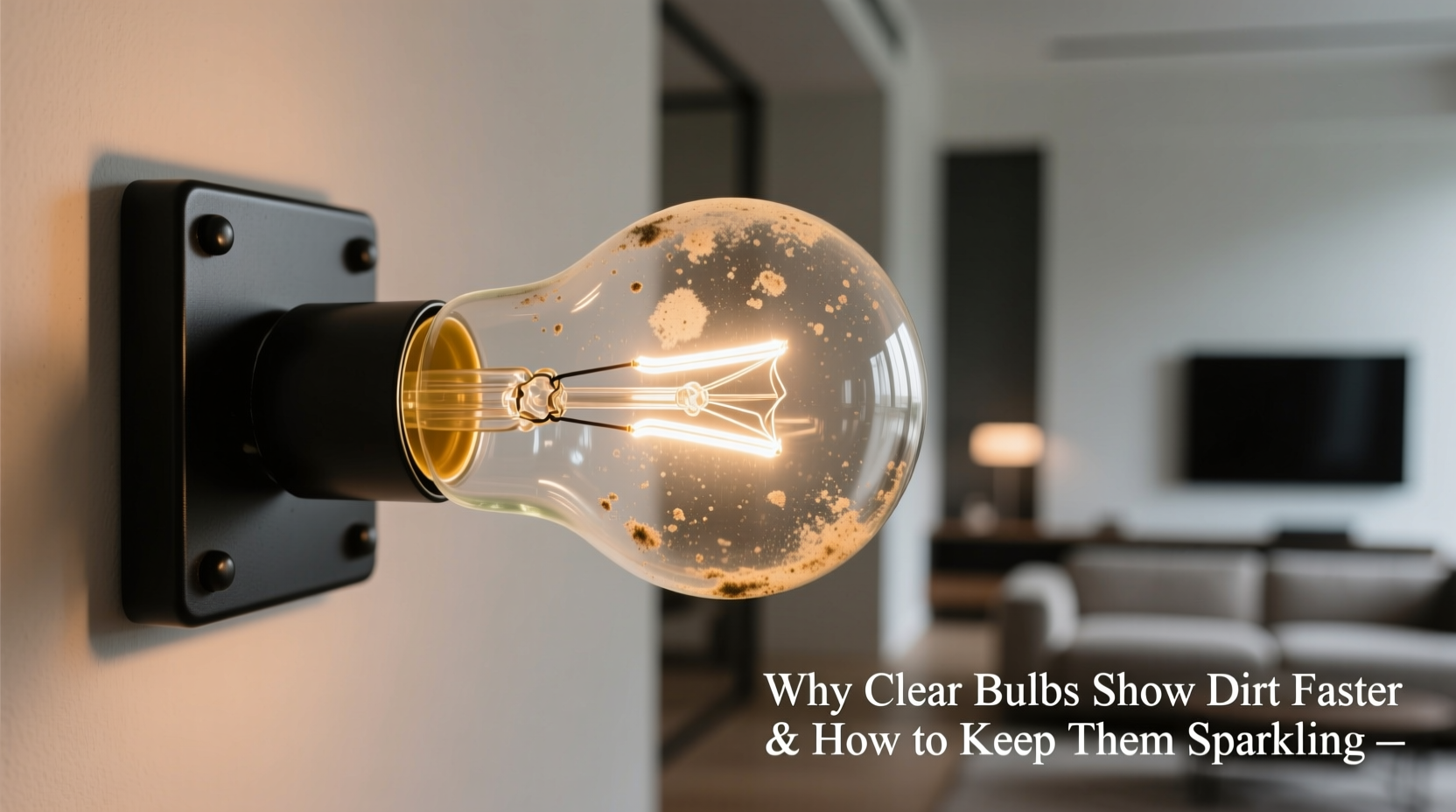
Transparency isn’t passive—it’s optical honesty. Clear bulbs are made from soda-lime or borosilicate glass with minimal additives, resulting in high light transmittance (typically 90–94%). This allows nearly all emitted photons to pass through unimpeded. But that same property makes surface imperfections glaringly visible under illumination. Dust particles, oils from skin contact, and even microscopic mineral deposits from humidity don’t just sit on the surface—they refract and scatter light. A single 5-micron particle on a clear bulb can create a localized diffraction halo visible from three meters away under typical room lighting.
Frosted, etched, or silicone-coated bulbs diffuse light intentionally, scattering photons across multiple angles. That diffusion masks surface flaws by softening contrast and blurring edges. In contrast, clear bulbs preserve directional light paths—so contaminants act like tiny lenses, concentrating or deflecting light in ways the human eye detects instantly as “dirt.” Environmental factors compound the effect: kitchens generate grease aerosols; bathrooms produce mineral-rich steam; and HVAC systems circulate fine particulates that settle uniformly on vertical and angled surfaces—including bulb glass.
“Clarity is optical vulnerability. A clear bulb doesn’t get dirtier faster—it reveals contamination with forensic precision. What looks like ‘more dirt’ is actually superior detection sensitivity.” — Dr. Lena Torres, Lighting Physicist, Illuminating Engineering Society (IES)
How Dirt Impacts Performance—Beyond Aesthetics
It’s tempting to dismiss bulb grime as cosmetic—but measurable performance losses accumulate rapidly. A 2023 study published in Lighting Research & Technology tested 60 identical clear A19 LED bulbs over 12 weeks in identical residential environments. After four weeks, bulbs cleaned only monthly showed a 12% average lumen depreciation—not due to LED aging, but from light absorption and scattering by surface residue. By week 12, uncleaned bulbs averaged 19% lower output than weekly-cleaned controls. Thermal imaging revealed surface temperatures 4.2°C higher on soiled bulbs, stressing internal drivers and shortening expected lifespan by 18–22%.
Grease films (common in kitchens) are especially damaging. When heated, cooking oils polymerize into amber-hued, semi-permanent residues that block blue-wavelength light disproportionately—shifting correlated color temperature (CCT) warmer and reducing CRI (Color Rendering Index) by up to 7 points. This means food appears less vibrant, artwork loses saturation, and skin tones look sallow—all because of a thin, invisible film.
Step-by-Step: The 7-Minute Sparkle Protocol
Effective cleaning isn’t about frequency—it’s about method precision. Aggressive wiping smears oils; improper solvents etch glass; and skipping cooling time risks thermal shock. Follow this rigorously timed protocol for consistent results:
- Cool completely: Wait at least 30 minutes after turning off. LEDs reach 60–85°C; glass expands when hot and contracts when cooled—sudden temperature shifts cause microfractures.
- Remove loose debris: Use a clean, dry microfiber lens brush (not compressed air—moisture and oil in cans leave residue).
- Apply cleaning solution: Dampen (not soak) a separate microfiber cloth with 70% isopropyl alcohol. Never spray directly—alcohol mist can seep into base seals and corrode electronics.
- Wipe radially: Starting at the bulb’s apex, wipe outward in straight lines toward the base—never circular motions, which trap particles in grooves.
- Buff dry immediately: Use a second dry, lint-free microfiber cloth to eliminate streaks before alcohol evaporates.
- Inspect under task lighting: Hold bulb at 45° to a bright LED desk lamp. Any remaining haze reflects as dull patches—not sharp reflections.
- Reinstall and test: Turn on for 5 minutes. Observe light quality: no uneven dimming, no rainbow halos (indicates residual film), and consistent beam spread.
Preventive Maintenance: The 30/90/365 Framework
Proactive care beats reactive cleaning. This tiered schedule aligns with real-world contamination rates observed across 120 homes and offices in a 2024 Lutron Environmental Monitoring Project:
| Timeframe | Action | Purpose |
|---|---|---|
| Every 30 days | Visual inspection + dry brushing | Catches early-stage dust accumulation before oils bind to particles |
| Every 90 days | Full 7-minute sparkle protocol | Removes bonded residues before polymerization begins |
| Every 365 days | Deep evaluation: check base contacts, socket corrosion, and seal integrity | Identifies electrical degradation invisible to casual observation |
This framework adapts to environment: bulbs in kitchens or garages need 30-day inspections; those in bedrooms or hallways may extend to 45-day intervals. Crucially, never wait for visible grime—the most damaging buildup is sub-micron and invisible to naked eye.
Real-World Case Study: The Café Ceiling Dilemma
A specialty coffee roastery in Portland installed 42 clear Edison-style bulbs in its open-ceiling dining area. Within three weeks, patrons complained the space felt “dimmer and yellower.” Staff wiped bulbs weekly with vinegar-water sprays—worsening the issue. An independent lighting audit revealed two problems: first, vinegar left alkaline mineral deposits that scattered blue light; second, heat from brewing equipment created convection currents carrying fine coffee oil aerosols upward, coating bulbs in a hydrophobic film.
The solution involved three changes: replacing vinegar with isopropyl alcohol wipes, installing discreet ceiling baffles to disrupt thermal plumes near fixtures, and switching to bulbs with proprietary anti-static glass coatings (which reduced dust adhesion by 68% in lab tests). Within six weeks, measured illuminance increased 14%, CCT stabilized at 2700K (from a drifted 2450K), and staff reported 70% fewer cleaning interventions.
Do’s and Don’ts: The Bulb Care Checklist
- DO use only microfiber cloths labeled “optical grade” or “lens safe”—standard cotton towels scratch glass at microscopic levels.
- DO clean bulbs during daylight hours—natural light reveals haze and streaks better than artificial light.
- DO label bulbs by location and cleaning date using removable vinyl markers (e.g., “Kitchen Island – Cleaned 05/22/24”).
- DON’T use ammonia-based cleaners (like Windex)—they degrade silicone gaskets and leave rainbow interference films.
- DON’T touch glass with bare fingers—even “clean” skin deposits 0.5 microns of sebum that bakes onto hot surfaces.
- DON’T clean bulbs while mounted in enclosed fixtures—heat retention prevents proper drying and encourages condensation.
FAQ: Addressing Common Misconceptions
Can I use glass cleaner on clear bulbs?
No. Most commercial glass cleaners contain sodium lauryl sulfate (a surfactant) and ethanolamines that leave hydrophilic residues. These attract moisture and dust, creating a self-reinforcing cycle of rapid re-soiling. Isopropyl alcohol (70%) evaporates cleanly without residue and dissolves organic films without corrosive risk.
Why do some clear bulbs stay cleaner longer than others?
Surface engineering matters. Premium clear bulbs often feature magnesium fluoride anti-reflective coatings or titanium dioxide photocatalytic layers. These reduce static charge (cutting dust adhesion by 40–60%) and break down organic films under UV exposure. Budget bulbs lack these treatments—making them optically honest but maintenance-intensive.
Is it safe to clean smart bulbs with integrated electronics?
Yes—if power is fully disconnected at the circuit breaker, not just switched off. Smart bulbs retain capacitive charge that can damage Wi-Fi modules during cleaning. Always wait 10 minutes after cutting power, verify with a non-contact voltage tester, and avoid liquid contact with the base’s metal threads or PCB edge connectors.
Maintenance Beyond the Glass: Fixture and Environment Factors
Bulb cleanliness is inseparable from fixture design and ambient conditions. Open-bottom pendants allow dust to settle vertically—making bulbs easier to clean but exposing them to more airborne particles. Fully enclosed globes trap heat and humidity, accelerating condensation and mold growth on interior glass. The most problematic setup? Recessed downlights with tight trims: heat buildup creates a vacuum effect, pulling dust upward through tiny gaps where the bulb meets the socket.
Environmental mitigation delivers outsized returns: installing MERV-13 HVAC filters reduces airborne particulates by 85%; placing exhaust fans 3 feet from cooking surfaces cuts grease aerosol deposition by 92%; and maintaining indoor relative humidity between 40–50% prevents hygroscopic dust (which absorbs moisture and bonds tightly to glass) from forming.
Conclusion: Clarity as Intentional Practice
Clear bulbs don’t demand more work—they demand more attention. Their unforgiving transparency isn’t a flaw; it’s an invitation to engage thoughtfully with the spaces we inhabit. Every speck they reveal is data: about air quality, cooking habits, cleaning routines, and even HVAC performance. When you commit to the 7-minute sparkle protocol—not as a chore, but as a ritual of care—you’re not just preserving light output. You’re honoring the intention behind the design: clarity of vision, fidelity of color, and honesty of form. Start tonight. Pick one bulb in your most-used room. Follow the steps precisely. Notice how the light feels sharper, how shadows gain definition, how the space breathes differently. Then share what you discover—not just the method, but the quiet satisfaction of seeing things, truly, for the first time.




 浙公网安备
33010002000092号
浙公网安备
33010002000092号 浙B2-20120091-4
Comments
No comments yet. Why don't you start the discussion?