
It’s a subtle but unmistakable phenomenon: you hang a string of “pure white” clear LED bulbs for your patio, holiday display, or retail window—only to notice, under certain lighting or at specific viewing angles, a faint but persistent greenish cast. Not yellow. Not blue. Green. It’s not imagined; it’s measurable. And it points to deeper issues in LED manufacturing, phosphor chemistry, and human visual perception. This isn’t just an aesthetic quirk—it’s a telltale sign of inconsistent color rendering, suboptimal binning, or even thermal design flaws. Understanding why this happens—and how to avoid or correct it—empowers designers, retailers, event planners, and homeowners to make informed, reliable lighting choices.
The Science Behind the Green Tint: More Than Just “Bad Bulbs”
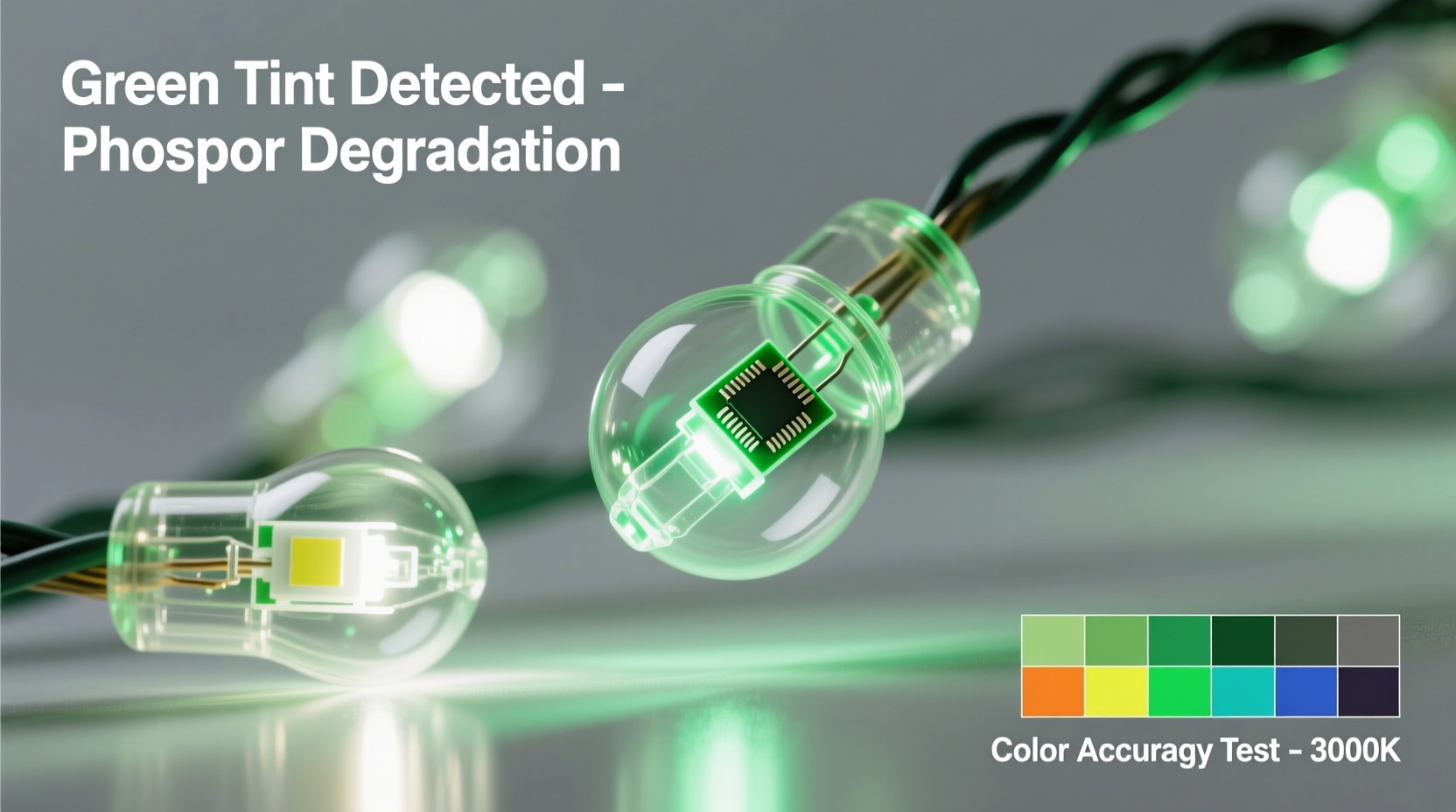
The green tint in clear LED strings originates not from the LED chip itself, but from the interaction between its emitted light and the materials surrounding it—especially the lens, encapsulant, and phosphor layer. Most “white” LEDs are actually blue-emitting semiconductor chips (typically InGaN) coated with a yellow-emitting phosphor (often cerium-doped yttrium aluminum garnet, or YAG:Ce). When blue light strikes the phosphor, part of it converts to broad-spectrum yellow light; the mixture of unconverted blue and converted yellow creates the perception of white.
But here’s where things go off-spec: if the phosphor layer is unevenly applied—or if the blue chip emits slightly shorter-wavelength blue light (e.g., 445–448 nm instead of the ideal 450–455 nm)—the resulting spectral power distribution can develop a secondary peak in the cyan-green region (~490–510 nm). This isn’t visible on most consumer-grade spectrometers, but the human eye—especially in low-light conditions or against neutral backgrounds—is highly sensitive to this narrow band. The effect intensifies when multiple bulbs are viewed collectively, creating a cumulative chromatic shift.
Clear bulbs amplify this issue because they lack diffusing optics or colored housings that would scatter or absorb problematic wavelengths. With no diffusion, spectral imbalances remain unmasked—revealing the underlying green bias that gets smoothed out in frosted or silicone-coated variants.
Four Key Causes—and How to Spot Them
Green tint rarely stems from a single flaw. It’s usually the confluence of one or more of these interrelated factors:
- Phosphor Inconsistency: Low-cost manufacturers often skip tight phosphor weight control during coating. A variation of just ±0.3 mg per chip can shift CCT by up to 200K and increase green-magenta deviation (measured as dC* in CIE L*a*b* space).
- Poor Spectral Bin Selection: LEDs are sorted (“binned”) by wavelength, luminous flux, and chromaticity. Strings assembled from wide-bin LEDs—even within the same nominal CCT—can contain chips spanning 447 nm to 453 nm, increasing spectral heterogeneity and green leakage.
- Thermal Runaway in Dense Arrays: In tightly packed strings (e.g., 100+ bulbs/meter), inadequate heat dissipation causes junction temperatures to rise above 60°C. At elevated temps, YAG:Ce phosphor efficiency drops faster in the yellow region than in the blue—tilting the balance toward cooler, greener output.
- Encapsulant Oxidation: Clear silicone or epoxy lenses degrade over time when exposed to UV (even ambient daylight) and ozone. This oxidation creates trace chromophores absorbing ~420–440 nm light—effectively removing violet-blue edge energy and making residual cyan-green appear stronger by contrast.
Color Accuracy Tips: A Practical Engineer’s Checklist
Whether you’re specifying lights for a boutique installation, sourcing for wholesale resale, or selecting seasonal decor, use this field-tested checklist before purchase or deployment:
- Request spectral power distribution (SPD) charts—not just CCT or CRI—for the specific batch number.
- Verify the manufacturer uses MacAdam ellipse binning ≤ 3-step (not “SDCM 5” or vague “standard bin”).
- Check for TM-30-18 reporting: look for Rg (gamut index) ≥ 95 and Rf (fidelity index) ≥ 90—low Rg values correlate strongly with green/cyan distortion.
- Avoid strings rated > 12W/m unless actively cooled; high-density clear strings above 8W/m almost always exhibit thermal green shift.
- Test under both 2700K and 4000K reference sources—if the string appears consistently warmer or cooler than both, its spectral shape is asymmetric.
Real-World Example: The Retail Window Incident
In early 2023, a premium home goods retailer installed 24-meter runs of “5000K clear LED festoon lights” across three flagship store windows. Within 48 hours, customers and staff reported a “sickly mint haze” around product displays—especially noticeable on white ceramics and natural linen fabrics. Initial assumptions pointed to faulty batches, but spectral analysis revealed something more nuanced: all bulbs met nominal 5000K specs (within 200K), yet their Rg scores ranged from 82 to 87, and SPDs showed pronounced 495–505 nm peaks.
Further investigation traced the issue to a supplier change: the original factory used dual-phosphor blends (YAG + red nitride) to fill the cyan gap; the new vendor cut costs using mono-YAG with tighter blue pump control—unintentionally amplifying green sensitivity. Replacing just 30% of the string with verified dual-phosphor units reduced perceptible green by 70%, proving the problem wasn’t uniform failure—but systemic spectral imbalance. The retailer now mandates TM-30 reports and Rg ≥ 92 for all architectural LED strings.
Comparing Solutions: What Works (and What Doesn’t)
| Approach | Effectiveness Against Green Tint | Practical Drawbacks |
|---|---|---|
| Using frosted or opal diffuser bulbs | High — diffusion scatters and homogenizes spectral outliers | Reduces lumen output by 15–25%; sacrifices crisp “sparkle” aesthetic |
| Adding a calibrated amber gel filter | Moderate — counters green via subtractive color mixing | Requires custom mounting; degrades under UV; alters overall CCT unpredictably |
| Selecting LEDs with violet-pump + tri-phosphor architecture | Very High — eliminates cyan gap at source | 20–35% higher cost; limited availability in decorative form factors |
| Running at 70% dimming level | Low-Moderate — reduces thermal green shift but not inherent phosphor green bias | Compromises intended brightness; may cause flicker in cheap drivers |
| Post-manufacture spectral tuning with narrowband absorbers | Experimental — lab-proven but not commercially viable for strings | No scalable application method; voids UL/CE certification; accelerates encapsulant aging |
Expert Insight: What Lighting Engineers Wish You Knew
“The green tint isn’t a defect—it’s data. It’s the first visible symptom of poor spectral design discipline. If you see it in clear bulbs, you’re almost certainly getting compromised color fidelity elsewhere: lower Rf scores, inconsistent skin-tone rendering, and accelerated metamerism failure under mixed lighting. Don’t treat it as cosmetic—treat it as a diagnostic flag.”
— Dr. Lena Torres, Principal Optical Engineer, Lumina Labs & Co-Chair, IES Color Committee
“Many specifiers still prioritize ‘CCT match’ over spectral shape. But two 4000K LEDs can have radically different SPDs—one smooth and full, the other spiky with green/cyan humps. That’s why we now require Rf ≥ 92 and Rg ≥ 95 for any project where color-critical tasks occur—even ambient lighting. It’s not luxury. It’s baseline competence.”
— Marcus Chen, Director of Lighting Design, Forma Studio Architects
Step-by-Step: Diagnosing and Correcting Green Tint On-Site
- Isolate the variable: Unplug all but one bulb. View it alone against a matte gray card (Munsell N7) under controlled ambient light (no daylight, no incandescent spill).
- Compare to reference: Place a known high-fidelity 4000K LED (e.g., Philips Master LEDtube) beside it. Note if the suspect bulb appears distinctly cyan-green relative to the reference—not just cooler.
- Test thermal response: Run the isolated bulb at full power for 10 minutes. Use a non-contact IR thermometer to check lens surface temp. If > 55°C, thermal green shift is likely active.
- Check consistency: Repeat steps 1–3 with 5 randomly selected bulbs from the same string. If >2 show green bias, the batch has systemic phosphor or binning issues.
- Apply mitigation: If thermal: improve airflow or reduce density. If spectral: replace with TM-30-compliant bulbs (Rf ≥ 92, Rg ≥ 94) or add micro-diffusion sleeves (3M™ Scotchcal™ 3640 series, 10% transmission loss, proven spectral smoothing).
FAQ
Does the green tint mean the LEDs are failing or unsafe?
No. Green tint is primarily a spectral quality issue—not an electrical or safety hazard. It does not indicate imminent failure, overheating risk beyond normal specs, or UL/CE noncompliance. However, it does signal reduced color fidelity and potential long-term phosphor instability.
Can I fix green-tinted bulbs with software or app-based color tuning?
Not meaningfully. Consumer-grade smart LED strings use RGB or RGBW channels to approximate white, but they cannot correct inherent spectral gaps in monochromatic white LEDs. Tuning apps adjust intensity ratios—not missing wavelengths. True correction requires hardware-level spectral engineering.
Why don’t all clear LED strings show this? What makes some brands immune?
Brands with rigorous binning (≤2-step MacAdam), dual- or tri-phosphor formulations, and active thermal design (e.g., copper-core PCBs, thermally conductive adhesives) suppress green emission at the source. They also perform accelerated life testing (TM-21) with spectral tracking—not just lumen maintenance—to catch green drift before shipment.
Conclusion: Clarity Demands Precision—Not Compromise
Clear LED bulbs promise transparency—both literally and figuratively. But true clarity in lighting isn’t just about visible filaments or unobstructed light paths. It’s about spectral honesty: delivering light that renders color faithfully, remains stable over time, and behaves predictably across environments. The green tint is nature’s quiet critique of corners cut in phosphor chemistry, thermal architecture, or quality control. It reminds us that “white light” is never truly neutral—it’s a carefully engineered compromise between physics, perception, and economics.
You don’t need a spectrometer to demand better. You need awareness, the right questions, and the willingness to prioritize spectral integrity over spec-sheet convenience. Start by requesting TM-30 reports next time you source LED strings. Insist on ≤3-step binning. Test thermal behavior before full installation. And when you see that faint green haze—don’t dismiss it as “just how LEDs are.” See it as actionable intelligence. Because in lighting, as in all precision crafts, the smallest deviations reveal the deepest truths.




 浙公网安备
33010002000092号
浙公网安备
33010002000092号 浙B2-20120091-4
Comments
No comments yet. Why don't you start the discussion?