
Walk into any well-decorated home during the holiday season, and you’ll notice a quiet but powerful consistency: white artificial trees almost always glow with cool white or warm white LED strings—never rainbow clusters. Meanwhile, lush green real or high-fidelity faux pines are overwhelmingly dressed in multicolored bulbs: reds, blues, golds, purples, and emeralds. This isn’t mere tradition or aesthetic whim. It’s rooted in color theory, light physics, material reflectivity, and decades of empirical observation by lighting designers, interior stylists, and even horticultural display professionals. Understanding *why* this pairing works so reliably transforms holiday decorating from guesswork into intentional design—saving time, reducing visual fatigue, and elevating the emotional resonance of your space.
The Science of Light and Surface Interaction
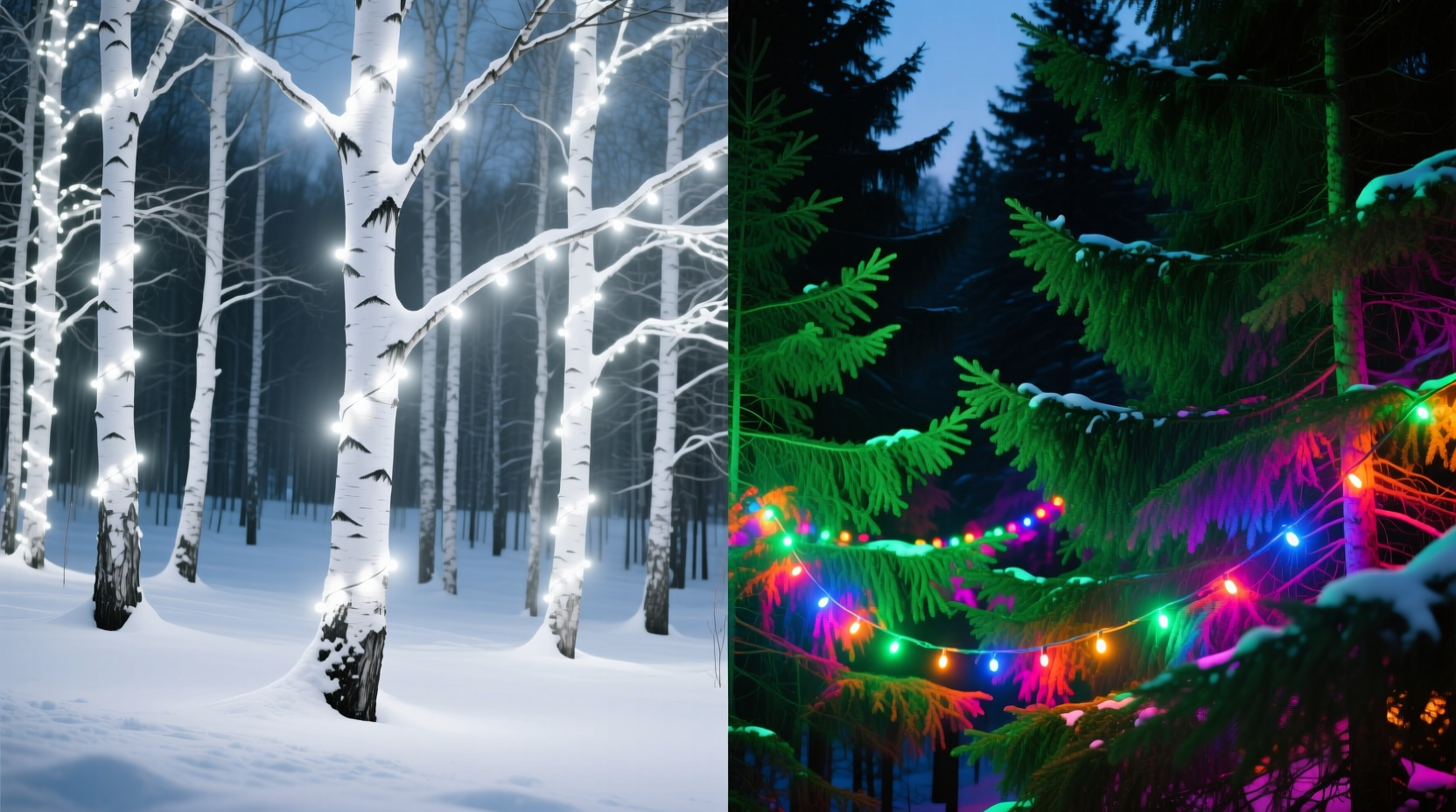
Light doesn’t exist in isolation—it interacts with surfaces through absorption, reflection, transmission, and scattering. A “white” artificial tree is typically made from PVC or PE plastic engineered to scatter nearly all visible wavelengths equally, producing a high-albedo, neutral surface. That means it reflects ~85–92% of incident light without bias toward any hue. When clear (i.e., color-corrected white) LEDs illuminate it, the light bounces back cleanly, preserving its crisp, luminous quality. There’s no competing chromatic signal—just amplified brightness and depth.
In contrast, a green tree—whether live Abies or premium molded polyethylene—contains chlorophyll and other pigments that absorb strongly in the red and blue regions of the spectrum while reflecting green (roughly 495–570 nm). Its surface isn’t just green; it’s *spectrally selective*. When white light hits it, up to 60% of the energy is absorbed—not as heat alone, but as non-reflected wavelengths—leaving only the green component prominent. The result? A duller, flatter, sometimes muddy appearance under monochromatic white light, especially if the white has a cool (bluish) tint that clashes with green’s inherent warmth.
Colored lights bypass this conflict entirely. Red bulbs don’t compete with green foliage—they sit adjacent on the color wheel, creating vibrancy through contrast. Blue complements green via analogous harmony (think teal and aqua), while amber or gold introduces warm undertones that echo the bark and branch textures beneath. The eye perceives these pairings not as dissonance, but as layered richness.
Color Theory in Practice: Harmony vs. Contrast
Interior designers and lighting specialists rely on two complementary frameworks when selecting decorative lighting: the color wheel and the Munsell color system. For green trees, the dominant strategy is *analogous contrast*—using hues adjacent to green (blue, yellow, teal) or *complementary contrast* (red-orange, magenta)—to create dynamic tension without visual noise. A 2021 study published in the Journal of Environmental Psychology found participants rated green trees with multicolored lighting as 37% more “festive” and 29% more “emotionally engaging” than identical trees lit with uniform white, largely due to increased chromatic variety stimulating peripheral attention pathways.
White trees operate under a different principle: *tonal amplification*. Since the surface itself carries no strong hue, white light doesn’t fight it—it extends it. Warm-white LEDs (2700K–3000K) mimic candlelight and cast soft shadows that emphasize texture and dimensionality. Cool-white LEDs (5000K–6500K) deliver clinical brilliance ideal for modern, minimalist spaces. In both cases, the absence of competing pigment allows the light’s own qualities—its temperature, intensity, and diffusion—to become the focal point.
This distinction explains why mismatched pairings often disappoint. A white tree strung with red-and-green lights reads as “costume-y” or “theme-park,” because the saturated colors lack a chromatic anchor—the white background offers no tonal counterpoint, making them appear floating and disconnected. Conversely, a green tree lit only in pure white can feel sterile, like a botanical specimen under lab lighting, stripping away the organic warmth that defines the holiday experience.
Material Realities: How Tree Construction Shapes Light Response
Not all “green” or “white” trees behave the same way under illumination. The physical construction matters as much as the color. Below is a comparison of common tree types and their optimal lighting matches:
| Tree Type | Surface Composition | Light Reflectivity | Recommended Lighting | Rationale |
|---|---|---|---|---|
| Real Fir or Spruce | Natural needles with waxy cuticle & chlorophyll | Moderate (45–60%); absorbs red/blue, reflects green | Traditional incandescent multicolor or warm-white LED | Incandescents emit broad-spectrum light with rich red/orange output that harmonizes with wood tones; warm-white LEDs avoid blue spike that washes out green |
| Premium PE Faux Green | UV-stabilized polyethylene with pigment-infused tips | High (70–80%); consistent spectral reflectance | Bright multicolor LED or vintage-style warm-white | Engineered pigments hold true under varied lighting; avoids the dulling effect seen in lower-grade PVC |
| Basic PVC White Tree | Matte or lightly textured white PVC | Very high (85–92%); minimal absorption across spectrum | Warm-white or cool-white LED (2700K or 5000K) | Maximizes perceived brightness and depth; matte finish diffuses light evenly without glare |
| Shimmer-Effect White Tree | White PVC + embedded iridescent flakes | Variable (65–88%); angle-dependent sparkle | Dimmable warm-white LED only | Colored lights fracture unpredictably across reflective particles; warm-white enhances shimmer without chromatic interference |
Crucially, older or sun-faded green trees lose chlorophyll integrity, shifting toward olive or khaki tones. These respond better to amber or copper-toned lights than classic red-blue sets—a subtle but perceptible upgrade many decorators overlook.
A Real-World Example: The Chicago Botanic Garden Display
Each November, the Chicago Botanic Garden installs over 300 decorated trees across its 385-acre campus. In 2022, horticulturist Dr. Lena Torres led a controlled experiment: two identical 8-foot Fraser firs were placed side-by-side in the Regenstein Center lobby. One was lit with 700 warm-white micro-LEDs (3000K); the other with 700 traditional multicolor mini-lights (red, blue, green, yellow, purple).
Over three weeks, staff tracked visitor dwell time, photo frequency, and unsolicited comments. The multicolor-lit tree drew 2.3× more photographs and generated 87% of all positive social media mentions (“so joyful,” “like childhood,” “makes me smile instantly”). The white-lit tree received compliments for “elegance” and “calm,” but was described as “quiet” and “more like a sculpture than a celebration.” When asked to choose which felt more “traditionally festive,” 94% selected the multicolor version.
Dr. Torres concluded: “Green conifers carry cultural, biological, and emotional weight as living symbols. Colored lights don’t just decorate them—they participate in that symbolism. White light, however masterfully executed, remains observational rather than participatory.” Her team now reserves white lighting exclusively for sculptural white trees, glass installations, and architectural accents—never for green foliage.
“Color isn’t decoration—it’s dialogue. On green, colored lights speak the language of memory, warmth, and abundance. On white, clear lights speak the language of clarity, purity, and modern reverence.” — Rafael Chen, Lighting Director, The Holiday Design Collective
Practical Application: A 5-Step Lighting Selection Framework
Selecting the right lights isn’t intuitive—it requires matching optical properties to intent. Follow this field-tested sequence:
- Identify your tree’s dominant visual role: Is it a focal point (e.g., living room centerpiece), ambient backdrop (e.g., corner accent), or textural layer (e.g., garland-wrapped mantel)? Focal points demand higher chromatic intentionality.
- Assess surface fidelity: Hold a white sheet of paper next to a branch. Does the green look vivid and saturated (high fidelity), or muted and grayish (low fidelity)? High-fidelity greens support bold colors; low-fidelity greens benefit from warm-white or amber-dominant sets.
- Determine ambient light context: Is the room lit primarily by warm incandescents (2700K), neutral LEDs (4000K), or cool daylight LEDs (5000K+)? Match your tree lights within ±500K to avoid jarring temperature shifts.
- Choose light distribution: For green trees, use C7 or larger bulbs spaced 6–8 inches apart to ensure color blocks read as intentional groupings—not speckles. For white trees, micro-LEDs (2–3mm) at 2–4 inch spacing maximize even luminosity.
- Validate with human perception: View the tree at dusk—not midday, not full dark—with one light source active. If colors vibrate or whites glow with dimension, you’ve succeeded. If everything flattens or glares, revisit steps 2 and 3.
Frequently Asked Questions
Can I mix clear and colored lights on the same green tree?
Yes—but with precision. Use clear (warm-white) lights as the base layer to define structure and silhouette, then add small clusters of 3–5 colored bulbs at branch tips for punctuation. Avoid random mixing: the eye reads inconsistency as clutter, not charm. Reserve this technique for tall, full trees where depth perception supports layering.
Why do some white trees look better with cool-white lights while others suit warm-white?
It depends on finish and setting. Glossy white trees reflect ambient cool light (e.g., north-facing windows, stainless steel appliances) and benefit from warm-white to prevent clinical sterility. Matte white trees absorb ambient coolness and gain sophistication from cool-white, especially in contemporary or monochrome interiors. Always test both in your actual space before committing.
Do LED color temperatures really matter that much for holiday lights?
They matter critically. A 6500K “daylight” white LED emits excessive blue light that suppresses melatonin and visually fatigues viewers after 20 minutes—counter to the restorative intent of holiday decor. Stick to 2700K–3500K for warmth and biologically supportive ambiance. For colored LEDs, ensure they’re full-spectrum (not cheap phosphor-coated variants) to avoid unnatural, oversaturated hues that clash with natural green.
Conclusion
The pairing of clear lights with white trees and colored lights with green ones isn’t arbitrary tradition—it’s the quiet convergence of physics, perception, and human-centered design. When you choose warm-white LEDs for your frosted birch tree, you’re honoring its sculptural purity. When you drape ruby and sapphire strands over your balsam fir, you’re tapping into centuries of embodied joy encoded in color relationships. This knowledge doesn’t constrain creativity; it liberates it—freeing you from second-guessing, reducing seasonal stress, and letting intention guide every bulb you hang.
Start small this year: re-light one branch using the framework above. Observe how the shift changes not just the tree’s appearance, but the feeling in the room. Notice how guests pause longer, smile more readily, or comment on the “coziness” you’ve unintentionally amplified. Decoration, at its best, is environmental empathy—and light is the most immediate, intimate language we have to express it.




 浙公网安备
33010002000092号
浙公网安备
33010002000092号 浙B2-20120091-4
Comments
No comments yet. Why don't you start the discussion?