
At first glance, both clear twinkle lights and warm white LED string lights may seem like simple decorative lighting options. Yet, when hung side by side, their visual impact is strikingly different. One emits a sharp, sparkling effect with visible points of light, while the other glows softly, casting a smooth, golden ambiance. The reason behind this difference lies not just in color but in the interplay of optics, materials, and human perception. Understanding these distinctions helps consumers make informed choices for holiday décor, outdoor patios, or ambient indoor lighting.
The Science of Light Emission and Diffusion
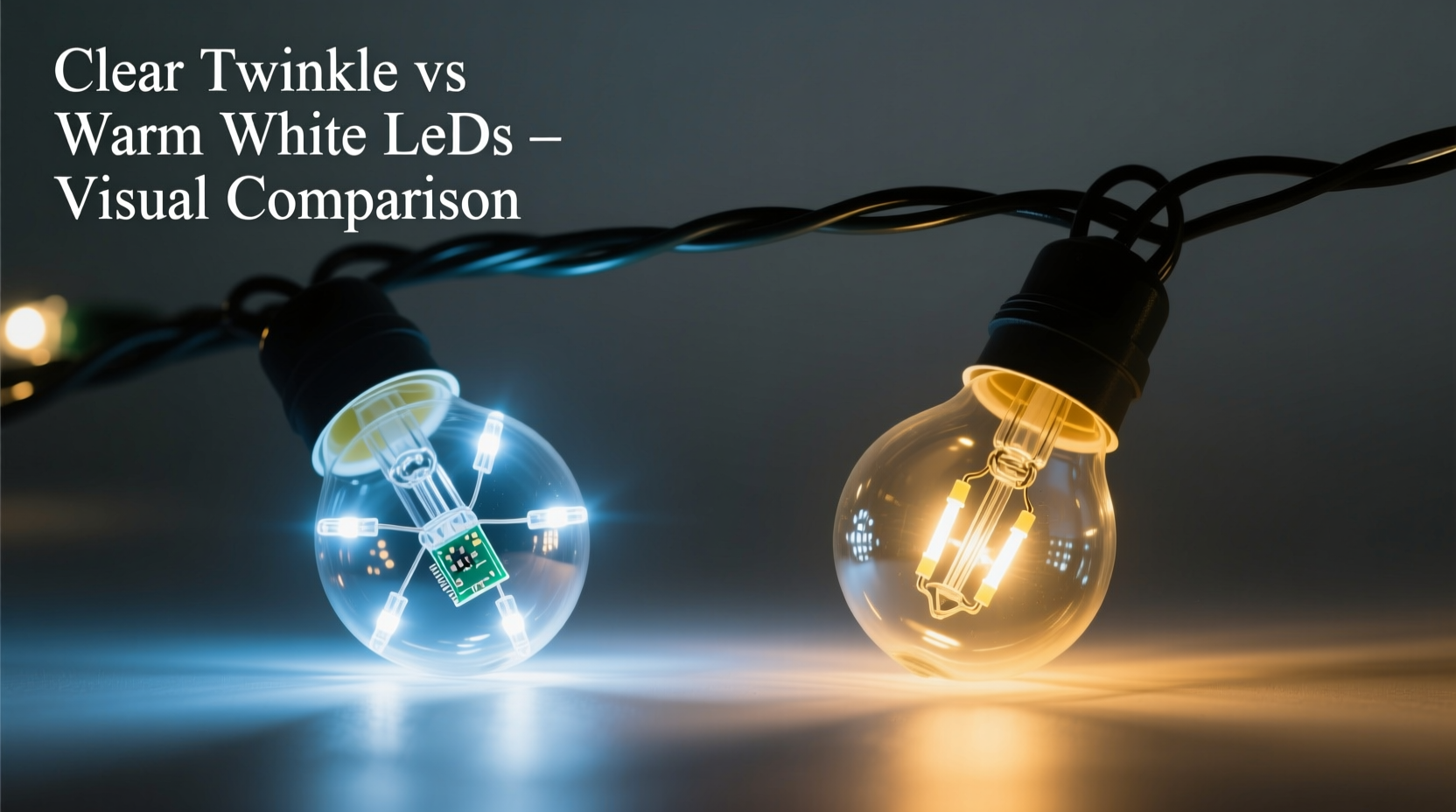
LEDs (Light Emitting Diodes) produce light through electroluminescence—a process where electrons recombine with electron holes within a semiconductor, releasing energy in the form of photons. While all LEDs generate light at a specific wavelength, how that light reaches the eye depends heavily on the bulb's housing and lensing.
Clear twinkle lights use transparent plastic casings that allow light to escape directly from the diode with minimal scattering. This results in high-intensity pinpoint beams that appear brighter up close and create a “sparkling” effect, especially in low-light environments. Because there’s no diffusion layer, shadows and reflections are more pronounced, contributing to a dynamic, flickering appearance when paired with twinkling circuits.
In contrast, warm white LEDs typically feature frosted or diffused lenses. These surfaces scatter the emitted light across a broader angle, softening the intensity and eliminating harsh hotspots. The result is a more uniform glow that mimics the gentle radiance of incandescent bulbs. This diffusion reduces glare and makes the light feel warmer and more inviting—even if the actual color temperature is similar to a clear LED.
Color Temperature vs. Visual Perception
While both types of lights can fall under the \"white\" spectrum, they differ significantly in color temperature—measured in Kelvin (K). Warm white LEDs typically range between 2700K and 3000K, producing a yellowish hue reminiscent of candlelight or traditional tungsten filaments. Clear twinkle lights, however, often emit a cooler white—sometimes reaching 4000K or higher—giving them a crisper, bluer tint.
But perceived warmth isn’t solely determined by Kelvin ratings. The clarity of the bulb plays a critical role. A 3000K LED inside a clear casing still appears sharper and less enveloping than a diffused 3000K bulb because the light remains concentrated. Human eyes interpret focused points of light as “cooler” even when the spectral output is identical. This phenomenon explains why two strings rated at the same color temperature can evoke entirely different moods.
Moreover, context influences perception. When used outdoors against a dark sky, clear twinkle lights resemble stars—distant and brilliant. Indoors, especially around reflective surfaces like glass or polished wood, they create lively highlights. Warm white diffused LEDs, on the other hand, blend seamlessly into interior décors, enhancing coziness without drawing attention to individual bulbs.
“Perceived warmth in lighting is as much about distribution and texture as it is about color temperature. Two lights at 2900K can feel worlds apart based on diffusion alone.” — Dr. Lena Torres, Lighting Design Researcher, MIT Media Lab
Bulb Design and Optical Engineering
The physical construction of the LED bulb determines how light behaves after emission. Let’s compare key structural differences:
| Feature | Clear Twinkle Lights | Warm White Diffused LEDs |
|---|---|---|
| Lens Material | Transparent polycarbonate or acrylic | Frosted or textured polymer |
| Light Spread | Narrow beam (15°–30°) | Wide dispersion (120°+) |
| Glare Level | High—visible direct source | Low—softened edges |
| Use Case | Decorative accent, outdoor sparkle | Ambient illumination, indoor comfort |
| Twinkling Mechanism | Often built-in intermittent circuitry | Rarely includes blinking; steady output |
Manufacturers engineer clear bulbs to maximize luminance—the amount of light emitted per unit area. This creates intense focal points ideal for catching the eye. Diffused bulbs prioritize illuminance—the total light falling on a surface—making them better suited for functional or mood lighting.
Additionally, many warm white LEDs incorporate phosphor coatings on the diode itself. This converts some blue light into longer wavelengths, shifting the overall output toward amber. In clear bulbs, this coating may be thinner or absent, preserving a purer, more energetic white tone—even in products labeled “warm white.”
Real-World Example: Patio Lighting Makeover
Consider Sarah, a homeowner in Portland who wanted to upgrade her backyard patio for evening gatherings. She initially installed clear twinkle lights overhead, expecting a romantic café-like atmosphere. Instead, guests complained of eye strain and found the space too “busy.” Individual bulbs were glaringly bright, and the twinkling effect felt chaotic rather than soothing.
After consulting a landscape designer, she replaced the clear strings with warm white diffused LEDs mounted along the pergola beams. The new setup produced a continuous, gentle wash of light. Conversation flowed more easily, food looked appetizing under flattering illumination, and the overall vibe shifted from festive to intimate.
This case illustrates how technical specifications translate into lived experience. Both systems used LED technology and similar wattages, yet only the diffused version achieved the desired emotional outcome. It wasn’t about brightness—it was about quality of light.
How to Choose the Right Option for Your Space
Selecting between clear twinkle lights and warm white diffused LEDs depends on your goals. Use the following checklist to guide your decision:
- Define the purpose: Is the lighting meant to be seen (decorative) or to help you see (functional)?
- Assess the environment: Will it be used indoors, outdoors, in full darkness, or ambient twilight?
- Evaluate viewing distance: Are people looking at the lights directly (e.g., ceiling-mounted), or are they part of a background ambiance?
- Match existing décor: Do cool, modern finishes dominate, or is the space warm and rustic?
- Test before committing: Purchase small sample strands to observe performance at different times of day.
Step-by-Step Guide to Installing Ambient-Friendly Lighting
- Survey the area: Walk through the space at night and note where shadows fall and where brightness is needed.
- Determine fixture locations: Mark spots for mounting clips or hooks, spacing them evenly for consistent coverage.
- Choose power sources: Decide whether to use plug-in sets, battery-operated strings, or hardwired solutions.
- Install warm white diffused LEDs first: Run these along edges, railings, or ceilings to establish a foundational glow.
- Add clear twinkle lights selectively: Place them in areas where sparkle enhances the scene—such as tree canopies or architectural details.
- Test and adjust: Turn on the lights and observe from multiple angles. Reposition any bulbs causing glare or uneven patterns.
- Secure wiring: Use weatherproof tape or conduit to protect connections, especially outdoors.
This layered approach ensures both functionality and aesthetic appeal, combining the best qualities of each type of light.
Frequently Asked Questions
Can I mix clear twinkle lights with warm white LEDs?
Yes, but do so intentionally. Mixing them works well when one type serves as a base layer (usually warm white) and the other adds accent sparkle (clear twinkle). Avoid alternating bulbs in the same strand, as this can create visual confusion. Instead, group them separately to maintain coherence.
Do warm white LEDs last longer than clear twinkle lights?
Lifespan depends more on build quality and usage than bulb clarity. Most quality LEDs last 25,000 to 50,000 hours regardless of lens type. However, clear bulbs may show signs of aging faster due to visible yellowing of plastic under UV exposure, particularly in sunny climates.
Why do some clear \"warm white\" LEDs still look cold?
Marketing labels can be misleading. Some manufacturers label any non-blue-white LED as “warm,” even if it measures above 3500K. Always check the Kelvin rating on packaging. True warm white should be below 3000K. Additionally, lack of diffusion amplifies the perception of coolness, making even properly colored clear bulbs appear harsher.
Final Thoughts: Light Shapes Experience
The difference between clear twinkle lights and warm white LEDs goes beyond aesthetics—it shapes how we experience a space. One excites the eye with brilliance and motion; the other comforts the soul with even, embracing warmth. Recognizing these distinctions empowers smarter design choices, whether decorating for the holidays or crafting a year-round sanctuary.
Modern lighting offers unprecedented control over ambiance, but only if users understand the tools at their disposal. By considering not just color temperature but also diffusion, beam angle, and application context, anyone can transform an ordinary setting into something memorable.




 浙公网安备
33010002000092号
浙公网安备
33010002000092号 浙B2-20120091-4
Comments
No comments yet. Why don't you start the discussion?