
For many college students, the first holiday season away from home isn’t just about missing family dinners or hometown lights—it’s about redefining what “home” means when your entire living space fits inside a 10-by-12-foot dorm room or a studio apartment smaller than a standard parking spot. In that context, the miniature Christmas tree has quietly evolved from a decorative afterthought into a cultural touchstone: a symbol of autonomy, warmth, and intentional joy. It’s not nostalgia dressed down—it’s resilience made tangible, scaled to fit real life. This isn’t about downsizing tradition; it’s about redesigning it for authenticity, affordability, and emotional sustainability.
The Spatial Reality of Student Living
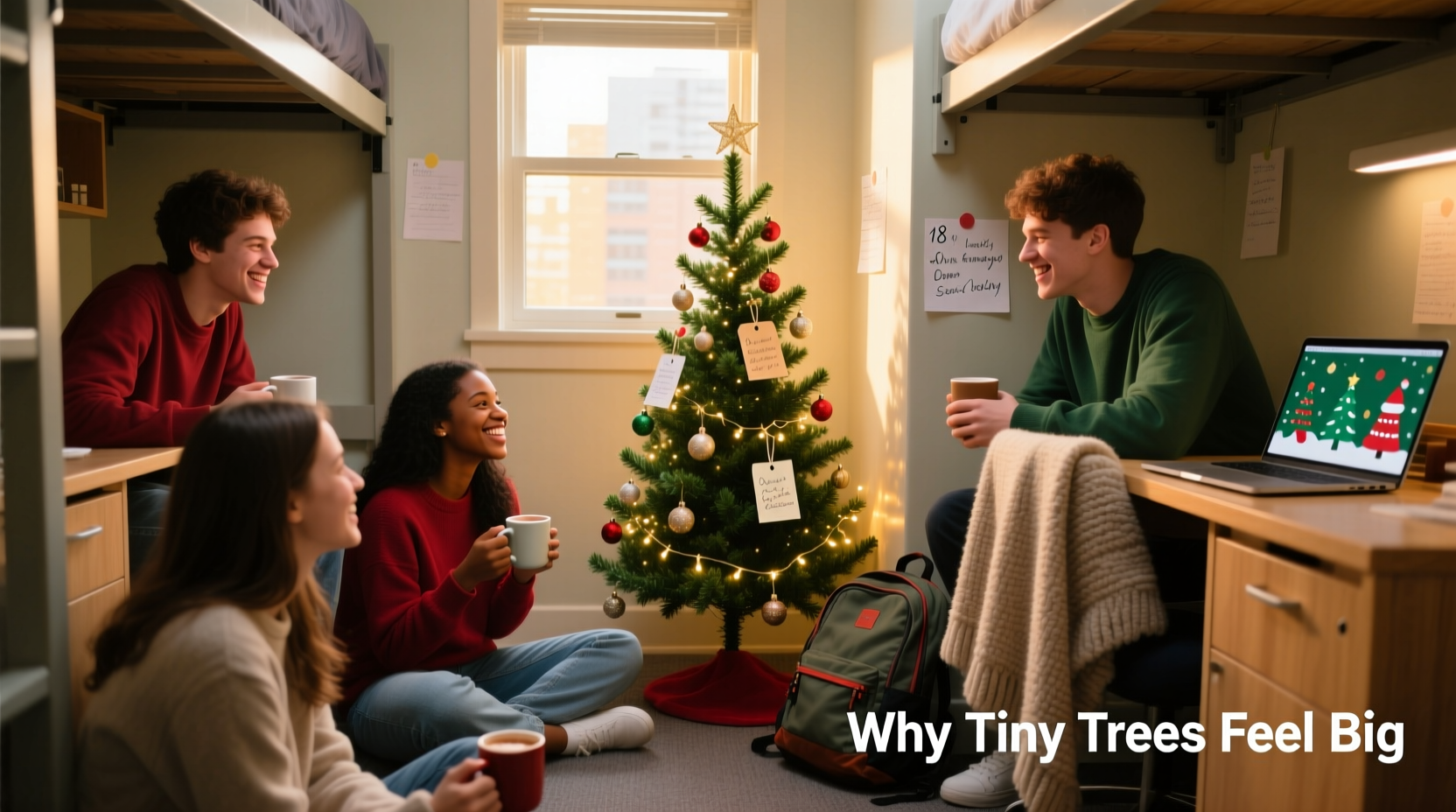
Most college housing units impose strict spatial constraints—not by choice, but by design. Dorm rooms average 80–120 square feet per resident, often shared with one or more roommates. Off-campus apartments favored by upperclassmen rarely exceed 400 square feet for a full unit. Fire codes prohibit live trees over 6 feet tall in many residence halls; some campuses ban them entirely. Even artificial trees face restrictions on base weight, electrical load, and flame-retardant certification. These aren’t arbitrary rules—they reflect genuine safety concerns in densely populated, older buildings with limited egress and outdated wiring.
Enter the mini Christmas tree: typically 18 to 36 inches tall, weighing under 5 pounds, and requiring no assembly tools or ladder access. Its footprint is smaller than a laptop bag. It fits on a windowsill, a bookshelf, a desk corner—even a repurposed milk crate draped with burlap. More importantly, its scale aligns with how students actually inhabit space: vertically, modularly, and transiently. Unlike a full-size tree demanding floor real estate and seasonal commitment, a mini tree lives where life happens—within arm’s reach of textbooks, headphones, and late-night ramen.
Psychological Anchoring in a Season of Flux
College coincides with profound developmental transitions: identity formation, geographic displacement, shifting support systems, and increasing responsibility—all compressed into four years. The holidays intensify this disorientation. Students report higher rates of seasonal loneliness during November and December, especially first-years navigating their first extended time away from home. A mini Christmas tree serves as what psychologists call a “micro-anchor”: a small, consistent sensory cue that grounds emotional experience in continuity and self-determination.
Lighting its LEDs, hanging a handmade ornament from childhood, or arranging pine-scented sachets around its base engages multiple senses—sight, touch, smell—activating memory networks tied to safety and belonging. Crucially, the act of choosing *how* to decorate it—minimalist white lights only, vintage tinsel, or thrift-store baubles strung with embroidery floss—becomes an assertion of personal narrative. It’s not about replicating home; it’s about declaring, “This version of me belongs here, too.”
“Students who create intentional, tactile rituals—even small ones like lighting a single candle or arranging a mini tree—show measurably lower cortisol levels during high-stress periods. The ritual matters more than the scale.” — Dr. Lena Torres, Clinical Psychologist & Director of Student Wellness at University of Vermont
Economic Pragmatism Meets Creative Expression
Let’s be direct: most college students operate on razor-thin budgets. The average undergraduate carries $3,200 in annual discretionary spending—after tuition, rent, groceries, and textbooks. A traditional 6-foot pre-lit artificial tree costs $80–$150. Add $30 for a stand, $25 for lights, $40 for ornaments, and $15 for storage—totaling over $180 for a single-season item. That’s nearly two-thirds of a month’s food budget.
A quality mini tree—LED-lit, weighted base, PVC or PE tips, 24 inches tall—costs $22–$45. Many students source them secondhand ($8–$15), upcycle materials (wire coat hangers + green pipe cleaners), or build them from scratch using foraged branches and twine. The economics extend beyond purchase price: mini trees consume 0.5–2 watts per hour versus 20–60 watts for full-size models. Over December’s 31 days, that’s less than $0.25 in electricity versus $3.50–$10.00.
But cost savings alone don’t explain the cultural resonance. What does is the creative agency it affords. With limited space comes intensified curation. Every ornament tells a story: a ceramic snowman from a campus craft fair, a tiny skateboard charm representing a new friend group, a photo ornament of parents holding a “We miss you!” sign. There’s no pressure to impress guests—just permission to express what feels true *now*. That freedom transforms decoration from performance into documentation.
Practicality Without Compromise: A Step-by-Step Setup Guide
Setting up a mini tree isn’t intuitive—it requires deliberate choices to maximize impact while respecting constraints. Here’s how students consistently get it right:
- Select the base first: Prioritize stability over aesthetics. Choose a weighted ceramic pot, a filled mason jar with sand, or a 3D-printed base with rubberized grip. Avoid flimsy plastic stands.
- Test electrical load: Plug the tree’s cord into the same outlet used for your laptop charger and lamp. If the circuit trips, use a UL-listed power strip with built-in surge protection—and never daisy-chain strips.
- Layer lighting strategically: Start with warm-white micro-LEDs wrapped tightly around the trunk. Add 3–5 accent lights (e.g., copper wire fairy lights) draped asymmetrically on outer branches for depth.
- Anchor with scent: Skip overpowering plug-ins. Instead, place a cotton ball soaked in 2 drops of balsam fir essential oil near the base—or tuck dried orange slices between branches.
- Finalize with meaning: Hang exactly 3–5 ornaments. Fewer items increase visual breathing room and emphasize intentionality. Rotate them weekly if desired—this extends emotional engagement across the season.
Mini Tree Comparison: What Works (and What Doesn’t) in Tiny Spaces
| Feature | Ideal for Students | Risky or Impractical |
|---|---|---|
| Height | 18–30 inches (fits under ceiling sprinklers, on desks) | 36+ inches (blocks sightlines, violates fire code in 62% of dorms) |
| Base Type | Weighted ceramic, sand-filled jar, or non-slip rubber base | Flimsy plastic tripod (tips easily with desk vibrations) |
| Lighting | USB-rechargeable or low-wattage LED (≤2W) | AC-powered strings with exposed wiring (trip hazard, outlet overload) |
| Material | PE tips (realistic, flame-retardant) or metal-wire frame | Uncoated PVC (off-gasses VOCs in poorly ventilated rooms) |
| Storage | Folds flat or nests into a 6\"x6\"x2\" box (fits under bed) | Rigid tube packaging (requires closet shelf space) |
Real Example: Maya’s Dorm Room Transformation
Maya Chen, a sophomore biochemistry major at Ohio State, moved into her double dorm in August with two suitcases, a folding chair, and a sense of quiet dread about the upcoming holidays. Her roommate planned to fly home for Thanksgiving and stay through New Year’s. Maya’s family lived 1,200 miles away and couldn’t afford her flight. “I didn’t want to feel like I was ‘settling’ for a sad, half-hearted holiday,” she said. “I wanted something that felt chosen—not compromised.”
She spent $14.99 on a 22-inch pre-lit spruce-style tree from a local thrift store. Using a repurposed glass apothecary jar filled with river stones and moss, she created a stable, natural-looking base. She hand-painted three wooden ornaments: one with her dorm building’s silhouette, one with her lab partner’s initials, and one reading “Rooted.” She strung biodegradable jute twine between the branches and clipped dried lavender buds along its length. For light, she used a solar-charged string that absorbed daylight from her south-facing window.
“It took 20 minutes to set up. It doesn’t dominate the room—but it changes the energy. When I study at night, that soft glow makes my desk feel like a sanctuary. When friends visit, they always comment on the lavender smell before they even see the tree. It’s not about being festive. It’s about saying, ‘This space is mine—and it holds joy, too.’”
FAQ: Mini Trees in Student Life
Can I take my mini tree to class or the library?
Yes—if it’s truly portable (under 2 lbs, battery-powered, and fully assembled). Many students use tabletop trees with suction-cup bases on study carrels or lab benches. Just ensure lights are dimmable and won’t distract others. Avoid scented elements in shared academic spaces.
What if my lease or dorm policy bans all decorations?
Focus on “stealth celebration”: a single branch in a vase with fairy lights, a framed photo of a family tree, or a holiday-themed notebook cover. Some students create “tree shadows” by projecting light patterns onto walls using stencil cutouts. The spirit matters more than the object.
How do I store it without a closet?
Disassemble and nest components inside a flat storage bin that slides under your bed (standard height clearance: 6–8 inches). Wrap lights around a cardboard spool; store ornaments in a mint tin or pill organizer. Label everything with masking tape—no one wants to dig for tinsel during finals week.
Why This Trend Endures Beyond December
The mini Christmas tree’s popularity isn’t a passing fad—it’s a response to structural realities that extend far beyond college. Students are among the first generation to navigate adulthood amid chronic spatial scarcity: rising rents, shrinking urban apartments, remote work blurring home/office boundaries, and climate-driven migration into denser housing. Their approach to the holiday tree models a broader ethos: that meaning isn’t proportional to size, that care can be precise rather than abundant, and that belonging is built through daily, intentional acts—not grand gestures.
When a student chooses a 24-inch tree over a 72-inch one, they’re not sacrificing tradition. They’re practicing design thinking: identifying constraints (space, budget, time, safety), defining human needs (comfort, connection, identity), and prototyping solutions that honor both. That mindset transfers directly to internships, research labs, and future homes. The tree becomes less a holiday prop and more a quiet manifesto—one lit branch at a time.




 浙公网安备
33010002000092号
浙公网安备
33010002000092号 浙B2-20120091-4
Comments
No comments yet. Why don't you start the discussion?