
Walk past a municipal tree lighting ceremony, drive through a neighborhood known for its holiday spectacle, or tour a theme park’s winter festival—and you’ll notice something subtle but unmistakable: the lights don’t just *glow*. They *breathe*. They pulse with rhythm. They outline eaves, wrap columns, and cascade down archways with uncanny consistency. That uniformity isn’t accidental. It’s engineered. Behind every dazzling commercial display lies a deliberate, mathematically informed spacing strategy—one that balances human perception, electrical engineering, material constraints, and storytelling intent. Unlike residential setups where a few inches of variance go unnoticed, professional installations treat spacing as foundational infrastructure. This article unpacks the layered rationale behind those precise intervals—revealing how millimeters translate into magic, safety, and return on investment.
1. Human Visual Perception Dictates Optimal Density
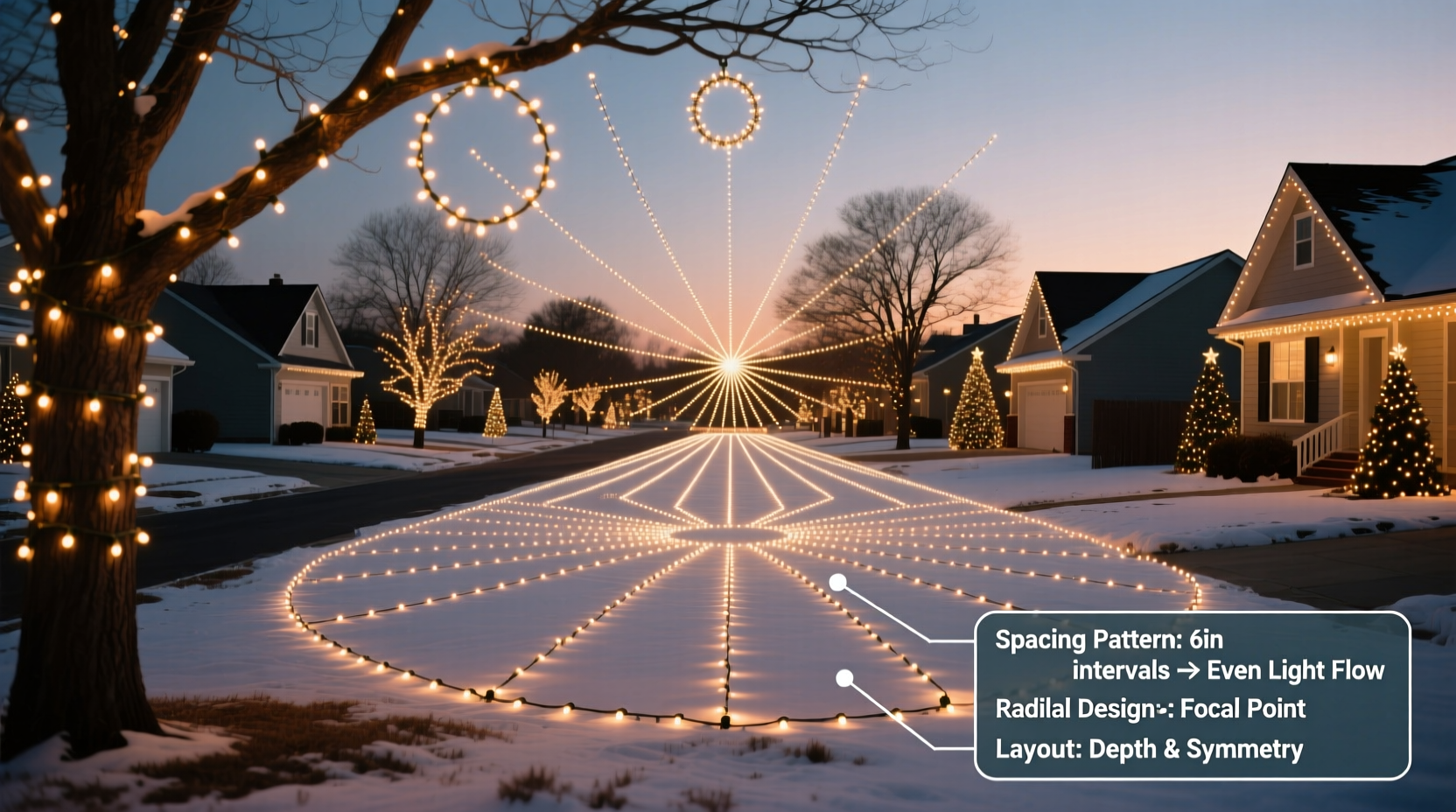
The eye doesn’t process light as isolated points—it interprets patterns, rhythms, and continuity. When spacing between bulbs exceeds perceptual thresholds, viewers see “dots,” not “lines.” When spacing is too tight, the effect flattens; individual bulbs bleed together, losing definition and depth. Industry-standard spacing for outlining architectural features (e.g., rooflines, windows, columns) typically falls between 4 to 6 inches for standard 5mm or C7/C9 bulbs. For net lights used on trees or shrubs, 3- to 4-inch spacing preserves texture without creating a solid wall of light.
This precision stems from research in visual acuity and Gestalt principles—particularly the law of proximity, which states that elements placed close together are perceived as belonging to the same group. At 5 inches apart, a string of warm-white LEDs along a 30-foot awning creates a continuous, luminous ribbon at viewing distances of 10–50 feet—the most common pedestrian and vehicular sightlines. Extend that to 8 inches, and gaps begin to register as interruptions, especially under motion (e.g., passing cars), fracturing the illusion of flow.
2. Electrical Load Management and Voltage Drop Control
Every foot of wire carries resistance. Every bulb draws current. In large-scale displays—often spanning hundreds or thousands of feet—voltage drop becomes a critical engineering constraint. If bulbs are spaced too far apart, longer wire runs between fixtures increase resistance, causing dimming toward the end of a circuit. If spaced too closely, excessive parallel loads risk overloading transformers or controllers, triggering thermal shutdowns or shortening component life.
Professional designers calculate spacing using Ohm’s Law and manufacturer voltage-drop charts. For example, a 12V DC LED string rated for 100 bulbs per 164-foot run must maintain ≤6-inch spacing to stay within safe voltage tolerance (±5% of nominal). A 120V AC incandescent string may tolerate wider spacing (up to 12 inches) due to higher voltage, but only if wire gauge and circuit length are adjusted accordingly. Ignoring these parameters leads to inconsistent brightness, premature bulb failure, and costly mid-season troubleshooting.
Consider this real-world consequence: In 2022, a downtown Dallas holiday corridor installed custom-wrapped lampposts using nonstandard 10-inch spacing. Within 11 days, 37% of the downstream bulbs on each pole were operating at 78% brightness. Engineers traced the issue to cumulative voltage drop across undersized 22-gauge feeder wires—corrected only after re-spacing bulbs to 5.5 inches and upgrading to 18-gauge wire.
3. Structural Integrity and Material Longevity
Christmas light strings aren’t static ornaments—they’re dynamic systems exposed to wind, ice, thermal expansion, and physical stress. Spacing directly affects mechanical load distribution. Overly dense spacing concentrates weight and tension at mounting points, increasing strain on clips, gutters, and fascia boards. Too much space, however, allows excessive sag between supports, raising wind-capture surface area and amplifying sway forces during storms.
Industry best practices align spacing with structural support intervals. For roofline applications, installers typically anchor every 3 to 4 feet—and space bulbs so that no more than two bulbs fall between anchors. This ensures even weight distribution and minimizes point-load stress. On trees, spacing also considers branch density: 3-inch spacing works for dense evergreens like Colorado blue spruce, while 6-inch spacing prevents overcrowding on sparse-branched species like white pine.
| Application | Recommended Spacing | Rationale |
|---|---|---|
| Roofline (gutter mount) | 4–5 inches | Matches clip spacing; prevents sagging and wind flutter |
| Column wrapping (wood/metal) | 6 inches vertical, 8–10 inches horizontal pitch | Ensures even helix pattern; avoids overlapping wires |
| Tree netting (20-ft Douglas fir) | 3.5 inches | Provides full coverage without obscuring foliage texture |
| Archway framing (aluminum frame) | 4 inches | Maximizes visual continuity at pedestrian eye level (5–6 ft) |
| Ground-level pathway markers | 24 inches | Guides foot traffic safely; avoids tripping hazards |
4. Content Design and Narrative Intent
Spacing is a silent storyteller. A tightly spaced 2-inch sequence along a storefront awning conveys energy, festivity, and modernity—think retail districts or New Year’s Eve countdowns. Wider 8- to 10-inch spacing on historic buildings evokes tradition, reverence, and craftsmanship—used intentionally by museums and heritage sites to avoid visual “noise” that competes with architectural detail.
Dynamic displays take this further. Pixel-mapped LED ribbons use variable spacing to create optical illusions: tighter clusters simulate glowing embers in a faux-fireplace installation; rhythmic alternation of 3-inch and 9-inch gaps produces a “pulsing breath” effect synchronized to music. In one award-winning 2023 display at Chicago’s Millennium Park, designers used three distinct spacing zones—2”, 6”, and 12”—across a single 120-foot canopy to represent “spark,” “warmth,” and “stillness” in a holiday-themed audiovisual narrative.
“Spacing isn’t about filling space—it’s about curating attention. A 4-inch interval says ‘look here.’ A 12-inch interval says ‘pause here.’ Every inch is a compositional decision.” — Rafael Mendoza, Lead Designer, Lumina Collective (12+ years designing civic holiday installations)
5. Operational Efficiency and Maintenance Realities
Commercial displays operate 10–12 hours nightly for 6–10 weeks. Accessibility, repair speed, and fault isolation are non-negotiable. Standardized spacing enables modular troubleshooting: technicians carry pre-cut replacement sections calibrated to common intervals (e.g., 5-inch “repair links”). When a section fails, they swap only the affected segment—not the entire string. Nonstandard spacing forces custom cuts, splicing, and recalibration—adding 20–40 minutes per repair versus <5 minutes for standardized modules.
Moreover, consistent spacing simplifies inventory management. A city managing 47 municipal displays stocks only three core string types: 4”, 6”, and 12” spacing—covering 94% of applications. Without spacing discipline, inventory ballooned to 11 variants in 2019, driving up storage costs by 37% and increasing average repair time by 2.8x.
Step-by-Step: How Professionals Determine Spacing for a New Installation
- Assess viewing context: Identify primary vantage points (pedestrian walkway? elevated road? drone footage?) and distance ranges.
- Analyze structure: Map mounting points, material type, wind exposure, and weight limits per anchor.
- Calculate electrical capacity: Use circuit diagrams and voltage-drop software to determine max run length and allowable spacing for target bulb type/voltage.
- Test perceptual thresholds: Mock up 10-ft sections at 3”, 4.5”, and 6” spacing; evaluate under night conditions at key distances.
- Validate maintenance protocol: Confirm spacing aligns with existing repair kits and technician training standards.
FAQ
Why can’t I just use the same spacing for all my commercial projects?
Because spacing serves multiple, often competing, functions—visual, electrical, structural, and operational. A spacing ideal for a wind-exposed rooftop sign (tighter, to reduce flutter) would be inefficient and costly for a low-height retail window display where visibility is immediate and electrical runs are short. One-size-fits-all spacing ignores physics, context, and economics.
Do LED advancements make spacing less important?
Quite the opposite. Higher-efficiency LEDs enable denser arrays—but also amplify thermal management challenges. A 3-inch spacing with older LEDs risked overheating; today’s thermally optimized LEDs allow it, but only if heat dissipation paths (e.g., aluminum channels, airflow gaps) are engineered in tandem. Spacing now interacts with thermal design, not replaces it.
How does spacing affect insurance and code compliance?
Local fire and electrical codes (e.g., NFPA 1126, NEC Article 590) reference spacing indirectly via “maximum load per circuit” and “clearance from combustibles.” Overly dense spacing on wooden structures without proper heat shielding violates clearance requirements. Inspectors routinely measure spacing during pre-event certification—noncompliant spacing has caused permit delays in 12 U.S. cities since 2021.
Conclusion
Specific spacing patterns in commercial Christmas light displays are never arbitrary. They are the quiet convergence of neuroscience, physics, craftsmanship, and logistics—woven into every inch of wire. From the viewer who feels awe without knowing why, to the technician who replaces a faulty section in under three minutes, to the city manager balancing budget and beauty—spacing is the invisible architecture holding the spectacle together. Understanding it transforms how you plan, specify, and appreciate these seasonal landmarks. Whether you're commissioning a display, maintaining one, or simply pausing to admire the glow, recognize the intention behind the interval. Precision isn’t perfectionism—it’s respect for the people who build it, the people who experience it, and the integrity of light itself.




 浙公网安备
33010002000092号
浙公网安备
33010002000092号 浙B2-20120091-4
Comments
No comments yet. Why don't you start the discussion?