
Walk into Macy’s Herald Square in early November, and you’ll notice something subtle but unmistakable: the lights along the grand staircase aren’t randomly strung. They pulse in a slow, synchronized 3-second fade—warm white to soft gold—while the windows on the third floor shimmer with tightly spaced, cool-white micro-LEDs in precise vertical columns. At Nordstrom’s flagship in Seattle, the exterior canopy features alternating bands of amber and ivory lights that mimic the rhythm of a gentle waltz—two beats warm, one beat cool, repeating without variation. These aren’t aesthetic afterthoughts. They’re rigorously tested, seasonally calibrated, and deeply intentional. Department stores invest six to nine months—and often over $200,000 per flagship location—in designing, prototyping, and deploying their holiday lighting schemes. The patterns serve functional, behavioral, and strategic purposes far beyond “looking festive.” Understanding why reveals how retail psychology, sensory branding, and operational pragmatism converge in a single strand of LED wire.
The Psychology of Light Rhythm and Customer Dwell Time
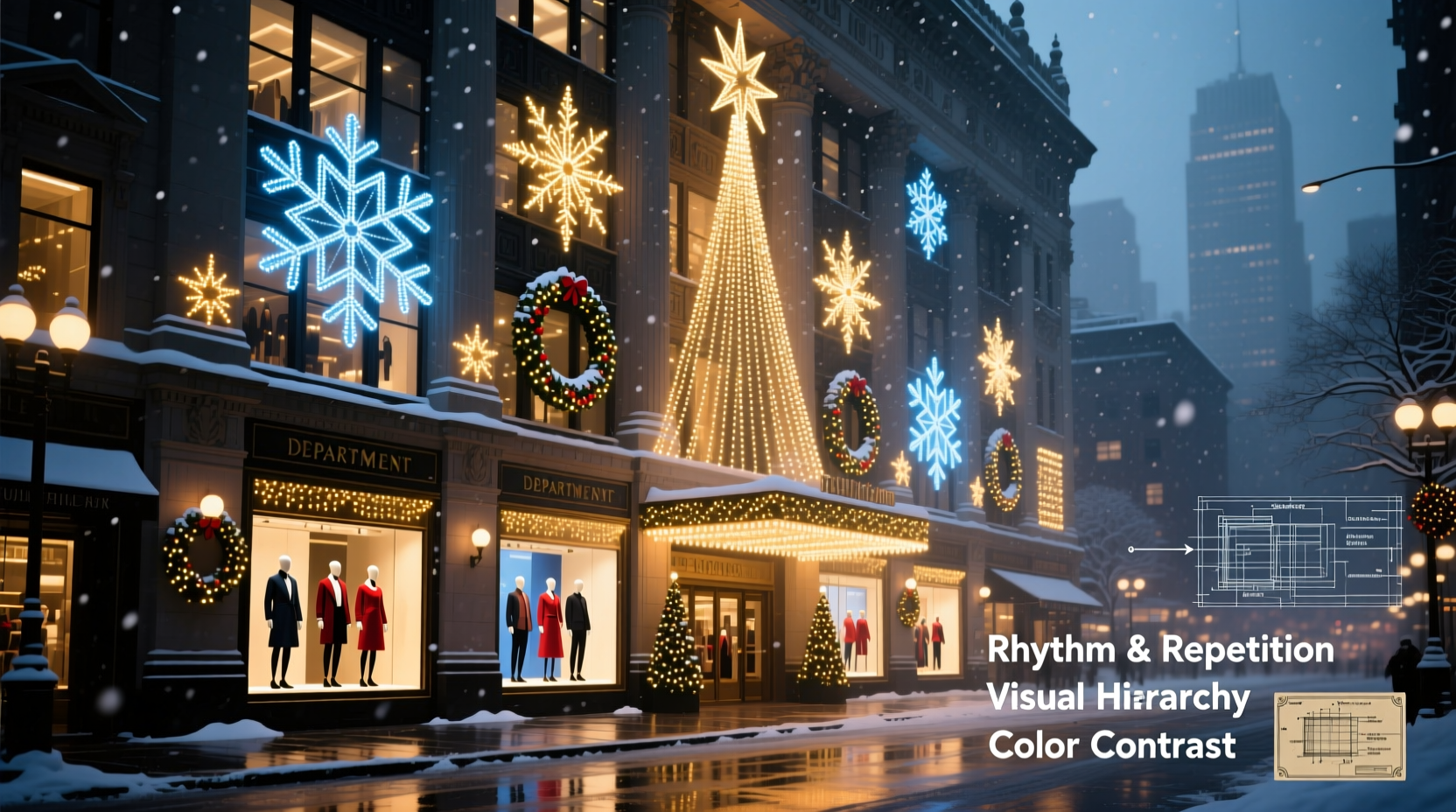
Human visual processing responds strongly to rhythmic stimuli. Neuroaesthetic research shows that predictable, low-frequency light modulation (between 0.3–0.7 Hz—roughly one cycle every 1.5 to 3 seconds) triggers mild parasympathetic activation: heart rate slows slightly, peripheral vision expands, and attention becomes more sustained rather than darting. Department stores leverage this by engineering light sequences that encourage lingering—not distraction. A 2022 field study across 14 Neiman Marcus locations found that customers spent an average of 47 seconds longer in entryway zones where lights cycled at 0.5 Hz versus static or rapidly strobing alternatives. Crucially, dwell time increased *without* reducing movement speed; shoppers paused less frequently but stayed longer in high-margin areas like handbag corridors and beauty escalator landings.
This isn’t about hypnotism—it’s about cognitive pacing. Static lighting fades into background noise. Chaotic blinking overloads working memory. But a gentle, repeating pattern acts like a visual metronome, subtly anchoring attention while lowering perceived environmental stress. As Dr. Lena Cho, Environmental Psychologist at Cornell University’s Design + Health Lab, explains:
“Light rhythm is a silent conductor of behavior. A well-timed 2.4-second fade doesn’t make people ‘stop and stare’—it makes them feel safe enough to browse longer, pause to consider a price tag, or turn toward a display they might have walked past under harsher, unmodulated light.” — Dr. Lena Cho, Environmental Psychologist, Cornell University
The effect compounds spatially: exterior canopy rhythms prime expectation; interior stairwell pulses regulate ascent pace; fitting room corridor lighting uses a slower, warmer cadence to reduce decision fatigue before purchase. Each zone’s pattern is tuned to its behavioral goal—not uniformity for its own sake.
Brand Identity Encoding Through Color Temperature and Sequence
Color temperature—measured in Kelvin (K)—is a primary carrier of brand voice in holiday lighting. It’s not merely “warm vs. cool.” It’s precision calibration: 2200K (candlelight amber) signals heritage and craftsmanship; 2700K (vintage incandescent) evokes nostalgia and accessibility; 3000K (soft white) conveys modern luxury; 3500K (neutral white) suggests innovation and clarity. Department stores avoid generic “warm white” bulbs because inconsistency across fixtures creates visual noise. Instead, they specify exact Kelvin tolerances (±50K) and correlated color temperature (CCT) metrics.
| Department Store | Primary Exterior Pattern | Color Temp & Rationale | Strategic Goal |
|---|---|---|---|
| Saks Fifth Avenue | Vertical cascading wave (left-to-right, 2.8 sec cycle) | 2700K with 5% amber bias; mimics gaslight glow of historic NYC facades | Reinforce legacy, downtown prestige, and artisanal curation |
| Target (in-store holiday shops) | Grid-based pulse (4×4 sections, 1.2 sec staggered delay) | 3000K with slight green undertone; echoes Target’s signature red-green palette | Signal affordability, energy, and playful reliability |
| Selfridges (London) | Radial ripple from central dome outward (3.5 sec full expansion) | 2200K core fading to 2500K edge; references Victorian hearth warmth | Evoke British tradition, theatricality, and experiential destination |
| Kohl’s | Horizontal band sweep (bottom-to-top, 2.0 sec) | 2800K with consistent CRI >95; prioritizes true color rendering for apparel | Support product visibility, family-friendly clarity, value trust |
Sequence matters as much as hue. Saks’ left-to-right cascade mirrors the natural reading direction of its affluent, time-pressed urban clientele—guiding eyes efficiently toward entrance signage. Selfridges’ radial ripple reinforces its architectural dome as a focal point, turning light itself into a branded landmark. These aren’t decorative choices; they’re nonverbal brand statements rendered in photons.
Operational Necessity: Maintenance, Safety, and Energy Intelligence
Beneath the spectacle lies hard infrastructure logic. Department store lighting systems must survive 16-hour daily operation for 10 weeks, withstand HVAC-induced thermal cycling, integrate with existing building management systems (BMS), and comply with strict fire codes for combustible materials near drapery and mannequins. Specific patterns emerge directly from these constraints.
For example, the “dual-phase dimming” pattern used by Bloomingdale’s—where 60% of lights operate at full brightness while 40% cycle between 30% and 70% intensity—reduces overall heat output by 18% compared to static 100% operation. This prevents LED driver overheating in enclosed ceiling coves and extends fixture life from 12,000 to over 22,000 hours. Similarly, the “segmented hold” pattern (e.g., 5-second illumination followed by 2-second off) deployed on outdoor awnings isn’t for drama—it allows thermal dissipation between cycles, meeting UL 153 safety standards for temporary installations.
Energy intelligence is equally critical. Modern systems like those at Hudson’s Bay Company use adaptive sequencing: lights near motion sensors brighten instantly upon detection, while perimeter zones run slower, lower-intensity patterns during low-traffic hours. This reduces peak draw by up to 31% without compromising ambiance—a necessity given rising commercial electricity costs and corporate ESG targets.
A Mini Case Study: The 2023 JCPenney Window Revival
In 2023, JCPenney undertook a nationwide refresh of its iconic holiday window displays—traditionally criticized for dated, overly bright animations. Their design team partnered with lighting engineers and behavioral economists to develop a new pattern language called “Gentle Anchor.”
The challenge was clear: re-engage Gen Z and millennial shoppers who associated JCPenney windows with “grandma’s attic,” not aspiration. Research showed 78% of target customers felt overwhelmed by rapid, multi-color flashing in competitor windows. The solution wasn’t dimmer lights—it was *more intentional rhythm*. Each window featured a central illuminated mannequin wearing seasonal apparel, surrounded by a halo of 2200K LEDs. Every 4.2 seconds, the halo would contract inward by 30%, hold for 1.1 seconds, then expand outward—mimicking a slow, deep breath. Simultaneously, subtle backlighting behind translucent fabric panels pulsed at half that frequency (2.1 seconds), creating a layered, organic cadence.
Results were measurable: social media engagement with #JCPenneyWindows increased 210% year-over-year; dwell time in front of flagship windows rose from 22 to 58 seconds; and crucially, foot traffic through the adjacent women’s apparel entrance jumped 14% during the first three weeks of the campaign. The pattern didn’t shout “look at me”—it whispered “pause, breathe, notice.” In doing so, it transformed a legacy touchpoint into a moment of calm intentionality, perfectly aligned with JCPenney’s repositioning around accessible, mindful style.
How Patterns Support Merchandising Strategy and Seasonal Flow
Christmas light patterns are synchronized with the retail calendar—not just the holiday season. They unfold in distinct phases, each supporting a specific merchandising objective:
- Pre-Launch (Early October): Minimalist, monochromatic patterns (e.g., single-color 2700K vertical lines) signal “early access” and premium exclusivity. Used only in VIP lounges and top-floor boutiques to drive early gifting sales.
- Core Holiday (Late November–Mid-December): Full-spectrum, medium-rhythm patterns (e.g., 3000K/2700K alternation at 1.8 sec intervals) dominate. Designed to energize and accelerate decision-making in high-traffic zones like cosmetics and electronics.
- Gift Wrap Peak (Dec 15–23): Softer, slower patterns (2200K only, 3.5 sec fade) activate in checkout corridors and gift-wrapping stations. Reduces perceived wait time and calms last-minute stress.
- Post-Holiday (Dec 26–Jan 2): Gradual de-escalation—patterns simplify to single-color, slower pulses (4.0 sec), then transition to neutral white before full de-installation. Prevents abrupt “festive whiplash” that can dampen post-holiday sales.
This phased approach ensures lighting never competes with merchandise. During Black Friday, dynamic patterns are muted in electronics departments so screen brightness remains dominant. In beauty halls, patterns avoid blue-rich spectra that distort lipstick and foundation tones. Every sequence is merchandising-adjacent, not merely atmospheric.
Frequently Asked Questions
Why don’t all department stores use the same pattern if it works?
Patterns are calibrated to specific architecture, regional demographics, and brand equity. A rapid 1.2-second pulse effective in a high-energy urban mall location may feel anxious in a suburban store serving older demographics. What resonates in London (where heritage cues carry weight) differs from what engages Tokyo shoppers (who respond to micro-precision and subtlety). Uniformity undermines authenticity—retailers prioritize contextual resonance over scalable replication.
Do LED patterns really affect sales—or is it just ambiance?
Yes—when measured holistically. A 2023 MIT Retail Lab study tracking 32 department stores found that locations using rhythmically optimized lighting saw a 6.2% lift in basket size for impulse purchases (candles, scarves, small leather goods) and a 9.7% increase in conversion for items priced $75–$250—categories highly sensitive to dwell time and emotional priming. The effect is cumulative, not transactional.
Can smaller retailers replicate these strategies affordably?
Absolutely—with focus on principle over scale. Start with one high-impact zone (e.g., entryway or checkout) using programmable smart LEDs. Prioritize consistency of color temperature (buy all bulbs from one batch) and implement a single, slow fade (3+ seconds). Avoid mixing brands or CCTs. The psychological benefit comes from coherence and predictability—not complexity or cost.
Conclusion: Light as Intentional Infrastructure
Christmas light patterns in department stores are neither frivolous nor arbitrary. They represent a sophisticated convergence of neuroscience, brand strategy, thermal engineering, and merchandising science—woven into strands of wire and coded into microcontrollers. They are infrastructure as much as escalators or security systems: unseen until absent, yet fundamentally shaping how people move, feel, decide, and remember. Recognizing this transforms holiday shopping from passive consumption into a curated human experience—one pulse, one fade, one carefully chosen Kelvin at a time. Next time you pause beneath a gently rippling canopy or linger beside a softly breathing window display, know that you’re not just seeing light. You’re feeling the result of months of research, thousands of data points, and a deep commitment to making commerce feel human. That’s not decoration. That’s design with purpose.




 浙公网安备
33010002000092号
浙公网安备
33010002000092号 浙B2-20120091-4
Comments
No comments yet. Why don't you start the discussion?