
Dog owners often witness a curious post-poop ritual: their pet backs up, kicks their hind legs rapidly against the ground, and then trots away as if nothing happened. While it may look like they're trying to scratch an itch or bury their waste, this behavior is far more intentional. It’s a deeply ingrained form of communication rooted in biology and evolution. This article breaks down why dogs kick their feet after defecating, focusing on the primary reason—territory marking—and explores the science, purpose, and social significance behind this instinct.
The Science Behind the Scratch
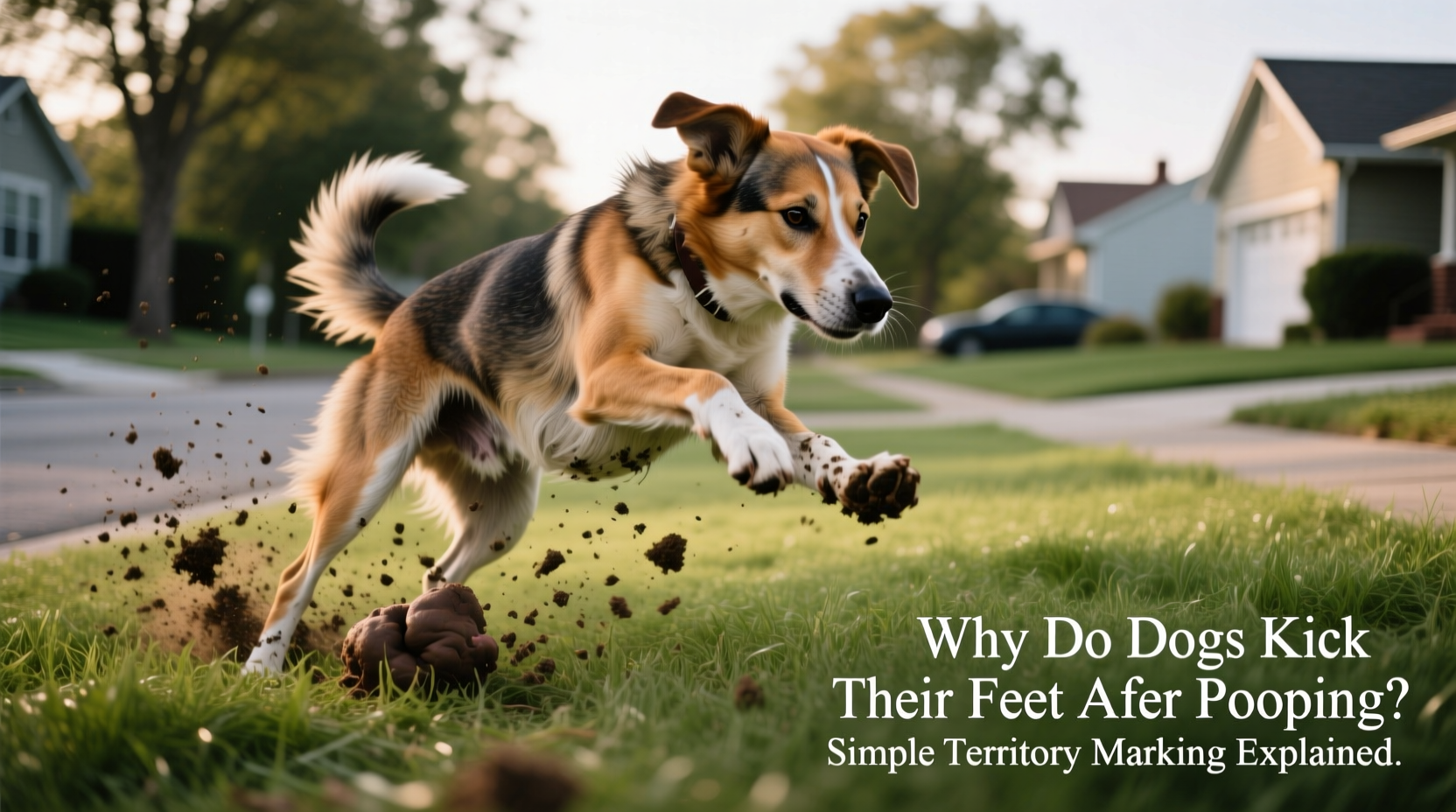
When a dog kicks its back legs after eliminating, it isn’t attempting to cover up its mess. In fact, quite the opposite. The kicking motion serves to spread the scent from glands located in the dog’s paws. These are called interdigital glands, situated between the paw pads, which release a unique chemical signature with every scratch.
As the dog scrapes the ground, it simultaneously deposits both fecal scent and foot-scent into the environment. This dual-layered olfactory message amplifies the signal sent to other dogs. Unlike humans, who rely heavily on visual cues, dogs communicate primarily through smell. A single kick can broadcast information about identity, sex, health, mood, and even reproductive status.
“Scent marking is one of the most sophisticated forms of animal communication. Dogs don’t just leave messages—they layer them for maximum impact.” — Dr. Rebecca Alvarez, Canine Behavior Specialist
This behavior is not random. Studies show that dogs are more likely to engage in post-defecation kicking when other dogs’ scents are present nearby. This suggests a competitive or assertive motivation—to overwrite or reinforce their presence in a shared space.
Evolutionary Roots of Territory Marking
To understand why this behavior persists, we must look back at the ancestors of modern domesticated dogs: wolves. In the wild, wolves use scent marking to define pack boundaries and avoid direct confrontations. Fighting over territory is risky and energy-intensive; scent signals allow animals to assess each other from a distance.
Dogs inherited this instinct. Even though most domestic dogs live in homes with predictable routines, their genetic programming remains tuned to mark and monitor their environment. Kicking after pooping is an extension of this ancestral need to claim space—not necessarily out of aggression, but as a way to say, “I was here.”
In multi-dog households or neighborhoods with frequent canine traffic, this behavior becomes more pronounced. Dogs may kick more vigorously or repeat the action multiple times, especially if they detect unfamiliar scents during walks.
How Scent Works in Canine Communication
Dogs possess up to 300 million olfactory receptors (humans have about 6 million), making their sense of smell anywhere from 10,000 to 100,000 times more acute. They don’t just smell poop—they decode complex chemical profiles within it.
The combination of feces and paw secretions creates a composite scent profile that lasts longer than feces alone. Grass, soil, and debris displaced by kicking help aerosolize these odors, allowing them to travel further on air currents. This ensures the message reaches more recipients across a wider area.
Moreover, the physical disturbance left behind—the scraped dirt or torn grass—is a visual cue for other dogs. Even if the scent fades, the mark on the ground signals that another dog has been active there. This dual signaling (olfactory + visual) makes the act highly effective in canine social networks.
| Signal Type | Source | Purpose |
|---|---|---|
| Olfactory (Smell) | Feces + Interdigital Glands | Convey identity, health, and emotional state |
| Visual (Sight) | Scraped Ground, Displaced Debris | Indicate recent activity and presence |
| Behavioral (Action) | Kicking Motion Itself | Reinforce dominance or familiarity in space |
Is This Behavior Linked to Burying Instincts?
A common misconception is that dogs kick to bury their waste, similar to cats using litter. However, this theory doesn’t hold under scrutiny. Cats bury their waste to hide their presence from predators or rivals. Dogs, being apex scavengers and pack animals, typically want to advertise their presence—not conceal it.
In fact, wild canids like coyotes and foxes exhibit the same kicking behavior, and they rarely fully bury their droppings. Instead, they leave them exposed on trails, mounds, or near territorial borders where they’re more likely to be detected. Domestic dogs mirror this pattern by choosing open areas on walks to eliminate and then kicking around the deposit.
The motion resembles digging, but it’s functionally different. It’s not about concealment—it’s about dispersion. Think of it less like burying trash and more like posting a public notice with added signatures.
Step-by-Step: What Happens During the Post-Poop Kick?
Understanding the sequence of actions helps clarify the intentionality behind the behavior. Here’s what typically occurs:
- Defecation: The dog squats and releases feces, leaving a primary scent marker.
- Backing Up: Immediately after, the dog steps backward, positioning its hind legs near the waste.
- Rapid Scratching: Using quick, alternating motions, the dog drags its hind paws across the ground, sometimes covering several inches or feet.
- Scent Dispersal: Paw glands secrete pheromones while the physical scraping spreads fecal particles and disturbs surrounding material.
- Departure: The dog walks away, often without looking back—its message has been sent.
This entire process takes seconds but packs a powerful communicative punch. Observant dog owners may notice variations in intensity depending on location. For example, a dog might kick more aggressively at the edge of a park than in their own backyard, suggesting contextual awareness of territorial importance.
Real-World Example: Max the Border Collie
Consider Max, a 4-year-old Border Collie living in a suburban neighborhood. Every morning, his owner takes him on a walk along a popular dog path. At two specific spots—one near a tree line and another at a crossroads—Max consistently kicks after pooping, much more so than at other locations.
A behavioral assessment revealed that these sites were high-traffic zones for other dogs. Scent analysis showed traces of at least five different canines within a 24-hour window. Max wasn't just eliminating; he was responding to competition. His kicking served as a deliberate counter-mark, reinforcing his presence in a contested area.
After switching to quieter routes for a week, Max’s kicking frequency dropped by nearly 70%. When returned to the original path, the behavior resumed immediately. This case illustrates how environmental stimuli directly influence marking behaviors, confirming their role in social navigation.
Do All Dogs Kick After Pooping?
No, not all dogs display this behavior equally. Some never kick at all, while others do it with enthusiasm. Factors influencing the frequency include:
- Breed tendencies: Terriers and herding breeds often show stronger marking instincts.
- Sex: Intact males tend to mark more than females or neutered males, though many spayed/neutered dogs still kick.
- Personality: Confident, assertive dogs may kick more frequently as a way to assert control over space.
- Environment: Urban dogs exposed to many other animals may kick more than rural dogs with fewer social encounters.
Lack of kicking doesn’t indicate a problem. Just as humans vary in how loudly they speak, dogs vary in how strongly they signal. As long as the dog is healthy and well-adjusted, variation in marking behavior is normal.
Checklist: Understanding Your Dog’s Marking Behavior
Use this checklist to assess whether your dog’s kicking is typical or warrants closer attention:
- ✅ Observe if kicking happens consistently after elimination
- ✅ Note whether it occurs more in public spaces vs. home yard
- ✅ Check for signs of anxiety or obsession (e.g., circling excessively, refusing to move)
- ✅ Rule out physical discomfort (lameness, sore paws)
- ✅ Monitor changes after neutering/spaying or medical treatments
- ✅ Consider consulting a vet or trainer if behavior becomes compulsive
Common Misunderstandings About Canine Marking
Several myths persist about why dogs kick after going to the bathroom. Let’s clarify them:
| Myth | Reality |
|---|---|
| Dogs kick to hide their poop. | No—they aim to highlight it. Concealment is rare in dominant or confident dogs. |
| Only male dogs do this. | False. Both sexes engage in scent marking, though males may do so more frequently. |
| Kicking means the dog is poorly trained. | Incorrect. This is instinctive, not a training failure. Housebroken dogs still mark outdoors. |
| It damages lawns, so it should be stopped. | While turf disruption can occur, suppressing natural behavior isn’t recommended unless excessive. |
Frequently Asked Questions
Why does my dog kick only sometimes after pooping?
Dogs assess their surroundings before deciding to mark. If they’re in a familiar, low-competition area (like their backyard), they may skip kicking. But in new or busy environments, the urge to communicate increases, triggering the behavior.
Can neutering reduce this behavior?
Yes, in some cases. Neutering reduces hormone-driven marking, especially in males. However, since kicking is also influenced by habit and environment, many neutered dogs continue the behavior at a lower intensity.
Should I stop my dog from kicking after pooping?
Generally, no. It’s a natural, healthy expression of canine communication. Unless it leads to injury (e.g., broken nails, strained muscles) or becomes obsessive, interference isn’t necessary. Redirecting to appropriate areas (like grassy patches instead of flower beds) is preferable to suppression.
Conclusion: Respecting Natural Canine Instincts
The next time you see your dog scratching the ground after a bathroom break, recognize it for what it truly is: a sophisticated, multisensory message written in scent and soil. Far from being a quirky habit, this behavior is a window into the rich, invisible world of canine communication—one built on smells, signals, and survival strategies refined over millennia.
Understanding these instincts fosters deeper empathy and better coexistence. Rather than viewing the kick as messy or unnecessary, appreciate it as a vital part of your dog’s identity and social intelligence. By allowing natural behaviors in safe, appropriate settings, you support your pet’s psychological well-being and strengthen your bond.




 浙公网安备
33010002000092号
浙公网安备
33010002000092号 浙B2-20120091-4
Comments
No comments yet. Why don't you start the discussion?