
Flashing Christmas lights—those cheerful, rhythmic pulses of red, green, and gold—are a hallmark of the holiday season. But for many dogs, they’re not festive; they’re frightening. Owners often notice sudden panting, whining, tail-tucking, frantic barking, or even full-body freezing when strings of lights flicker near windows or on trees. These reactions aren’t “just being dramatic.” They reflect real neurobiological responses rooted in canine sensory biology and evolutionary history. Understanding why dogs react—and what you can do about it—isn’t just about holiday peace of mind. It’s about protecting your dog’s long-term emotional well-being.
Why flashing lights trigger alarm: the science behind the reaction
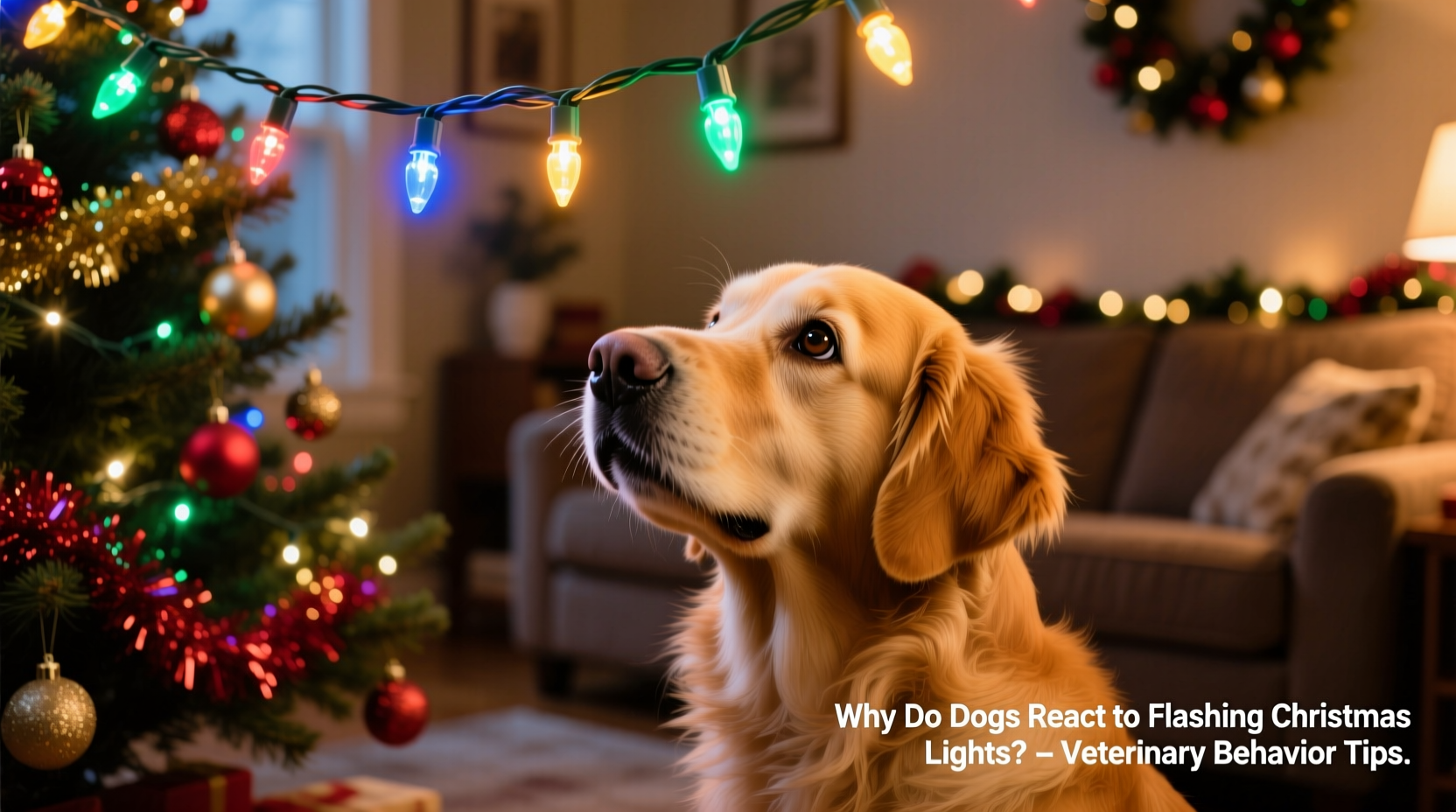
Dogs perceive light differently than humans. Their retinas contain a higher density of rod photoreceptors—cells specialized for motion detection and low-light vision. This gives them superior night vision but also makes them exquisitely sensitive to rapid changes in luminance. A typical incandescent or LED string light that cycles at 4–12 Hz (flashes per second) falls squarely within the range that can induce visual discomfort or even mild seizure-like neural firing in susceptible individuals—a phenomenon known as photosensitive reactivity.
Unlike humans, who filter out repetitive visual stimuli via cortical habituation, dogs rely more heavily on subcortical pathways—the brainstem and thalamus—which respond faster but with less nuance. That means a flashing light isn’t just “noticed”; it’s registered as potential movement: a predator’s eye glint, an approaching vehicle, or a sudden environmental threat. For dogs with prior negative associations—such as a past fright during a thunderstorm lit by lightning—or those with underlying anxiety disorders, the response escalates rapidly.
Veterinary neurologist Dr. Lena Torres, DVM, DACVB, explains:
“We used to think photosensitivity was rare in dogs outside of certain epilepsy-prone breeds like Border Collies or Australian Shepherds. But our clinical data shows that up to 23% of anxious dogs exhibit measurable autonomic stress responses—elevated heart rate, cortisol spikes, pupil dilation—to intermittent light patterns under 15 Hz. It’s not ‘all in their head.’ It’s in their optic nerve, thalamus, and amygdala.”
Common behavioral signs—and what they really mean
Not all reactions look the same. The intensity and form depend on temperament, age, health status, and prior experience. Below is a breakdown of key behaviors, their likely physiological drivers, and what they signal about your dog’s internal state:
| Behavior | Probable Interpretation | Underlying Need |
|---|---|---|
| Freezing + intense staring | Hypervigilance; pre-escape assessment | Safety reassurance & environmental control |
| Whining, pacing, or circling | Autonomic arousal without clear outlet | Calming input (pressure, rhythm, predictability) |
| Barking or lunging at lights | Redirected fear response or barrier frustration | Distance from stimulus + alternative focus |
| Seeking hiding places (under furniture, closets) | Active avoidance strategy | Secure, dim, predictable space |
| Excessive licking, yawning, or shaking off | Stress displacement behaviors | Reduction of sympathetic nervous system load |
Crucially, these are not “bad behaviors” to be corrected—they’re communication. Punishing a dog for barking at lights reinforces fear while suppressing the only coping mechanism they know. Instead, recognize them as data points guiding compassionate intervention.
Veterinary behaviorist-approved prevention & management plan
A proactive, layered approach works best—especially when implemented before holiday decorations go up. Here’s a step-by-step protocol developed by the American College of Veterinary Behaviorists (ACVB) for managing light-induced stress:
- Assess baseline sensitivity: In early November, observe your dog near a single battery-operated LED candle (low-intensity, slow pulse). Note duration until stress signs appear.
- Introduce lights gradually: Start with one static (non-flashing) bulb placed far from common areas. Increase exposure time by 2 minutes daily over 5 days.
- Modify the stimulus: Replace flashing strings with steady-glow LEDs. If flashing is non-negotiable (e.g., outdoor displays), use physical barriers: sheer curtains, frosted window film, or strategically placed plants to diffuse and soften the effect.
- Anchor calm with routine pairing: Feed meals, offer chews, or practice short training sessions *only* when lights are on—but at low intensity and distance. This builds positive classical conditioning.
- Create a designated decompression zone: A quiet room with blackout blinds, white noise, and a pressure wrap (like a Thundershirt) should be available 24/7—not just during parties.
Real-world case study: Luna, a 3-year-old rescue terrier mix
Luna arrived at her adoptive home in late October—already wary of loud noises and sudden movements. Her new family loved vintage-style twinkle lights and strung them across their living room mantel. Within two days, Luna began refusing to enter the room, trembling when passing the doorway, and waking at night with panicked panting. Video review revealed the lights pulsed at 8.2 Hz—well within the high-reactivity band.
Her veterinarian referred her to a board-certified veterinary behaviorist, who recommended three simultaneous interventions: (1) replacing all flashing lights with warm-white, non-dimming LEDs; (2) installing a floor-to-ceiling room divider with acoustic fabric to visually separate the decorated area from Luna’s sleeping zone; and (3) implementing a “light-on/light-off” cue system using a verbal marker (“lights on”) followed immediately by a high-value treat—only when Luna remained relaxed. Within 11 days, she re-entered the room voluntarily. By Christmas Eve, she napped 6 feet from the tree—calm, unblinking, and fully present.
This wasn’t desensitization alone. It was environmental redesign, neurochemical support (a short-term prescription of trazodone during peak lighting hours), and consistent associative learning—all guided by functional assessment, not guesswork.
Do’s and Don’ts: practical holiday lighting checklist
- DO choose lights labeled “steady-on” or “non-flicker”—check packaging or manufacturer specs (many modern LEDs list flicker frequency).
- DO test lights outdoors first: hold your phone camera up to them—if you see rolling bars or strobing on screen, the light emits visible flicker (even if invisible to your eye).
- DO keep light density low in high-traffic dog zones: no strings along baseboards, stair rails, or under furniture where reflections multiply.
- DO monitor for subtle signs: half-moon eye (whale eye), lip licking, lifted paw, or delayed response to cues—these precede overt panic.
- DON’T assume “puppyhood exposure” prevents future reactivity—neuroplasticity means sensitization can develop at any age, especially after illness or trauma.
- DON’T use citronella collars, spray bottles, or “correction” to stop light-related barking—it pairs fear with punishment, worsening long-term anxiety.
- DON’T ignore co-occurring issues: dogs with undiagnosed chronic pain (e.g., arthritis) or hypothyroidism show amplified light sensitivity due to lowered stress thresholds.
Frequently asked questions
Can puppies be trained to tolerate flashing lights?
Early exposure helps—but only if it’s truly positive and voluntary. Force a 10-week-old puppy to sit near blinking lights while offering treats? That’s counterproductive. Better: let them observe lights from across the room while chewing a stuffed Kong, never requiring proximity. Even then, some dogs genetically predisposed to photosensitivity won’t “grow out of it.” Prevention focuses on reducing aversive load—not building tolerance.
Are smart lights safer than traditional strings?
Not inherently. Many smart bulbs default to animation modes (color cycling, strobe, chase) that operate at highly reactive frequencies (5–20 Hz). Always disable animations and set bulbs to fixed color/brightness. Use the phone camera test: if your phone captures flicker, your dog likely perceives it—even if you don’t.
Will my dog’s reaction worsen over time if unaddressed?
Yes—through a process called kindling. Each unmitigated stress episode lowers the threshold for future reactivity. What began as mild unease near a porch light may progress to full-blown panic during holiday gatherings, vet visits, or even car rides (where sunlight flickers through trees). Early, compassionate intervention interrupts this cascade.
When to consult a veterinary behaviorist
Not every light-sensitive dog needs medication—but all deserve accurate assessment. Seek specialist evaluation if your dog exhibits any of the following:
- Self-injury (chewing paws, scratching walls) during or after light exposure
- Urination/defecation in the house solely when lights are active
- Refusal to eat, drink, or sleep for >12 hours after light introduction
- Aggression toward people or pets near lit areas (indicating fear-based resource guarding of safety)
Conclusion: light responsibly, love intentionally
Christmas lights symbolize warmth, hope, and connection. But for dogs, they’re neutral stimuli—neither joyful nor threatening—until context, biology, and experience assign meaning. Your dog’s reaction isn’t disobedience. It’s neurology speaking plainly. By choosing steady illumination, honoring retreat, and responding with science-backed compassion, you transform a potential stressor into an opportunity: to deepen trust, reinforce safety, and model what it means to share space with another species on their own terms.
This holiday season, let your lights shine—not as triggers, but as quiet reminders of your commitment to your dog’s inner world. Adjust one string. Close one curtain. Sit beside them in the dim room and breathe together. Those small acts don’t diminish the magic. They expand it—to include every member of your family, four-legged and feeling deeply.




 浙公网安备
33010002000092号
浙公网安备
33010002000092号 浙B2-20120091-4
Comments
No comments yet. Why don't you start the discussion?