
It’s a familiar scene: holiday lights strung across the porch, wrapped around railings, draped over bushes—each strand plugged into an extension cord that snakes back to the nearest outlet. Then, halfway through the evening, you notice the cord feels warm. Not just slightly warm—noticeably warm. Maybe even hot near the plug or where it coils under the deck. Your instinct may be to shrug it off as “normal.” It isn’t. Heat in an extension cord is not a side effect—it’s a warning signal from physics itself. When cords overheat while powering multiple light strands, they’re operating beyond their safe current capacity, risking insulation breakdown, arcing, and fire. This isn’t theoretical risk. According to the U.S. Consumer Product Safety Commission (CPSC), an estimated 3,000 home fires annually are linked to decorative lighting—and nearly 40% involve improper use of extension cords.
The Physics Behind the Heat: Why Wires Warm Up
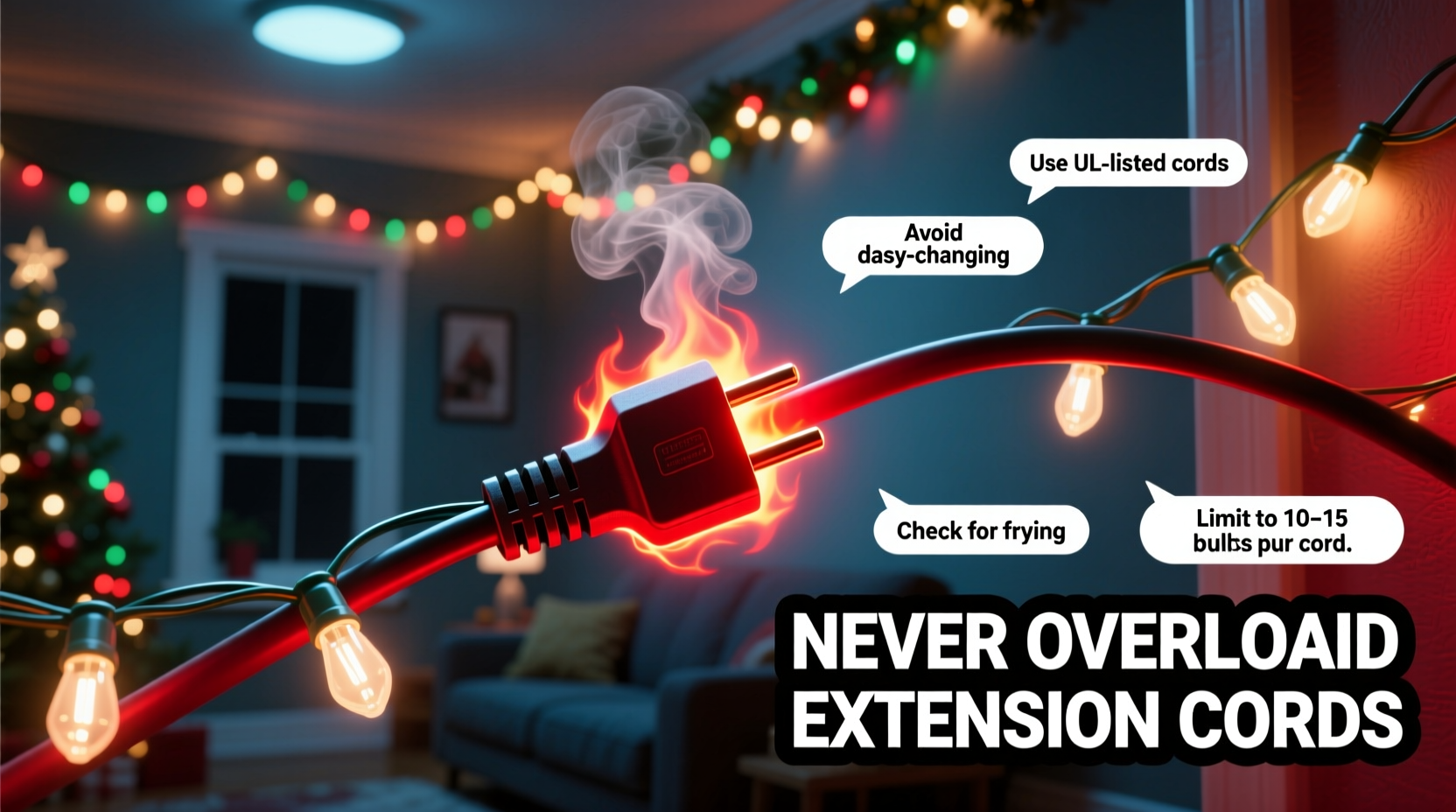
Extension cords heat up due to resistive heating—a direct consequence of electrical resistance in the wire. All conductors resist current flow to some degree; copper and aluminum are good conductors, but they’re not perfect. When electrons move through the wire, they collide with atoms in the metal lattice, converting some electrical energy into thermal energy. The amount of heat generated follows Joule’s Law: H = I² × R × t, where H is heat energy, I is current (in amperes), R is resistance (in ohms), and t is time. Crucially, heat increases with the *square* of the current. Double the current, and heat output quadruples.
Light strands—especially older incandescent ones—draw significantly more current than people assume. A single 100-light incandescent string can draw 0.3–0.5 amps at 120 volts. Chain five together on one cord? That’s 1.5–2.5 amps. Add a second set of five? You’re now pushing 3–5 amps. But here’s what most overlook: the cord’s gauge (thickness) determines its maximum safe amperage. A common 16-gauge cord—often sold cheaply at big-box stores—is rated for only 13 amps *at best*, and only if it’s under 50 feet and uncoiled. In practice, with multiple strands, coiling, outdoor cold, or aging insulation, that rating drops sharply.
How Many Light Strands Are Too Many? A Real-World Load Comparison
Manufacturers rarely print total wattage or amperage on light packaging—but they should. Below is a realistic comparison of common light types and their cumulative load impact on standard extension cords. Values assume 120V AC supply and typical residential outlets (15-amp circuits).
| Light Type | Per Strand Wattage | Per Strand Amps | Max Safe Strands on 16-Gauge Cord (100 ft) | Max Safe Strands on 14-Gauge Cord (100 ft) |
|---|---|---|---|---|
| Incandescent (100-bulb) | 40–60W | 0.33–0.5A | 12–18 | 18–25 |
| LED (100-bulb, low-power) | 4–7W | 0.03–0.06A | 100–150+ | 150–200+ |
| LED (100-bulb, premium, full-color) | 12–20W | 0.1–0.17A | 50–85 | 85–120 |
| Mixed Incandescent + LED (common scenario) | Variable | 0.2–0.8A avg. | 10–15 | 15–22 |
Note: These numbers assume ideal conditions—cord fully uncoiled, ambient temperature ~20°C, new insulation, and no other loads on the same circuit. In reality, most users daisy-chain cords, coil excess length, run them under rugs or snow, and plug in additional devices (outdoor speakers, inflatables, etc.). Each factor reduces safe capacity by 20–40%.
A Mini Case Study: The Overloaded Porch Circuit
In December 2022, a homeowner in Portland, Oregon, decorated his front porch with 14 strands of vintage-style incandescent lights—seven on each side. He used two 50-foot, 16-gauge extension cords purchased online for $8 each, plugging both into a single outdoor GFCI outlet. For three evenings, everything worked. On the fourth night, neighbors noticed smoke curling from beneath the porch railing. Fire investigators found the primary failure point: one cord’s male plug had melted, with charring visible inside the plastic housing. The cord itself showed localized blackening near the first light connection point—indicating sustained overheating. The homeowner had unknowingly drawn 4.2 amps through a cord rated for 13A *only* when perfectly installed. But because the cord was coiled twice under a wooden step (trapping heat), bundled with another cord, and exposed to overnight frost followed by daytime thaw (causing condensation and micro-cracks in insulation), its effective ampacity dropped to ~7.5A. Still within margin—except he’d also plugged in a 600W inflatable snowman on the same cord. Total load: 8.7A. Sustained for hours, that pushed conductor temperature past 90°C, degrading PVC insulation until arcing began between strands.
This wasn’t negligence—it was a cascade of small, common oversights. And it’s entirely preventable with grounded knowledge.
7 Actionable Safety Tips—Backed by NEC & UL Standards
The National Electrical Code (NEC) and Underwriters Laboratories (UL) provide clear guidelines—not suggestions—for safe extension cord use. These tips translate those standards into daily practice:
- Match cord gauge to load—and always err larger. Use 14-gauge for runs over 50 feet or any multi-strand setup. Reserve 12-gauge for permanent seasonal setups (e.g., roof lines, large trees). Never use 16- or 18-gauge for more than two incandescent strands or five basic LED strands.
- Uncoil completely before energizing. Coiling traps heat, raising internal temperature by up to 35°C. UL 817 requires cords to be tested uncoiled; coiled operation voids safety certification.
- Limit daisy-chaining to one cord only. NEC Article 400.8(1) prohibits using extension cords as permanent wiring. More critically, each connection adds resistance—and potential failure points. Two cords mean two plugs, two sockets, and double the chance of loose contact, which creates high-resistance heating.
- Check temperature every 20 minutes for the first hour. Use the back of your hand—not fingers—to briefly touch mid-cord and plug bodies. If you can’t hold contact for 3 seconds, unplug immediately and reassess load.
- Use outdoor-rated, heavy-duty cords marked “WT” (Weather/Temperature resistant) or “W” (Outdoor). Indoor cords lack UV stabilizers and moisture-resistant jackets. Exposure to rain, snow, or sun degrades insulation rapidly—even if the cord looks fine.
- Plug into a GFCI-protected outlet—always. GFCIs cut power within 1/40th of a second if they detect current leakage (e.g., from damaged insulation). They won’t stop overheating directly, but they prevent electrocution and often trip before heat causes catastrophic failure.
- Calculate total load—not just “how many strands.” Add up all connected devices: lights, inflatables, speakers, projectors. Use a simple clamp meter ($35–$60) to verify actual draw. If total exceeds 80% of circuit capacity (12A on a 15A circuit), redistribute.
Expert Insight: What Electricians See on Holiday Calls
Master electrician and NFPA-certified safety trainer Marcus Bell has responded to over 200 holiday-related electrical emergencies since 2015. His field notes reveal consistent patterns—and a sobering truth about perception versus reality.
“Ninety-two percent of overheated cord incidents I’ve investigated involved cords rated ‘adequate’ on paper—but misapplied. People read ‘13A max’ and think, ‘I’m only using 5A, so I’m fine.’ They don’t realize that rating assumes 25°C ambient, zero bends, and brand-new insulation. I’ve measured 16-gauge cords at 72°C internally while drawing just 6.8A—because they were buried under mulch and sharing conduit with a landscape lighting transformer. Heat doesn’t lie. Your cord’s temperature is the only real-time diagnostic tool you have. Listen to it.” — Marcus Bell, Licensed Master Electrician & NFPA 70E Instructor
Step-by-Step: How to Audit Your Light Setup in Under 10 Minutes
Before hanging a single bulb, follow this verified sequence:
- Identify your outlet’s circuit. Turn off the breaker, test all nearby outlets and switches with a non-contact voltage tester, and label the circuit (e.g., “Front Porch/Garage”). Note its amperage (usually 15A or 20A).
- Calculate total wattage. Find the UL label on each light package. Multiply watts per strand × number of strands. Add wattage of all other devices on the same cord.
- Convert to amps. Divide total watts by 120 (standard U.S. voltage). Example: 840W ÷ 120 = 7A.
- Select cord gauge. For ≤50 ft runs: 14-gauge supports up to 15A safely. For >50 ft or mixed loads: use 12-gauge (up to 20A). Verify the cord is UL-listed and marked “Outdoor” or “WT.”
- Inspect cord condition. Reject any cord with cracked, stiff, or discolored insulation; bent or corroded prongs; or loose strain relief at the plug.
- Map physical routing. Ensure cord will remain uncoiled, elevated off ground/snow, and away from foot traffic, doors, or heat sources (grills, heaters).
- Test before final installation. Plug in, wait 15 minutes, check temperature. If warm, reduce load by 1–2 strands and retest.
FAQ: Common Questions—Answered by Code and Evidence
Can I use a power strip instead of an extension cord for my lights?
No—unless it’s specifically rated and listed for outdoor use *and* designed for continuous lighting loads. Most indoor power strips lack thermal protection, proper gauge wiring, or weather sealing. UL 1363 lists strict requirements for relocatable power taps used outdoors; fewer than 12% of consumer power strips meet them. Using one indoors for lights is acceptable; outdoors, it’s a code violation and fire hazard.
Why do LED lights still cause heating if they use less power?
They don’t—*if* you’re using quality LEDs with stable drivers. However, cheap LED strings often use undersized internal wiring and poorly regulated constant-current drivers. Voltage spikes, poor heat sinking at the controller, and capacitor degradation can cause localized heating *within the string itself*, which then transfers to the extension cord via conduction. Also, many “LED” packages contain legacy sockets wired for incandescent bulbs—creating impedance mismatches that increase reactive current and cord heating.
Is it safe to run extension cords under carpets or rugs?
No—never. NEC 400.8(2) explicitly prohibits concealing extension cords in walls, ceilings, floors, or under carpets. Trapped heat cannot dissipate, accelerating insulation breakdown. Carpets also create abrasion points and trap dust/moisture, increasing fire risk. Use floor cord covers rated for pedestrian traffic instead—or better, install permanent outdoor outlets where needed.
Conclusion: Respect the Current, Protect What Matters
Extension cords are tools—not magic conduits. They obey immutable laws of physics, and when misused, they respond predictably: with heat, degradation, and eventually, failure. The warmth you feel isn’t “just part of the holidays.” It’s electrons struggling against resistance, insulation softening under stress, and safety margins evaporating. Every strand of light you hang is a vote for beauty and celebration—but it must be cast with intention, calculation, and respect for the invisible forces powering it. You don’t need technical expertise to stay safe. You need awareness, a tape measure, a clamp meter, and the willingness to pause before plugging in. Start this season with one audit. Replace one undersized cord. Uncoil every length. Check that GFCI. Those small acts don’t diminish the joy—they safeguard it. Because the brightest lights shine longest when grounded in knowledge, not hope.




 浙公网安备
33010002000092号
浙公网安备
33010002000092号 浙B2-20120091-4
Comments
No comments yet. Why don't you start the discussion?