
Every holiday season, fire departments across North America respond to dozens of structure fires traced directly to overheated extension cords powering outdoor and indoor Christmas displays. According to the U.S. Fire Administration, decorative lighting accounts for an estimated 770 home fires annually—and over 60% of those involve electrical distribution or lighting equipment, most commonly extension cords used beyond their safe capacity. These aren’t rare anomalies: they’re predictable failures rooted in physics, product misuse, and widespread misunderstanding of basic electrical safety. Overheating isn’t a sign that “the cord is working hard”—it’s a warning that resistance is generating dangerous heat, insulation is degrading, and ignition is imminent. This article explains exactly why extension cords fail under holiday loads, what real-world conditions accelerate the risk, and—most importantly—how to eliminate fire hazards without sacrificing festive cheer.
Why Extension Cords Overheat: The Physics Behind the Heat
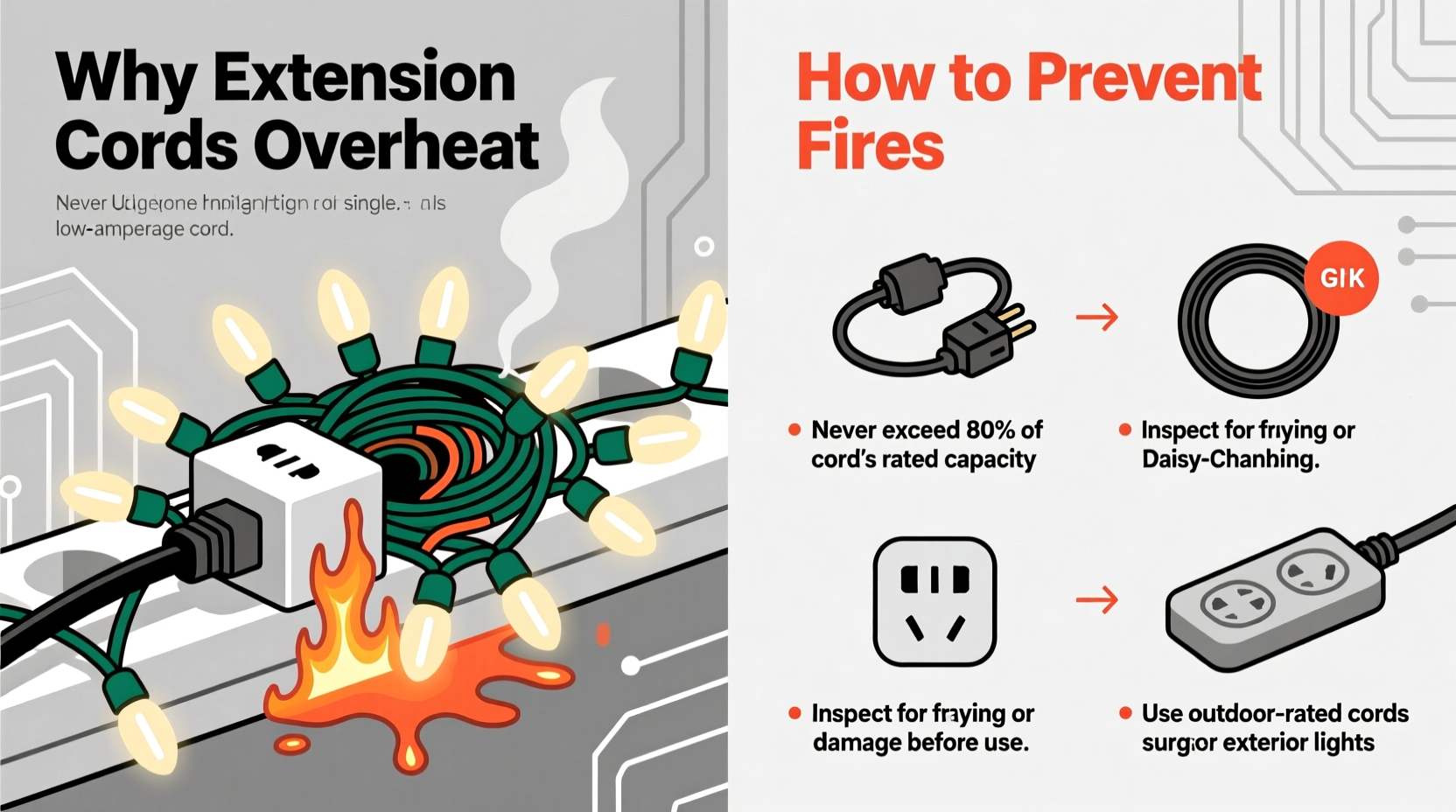
Extension cords overheat when they carry more current (measured in amperes) than they’re designed to handle safely. Every cord has a specific ampacity—the maximum continuous current it can conduct without exceeding safe temperature limits. That rating depends on three interrelated factors: wire gauge (thickness), conductor material (copper vs. aluminum), and insulation type. Thinner wires (higher gauge numbers like 18 AWG or 16 AWG) offer greater electrical resistance. When current flows through resistance, energy converts to heat—governed by Joule’s Law: Heat = I² × R × t (where I is current, R is resistance, and t is time). Double the current, and heat generation quadruples.
Modern LED Christmas lights draw far less power than incandescent strings—typically 0.04–0.2 amps per 100-light strand—but many households still use older incandescent sets (0.3–0.8 amps each) or mix both types. A single 16 AWG extension cord rated for 13 amps may seem robust—until you plug in eight incandescent light strands (6.4 amps), a pre-lit wreath (1.2 amps), and two inflatable yard decorations (2.5 amps total). That’s already 10.1 amps—and that’s before accounting for voltage drop over distance, ambient cold (which stiffens insulation and reduces heat dissipation), or coiling excess cord (trapping heat). Worse, many budget cords sold at seasonal retailers are mislabeled or use undersized copper-clad aluminum (CCA) wire, which has 37% higher resistance than pure copper—causing disproportionate heating at the same load.
The Five Most Common Causes of Holiday Cord Overheating
Overheating rarely results from a single mistake—it’s usually the convergence of several compounding errors. Here’s what consistently appears in fire investigation reports:
- Exceeding outlet and cord capacity: Standard residential outlets are rated for 15 amps. Plugging multiple high-wattage devices—including lights, animatronics, and hot beverage warmers—into one circuit easily exceeds this limit. Daisychaining extension cords multiplies resistance and heat buildup exponentially.
- Using indoor-rated cords outdoors: Indoor cords lack UV-resistant, moisture-sealed jackets. Exposure to rain, snow, or freeze-thaw cycles cracks insulation, exposing conductors and creating short-circuit pathways that generate intense localized heat.
- Physical damage and improper placement: Cords run under rugs, pinched in doorways, or stretched across walkways suffer abrasion and compression. Damaged insulation increases resistance at weak points and invites ground faults.
- Poor ventilation and heat trapping: Coiling unused cord length, stuffing cords into tight junction boxes, or bundling multiple cords together prevents heat dissipation. Ambient cold further impairs cooling, as convection slows in frigid air—even though the cord itself is warmer than surroundings.
- Aging and counterfeit products: Cords older than 10 years often have brittle, cracked insulation and degraded copper conductivity. Counterfeit cords—especially those imported without UL/ETL certification—frequently use substandard materials and false ampacity labeling.
How to Prevent Fires: A Step-by-Step Safety Protocol
Prevention requires deliberate, consistent action—not just buying “heavy-duty” gear. Follow this verified sequence before installing any holiday lighting:
- Evaluate your circuit load: Locate your home’s breaker panel. Identify the circuit powering your intended outlet(s). Add up the wattage of every device on that circuit (watts = volts × amps; check labels or use a plug-in power meter). Stay below 80% of the circuit’s rating (e.g., ≤12 amps on a 15-amp circuit).
- Select the right cord—for the location and load: Use only outdoor-rated (marked “W-A” or “SJTW”), UL/ETL-listed cords. For runs over 50 feet or loads above 10 amps, use 14 AWG or thicker. For permanent outdoor displays, consider installing a dedicated GFCI-protected outlet.
- Calculate total light load accurately: Don’t rely on package claims. Multiply the number of strands by their actual measured amperage (use a clamp meter if possible). For incandescent: assume 0.5A/100 lights. For LED: assume 0.1A/100 lights. Add 20% buffer for inrush current when lights first power on.
- Install with airflow and protection in mind: Run cords along walls—not across lawns or driveways. Elevate them slightly off wet ground using cord protectors. Never staple, nail, or tape cords to surfaces. Leave at least 6 inches of slack at each connection point to avoid tension on terminals.
- Monitor and maintain daily: Touch cords lightly each evening for the first 48 hours. If warm to the touch (not just room temperature), unplug immediately. Inspect daily for swelling, discoloration, or melting near plugs or splices. Unplug during storms or high winds.
Do’s and Don’ts: A Practical Comparison Table
| Action | Do | Don’t |
|---|---|---|
| Cord Selection | Use 14 AWG or thicker outdoor-rated cord for >50 ft runs or >10A loads | Use 18 AWG indoor cords for outdoor trees or roof lines |
| Outlet Use | Plug max 2–3 light strands into one outlet; use separate circuits for front/back displays | Daisy-chain 4+ extension cords or use power strips as primary distribution hubs |
| Installation | Elevate cords off wet grass with plastic cord ramps; secure with outdoor-rated staples | Bury cords in snow, run under carpets, or wrap tightly around metal gutters |
| Maintenance | Test GFCI outlets monthly; replace cords showing cracked insulation or bent prongs | Ignore slight warmth, discoloration, or buzzing sounds at connections |
| Storage | Coil loosely in figure-eights; store in climate-controlled, dry space away from sunlight | Tightly wrap around cardboard tubes or leave coiled in damp garage corners |
Real-World Case Study: The Suburban Porch Fire
In December 2022, a family in Portland, Oregon, installed 14 strands of vintage incandescent lights on their front porch—seven on the railing and seven on pillars—powered by a single 50-foot, 16 AWG “heavy-duty” extension cord purchased from a big-box retailer. They daisy-chained a second identical cord to reach an outlet 20 feet away. The display ran for 36 hours before smoke was noticed coming from beneath the porch railing. Fire investigators found the first cord’s male plug had melted completely, with adjacent wood charred to a depth of 1.5 inches. Lab testing revealed the cord was labeled 13A but delivered only 8.2A safely due to CCA wiring and thin insulation. Total load was 11.9A—well above its true capacity. Crucially, the cord had been run under a rubber welcome mat (trapping heat) and stapled to damp cedar siding (accelerating corrosion). No injuries occurred, but the porch required full reconstruction. This wasn’t “bad luck”—it was five preventable errors converging: wrong wire type, excessive load, poor ventilation, physical damage, and inadequate monitoring.
“Most holiday electrical fires aren’t caused by defective lights—they’re caused by people treating extension cords as disposable accessories rather than engineered safety components. A cord is only as safe as the load it carries, the environment it endures, and the attention it receives.” — Chief Brian Hargrove, NFPA Electrical Division
Frequently Asked Questions
Can I use one extension cord for both indoor and outdoor lights?
No. Indoor cords lack weatherproofing and UV resistance. Even brief exposure to dampness or sunlight degrades insulation rapidly. Always use cords explicitly rated “Outdoor” or “W-A” for any exterior application—even if running only a few feet outside a window.
My LED lights feel warm near the plug—is that normal?
Slight warmth at the plug is common due to resistance in the connector, but the cord itself should remain near ambient temperature. If the cord jacket feels warm—or if you detect a faint “hot plastic” odor—unplug immediately. This indicates either an overloaded cord, poor contact at the receptacle, or internal damage.
How often should I replace holiday extension cords?
Replace cords every 5 years if used seasonally, or immediately if you observe cracked insulation, bent prongs, loose fittings, or discoloration. Store them properly (loosely coiled, dry, dark place) to maximize lifespan—but never assume age alone makes a cord unsafe. Always test functionality and inspect visually before each use.
Conclusion: Celebrate Safely, Not Sacrificially
Holiday lighting should evoke warmth, nostalgia, and shared joy—not anxiety about hidden hazards behind the glow. Understanding why extension cords overheat isn’t about memorizing technical specs—it’s about respecting the physics of electricity and committing to simple, repeatable habits. You don’t need expensive gear to stay safe: you need accurate load calculations, honest assessments of cord condition, and the discipline to unplug when something feels off. Every year, families lose homes—and lives—to preventable electrical fires ignited by assumptions, convenience, and silence where vigilance should speak. This season, make safety part of your tradition: test GFCIs, measure actual loads, choose cords by gauge not marketing, and treat every extension cord as a critical safety component—not temporary wiring. Your lights will shine brighter knowing they’re powered with care, not compromise.




 浙公网安备
33010002000092号
浙公网安备
33010002000092号 浙B2-20120091-4
Comments
No comments yet. Why don't you start the discussion?