
Walking into a packed subway, standing in a long queue at a concert, or navigating a busy shopping mall can trigger an overwhelming sense of discomfort for some people. The heart races, breathing becomes shallow, and thoughts spiral into worst-case scenarios. If you've ever wondered why crowded environments provoke such intense reactions, you're not alone—and there's solid psychological science behind it.
Anxiety in crowds isn't just about being \"shy\" or \"overly sensitive.\" It’s often rooted in deeply wired survival mechanisms, cognitive distortions, and sometimes clinical conditions like social anxiety disorder or agoraphobia. Understanding the underlying psychology is the first step toward managing these feelings with confidence and control.
The Evolutionary Roots of Crowd Anxiety
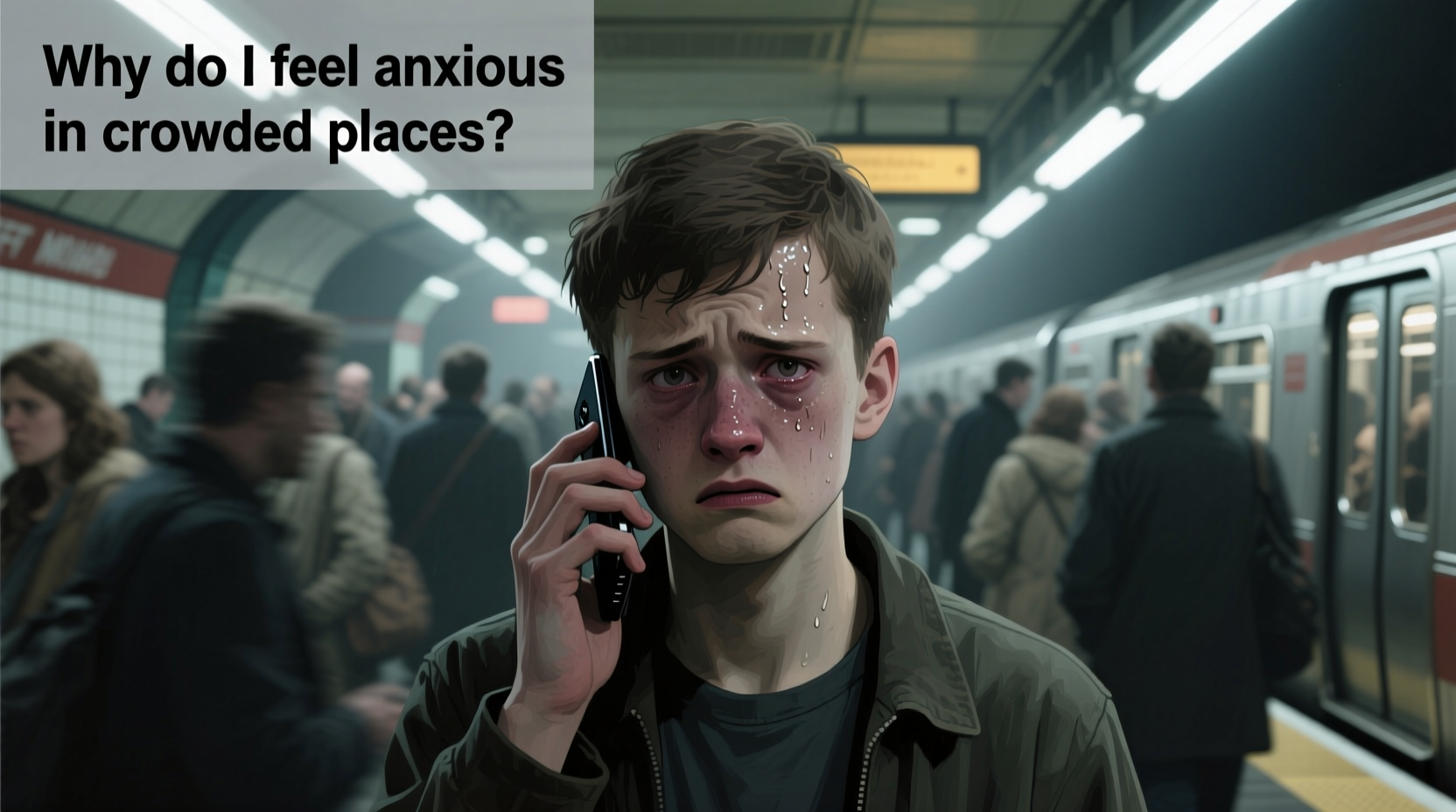
Human beings evolved in small, tight-knit groups where social dynamics were predictable and threats could be easily identified. In such environments, staying alert to potential danger—like unfamiliar faces or sudden movements—was crucial for survival. This hyper-vigilance was adaptive then, but today, it can misfire in modern settings filled with strangers and sensory overload.
In a crowd, your brain may subconsciously interpret the density of people as a threat. Are they all watching me? Could someone harm me? Is there a way out if something goes wrong? These questions activate the amygdala, the brain’s fear center, triggering the fight-or-flight response even when no real danger exists.
“We’re hardwired to detect threats in our environment. Crowds create uncertainty, and uncertainty triggers anxiety—even when we logically know we’re safe.” — Dr. Lena Torres, Cognitive Behavioral Psychologist
This evolutionary mismatch explains why rational reassurance (“You’re fine, nothing will happen”) often fails to calm the body’s physical symptoms. The emotional brain doesn’t respond to logic; it responds to perceived safety.
Cognitive and Sensory Overload: Why Your Brain Feels “Full”
Beyond primal instincts, modern crowd anxiety is heavily influenced by cognitive load—the amount of mental effort being used in working memory. A crowded space bombards you with stimuli: overlapping conversations, bright lights, sudden movements, smells, temperature changes, and physical contact.
When too much information floods your senses simultaneously, your brain struggles to process it all. This leads to what psychologists call sensory overload, which can manifest as dizziness, confusion, irritability, or full-blown panic attacks.
People with high sensitivity (often referred to as Highly Sensitive Persons or HSPs) are especially prone to this. Research suggests that 15–20% of the population processes sensory data more deeply, making them more vulnerable to overstimulation in chaotic environments.
Social Evaluation Fear and the Spotlight Effect
For many, the anxiety isn’t about the crowd itself—it’s about being seen within it. Social anxiety disorder (SAD) affects approximately 7% of U.S. adults and involves an intense fear of judgment, embarrassment, or negative evaluation by others.
In a crowd, this fear intensifies due to the spotlight effect—a cognitive bias where individuals believe they are being noticed more than they actually are. You might worry: What if I stumble? What if I look nervous? Will people think I’m weird?
The irony is that most people in a crowd are focused on themselves, not on scrutinizing you. But when anxiety takes over, your mind assumes the worst, creating a self-reinforcing loop: fear of judgment → increased self-consciousness → visible signs of anxiety (blushing, trembling) → perceived confirmation of being judged.
Common Thought Patterns in Social Crowd Anxiety
- \"Everyone is looking at me.\"
- \"I’ll do something embarrassing and humiliate myself.\"
- \"If I show anxiety, people will think I’m weak or unstable.\"
- \"I won’t be able to escape if I start panicking.\"
These thoughts aren't facts—but they feel real. Cognitive Behavioral Therapy (CBT) works by helping individuals identify and challenge these distortions through evidence-based questioning.
Agoraphobia and the Fear of Trapped Spaces
In more severe cases, anxiety in crowded places may be linked to agoraphobia—a condition characterized by fear of situations where escape might be difficult or help unavailable if panic-like symptoms occur. Contrary to popular belief, agoraphobia isn’t just a fear of open spaces; it often involves enclosed or densely populated areas like malls, theaters, or public transport.
The Diagnostic and Statistical Manual of Mental Disorders (DSM-5) classifies agoraphobia as a distinct anxiety disorder, frequently co-occurring with panic disorder. However, it can also develop independently due to traumatic experiences, chronic stress, or learned avoidance behaviors.
Someone with agoraphobia might avoid concerts, festivals, or even grocery shopping during peak hours. Over time, avoidance reinforces the fear, shrinking their comfort zone until everyday activities become daunting.
| Condition | Primary Trigger | Typical Avoidance Behaviors |
|---|---|---|
| Social Anxiety Disorder | Fear of judgment or embarrassment | Avoiding eye contact, leaving early, skipping events |
| Agoraphobia | Fear of being unable to escape | Refusing public transit, needing a companion, avoiding crowds |
| Sensory Processing Sensitivity | Overstimulation from noise, touch, movement | Leaving noisy venues, wearing headphones, seeking quiet zones |
Biological and Environmental Contributors
Anxiety in crowds isn’t solely psychological—it has biological underpinnings too. Neurotransmitters like serotonin and GABA regulate mood and stress responses. Imbalances in these chemicals can lower your threshold for anxiety.
Additionally, environmental factors play a role:
- Past trauma: A previous negative experience (e.g., getting lost as a child in a crowd) can condition the brain to associate crowds with danger.
- Lack of control: Crowds are unpredictable. Not knowing who’s around you or what might happen next increases perceived risk.
- Learned behavior: Growing up with anxious caregivers may teach you to view public spaces as threatening.
Genetics also contribute. Studies show that anxiety disorders run in families, with heritability estimates ranging from 30% to 50%. While genes don’t determine destiny, they can influence temperament and stress reactivity.
Step-by-Step Guide to Managing Crowd Anxiety
Managing anxiety in crowded places requires a multi-pronged approach combining cognitive, behavioral, and physiological strategies. Here’s a practical, evidence-based sequence to build tolerance and reduce distress:
- Identify Your Triggers: Keep a journal for one week. Note when and where anxiety arises, what you were thinking, and how intense the reaction was (rate 1–10).
- Practice Grounding Techniques: Use the 5-4-3-2-1 method: Name 5 things you see, 4 you can touch, 3 you hear, 2 you smell, and 1 you taste. This brings attention back to the present.
- Use Controlled Breathing: Inhale slowly for 4 seconds, hold for 4, exhale for 6. Repeat for 2 minutes. This activates the parasympathetic nervous system, reducing arousal.
- Challenge Catastrophic Thoughts: Ask: “What’s the evidence this will go badly? What’s a more balanced perspective?” Write down alternative interpretations.
- Gradual Exposure: Start small—visit a moderately busy café for 10 minutes. Gradually increase duration and crowd density over weeks. Success builds confidence.
- Plan an Exit Strategy: Knowing you can leave anytime reduces the fear of entrapment. Arrive early, sit near exits, and carry water or calming tools (e.g., fidget items).
- Seek Professional Support: If anxiety interferes with daily life, consider CBT or acceptance and commitment therapy (ACT) with a licensed therapist.
Mini Case Study: Overcoming Concert Anxiety
Maya, 28, loved music but avoided live shows for years. At her first concert in a decade, she entered a packed venue and immediately felt her chest tighten. Her palms sweated, her vision blurred slightly, and she became convinced she was having a heart attack. She left after 15 minutes, embarrassed and frustrated.
After consulting a therapist, Maya learned her reaction stemmed from a mix of social evaluation fear and sensory overload. Using CBT, she reframed thoughts like “People will notice I’m panicking” to “Most people are focused on the music.” She practiced exposure by attending smaller acoustic sets, using earplugs to dampen sound, and applying box breathing when anxious.
Within four months, she attended a full stadium concert—nervous, but in control. “I still feel butterflies,” she said, “but now I know they don’t have to take over.”
Checklist: Preparing for a Crowded Event
- ✅ Identify your anxiety triggers (noise, touch, being watched)
- ✅ Practice deep breathing or mindfulness for 5 minutes daily
- ✅ Choose clothing that feels comfortable and non-restrictive
- ✅ Bring a water bottle and any calming tools (e.g., stress ball)
- ✅ Plan your entry and exit route in advance
- ✅ Set a realistic goal (e.g., “Stay for 20 minutes”)
- ✅ Schedule downtime afterward to decompress
FAQ
Is it normal to feel anxious in crowds?
Yes. Mild discomfort in crowded places is common, especially in loud or unfamiliar environments. However, if anxiety consistently disrupts your life or leads to avoidance, it may indicate a treatable condition like social anxiety or agoraphobia.
Can medication help with crowd anxiety?
In some cases, yes. SSRIs (like sertraline) are often prescribed for chronic anxiety disorders. Short-term use of beta-blockers may help manage physical symptoms like rapid heartbeat. Always consult a psychiatrist before starting medication.
How long does it take to overcome crowd anxiety?
Progress varies, but many people see meaningful improvement within 8–12 weeks of consistent CBT and exposure practice. Longstanding fears may require more time, but gradual progress is almost always possible.
Conclusion: Reclaiming Your Space in the World
Feeling anxious in crowded places doesn’t mean there’s something wrong with you. It means your brain is trying to protect you—sometimes too zealously. With insight, patience, and deliberate practice, you can recalibrate your response and reclaim your freedom to move through the world without fear.
Anxiety thrives in isolation and silence. By understanding its roots and taking structured steps forward, you shift from avoidance to agency. Whether it’s a subway ride, a festival, or a holiday market, you deserve to participate fully—not just survive, but belong.




 浙公网安备
33010002000092号
浙公网安备
33010002000092号 浙B2-20120091-4
Comments
No comments yet. Why don't you start the discussion?