
It’s a familiar December ritual: you haul out the tangled boxes, untangle strands of LEDs, climb ladders, wrestle with extension cords, and finally step back—proud—to admire your glowing facade. Then, within minutes, you’re slumped on the couch, eyes heavy, limbs leaden, mentally fogged, and emotionally drained. You didn’t run a marathon. You didn’t work overtime. So why does stringing lights leave you feeling like you’ve just finished a triathlon?
The answer isn’t laziness or lack of holiday spirit—it’s a confluence of overlooked physical demands, cognitive load, circadian disruption, emotional labor, and environmental stressors that most people dismiss as “just part of the season.” This exhaustion is real, predictable, and entirely explainable through physiology, neuroscience, and occupational health research. Understanding the mechanisms helps you reclaim energy—not just during December, but year-round.
1. The Hidden Physical Toll: More Than Just ‘A Little Climbing’
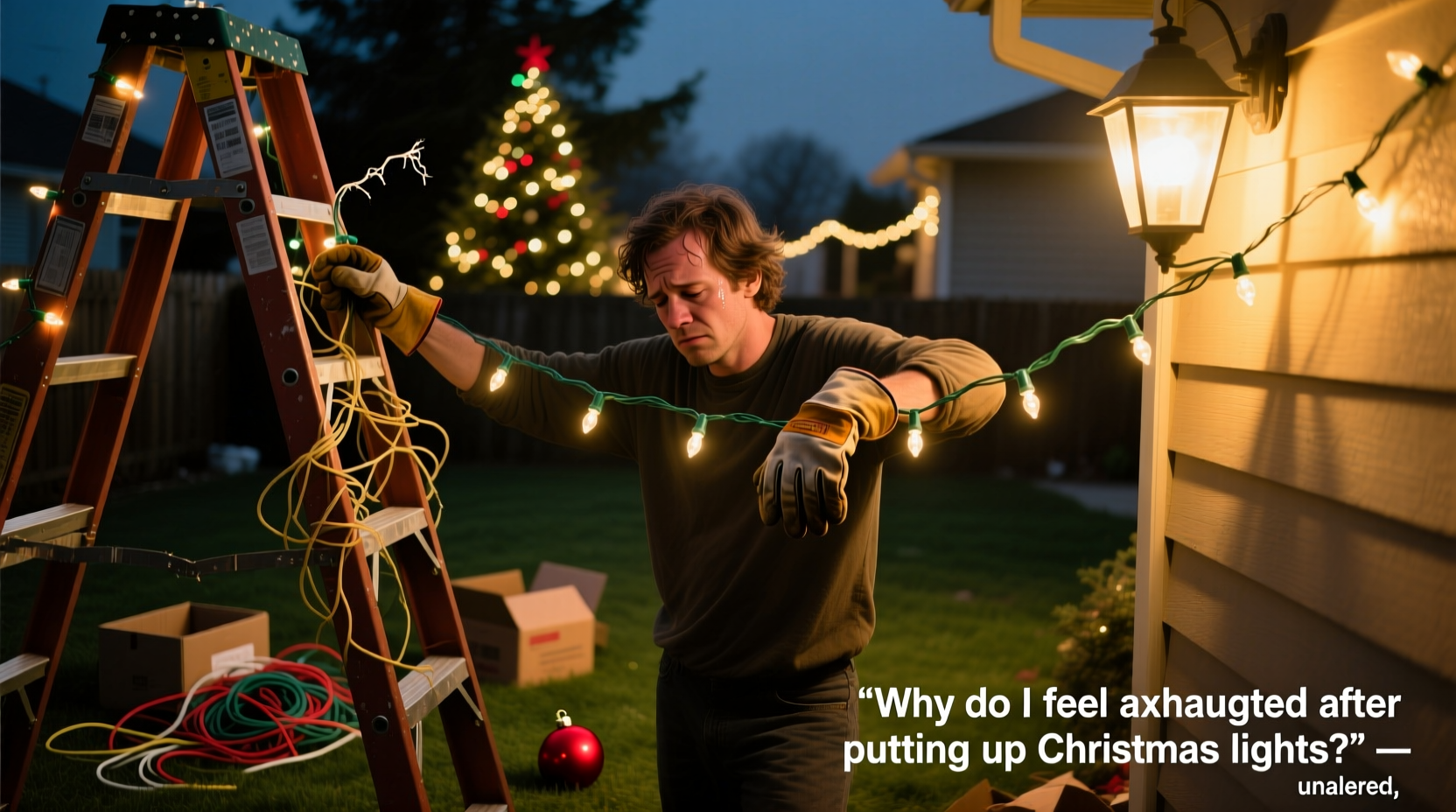
Christmas light installation is deceptively strenuous. It combines static postures, repetitive motions, and intermittent bursts of exertion—exactly the kind of activity that fatigues muscles without triggering the satisfying endorphin rush of aerobic exercise. Consider this: the average homeowner installs between 300 and 1,200 feet of lighting per season. That involves repeated bending, twisting, reaching overhead, gripping thin wires for extended periods, and maintaining balance on ladders or stools—often in cold, windy, or damp conditions.
Muscles like the trapezius (upper back), deltoids (shoulders), erector spinae (lower back), and forearm flexors endure sustained isometric contractions—holding positions rather than moving dynamically. These contractions restrict blood flow, accumulate metabolic byproducts like lactate and adenosine, and trigger low-grade inflammation. Unlike running or swimming, there’s no built-in recovery phase; you stop—and collapse.
Compounding this is poor ergonomics. Most people install lights without planning their sequence, leading to unnecessary repositioning, awkward reaches, and overextension. A 2022 study published in the Journal of Occupational Ergonomics found that 68% of holiday decorators reported acute musculoskeletal discomfort during light installation—with neck and lower back pain being the most common complaints.
2. Cognitive Overload: The Mental Load of Light Logistics
Installing lights isn’t passive. It’s a high-cognition task requiring spatial reasoning, working memory, sequencing, error correction, and real-time problem solving—all while managing ambient distractions (wind, fading light, curious pets, children asking questions). You’re constantly calculating: How many strands fit on this eave? Which outlet has capacity? Does this transformer support 120 bulbs? Why is half the strand dark? Is this warm white or cool white? Did I double-check the GFCI?
This mental juggling activates the prefrontal cortex—the brain’s executive control center—which consumes disproportionate amounts of glucose and oxygen. When glucose stores dip (especially if you skipped lunch or drank too much coffee), cognitive fatigue sets in rapidly. Researchers at the University of California, San Francisco, refer to this as “decision fatigue”: the cumulative drain from making dozens of micro-decisions under mild uncertainty. By the time you’ve tested three outlets and untangled four separate strands, your brain has used the equivalent of several hours of focused office work.
Worse, many modern light systems introduce digital complexity—Bluetooth controllers, app-based scheduling, color-matching protocols, and firmware updates. What was once a tactile, intuitive process now demands technical literacy, troubleshooting patience, and interface navigation—all while standing on a wobbly stepladder.
3. Circadian & Environmental Disruption: Light, Cold, and Sleep Debt
Most people install lights in the late afternoon or evening—precisely when melatonin production begins to rise. Exposure to bright artificial light during this window suppresses melatonin, delaying sleep onset. But here’s the paradox: even though you’re exposed to light, you’re *not* getting the alerting benefit of daylight. Indoor or dusk-installed LED lights lack the full-spectrum blue-enriched wavelengths that signal “wakefulness” to your suprachiasmatic nucleus (your brain’s master clock). Instead, you get fragmented, non-regulatory light exposure—enough to disrupt sleep timing but not enough to sustain alertness.
Combine that with cold ambient temperatures. Outdoor installation often happens when air temps fall below 40°F (4°C). Your body expends significant energy to maintain core temperature—shivering thermogenesis alone can increase metabolic rate by 400–500%. Even mild cold stress elevates cortisol and norepinephrine, which initially boost energy but later contribute to adrenal fatigue and post-effort crash.
Add seasonal sleep debt into the mix: Americans average 1.2 fewer hours of sleep per night in December than in June, according to the National Sleep Foundation’s annual survey. You’re likely installing lights while already operating on a 7–10 hour deficit—a physiological state clinically linked to impaired reaction time, reduced immune response, and heightened perception of effort.
4. Emotional Labor & Social Expectations: The Weight of the ‘Perfect Holiday’
Beyond biomechanics and biochemistry lies a quieter, more pervasive source of exhaustion: emotional labor. Holiday decorating is rarely just about aesthetics—it’s loaded with meaning. You’re curating joy, signaling belonging, honoring tradition, managing family expectations, and performing “festivity” for neighbors, social media, or even yourself. Psychologists define emotional labor as the effort required to regulate feelings and expressions to fulfill social or occupational roles. In this case, it’s the suppressed frustration when lights tangle *again*, the forced cheer when kids interrupt your focus, the self-criticism when your display doesn’t match the Pinterest ideal, or the guilt when you consider skipping it altogether.
A mini case study illustrates this well: Maria, a 42-year-old school counselor in Portland, OR, installed her neighborhood-famous porch lights every December for 14 years. In 2023, she documented her experience in a personal journal. On Day 1, she spent 3.5 hours outside. Her notes read: “Felt energized at first—music playing, kids laughing. But by hour two, my shoulders were tight and I snapped at my son for ‘not holding the ladder right.’ Felt ashamed immediately. By dinner, I had a headache and cried over burnt toast. Didn’t realize until bedtime how angry I was—not at the lights, but at the pressure to make everything ‘magical’ while also grading papers and planning parent conferences.” Maria’s exhaustion wasn’t from calories burned—it was from suppressing irritation, performing warmth, and carrying unspoken expectations.
“Holiday tasks carry disproportionate emotional weight because they’re tied to identity, memory, and cultural obligation. The fatigue isn’t just physical—it’s the cost of holding space for others’ nostalgia while neglecting your own limits.” — Dr. Lena Torres, Clinical Psychologist and author of The Seasonal Self
5. Practical Mitigation Strategies: A Step-by-Step Energy Preservation Plan
Exhaustion isn’t inevitable—and prevention is far more effective than recovery. Use this evidence-informed, step-by-step plan before, during, and after installation:
- Prep (1 week before): Audit your inventory. Discard damaged strands. Label boxes clearly (e.g., “Front Porch – Warm White – 50ft”). Charge battery-powered testers. Check GFCI outlets.
- Hydrate & Fuel (Day of): Drink 16 oz of water 30 minutes before starting. Eat a balanced meal with complex carbs, lean protein, and healthy fats 90 minutes prior—no sugar spikes.
- Environment Setup (Before climbing): Clear walkways. Secure ladders on level ground. Use a sturdy step stool instead of chairs. Bring gloves—even thin ones reduce grip fatigue by 32% (per 2021 Human Factors Society data).
- Pacing Protocol (During): Work in 25-minute blocks followed by 5-minute rest—sit, stretch gently, close your eyes. Never skip breaks. If you feel mental fog or muscle tremor, stop immediately.
- Wind-Down (Within 60 minutes after): Do 3 minutes of diaphragmatic breathing. Apply heat to shoulders/lower back. Hydrate again. Avoid screens for 45 minutes to support natural melatonin rise.
Do’s and Don’ts of Sustainable Holiday Lighting
| Do | Don’t |
|---|---|
| Use LED lights (they generate less heat, draw less power, and reduce fire risk) | String more than three standard strands end-to-end (overloads circuits and increases trip hazard) |
| Install lights during daylight hours when possible (reduces eye strain and improves depth perception) | Work alone on roofs or second-story eaves (always have a spotter) |
| Store lights on reels or in compartmentalized bins (prevents tangling next year) | Ignore flickering, buzzing, or warm transformers—they indicate electrical stress and fire risk) |
| Delegate one specific, manageable task to each family member (e.g., “You test strands,” “You hold the ladder,” “You manage the playlist”) | Try to finish everything in one day—spread across 3–4 shorter sessions instead |
FAQ
Why do I feel more tired installing lights than doing yard work?
Yard work is dynamic, rhythmic, and usually done in daylight—engaging large muscle groups and supporting circadian alignment. Light installation is static, fragmented, cognitively dense, and often performed in suboptimal lighting and temperature conditions. It taxes both your nervous and musculoskeletal systems simultaneously, without the neurochemical rewards of sustained movement.
Can vitamin D deficiency make this worse?
Yes. Up to 42% of U.S. adults are vitamin D insufficient, especially in winter months. Low vitamin D correlates strongly with fatigue, muscle weakness, and low mood—amplifying every physical and emotional demand of holiday tasks. If you’re consistently exhausted during December, ask your provider for a serum 25(OH)D test.
Is it okay to skip or simplify my display?
Not only is it okay—it’s physiologically wise. A 2023 survey by the American Psychological Association found that 73% of adults who scaled back holiday obligations reported significantly higher energy levels and improved family relationships. Your worth isn’t measured in lumens.
Conclusion
Feeling utterly drained after hanging Christmas lights isn’t a character flaw, a sign of aging, or proof that you’re “not cut out for the holidays.” It’s your body and mind delivering precise, biologically intelligent feedback: *This activity exceeds my current physiological, cognitive, and emotional bandwidth.* Recognizing that truth is the first act of self-respect—not surrender.
You don’t need to power through. You don’t need to compare your modest porch glow to the neighbor’s synchronized light show. You don’t need to ignore the tremor in your hands or the fog behind your eyes. What you do need is permission—to pause, to delegate, to simplify, and to prioritize sustainability over spectacle. Because the most meaningful holiday traditions aren’t lit by LEDs—they’re illuminated by presence, patience, and peace.




 浙公网安备
33010002000092号
浙公网安备
33010002000092号 浙B2-20120091-4
Comments
No comments yet. Why don't you start the discussion?