
Eight hours of sleep is widely considered the gold standard for adult rest. Yet, many people wake up groggy, unfocused, and exhausted despite hitting that target. If you're logging a full night’s sleep but still dragging through the day, the problem likely isn’t duration—it’s quality. The architecture of your sleep, particularly the balance and progression of sleep cycles, plays a far greater role in how refreshed you feel than the number on the clock.
Sleep isn’t a uniform state. It’s a dynamic process made up of repeating cycles lasting roughly 90 minutes each. Each cycle includes stages of light sleep, deep sleep, and REM (rapid eye movement) sleep—each with distinct physiological roles. Disruptions to this rhythm, even subtle ones, can leave you feeling unrested no matter how long you were technically “asleep.”
This article explores why you might still feel tired after eight hours, focusing on sleep cycle irregularities, circadian timing, and practical strategies to align your rest with your body’s natural biology.
The Science of Sleep Cycles
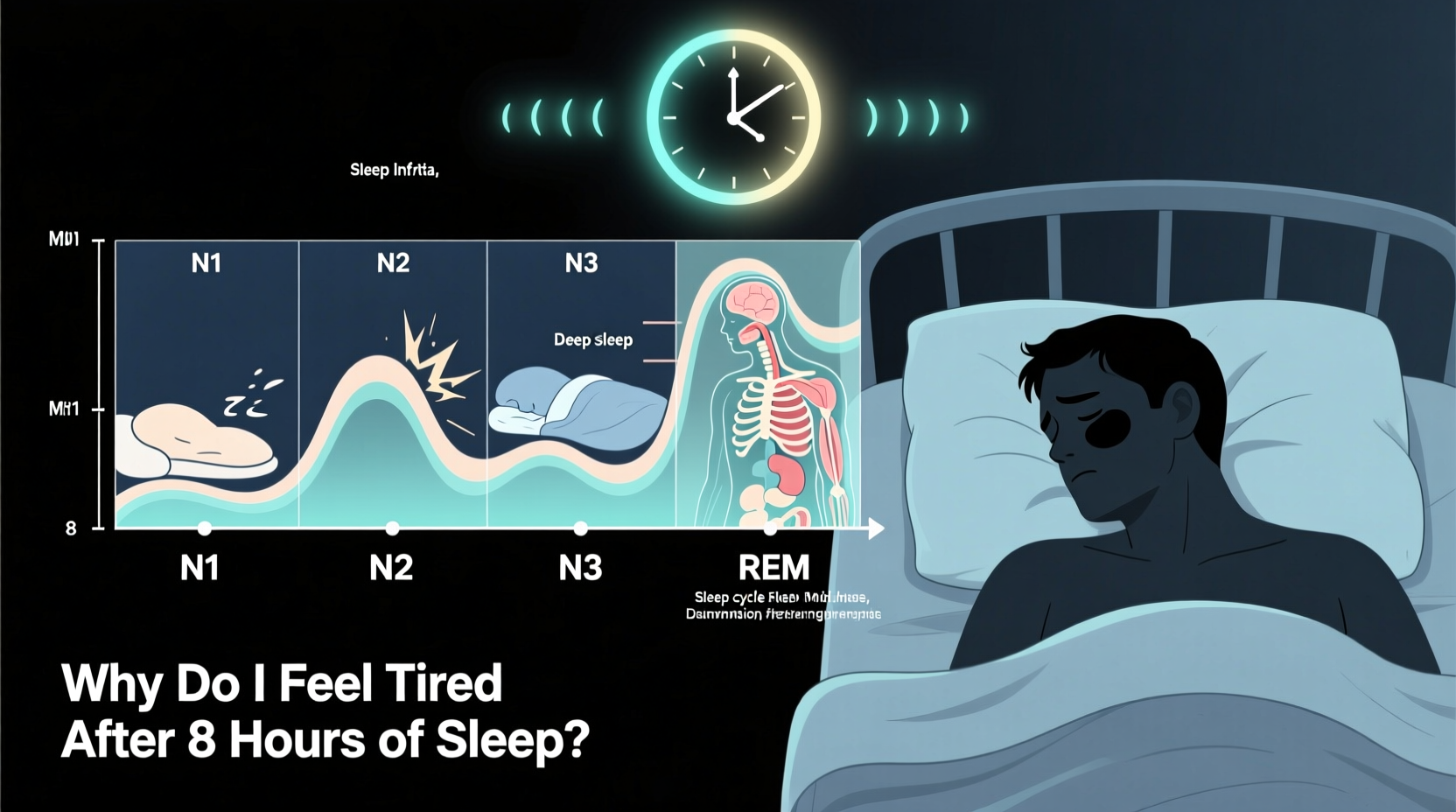
Understanding sleep requires moving beyond total hours to examine what happens during those hours. A typical night consists of four to six 90-minute sleep cycles, each progressing through three non-REM stages and one REM stage:
- Stage 1 (N1): Light sleep, transition from wakefulness. Lasts 1–5 minutes.
- Stage 2 (N2): Body temperature drops, heart rate slows. Prepares for deep sleep. Makes up about 50% of total sleep.
- Stage 3 (N3): Deep, slow-wave sleep. Critical for physical restoration, immune function, and memory consolidation.
- REM Sleep: Brain activity surges, dreams occur. Essential for emotional regulation and cognitive performance. Increases in duration in later cycles.
Waking up at the end of a complete cycle—especially during or after REM—tends to produce a more alert, refreshed state. Conversely, being jolted awake mid-cycle, particularly during deep sleep, can cause sleep inertia: that heavy, disoriented feeling that lingers for hours.
“Sleep quality is not measured by time in bed, but by the integrity of sleep architecture. Fragmented or mistimed cycles undermine recovery just as much as short sleep.” — Dr. Rebecca Turner, Sleep Neurologist, Stanford Center for Sleep Sciences
Circadian Misalignment: When Your Clock Is Off
Your internal body clock, or circadian rhythm, regulates when you feel sleepy and alert. It’s synchronized primarily by light exposure, meal timing, and consistent sleep-wake schedules. Even with eight hours in bed, if your sleep window doesn’t align with your biological rhythm, you’ll miss the optimal windows for deep and REM sleep.
For example, someone who sleeps from 3 a.m. to 11 a.m. may get eight hours, but they’re compressing their REM-rich late-night cycles into daylight hours, when cortisol begins rising. This mismatch suppresses melatonin and disrupts hormonal flow, leaving them fatigued despite sufficient duration.
Common Sleep Cycle Disruptors
Several lifestyle and medical factors interfere with smooth cycling through sleep stages:
- Irregular sleep schedule: Shifting bedtimes prevent your brain from anticipating and preparing for each phase.
- Alcohol consumption: While it may help you fall asleep faster, alcohol fragments REM sleep and reduces deep sleep quality.
- Blue light exposure before bed: Suppresses melatonin, delaying the onset of Stage 1 and pushing back the entire cycle sequence.
- Stress and anxiety: Heightened cortisol levels increase nighttime awakenings and reduce time spent in restorative stages.
- Sleep apnea: Breathing interruptions fragment sleep, often without full awakening, leading to micro-awakenings that break cycle continuity.
Even minor disturbances—like a pet jumping on the bed or a partner snoring—can shift you from deep to light sleep, resetting the cycle and reducing overall efficiency.
Optimizing Sleep Timing: The Power of Wake-Up Consistency
Most people focus on bedtime, but wake-up time is actually the anchor of healthy sleep regulation. Waking at the same time every day—regardless of when you fell asleep—helps set your circadian clock and improves the predictability of sleep cycles.
Over time, this consistency trains your body to initiate sleep earlier in the evening because it knows when it will need to rise. As a result, you’re more likely to enter deep sleep during its biologically ideal window (typically between 11 p.m. and 3 a.m.) and enjoy longer REM periods in the early morning.
“Fixing wake time is the single most effective behavioral intervention for improving sleep continuity.” — Dr. Matthew Walker, author of *Why We Sleep*
Step-by-Step Guide to Aligning Your Sleep Cycles
- Determine your ideal wake-up time based on your daily obligations—not how you feel today, but what’s sustainable long-term.
- Set an alarm and get up immediately, even on weekends. Open curtains or go outside for natural light within 30 minutes.
- Count backward in 90-minute increments from your wake time to find optimal bedtimes (e.g., waking at 7 a.m. means ideal bedtimes are 9:30 p.m., 11 p.m., or 12:30 a.m.).
- Select the earliest realistic bedtime that allows you to fall asleep naturally without lying awake.
- Maintain this schedule for at least two weeks to allow your body to adjust.
- Track your energy levels upon waking and throughout the morning to assess improvements.
Sleep Efficiency vs. Total Sleep Time
Two people may both sleep eight hours, but their experiences differ drastically based on sleep efficiency—the percentage of time in bed actually spent sleeping. Frequent awakenings, restless legs, or rumination can turn eight hours in bed into only six hours of real sleep.
Low sleep efficiency means fewer completed cycles and less time in critical stages. For instance, deep sleep typically occurs in the first half of the night. If you’re waking repeatedly during these early hours, you may miss most of your N3 sleep, regardless of how long you stay in bed.
| Sleep Pattern | Total Time in Bed | Actual Sleep Time | Sleep Efficiency | Expected Morning Energy |
|---|---|---|---|---|
| Uninterrupted, aligned with rhythm | 8 hours | 7.5 hours | 94% | High |
| Frequent awakenings | 8 hours | 6 hours | 75% | Low |
| Delayed sleep onset | 8 hours | 6.5 hours | 81% | Moderate |
| Early waking, unable to return | 8 hours | 5.5 hours | 69% | Very Low |
Mini Case Study: Recovering Natural Rhythm
Sarah, a 34-year-old marketing consultant, consistently slept from midnight to 8 a.m. but woke feeling drained. She drank coffee by 9 a.m. and struggled with afternoon crashes. After tracking her sleep with a wrist monitor, she discovered she was only getting 5.8 hours of actual sleep due to frequent nighttime awakenings and low REM.
She implemented a fixed wake-up time of 7 a.m. daily, eliminated alcohol three nights before workweek, and began a wind-down routine at 10 p.m. Within 10 days, her sleep efficiency rose to 89%, and she reported deeper rest and improved morning clarity—even though her bedtime gradually shifted earlier to 10:30 p.m.
The key wasn’t more sleep—it was more coherent, uninterrupted cycling aligned with her circadian biology.
Checklist: Optimize Your Sleep Cycle Health
- ✅ Set a consistent wake-up time (±15 minutes)
- ✅ Avoid alcohol within 3 hours of bedtime
- ✅ Limit screen use 60–90 minutes before sleep
- ✅ Expose yourself to bright light within 30 minutes of waking
- ✅ Keep bedroom cool (60–67°F / 15–19°C), dark, and quiet
- ✅ Track sleep efficiency for one week using a journal or device
- ✅ Evaluate for signs of sleep apnea (snoring, gasping, daytime fatigue)
FAQ: Common Questions About Tiredness After 8 Hours
Can I be sleep-deprived even with 8 hours of sleep?
Yes. True sleep deprivation includes poor-quality sleep. If your cycles are fragmented or mistimed, your brain and body don’t receive the restorative benefits of deep and REM sleep, leading to functional impairment similar to short sleep.
Does oversleeping cause fatigue?
Yes. Sleeping significantly past your natural wake time—especially beyond 9 hours—can lead to sleep inertia and circadian disruption. It may also indicate underlying issues like depression, sleep apnea, or poor sleep quality forcing compensatory long durations.
How do I know if my sleep cycles are disrupted?
Symptoms include unrefreshing sleep, excessive daytime sleepiness, difficulty concentrating, mood changes, and reliance on caffeine. Wearable trackers can provide insights into sleep staging, though clinical polysomnography is the gold standard for diagnosis.
Conclusion: Reclaim Restful Mornings
Feeling tired after eight hours of sleep is not normal—and it’s not inevitable. The solution lies not in adding more time in bed, but in honoring the natural ebb and flow of your sleep cycles. By stabilizing your wake-up time, minimizing disruptions, and aligning your rest with your circadian biology, you can transform unrefreshing sleep into truly restorative rest.
Start tonight. Choose one change—whether it’s setting a firm alarm, cutting out evening wine, or dimming screens earlier—and commit to it for seven days. Small shifts compound into profound differences in energy, focus, and well-being. Sleep isn’t just about time; it’s about rhythm. Get yours right, and you’ll wake up ready to live fully.




 浙公网安备
33010002000092号
浙公网安备
33010002000092号 浙B2-20120091-4
Comments
No comments yet. Why don't you start the discussion?