
Forgetting someone’s name moments after being introduced is a common, often embarrassing experience. It doesn’t mean you’re losing your mind — it means your brain isn’t processing the information deeply enough to retain it. Names are arbitrary labels with little inherent meaning, making them among the hardest pieces of information to store in long-term memory. The good news? With deliberate strategies, you can train your brain to remember names more effectively and build stronger connections in both personal and professional settings.
This article explores why names slip through mental cracks so easily, examines the cognitive mechanisms behind forgetting, and provides practical, research-supported techniques to enhance name recall. Whether you're networking at events, meeting new clients, or simply trying to strengthen relationships, these tools will help you stop saying, “Sorry, what was your name again?”
The Science Behind Forgetting Names
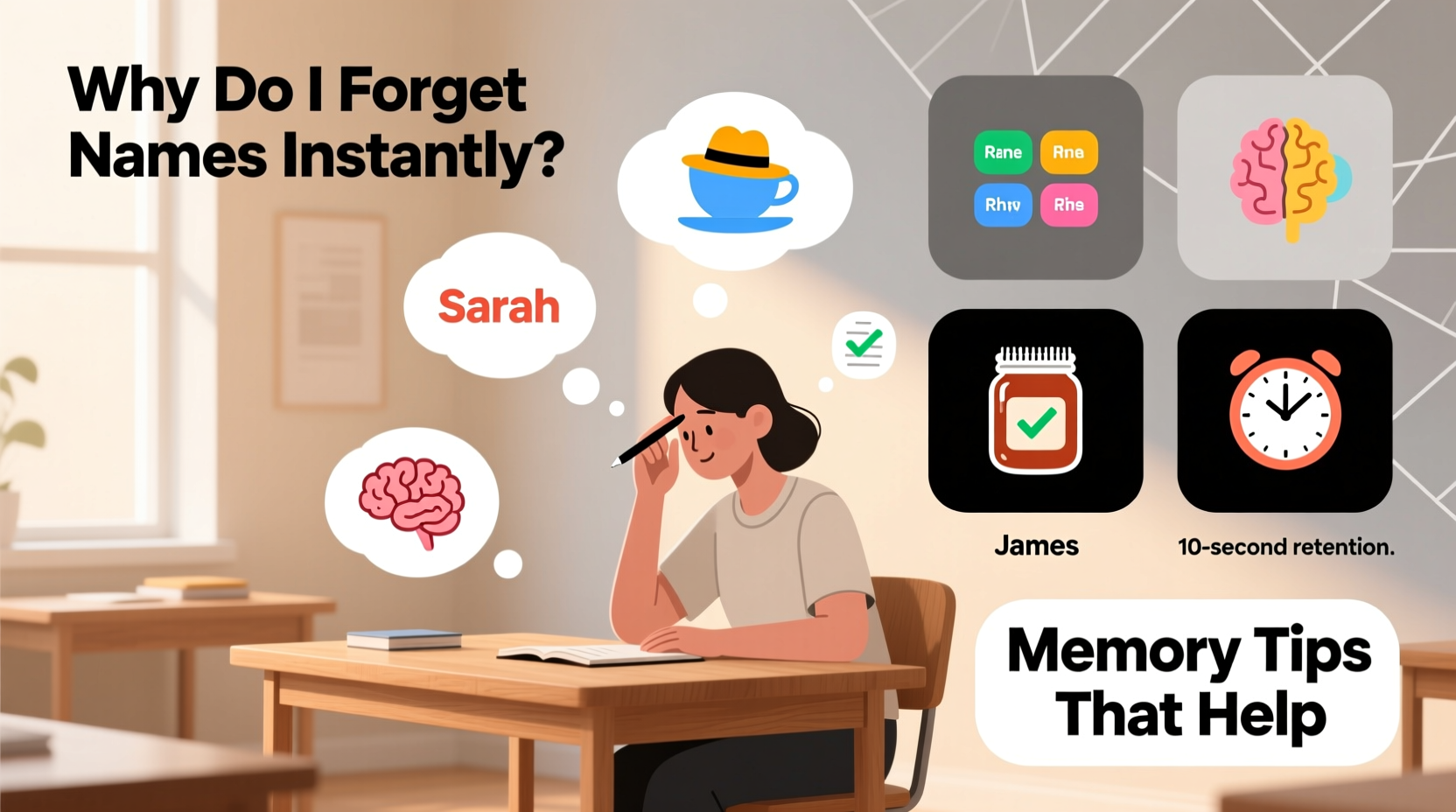
Human memory operates in three stages: encoding, storage, and retrieval. Forgetting a name usually happens at the first stage — encoding. When you meet someone, your brain is simultaneously processing their face, tone of voice, body language, and surroundings. Amid this sensory overload, the name often gets minimal attention.
Psychologists call this the “next-in-line” effect. Just as you prepare to introduce yourself, your focus shifts inward, reducing your ability to absorb the other person’s name. Additionally, names lack semantic meaning — unlike a job title or hobby, which link to existing knowledge, a name like “Julian” doesn’t automatically connect to anything in your memory network unless you create that link intentionally.
“Names are forgotten not because of poor memory, but because of poor encoding. Attention at the moment of learning is the key.” — Dr. Elizabeth Loftus, Cognitive Psychologist
Neuroimaging studies show that when people successfully remember names, there's increased activity in the left inferior prefrontal cortex — a region associated with deep processing and meaningful association. In contrast, passive repetition (like silently repeating “Sarah, Sarah, Sarah”) activates fewer neural pathways and leads to rapid decay.
7 Proven Memory Tips That Help You Remember Names
Improving name recall isn't about having a “good memory” — it’s about using better strategies. These seven evidence-based techniques leverage how the brain encodes and retrieves information.
1. Repeat the Name Immediately
Say the person’s name aloud within the first 10 seconds of meeting them. Use it naturally in conversation: “Nice to meet you, Alex. What brings you here today?” This reinforces auditory and verbal memory pathways.
2. Associate the Name with a Visual Image
The brain remembers images far better than abstract words. Create a vivid mental picture linking the name to something concrete. If you meet someone named “Baker,” imagine them wearing a chef’s hat and tossing flour. For “Audrey,” picture Audrey Hepburn in *Breakfast at Tiffany’s*. The quirkier the image, the more memorable it becomes.
3. Find a Rhyme or Alliteration
Rhyming names are easier to recall. If the name doesn’t rhyme naturally, invent a playful connection. “Dan from the van,” “Linda with the binder,” or “Mike on the bike” use rhythm and sound patterns to boost retention.
4. Connect the Name to Someone You Know
If the name reminds you of a friend, relative, or celebrity, make that connection explicit. “You remind me of my cousin Laura — same bright smile.” This embeds the new name into an existing memory node, strengthening recall.
5. Focus on Distinctive Features
Tie the name to a physical trait — not in a rude way, but as a mental anchor. “Glasses Greg,” “Tall Tamara,” or “Pierced Paul” (internally, never spoken) creates a dual cue: visual + verbal. Studies show that pairing faces with traits improves recognition by up to 30%.
6. Write It Down (When Possible)
After a meeting, jot down names alongside a distinguishing detail. At a conference? Note: “Rosa – purple scarf, works in sustainability.” Writing engages motor memory and forces deeper processing. Even mentally “writing” the name in the air can help.
7. Review Within 24 Hours
Memory consolidates over time, especially during sleep. Rehearse the names of people you met earlier that day. Try recalling them without cues. Spaced repetition — reviewing at increasing intervals — dramatically increases long-term retention.
Step-by-Step Guide to Remembering Names in Real Time
Next time you’re in a social situation, follow this five-step process to lock in names the moment you hear them:
- Pause and listen: Make eye contact and silence internal chatter. Focus entirely on the introduction.
- Repeat aloud: Say the name in a follow-up sentence: “Great to meet you, Nadia. I’m Chris.”
- Visualize: Instantly create a mental image linked to the name (e.g., Nadia = “Neon lights”).
- Connect: Link the name to a feature, sound, or familiar person.
- Reinforce: Use the name two more times in conversation: “What do you think, Nadia?” or “That’s a great point, Nadia.”
This sequence takes less than 30 seconds but engages multiple areas of the brain — auditory, visual, linguistic, and emotional — creating a rich memory trace that’s harder to lose.
Common Mistakes That Worsen Name Forgetting
Avoid these habits that sabotage memory from the start:
| Mistake | Why It Hurts Memory | Better Alternative |
|---|---|---|
| Multi-tasking during introductions | Dilutes attention, weakens encoding | Pause phone use; give full attention |
| Assuming you’ll “just remember” | No active strategy applied | Use visualization or association immediately |
| Apologizing excessively for forgetting | Creates anxiety, impairs future recall | Politely ask again: “Help me remember your name?” |
| Using generic terms like “buddy” or “sweetheart” | Undermines sincerity and weakens name reinforcement | Ask once, then use the name consistently |
Mini Case Study: From Chronic Forgetter to Networking Pro
Mark, a sales manager, struggled with remembering client names, which made him appear disinterested despite his strong relationship-building skills. After missing a key client’s name during a presentation, he decided to change his approach.
He started applying the visualization technique: when introduced to “Diane from DigitalEdge,” he pictured her holding a giant digital “D.” He repeated her name three times in their conversation and noted her name afterward with the phrase “D for data-driven.”
Within three weeks, colleagues noticed his improved recall. Six months later, he closed a major deal with a client who remarked, “I’m impressed you remembered my name from our first meeting.” Mark credits the shift not to a better memory, but to better habits.
Checklist: How to Remember Names Like a Pro
Print or bookmark this checklist to practice consistently:
- ✅ Make strong eye contact during introductions
- ✅ Repeat the name within 10 seconds
- ✅ Create a vivid mental image tied to the name
- ✅ Link the name to a sound, rhyme, or familiar person
- ✅ Connect the name to a distinctive facial or clothing feature
- ✅ Use the name naturally two more times in conversation
- ✅ Jot down names and associations after events
- ✅ Review names within 24 hours
- ✅ Practice mindfulness to reduce mental clutter
- ✅ Be kind to yourself — occasional slips are normal
Frequently Asked Questions
Is forgetting names a sign of dementia?
No. Occasional name lapses are normal at any age. Dementia-related memory loss typically involves forgetting recent events, repeating questions, or getting lost in familiar places. If you’re only struggling with names but remember conversations and contexts, it’s likely a normal cognitive limitation, not a medical issue.
What if I already forgot someone’s name? How do I recover gracefully?
Be honest and polite. Say, “I’m so glad we’re talking — help me remember your name?” Most people appreciate the effort. Avoid bluffing or using vague terms like “you.” A sincere request shows respect and often strengthens rapport.
Can memory training really improve name recall?
Yes. Research from the University of Pennsylvania found that individuals trained in associative memory techniques improved name-face recall by 80% in just two weeks. The brain is highly adaptable, and deliberate practice reshapes neural pathways responsible for memory.
Conclusion: Stop Forgetting, Start Remembering
Forgetting names isn’t a flaw — it’s a function of how memory works. Without intentional encoding, even the sharpest minds let names fade. But with simple, consistent strategies, you can transform this weakness into a strength. The ability to remember someone’s name communicates respect, builds trust, and deepens connections in ways few other gestures can.
You don’t need a photographic memory. You need a system. Start tonight: at dinner, with a colleague, or online — apply one technique. Repeat the name. Create an image. Make the connection. Over time, these small actions compound into lasting improvement.




 浙公网安备
33010002000092号
浙公网安备
33010002000092号 浙B2-20120091-4
Comments
No comments yet. Why don't you start the discussion?