
Forgetting names minutes after meeting someone, walking into a room and blanking on why you’re there, or struggling to recall information you just read—these experiences are more common than you think. Memory lapses aren’t always a sign of aging or cognitive decline. Often, they stem from how we process, store, and retrieve information. Understanding the science behind forgetting and applying practical memory techniques can dramatically improve your ability to remember what matters.
The human brain is not designed to retain every piece of information it encounters. Instead, it prioritizes based on relevance, repetition, and emotional weight. When memory fails, it’s usually not because the data was lost—it’s because the retrieval path wasn’t strong enough. The good news? Memory is not fixed. Like a muscle, it can be trained, strengthened, and optimized with the right strategies.
The Science Behind Forgetting
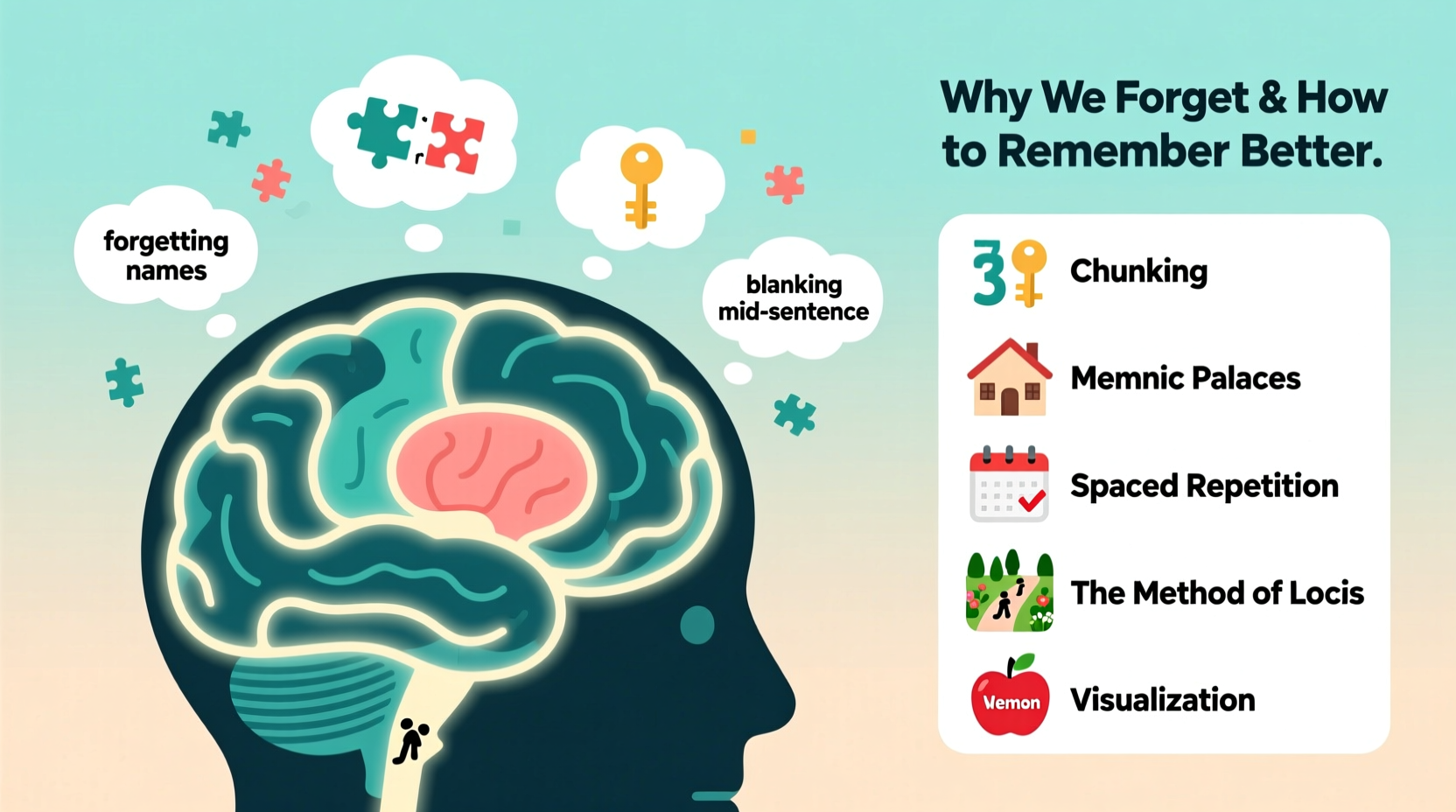
Forgetting is a natural part of the brain’s filtering system. Without it, we’d be overwhelmed by irrelevant details. Psychologist Hermann Ebbinghaus first mapped this phenomenon in the 1880s with his \"forgetting curve,\" which shows that without reinforcement, we lose up to 70% of new information within 24 hours.
This rapid decay happens because memories move through stages: sensory input, short-term storage, and long-term consolidation. Most forgetting occurs when information never transitions from short-term to long-term memory. Common reasons include:
- Lack of attention: Distractions prevent encoding.
- Poor organization: Unstructured information is harder to retrieve.
- Stress and fatigue: Cortisol impairs memory formation.
- Overloading: Trying to absorb too much too quickly.
- No emotional connection: Emotionally neutral facts are less likely to stick.
Memory Tricks That Actually Work
Improving memory isn’t about brute-force repetition. It’s about working with your brain’s natural processes. The most effective techniques leverage association, visualization, and structure to create durable mental pathways.
1. The Spaced Repetition Method
Instead of cramming, review information at increasing intervals. This technique aligns with how the brain consolidates memories during sleep and downtime.
- Learn new material (e.g., vocabulary, concepts).
- Review it after 1 day.
- Review again after 3 days.
- Then at 1 week, 2 weeks, and 1 month.
Apps like Anki automate this process using algorithms that optimize timing based on your performance.
2. The Memory Palace (Method of Loci)
Used by ancient Greeks and modern memory champions, this method involves visualizing a familiar place—like your home—and placing pieces of information in specific locations.
For example, to remember a grocery list: picture milk spilling on your front doormat, bread stacked on the sofa, and eggs balanced on the bathroom sink. When you mentally walk through your house, each image triggers the associated item.
“Top performers don’t have better memories—they use better strategies.” — Dr. Henry Roediger, Cognitive Psychologist, Washington University
3. Chunking and Pattern Recognition
The average person can hold 7±2 items in short-term memory. Chunking reduces cognitive load by grouping information into meaningful units.
Example: Remembering a phone number as 555-867-5309 instead of ten separate digits. Similarly, break down complex ideas into themes or acronyms.
4. Elaborative Encoding
This involves linking new information to what you already know. Ask yourself: “How does this relate to my life?” or “What does this remind me of?”
When learning about photosynthesis, for instance, connect it to a time you saw a plant grow toward sunlight. The personal link strengthens retention.
Common Memory Myths Debunked
Misconceptions about memory can lead to ineffective habits. Here’s what research says about popular beliefs:
| Myth | Reality |
|---|---|
| You only use 10% of your brain. | Modern imaging shows activity across nearly all regions, even during simple tasks. |
| Memory decline is inevitable with age. | While processing speed may slow, older adults often outperform younger ones in semantic memory and wisdom-based recall. |
| Writing things down weakens memory. | Note-taking enhances encoding, especially when done by hand and reviewed later. |
| Some people are just born with bad memories. | Genetics play a role, but strategy use has a far greater impact than innate ability. |
A Real-Life Example: Maria’s Turnaround
Maria, a 34-year-old project manager, struggled to remember client names and meeting details. She often apologized for forgetting key points, which affected her confidence. After reading about spaced repetition and the memory palace, she decided to test them.
She started small: assigning each team member a vivid mental image placed in her office layout. The quiet analyst became a librarian sitting at the reception desk; the energetic marketer turned into a dancer on the conference table. Within two weeks, she recalled everyone’s name instantly in meetings.
She also began reviewing her daily notes before bed and again the next morning. Over three months, her colleagues noticed her sharper presence and reliability. “I didn’t get a better memory,” she said. “I just learned how to use the one I already had.”
Step-by-Step Guide to Building a Stronger Memory
Improving memory doesn’t require drastic changes. Follow this 30-day plan to build lasting habits:
- Day 1–3: Audit your current habits. Note when and where you forget things most (e.g., names, appointments, tasks).
- Day 4–7: Practice focused attention. Spend 10 minutes daily reading without distractions. Summarize what you read immediately after.
- Day 8–14: Implement spaced repetition for one type of information (e.g., new contacts). Review names after 1 day, 3 days, and 1 week.
- Day 15–21: Build a simple memory palace for your shopping list or daily to-dos. Use your apartment or commute route.
- Day 22–30: Combine techniques. Link new knowledge to personal stories and review it using spaced intervals.
By day 30, you’ll notice improved recall and reduced mental clutter. The key is consistency—not perfection.
Checklist: Daily Habits for Better Memory
Use this checklist to reinforce memory-friendly behaviors every day:
- ✅ Get 7–9 hours of quality sleep.
- ✅ Minimize multitasking during learning.
- ✅ Write down important information immediately.
- ✅ Review key facts before bed.
- ✅ Use visualization for names or lists.
- ✅ Stay physically active—exercise boosts hippocampal function.
- ✅ Hydrate and eat brain-supportive foods (omega-3s, leafy greens, berries).
- ✅ Practice mindfulness or meditation to reduce mental noise.
FAQ
Why do I forget things seconds after thinking of them?
This typically happens when information stays in your short-term memory without being encoded into long-term storage. Lack of attention, distraction, or failure to rehearse the thought causes it to fade quickly. Try repeating the idea aloud or writing it down immediately to anchor it.
Can anxiety really affect my memory?
Yes. Chronic stress and anxiety elevate cortisol levels, which can damage the hippocampus—the brain region responsible for forming new memories. Anxiety also floods the mind with intrusive thoughts, reducing available cognitive space for retention. Mindfulness and breathing exercises can help mitigate this effect.
Are memory supplements effective?
Most over-the-counter \"brain boosters\" lack strong scientific backing. Some compounds like omega-3 fatty acids, phosphatidylserine, and caffeine show modest benefits, but lifestyle factors—sleep, exercise, and mental engagement—are far more impactful. Always consult a healthcare provider before starting supplements.
“The best memory aid is attention. If you pay full attention when learning, you won’t need to struggle to remember later.” — Dr. Amishi Jha, Neuroscientist and Author of *Peak Mind*
Conclusion: Take Control of Your Memory Today
Forgetting is not a flaw—it’s feedback. It signals that your brain needs better input, structure, or reinforcement. By understanding the mechanisms behind memory and applying proven techniques, you can transform how you learn, work, and interact with the world.
You don’t need a photographic memory to be sharp and reliable. You need strategies that align with how your brain naturally works. Start small: pick one trick—spaced repetition, the memory palace, or elaborative encoding—and practice it for a week. Notice the difference. Then build from there.




 浙公网安备
33010002000092号
浙公网安备
33010002000092号 浙B2-20120091-4
Comments
No comments yet. Why don't you start the discussion?