
It’s a familiar moment: you’re standing under warm water, lost in thought, not actively trying to solve anything — and suddenly, a brilliant idea appears. Maybe it’s the solution to a work problem, a clever line for a poem, or a long-overdue life decision. This isn’t just coincidence. There’s real neuroscience and psychology behind why so many people experience bursts of creativity in the shower. The answer lies in a mental state known as “relaxed focus” — a sweet spot where the brain is calm yet active, free from distractions but still processing deeply.
Understanding this phenomenon doesn’t just explain a quirky habit; it offers practical insights into how we can cultivate creativity intentionally, not just by accident during daily routines. By examining brain activity, attention modes, and environmental triggers, we can replicate the conditions that spark innovation — whether you're in the bathroom or the boardroom.
The Neuroscience of Shower Thoughts
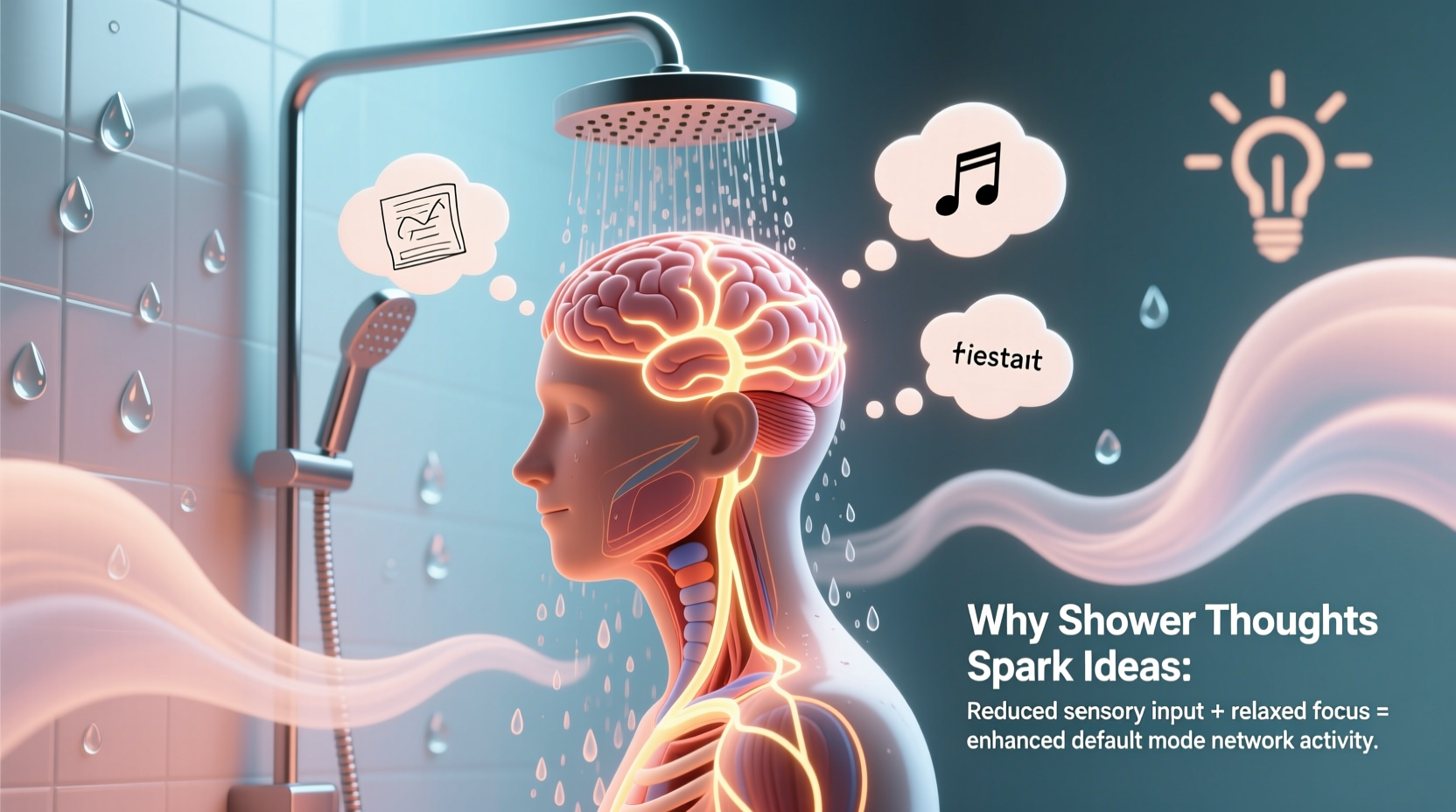
The human brain operates in different modes depending on what we’re doing. When you're intensely focused — writing an email, debugging code, or studying — your brain engages the **executive control network** (ECN). This system manages concentration, logic, and goal-directed thinking. But when you step into the shower, something shifts.
With no immediate demands, your mind disengages from high-effort tasks and activates the **default mode network** (DMN). First identified by neuroscientist Marcus Raichle, the DMN becomes more active during rest, daydreaming, or low-stimulus activities like walking, driving, or showering. It's responsible for self-reflection, memory integration, and making connections between seemingly unrelated ideas.
Crucially, the DMN doesn't shut off the ECN completely. Instead, the two networks coexist in a balanced way during states of relaxed focus. This allows for **divergent thinking** — the ability to generate multiple solutions to a problem — which is at the heart of creativity.
“Moments of insight often occur when the brain is not trying too hard. The shower provides a perfect environment for unconscious processing to surface.” — Dr. John Kounios, Cognitive Neuroscientist and Co-Author of *The Eureka Factor*
Why the Shower Triggers Insight
The shower is uniquely suited to trigger creative breakthroughs. It combines several psychological and environmental factors that support relaxed focus:
- Routine and Repetition: Showering is automatic. Your hands move through familiar motions without requiring conscious thought, freeing up mental bandwidth.
- Sensory Isolation: The sound of running water creates a form of white noise that blocks external distractions while providing gentle auditory stimulation.
- Physical Comfort: Warm water relaxes muscles, reduces stress hormones like cortisol, and promotes a sense of safety — all conducive to open-minded thinking.
- Privacy and Solitude: Few interruptions mean fewer cognitive switches, allowing thoughts to flow uninterrupted.
These elements create what psychologists call a “low cognitive load” environment — one where your brain isn’t overwhelmed with decisions or stimuli, but still remains gently engaged. In this state, subconscious ideas bubble up to the surface.
Relaxed Focus vs. Hyperfocus: Understanding Mental States
Not all focus is the same. While productivity culture often glorifies intense concentration, true creativity thrives in contrast. Consider the differences between hyperfocus and relaxed focus:
| Mental State | Brain Activity | Cognitive Load | Creative Output |
|---|---|---|---|
| Hyperfocus | Executive Control Network dominant | High | Linear problem-solving, execution |
| Relaxed Focus | Default Mode Network + moderate ECN | Low to moderate | Insight, ideation, pattern recognition |
| Zoning Out | Default Mode Network only | Very low | Limited awareness, passive daydreaming |
Hyperfocus is excellent for completing tasks, but it narrows attention. You become less likely to notice peripheral ideas or make unexpected connections. Relaxed focus, on the other hand, widens the mental lens. It encourages **associative thinking** — linking concepts from different domains, such as combining music theory with software design or biology with architecture.
This is why some of history’s most innovative thinkers scheduled downtime deliberately. Albert Einstein played the violin between equations. Salvador Dalí napped with keys in hand, letting dreams guide his art. These weren’t breaks from work — they were part of the process.
How to Cultivate Relaxed Focus Outside the Shower
You don’t need to be wet to think clearly. The key is to design habits and environments that mimic the cognitive conditions of the shower. Here’s a step-by-step guide to building deliberate moments of relaxed focus into your day:
- Identify Low-Stimulus Routines: List daily activities that require minimal attention — brushing teeth, brewing coffee, stretching, or commuting (if not driving).
- Assign Creative Intent: Before starting one of these routines, pose a question to yourself: “How can I improve my team meetings?” or “What’s missing from my current project?”
- Minimize Distractions: Silence notifications. Avoid podcasts or music if possible. Let your mind wander freely.
- Carry a Capture Tool: Keep a waterproof notepad in the shower, or use a voice memo app immediately after. Ideas are fleeting; document them fast.
- Reflect Weekly: Review captured ideas every Sunday. Look for patterns, connections, or actionable insights.
The goal isn’t to force inspiration but to create space where it can emerge naturally. Think of your brain as a search engine that works better in the background. When you stop typing commands, it starts indexing deeper results.
Mini Case Study: From Shower Insight to Startup Pivot
Jamie Chen, a product designer in Portland, had been stuck for weeks on a fitness app that users found confusing. Despite user testing and redesigns, engagement remained low. One morning in the shower, she asked herself, “What if we stopped trying to teach people how to use it — and just made it feel natural?”
In that moment, she imagined the app responding like a dance partner — intuitive, adaptive, responsive. She grabbed a towel, opened her phone, and recorded a 90-second voice note outlining a new interface philosophy based on rhythm and feedback loops.
Two weeks later, her team prototyped the concept. User testing showed a 40% increase in retention. The insight didn’t come from a sprint session or brainstorming workshop — it came from a quiet moment of relaxed focus, triggered by nothing more than steam and soap.
Common Myths About Creativity and Inspiration
Despite growing awareness of the science behind insight, several myths persist:
- Myth: Creativity strikes randomly. Truth: While insights may feel sudden, they result from prior effort. Your brain needs raw material — experiences, knowledge, questions — to process subconsciously.
- Myth: You need to be an artist or genius to have good ideas. Truth: Everyone accesses the default mode network. Creativity is a function of practice and environment, not innate talent.
- Myth: Busyness fuels innovation. Truth: Overwork suppresses the DMN. Chronic stress increases beta brainwaves (associated with anxiety) and decreases alpha waves (linked to relaxed alertness).
Recognizing these misconceptions helps demystify the creative process. Ideas don’t appear from nowhere — they emerge from preparation meeting opportunity, often in the quietest moments.
Checklist: Build Your Own Idea-Friendly Routine
Use this checklist to integrate relaxed focus into your lifestyle:
- ✅ Dedicate 10–15 minutes daily to a repetitive, low-demand task (e.g., washing dishes, walking)
- ✅ Pose a specific challenge before starting (“How can I communicate this better?”)
- ✅ Eliminate digital distractions during the activity
- ✅ Keep a notebook or recording device nearby
- ✅ Review and reflect on captured ideas weekly
- ✅ Share promising insights with a colleague or mentor
Frequently Asked Questions
Can I train myself to have more shower-like insights?
Yes. While you can’t force insight, you can increase its likelihood. Regularly expose your brain to diverse inputs (books, conversations, art), then allow downtime for integration. The combination of learning and resting builds creative potential.
Is the shower the only place this happens?
No. Similar moments occur during walks, gardening, jogging, or even lying in bed. Any activity that balances mild engagement with mental freedom can trigger insight. The shower is simply one of the most consistent and accessible examples.
What if I forget my ideas before I can write them down?
It’s common. To reduce loss, try verbalizing the idea aloud (even whispering helps encode it in memory) or use a wearable voice recorder. Over time, you’ll learn which types of ideas are worth capturing versus passing thoughts.
Conclusion: Harness the Power of Quiet Thinking
The next time you find yourself struck by a sudden idea in the shower, don’t dismiss it as a fluke. Recognize it as evidence of a powerful cognitive process — one that blends relaxation with subconscious problem-solving. Your brain isn’t taking a break; it’s working differently, and often more effectively.
Modern life prioritizes speed, efficiency, and constant output. But innovation requires balance. By honoring the value of stillness, repetition, and solitude, you give your mind permission to connect dots you didn’t know existed.




 浙公网安备
33010002000092号
浙公网安备
33010002000092号 浙B2-20120091-4
Comments
No comments yet. Why don't you start the discussion?