
It happens in nearly every social setting: someone introduces themselves, you repeat their name with a smile, and within seconds—gone. The name evaporates from your mind as if it were never there. You're not alone. This common experience is less about failing memory and more about how the brain processes, encodes, and retrieves information. Understanding the psychological mechanisms behind this phenomenon can reduce frustration and offer practical ways to improve retention.
Forgetting names so quickly isn't usually a sign of cognitive decline or rudeness—it's a reflection of how human memory works under everyday conditions. Names are arbitrary labels without inherent meaning, making them harder to encode than descriptive traits like \"the woman who loves hiking\" or \"the guy with the deep voice.\" Psychology offers clear explanations for why this occurs and strategies to counteract it.
The Cognitive Science Behind Name Forgetting
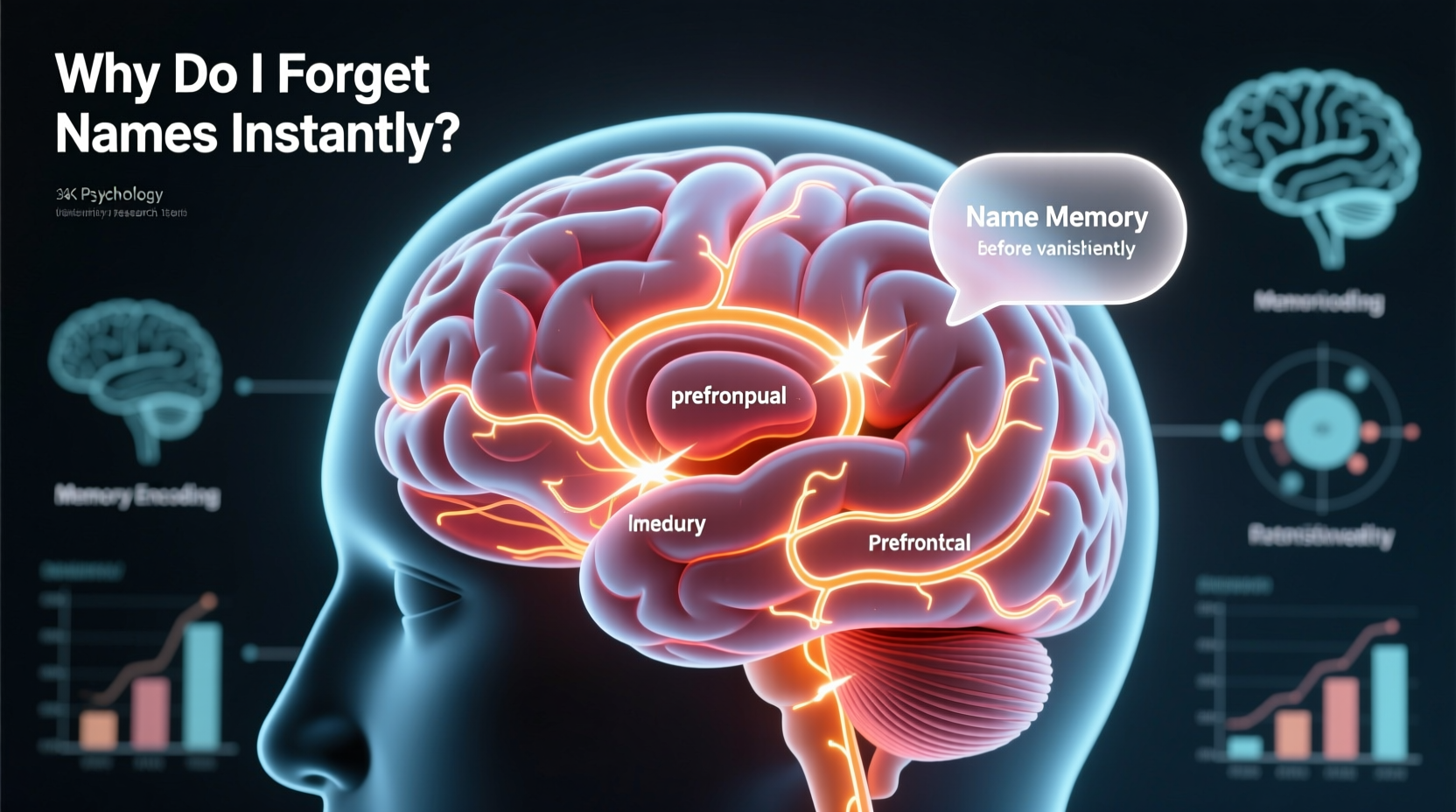
Human memory operates through three key stages: encoding, storage, and retrieval. Forgetting a name almost immediately typically fails at the first stage—encoding. When you meet someone, your brain is processing multiple stimuli: facial features, tone of voice, body language, environmental distractions, and internal thoughts. Amid this overload, the name—a single, abstract piece of data—is often poorly encoded because it lacks emotional or semantic significance.
Dr. Elizabeth Loftus, a renowned cognitive psychologist, explains:
\"Our memory doesn’t record events like a video camera. It reconstructs them based on fragments, expectations, and context. Names, being isolated facts, are among the first things lost in that reconstruction.\"
This selective encoding is governed by attentional resources. If you're distracted, anxious, or multitasking during an introduction, your brain may not allocate enough focus to solidify the name into short-term memory, let alone transfer it to long-term storage.
Why Names Are Harder to Remember Than Faces
Faces are processed holistically by the fusiform face area in the brain, allowing for rapid recognition and association with emotions or past experiences. In contrast, names are linguistic labels arbitrarily assigned to individuals. There’s no logical link between the person and the name “Sarah” or “James.” Without meaningful associations, names remain fragile in memory.
A 2019 study published in *Memory & Cognition* found that participants remembered occupational details or personal anecdotes about a person 65% more accurately than their names—even when both were introduced simultaneously. This highlights the brain’s preference for meaningful, narrative-based information over abstract identifiers.
Common Psychological Factors That Impair Name Retention
Several cognitive and emotional factors contribute to instant name forgetting. Recognizing these can help identify personal patterns and improve recall habits.
- Lack of Attention: If you’re thinking about what to say next or scanning the room, you’re not fully present during the introduction.
- Social Anxiety: Nervousness increases cognitive load, diverting mental resources away from encoding.
- Age-Related Changes: While not a disease, aging can slow processing speed and reduce working memory capacity, affecting immediate recall.
- Multitasking: Checking your phone or holding another conversation while being introduced severely limits attention.
- Low Motivation: If you don’t expect to see the person again, your brain may deem the name irrelevant and discard it.
Interestingly, research shows people are more likely to remember names when they believe they’ll be held accountable—such as needing to introduce the person later. This suggests motivation plays a critical role in encoding success.
Strategies to Improve Name Recall (Backed by Psychology)
Memory isn’t fixed—it’s trainable. Using evidence-based techniques, you can significantly improve your ability to remember names after first meeting someone.
1. Practice Active Listening
When someone says their name, pause. Stop scanning the room or planning your response. Repeat the name aloud: “Nice to meet you, Alex.” This act of verbalization reinforces auditory and motor memory pathways.
2. Use Elaborative Encoding
Link the name to something memorable. If you meet someone named “Rose,” imagine her holding a red rose. If the name is “Greg,” think of Gregorian chants. The more vivid and unusual the image, the better it sticks.
3. Engage in Name Repetition Throughout Conversation
Naturally weave the person’s name into dialogue: “So, Maria, what brought you here tonight?” Repeating the name strengthens neural connections and moves it from short-term to long-term memory.
4. Focus on Distinctive Features
Pair the name with a standout physical or behavioral trait. “Julian with the bright green watch.” This creates dual coding—both verbal (name) and visual (watch)—which enhances recall.
5. Write It Down (If Appropriate)
After a networking event, jot down names alongside a brief note: “Lena – talked about sustainable fashion.” Writing activates different brain regions and reinforces memory consolidation.
“Memory is strengthened not by repetition alone, but by meaning. When we connect a name to a story, image, or emotion, it becomes part of a network the brain is more likely to retain.” — Dr. Daniel Schacter, Harvard Psychologist and Memory Researcher
Checklist: How to Remember Names After First Meeting
- Make eye contact during introduction
- Repeat the name immediately (“Hi, Sam!”)
- Create a mental image linked to the name
- Use the name naturally in the next 2–3 sentences
- Note one distinctive feature (glasses, laugh, accent)
- If possible, write the name down within 10 minutes
- Review names mentally before leaving the event
Mini Case Study: Sarah’s Networking Breakthrough
Sarah, a marketing consultant, used to dread networking events. She’d meet ten people and forget every name by the end of the night. Embarrassed, she avoided follow-ups, damaging professional relationships.
She began applying elaborative encoding: when introduced to “David,” she noticed his bow tie and imagined him as “David Bowie.” She repeated his name twice in conversation and later jotted a note: “David – bow tie, loves vinyl records.” Within weeks, her recall improved dramatically. Colleagues commented on her attentiveness, and her referral rate increased by 30% over three months.
Sarah’s transformation wasn’t due to a better memory—it was due to smarter memory techniques.
Do’s and Don’ts of Name Retention
| Do | Don’t |
|---|---|
| Repeat the name aloud right after hearing it | Assume you’ll remember it later without reinforcement |
| Link the name to a visual or familiar person | Rely solely on rote repetition without association |
| Ask for spelling if the name is uncommon | Pretend you remember if you’ve already forgotten |
| Use the name in conversation naturally | Overuse the name, which can seem insincere |
| Take notes after social interactions | Blame yourself harshly—this is normal brain behavior |
When Forgetting Names Might Signal Deeper Issues
Occasional name forgetting is normal. But consistent difficulty remembering names—and faces, appointments, or recent conversations—could indicate underlying concerns:
- Chronic Stress: High cortisol levels impair hippocampal function, crucial for memory formation.
- Sleep Deprivation: Poor sleep disrupts memory consolidation during REM cycles.
- Vitamin Deficiencies: Low B12 or vitamin D can affect cognitive performance.
- Early Cognitive Changes: While rare, persistent issues warrant evaluation by a neurologist.
If you notice broader memory lapses—like forgetting why you walked into a room, missing appointments, or repeating questions—it’s wise to consult a healthcare provider. However, isolated name forgetting, especially in social settings, remains overwhelmingly a normal cognitive quirk.
Frequently Asked Questions
Is forgetting names a sign of dementia?
No, not necessarily. Occasional name forgetting is common at all ages. Dementia-related memory loss involves deeper impairments—like confusion about time, place, or identity—and affects daily functioning. If concerned, seek a clinical assessment rather than self-diagnosing.
Why do I remember names better after seeing someone multiple times?
Repeated exposure strengthens synaptic connections through a process called long-term potentiation. Each encounter reactivates the memory trace, making it more durable. Familiarity also adds contextual cues—shared experiences, voices, mannerisms—that make retrieval easier.
Are some names harder to remember than others?
Yes. Uncommon or culturally unfamiliar names require more cognitive effort to process. The brain prefers patterns and predictability. A name like “John” fits common phonetic structures in English, while “Zephyrine” may require extra encoding effort. This doesn’t mean you won’t remember it—just that it needs more intentional reinforcement.
Conclusion: Transforming a Common Frustration into a Skill
Forgetting names instantly isn’t a flaw—it’s a feature of how the human brain prioritizes information. By understanding the psychology behind memory encoding and applying simple, science-backed techniques, you can turn this common frustration into a mastered skill.
Start small: repeat one name today, attach an image, and use it in conversation. Over time, these micro-habits build a reputation for attentiveness and strengthen your social and professional relationships. Memory isn’t just about storage—it’s about intention. When you decide a name matters, your brain follows.




 浙公网安备
33010002000092号
浙公网安备
33010002000092号 浙B2-20120091-4
Comments
No comments yet. Why don't you start the discussion?