
Procrastination isn't reserved for monumental projects or overwhelming deadlines. Often, it strikes in the most baffling way—when the task at hand is simple, quick, and nearly effortless. You know you should reply to that email, make that five-minute phone call, or toss your laundry in the machine. Yet, you delay. Over and over. The confusion deepens because logic suggests: if it’s so easy, why not just do it?
The truth is, ease of execution has little to do with whether we act. Human behavior is driven less by logic and more by emotion, motivation, and subconscious patterns. Procrastination on easy tasks reveals deeper psychological mechanisms at play—fear, identity conflict, emotional regulation issues, and misaligned rewards. Understanding these hidden forces is the first step toward breaking the cycle.
The Myth of Laziness: It’s Not About Effort
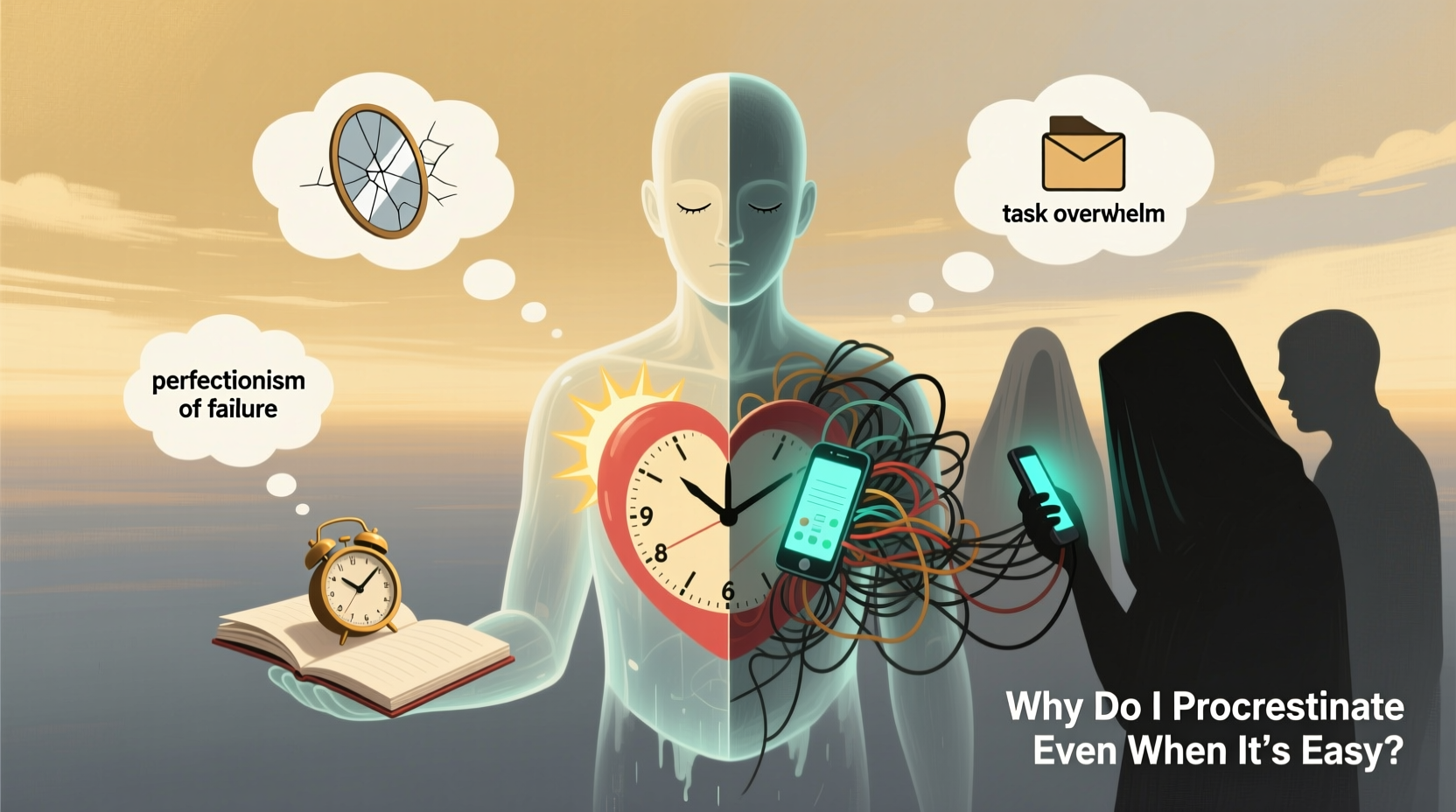
Many assume procrastination stems from laziness, especially when the task requires minimal energy. But research consistently shows that procrastinators are not inherently lazy. In fact, they often work hard—just at the wrong times or under pressure. The issue lies not in effort but in emotional regulation.
Dr. Piers Steel, author of *The Procrastination Equation*, explains: “Procrastination is an emotion regulation problem, not a time management one.” When faced with even a simple task, underlying emotions like anxiety, boredom, or self-doubt can trigger avoidance. The brain seeks immediate relief from discomfort, favoring short-term mood repair over long-term progress.
An easy task might feel trivial, but if it's associated with negative feelings—even subtly—it becomes something to escape. For example, replying to a work email might be quick, but if it reminds you of unresolved tension with a colleague, your brain may resist it despite its simplicity.
Psychological Triggers Behind Easy-Task Procrastination
Several cognitive and emotional factors explain why simple tasks get delayed. These aren’t flaws—they’re predictable patterns of human psychology.
1. Task Aversion Through Emotional Association
Even low-effort tasks can carry emotional weight. Filling out a form might remind you of bureaucracy; sending a text might stir social anxiety. Your brain doesn’t distinguish between physical difficulty and emotional discomfort. If a task evokes unease—even faintly—it gets labeled as “something to avoid.”
2. Present Bias and Delayed Rewards
Humans are wired to prioritize immediate rewards over future benefits. This is known as present bias. An easy task like scheduling a dentist appointment offers no instant payoff. The reward (health, prevention) is distant. Meanwhile, scrolling social media delivers dopamine now. The brain chooses the path of least resistance to current mood.
3. Identity Misalignment
Sometimes, we delay tasks because they don’t align with our self-image. For instance, someone who sees themselves as “creative” might avoid administrative chores, even if they take two minutes. These actions feel incongruent with their identity, making them psychologically harder to initiate.
4. Perfectionism in Disguise
Perfectionism isn’t only about doing things perfectly—it’s also about avoiding anything that feels “less than.” Even simple tasks can fall prey to this. Replying to an email might seem easy, but if you worry your response isn’t witty or professional enough, you delay it. The fear isn’t failure; it’s falling short of an internal standard.
5. Decision Fatigue and Cognitive Load
Even when a task is physically simple, it may require a micro-decision: what to say, when to do it, how to frame it. Over time, these small choices accumulate. After a day of decisions, your mental reserves are depleted. A “simple” task suddenly feels burdensome because it demands cognitive energy you no longer have.
“Procrastination is not a time management issue. It’s a voluntary delay of an intended course of action despite knowing that we’ll be worse off for it.” — Dr. Tim Pychyl, Procrastination Researcher, Carleton University
Breaking the Cycle: A Step-by-Step Guide
Understanding the why is crucial, but change requires action. Here’s a practical, psychology-backed method to stop delaying easy tasks.
- Identify the Trigger Emotion
Pause before avoiding the task. Ask: What am I feeling right now? Boredom? Anxiety? Resentment? Naming the emotion reduces its power. - Reframe the Task
Instead of “I have to send an email,” try “I’m choosing to communicate clearly.” Reframing gives you agency and softens resistance. - Use the Two-Minute Rule
If a task takes less than two minutes, do it immediately. This rule, popularized by David Allen in *Getting Things Done*, prevents small tasks from piling up and becoming mentally cluttered. - Create Implementation Intentions
Instead of vague plans (“I’ll do it later”), specify: “After I finish my coffee, I’ll reply to that message.” Concrete plans bypass decision fatigue. - Pair with a Reward
Link the task to a small, immediate reward. Example: “After I schedule my appointment, I’ll listen to one song I love.” This counters present bias by creating instant gratification.
Do’s and Don’ts of Managing Easy-Task Procrastination
| Do’s | Don’ts |
|---|---|
| Break tasks into micro-actions (e.g., “open email” instead of “reply to all”) | Wait for motivation to strike before acting |
| Use timers for accountability (e.g., “I’ll work on this for 90 seconds”) | Label yourself as “lazy” or “undisciplined” |
| Track completed easy tasks to build momentum | Ignore the emotional reason behind the delay |
| Place reminders in your environment (sticky notes, calendar alerts) | Rely solely on memory or good intentions |
| Practice self-compassion when you slip | Punish yourself for procrastinating |
Mini Case Study: Sarah and the Unsent Birthday Text
Sarah prides herself on being thoughtful. Yet every year, she delays sending birthday messages to close friends—sometimes until days after the event. The task takes less than a minute. There’s no excuse. But the pattern repeats.
Upon reflection, Sarah realizes the delay isn’t about time. It’s about fear. She worries her message won’t sound sincere enough. She imagines the recipient thinking, “She forgot, and this is all she says?” The emotional weight of perceived inadequacy paralyzes her, despite the simplicity of typing “Happy Birthday!”
With help, Sarah starts using implementation intentions: “When I see the birthday reminder, I’ll send a voice note saying whatever comes to mind.” She swaps perfection for authenticity. Within weeks, she sends messages on time—not because the task changed, but because her emotional relationship to it did.
Action Checklist: Reclaim Control Over Simple Tasks
Use this checklist daily or weekly to disrupt procrastination cycles:
- ☐ Identify one easy task you’ve been avoiding
- ☐ Name the emotion tied to it (boredom, guilt, anxiety, etc.)
- ☐ Break it into the smallest possible step
- ☐ Schedule it with a specific time or trigger (“after breakfast,” “post-lunch”)
- ☐ Do it within 10 minutes of the trigger
- ☐ Acknowledge completion—write it on your Done List
- ☐ Reflect: How did it feel afterward? (Most report relief or pride)
Frequently Asked Questions
Why do I procrastinate on tasks I enjoy?
Even enjoyable tasks can be delayed if they’re tied to pressure or expectations. For example, painting might be fun, but if you associate it with “being productive” or “proving creativity,” it can trigger performance anxiety. The emotional burden overrides the pleasure.
Is procrastinating on small tasks a sign of ADHD?
Not necessarily—but it can be a symptom. People with ADHD often struggle with task initiation, especially for low-stimulation activities, regardless of simplicity. If procrastination is chronic, impairs functioning, and is paired with distractibility or impulsivity, consulting a professional is advisable.
Can mindfulness help with procrastination?
Yes. Mindfulness increases awareness of avoidance patterns without judgment. By noticing the urge to delay—and the emotions behind it—you create space to choose differently. Studies show mindfulness training reduces procrastination by improving emotional regulation and self-awareness.
Conclusion: Small Actions, Lasting Change
Procrastination on easy tasks isn’t irrational—it’s deeply human. It reflects how emotion shapes behavior far more than logic. Recognizing that the barrier isn’t effort but internal resistance allows you to respond with compassion and strategy, not shame.
Each time you complete a simple task you’ve been avoiding, you rewire your brain. You prove that action precedes motivation. You reclaim agency. Over time, these small wins accumulate into a life of greater clarity, confidence, and control.




 浙公网安备
33010002000092号
浙公网安备
33010002000092号 浙B2-20120091-4
Comments
No comments yet. Why don't you start the discussion?