
It’s a familiar scenario: you have a five-minute task—reply to an email, wash a dish, update your calendar—and yet you avoid it for hours, even days. No deadline pressure, no complexity, just a simple action that somehow feels insurmountable. You’re not lazy. You’re not disorganized. What you’re experiencing is likely the Wall of Awful, a psychological phenomenon where low-effort tasks accumulate emotional weight until they form an invisible barrier to action.
The irony is that these tasks are only “awful” in perception. They carry no real danger, no physical strain, and often require minimal time. Yet mentally, they loom large. Understanding this mechanism is the first step toward dismantling it. Procrastination on easy tasks isn’t about time management—it’s about emotional regulation, attention economy, and how our brains assign value to effort versus discomfort.
The Psychology Behind Procrastinating on Simple Tasks
At its core, procrastination is not a failure of discipline but a conflict between two systems in the brain: the limbic system, which governs emotions and immediate rewards, and the prefrontal cortex, responsible for planning and long-term thinking. The limbic system wins more often than we’d like to admit—especially when the perceived cost of starting a task outweighs its benefit.
For easy tasks, the reward is often intangible or delayed: “I’ll feel better once it’s done.” But the emotional cost—boredom, irritation, minor anxiety—feels immediate. The brain defaults to short-term mood repair: “I don’t feel like doing it now, so I’ll do it later.” Later never comes because the emotional burden grows with each delay.
This creates what psychologist Dr. Timothy Pychyl calls the “procrastination loop”: avoidance → temporary relief → guilt → increased stress → further avoidance. The task doesn’t get easier; it gets heavier.
What Is the Wall of Awful?
The term “Wall of Awful” was popularized by productivity expert Anne-Laure Le Cunff to describe the accumulation of small, unpleasant tasks that collectively form a psychological barrier. Individually, each task is trivial. Together, they create a sense of overwhelm that paralyzes action.
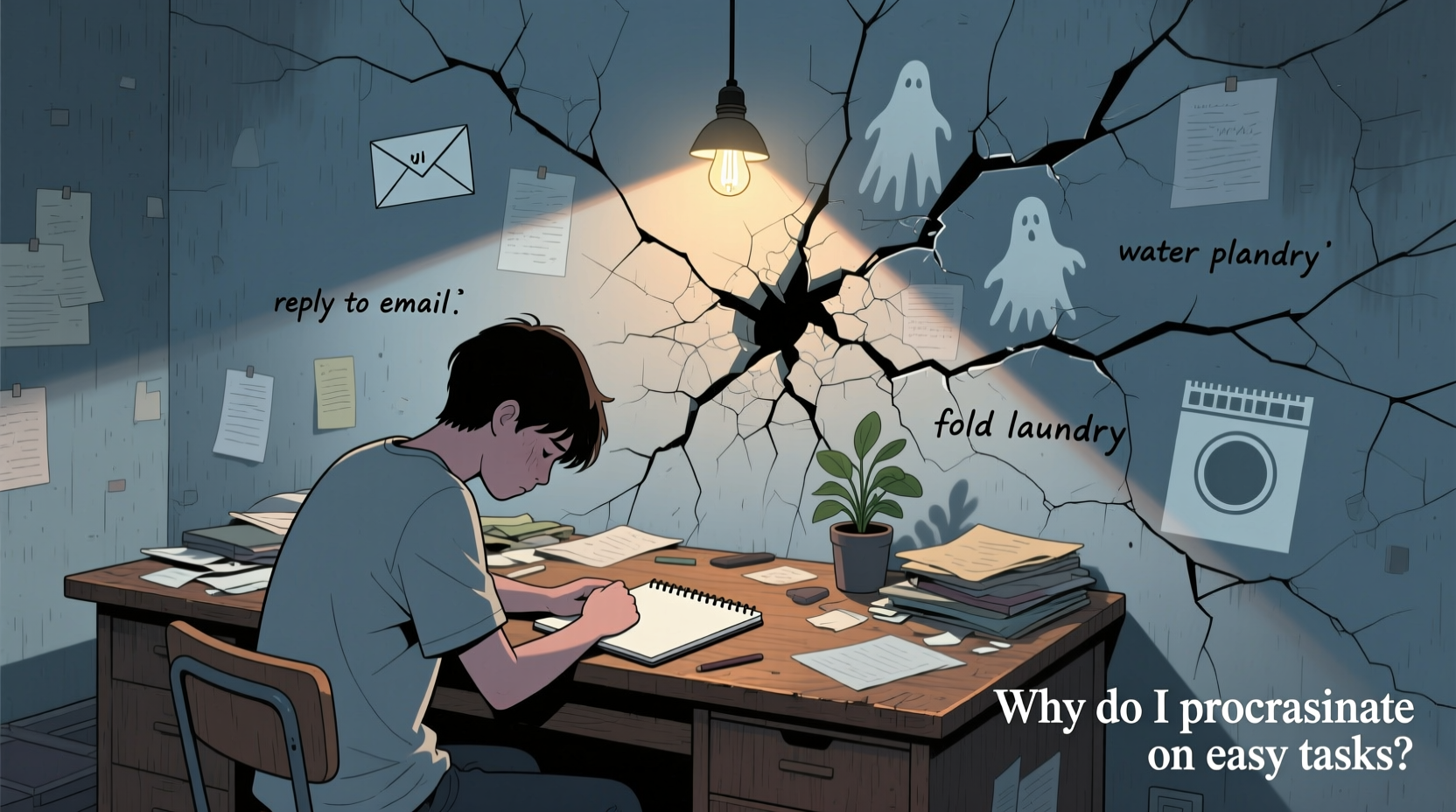
Imagine your mental workspace as a room. Every undone task is like leaving a piece of trash on the floor. One candy wrapper? No big deal. But leave ten, twenty, fifty over days and weeks, and suddenly the room feels unlivable. You don’t want to enter, let alone clean it. That’s the Wall of Awful—a cluttered mindspace where even opening your email feels like stepping into chaos.
The wall isn’t built overnight. It forms silently, one avoided task at a time. And because the tasks are easy, we assume we can handle them “whenever.” But their emotional compound interest is steep. Each neglected item adds to the cognitive load, making it harder to focus, decide, or initiate action—even on unrelated goals.
“Procrastination is an emotion regulation problem, not a time management problem.” — Dr. Tim Pychyl, author of *Solving the Procrastination Puzzle*
Why Easy Tasks Trigger Disproportionate Resistance
If the tasks are simple, why the intense resistance? Several psychological mechanisms explain this mismatch:
- Task aversion due to association: A task may be neutral in itself but linked to something emotionally charged—a person, a memory, or a broader project you dread.
- Lack of intrinsic reward: Tasks like filing receipts or scheduling appointments offer no joy, curiosity, or sense of mastery. The brain sees them as “taxes” on attention.
- Decision fatigue: Even tiny choices (“Which subject line should I use?”) drain mental energy, especially when accumulated.
- Perfectionism in disguise: Some avoid starting because they fear doing it imperfectly. Better to not start than to fail slightly.
- Identity conflict: “I’m not someone who does boring work.” Avoiding the task preserves a self-image of creativity or spontaneity.
These factors transform a 2-minute chore into a symbolic battle. Crossing it off isn’t just completion—it feels like surrendering autonomy, admitting you’re subject to routine.
How to Break Through the Wall of Awful: A Step-by-Step Guide
Dismantling the Wall of Awful requires structural change, not willpower. Here’s a practical, neuroscience-informed approach:
- Inventory your avoided tasks. List every small thing you’ve been putting off—emails, calls, errands, digital cleanup. Be specific: “Reply to Sarah about lunch” not “Handle messages.”
- Categorize by emotional trigger. Is it boredom? Fear of response? Guilt? Labeling the emotion reduces its power.
- Pick one task under two minutes. Use the “two-minute rule” from David Allen’s GTD method: if it takes less than two minutes, do it immediately.
- Use the five-second start. Count down from five and begin before your brain protests. This interrupts hesitation loops.
- Pair with a habit anchor. Attach the task to an existing routine: “After I pour coffee, I’ll open my inbox and reply to one email.”
- Clear visual progress. Use a checklist or app to mark completions. Visual feedback activates reward circuits.
- Review weekly. Dedicate 15 minutes every Sunday to scan for emerging micro-tasks before they pile up.
The goal isn’t perfection—it’s momentum. Each completed task weakens the Wall of Awful. Over time, the brain begins to associate action with relief, not dread.
Real Example: How Maria Reclaimed Her Workflow
Maria, a freelance designer, found herself avoiding client emails despite having no workload crisis. She wasn’t busy—she was blocked. Her inbox had 37 unread messages, most requiring brief replies. The thought of opening it triggered anxiety. She labeled herself “lazy,” but the truth was more nuanced.
In coaching, she realized her avoidance stemmed from two hidden emotions: guilt over past delays and fear that replies would lead to new requests. The emails weren’t hard—they were emotionally loaded.
She applied the step-by-step method: listed all 37, categorized by emotion, and picked three with the lowest effort. Using the five-second rule, she replied to one while waiting for her laptop to boot. The relief was instant. By day three, she’d cleared half. Within a week, her inbox was at zero, and she implemented a daily 10-minute “email triage” ritual.
Maria didn’t gain more time. She reduced emotional friction. The Wall of Awful crumbled not through force, but through consistent, tiny acts of re-engagement.
Do’s and Don’ts When Facing Micro-Procrastination
| Do | Don’t |
|---|---|
| Break tasks into “starter steps” (e.g., “Open document”) | Wait for motivation to strike |
| Use implementation intentions: “When X happens, I will do Y” | Rely on vague plans like “I’ll do it later” |
| Accept “good enough” output for low-stakes tasks | Insist on perfection for administrative work |
| Group similar micro-tasks into batches | Scatter attempts across the day without focus |
| Celebrate completion, not duration | Measure productivity by hours worked |
Checklist: Rebuilding Task Tolerance
Use this checklist weekly to prevent the Wall of Awful from reforming:
- ☐ List all pending micro-tasks (limit: 10 per session)
- ☐ Identify the dominant emotion behind each (boredom, guilt, fear)
- ☐ Select one task taking under 2 minutes and complete it now
- ☐ Schedule one 10-minute “clearance window” for small tasks
- ☐ Anchor one recurring micro-task to a daily habit (e.g., “After brushing teeth, I’ll plan tomorrow’s top 3 tasks”)
- ☐ Reflect: How did completing tasks affect your mood?
Frequently Asked Questions
Isn’t this just about being more disciplined?
No. Discipline implies sustained effort, but the issue here is initiation. Research shows that people who appear “disciplined” often structure their environments to reduce temptation and friction. They don’t rely on willpower—they design systems where action is the default.
What if I do everything else but avoid one specific task?
This often signals a deeper emotional block—shame, fear of judgment, or identity conflict. Ask: “What’s the worst that could happen if I do this?” or “What story am I telling myself about this task?” Journaling can uncover hidden narratives driving avoidance.
Can technology help break the Wall of Awful?
Yes, but selectively. Apps like Todoist or TickTick help externalize reminders, reducing cognitive load. However, over-reliance on complex tools can become procrastination itself. Start simple: pen and paper, a timer, and consistency.
Conclusion: Small Actions, Lasting Change
Procrastinating on easy tasks isn’t a character flaw—it’s a predictable response to emotional friction. The Wall of Awful isn’t made of tasks; it’s built from avoided feelings. The solution isn’t to try harder, but to start smaller, with compassion and strategy.
Every time you complete a micro-task, you rewire your brain’s prediction: action leads to relief, not pain. Over time, the wall erodes. You reclaim mental space, clarity, and agency. The smallest deeds, consistently honored, cultivate the deepest confidence.




 浙公网安备
33010002000092号
浙公网安备
33010002000092号 浙B2-20120091-4
Comments
No comments yet. Why don't you start the discussion?