
It starts with a simple thought: “I’ll just do it in a minute.” But minutes turn into hours. The laundry remains unfolded. The email goes unanswered. The trash isn’t taken out. These aren’t monumental tasks—yet they feel impossible to start. If this sounds familiar, you’re not lazy, undisciplined, or unmotivated. You may be experiencing executive dysfunction, a cognitive challenge that disrupts planning, prioritizing, initiating, and completing even the most basic activities.
Procrastination on simple tasks is often misinterpreted as a moral failing. In reality, it’s frequently rooted in neurological and psychological processes that go far beyond willpower. Understanding the mechanisms behind this behavior—especially how executive function impacts decision-making and action—is essential for developing compassionate, effective solutions.
What Is Executive Function—and Why Does It Matter?
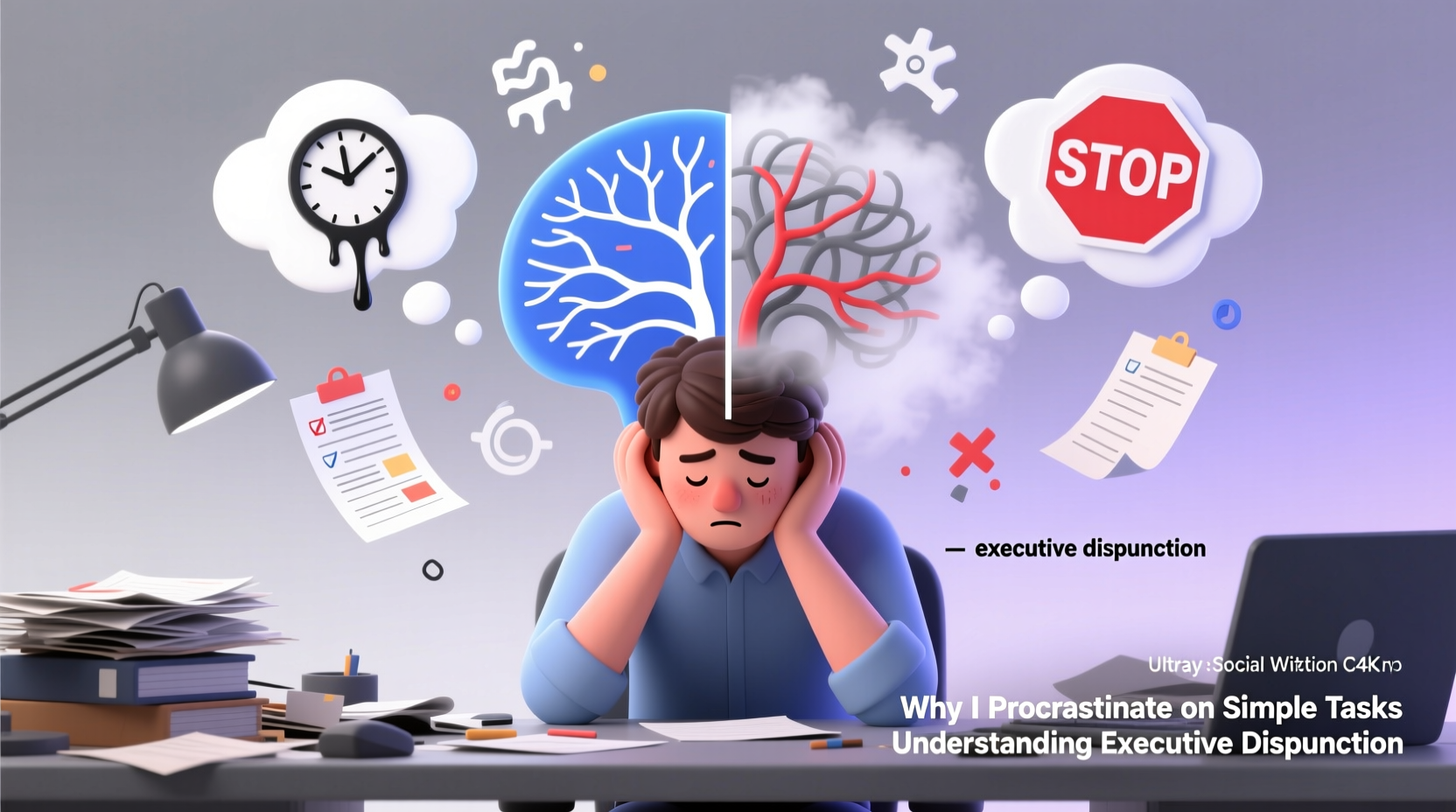
Executive function refers to a set of mental skills managed by the prefrontal cortex of the brain. These include working memory, flexible thinking, self-control, task initiation, organization, time management, and emotional regulation. Think of it as the brain’s internal project manager: it helps you plan your day, switch between tasks, resist distractions, and follow through on intentions.
When executive function works smoothly, you can wake up, make breakfast, respond to messages, and manage your responsibilities without constant mental effort. But when it’s impaired—due to stress, ADHD, depression, anxiety, trauma, or neurodivergence—that internal manager becomes overwhelmed, under-resourced, or offline entirely.
In these moments, even straightforward tasks like replying to an email or brushing your teeth can trigger resistance. The issue isn’t unwillingness—it’s an inability to access the cognitive tools needed to begin.
“Executive dysfunction isn’t about motivation; it’s about capacity. Just as a broken leg prevents walking, impaired executive function blocks action—even when the person wants to act.” — Dr. Russell Barkley, Clinical Neuropsychologist and ADHD Researcher
The Hidden Mechanics of Task Initiation Failure
One of the most frustrating aspects of executive dysfunction is the gap between intention and action. You know what needs to be done. You want to do it. But something stops you from starting.
This is known as **task initiation failure**, a hallmark of executive dysfunction. It occurs because the brain struggles to:
- Shift from a resting state to an active one
- Evaluate the urgency or reward of a task
- Overcome the initial resistance (activation energy) required to begin
- Maintain attention long enough to complete multi-step actions
For example, taking out the trash might involve standing up, walking to the kitchen, opening the cabinet, tying the bag, carrying it outside, and returning. Each step requires a separate decision. When executive function is impaired, the brain perceives this chain as overwhelming—not because the steps are complex, but because each demands cognitive resources that feel depleted.
Common Triggers of Executive Dysfunction
Executive dysfunction doesn’t occur in a vacuum. It’s often triggered or worsened by specific conditions. Recognizing these can help you anticipate and mitigate breakdowns in function.
| Trigger | How It Affects Executive Function | Real-World Example |
|---|---|---|
| ADHD | Impairs working memory, impulse control, and task initiation | Forgets to pay bills despite setting reminders |
| Chronic Stress | Overloads the prefrontal cortex, reducing cognitive flexibility | Unable to organize a grocery list during a busy workweek |
| Anxiety | Creates mental loops that block action due to fear of imperfection | Delays sending an email over minor wording concerns |
| Depression | Reduces dopamine, which is critical for motivation and reward processing | Lies in bed unable to shower, despite wanting to feel better |
| Sensory Overload | Disrupts focus and increases mental fatigue | Cannot fold laundry in a noisy household |
These triggers don’t excuse inaction—they explain it. And with explanation comes the possibility of intervention.
A Real-Life Scenario: Maya’s Morning Routine Collapse
Maya, a 32-year-old graphic designer, wakes up determined to have a productive day. She sets her alarm, plans her morning: shower, coffee, review client feedback, reply to emails. But by 10 a.m., she’s still in pajamas, scrolling on her phone, feeling guilty and frustrated.
Here’s what actually happened:
- Alarm rings. She hits snooze—just once.
- Wakes up 20 minutes later, already feeling behind.
- Tries to get up, but the thought of turning on lights and facing the day feels heavy.
- Picks up her phone to check the time. Sees a message. Responds. Then scrolls.
- Hours pass. The shower remains untouched. Emails unopened.
From the outside, it looks like laziness. But internally, Maya’s executive function system was compromised. Sleep disruption from late-night work reduced her cognitive reserves. Anxiety about client feedback made the task feel emotionally risky. Her brain defaulted to low-effort activities (scrolling) to avoid discomfort. The result? A simple morning routine collapsed under invisible cognitive load.
This is not uncommon. Millions experience similar cycles daily—not because they lack ambition, but because their brains struggle to translate intention into motion.
Strategies to Work With Your Brain, Not Against It
Improving executive function isn’t about pushing harder. It’s about designing systems that reduce strain and support action. Here are evidence-based approaches:
1. Use External Scaffolding
Rely less on memory and more on external tools. Your brain doesn’t need to remember everything—it needs cues and structure.
- Use visual task boards (whiteboards, sticky notes)
- Set alarms for transitions (“Time to start cooking”)
- Place items where they’ll prompt action (shoes by the door for walks)
2. Lower the Barrier to Starting
Make the first step so easy it feels automatic. The goal isn’t completion—it’s initiation.
3. Pair Tasks with Existing Habits (Habit Stacking)
Attach a new behavior to an established one. This leverages automaticity.
Examples:
- After I pour my coffee, I’ll open my planner.
- After I brush my teeth, I’ll lay out my clothes.
4. Use Body Doubling
Work alongside someone else—even virtually. Their presence provides subtle accountability and reduces isolation-induced inertia.
This technique is especially effective for people with ADHD. Knowing someone else is also working can activate mirror neurons and social motivation, making it easier to begin.
5. Schedule Recovery Time
Executive function is a finite resource. After intense focus or emotional labor, your brain needs downtime. Ignoring this leads to burnout and worsening dysfunction.
Plan short breaks, walks, or sensory-neutral activities between tasks. Treat recovery as non-negotiable maintenance, not indulgence.
Action Checklist: Building Sustainable Systems
Use this checklist to create personalized supports for executive dysfunction:
- Identify 2–3 recurring tasks you consistently avoid
- Break each into micro-steps (e.g., “Open laptop” → “Log in” → “Open email”)
- Assign a tiny first step (under 30 seconds)
- Pair the task with a habit you already do (habit stacking)
- Set a visual reminder or alarm
- Test the system for 3 days and adjust as needed
- Schedule a 10-minute break after completion
Track what works. Adjust what doesn’t. Progress isn’t linear—but consistency builds momentum.
FAQ: Common Questions About Procrastination and Executive Dysfunction
Is procrastination always a sign of executive dysfunction?
No. Everyone procrastinates occasionally due to fatigue, disinterest, or poor time estimation. However, chronic procrastination on simple, low-stakes tasks—especially when accompanied by guilt, shame, or mental paralysis—is a strong indicator of underlying executive challenges, particularly in neurodivergent individuals.
Can executive function be improved?
Yes. While some conditions like ADHD are lifelong, executive function skills can be strengthened through practice, environmental design, therapy, and sometimes medication. Cognitive-behavioral strategies, mindfulness, and structured routines all contribute to improved function over time.
What if I’m not diagnosed with ADHD or another condition?
You don’t need a diagnosis to experience executive dysfunction. It can arise from stress, burnout, sleep deprivation, or mental health conditions like anxiety and depression. The strategies that help are often the same: reduce cognitive load, increase support, and prioritize self-compassion.
Conclusion: Redefining Productivity Through Self-Understanding
Procrastinating on simple tasks isn’t a character flaw. It’s a signal—a sign that your cognitive system is overloaded, under-supported, or operating under hidden constraints. By shifting the narrative from “I should just do it” to “Why is this hard right now?” you open the door to meaningful change.
Executive dysfunction isn’t solved by willpower. It’s managed through awareness, adaptation, and kindness. Start small. Build systems, not guilt. Celebrate micro-wins. And remember: the goal isn’t perfection. It’s progress—with your brain, not against it.




 浙公网安备
33010002000092号
浙公网安备
33010002000092号 浙B2-20120091-4
Comments
No comments yet. Why don't you start the discussion?