
Procrastination is a universal experience. You have hours—sometimes days—ahead of you, no immediate deadlines, and yet you find yourself scrolling through social media, reorganizing your desk, or suddenly developing an intense interest in laundry. The irony is sharp: the more time you have, the more likely you are to delay. This isn’t laziness. It’s not a moral failing. It’s a deeply rooted psychological pattern shaped by emotion regulation, fear, and cognitive biases. Understanding why we delay when time is on our side reveals not just the mechanics of procrastination but pathways to meaningful change.
The Emotional Engine Behind Delay
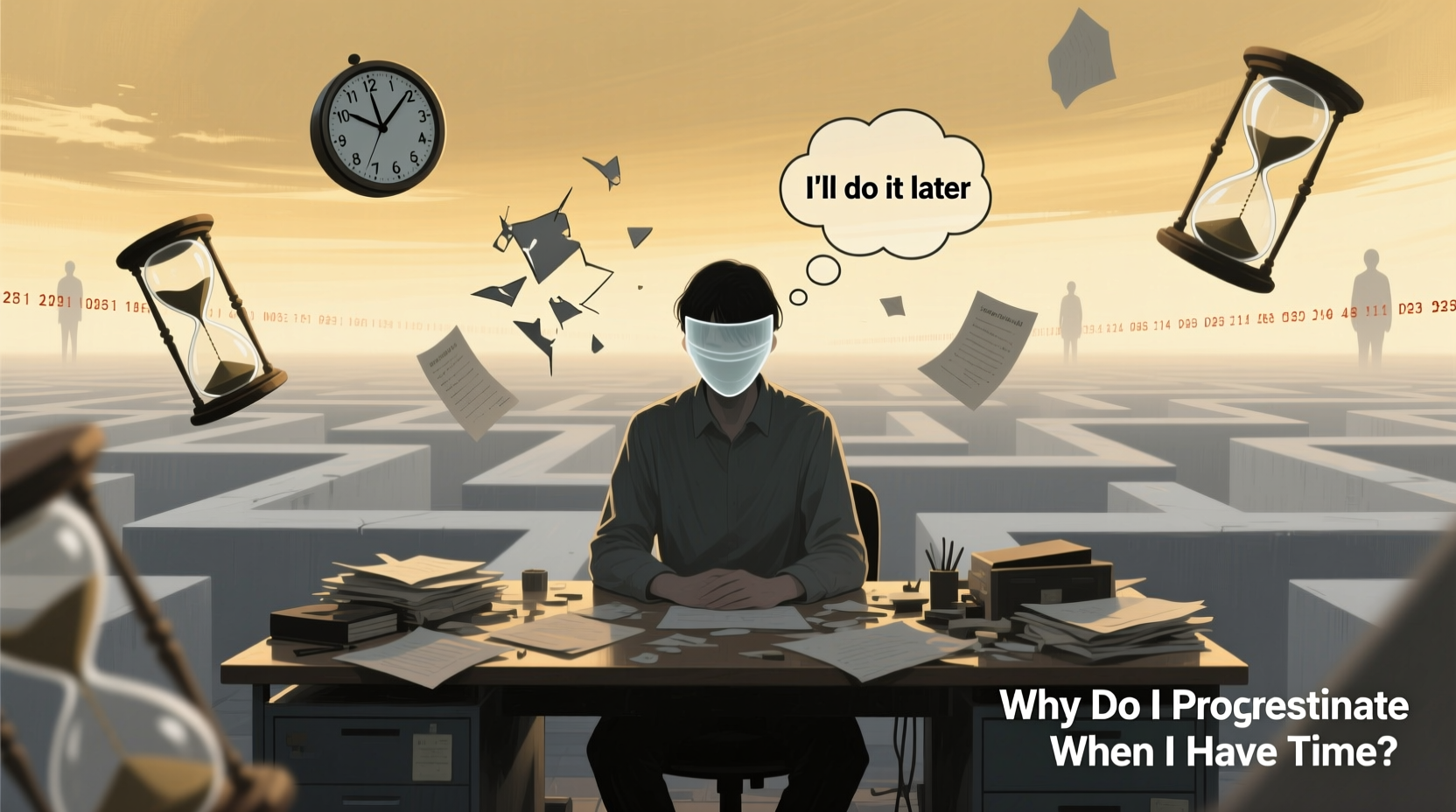
At its core, procrastination is less about time management and more about mood management. When faced with a task—especially one that feels ambiguous, overwhelming, or emotionally taxing—the brain instinctively seeks relief from discomfort. Even if the task isn’t urgent, the mere anticipation of stress, boredom, or potential failure triggers an emotional response. The prefrontal cortex, responsible for planning and self-control, is overridden by the limbic system, which governs emotions and survival instincts.
This internal conflict explains why someone might postpone writing a paper they’ve had weeks to complete. The assignment isn’t due tomorrow, but the idea of starting it brings up anxiety about quality, fear of judgment, or dread of effort. In that moment, the brain doesn’t weigh long-term consequences; it prioritizes short-term emotional comfort. Scrolling through memes offers instant gratification and distraction. Writing does not. So, the limbic system wins.
“Procrastination is an emotion regulation problem, not a time management problem.” — Dr. Tim Pychyl, psychologist and author of *Solving the Procrastination Puzzle*
Cognitive Distortions That Fuel Delay
Several thinking errors reinforce the cycle of delay, especially when time appears abundant:
- Temporal Discounting: We value immediate rewards more than future benefits. Finishing a report earns praise in two weeks; watching a show gives joy now. The brain discounts the future reward as less real.
- Optimism Bias: “I’ll feel more motivated later.” “I work better under pressure.” These beliefs create false confidence in future selves who never arrive.
- Task Aversion: Tasks perceived as boring, difficult, or meaningless trigger avoidance. The longer we wait, the more aversive the task becomes due to accumulated anxiety.
- Perfectionism: Paradoxically, wanting to do something perfectly can prevent starting at all. The fear of producing subpar work outweighs the desire to make progress.
These distortions form a feedback loop: delay leads to guilt, guilt increases stress, stress makes the task feel harder, and the cycle repeats.
The Myth of Readiness and the \"Right Time\"
Many people wait for the perfect conditions to begin: the right mood, a quiet environment, full energy. But readiness is often a myth constructed by avoidance. Research shows that action precedes motivation, not the other way around. Waiting to feel ready is like waiting for wind before learning to sail.
Consider the case of Maria, a freelance graphic designer. She had three weeks to complete a client project. For the first ten days, she told herself she’d start when she felt inspired. She cleaned her workspace, researched design trends, and watched tutorials—all productive-seeming activities that weren’t the actual work. By week two, anxiety spiked. She worked late into the nights, delivering a rushed final product. Her client noticed the drop in quality. Maria blamed her lack of time, but the real issue was her belief in a mythical “ideal state” for creativity.
Maria’s story illustrates a common trap: mistaking preparation for progress. Gathering resources, organizing files, or planning endlessly can feel like productivity, but without execution, it’s just procrastination in disguise.
Strategies to Break the Cycle of Delay
Overcoming procrastination requires rewiring habits and expectations. Here’s a step-by-step approach grounded in behavioral psychology:
- Break tasks into micro-actions: Instead of “write report,” try “open document and write one paragraph.” Small actions reduce activation energy.
- Use the 5-minute rule: Commit to working on a task for just five minutes. Often, starting is the hardest part, and momentum takes over.
- Reframe the task: Focus on process, not outcome. Ask, “What’s the smallest step I can take?” rather than “How will this turn out?”
- Schedule implementation intentions: Use “if-then” planning. Example: “If it’s 9 a.m., then I will write for 25 minutes.” Specificity increases follow-through.
- Reduce friction: Eliminate distractions beforehand. Close tabs, silence notifications, and prepare your workspace so starting is effortless.
| Common Thought | Reality Check |
|---|---|
| “I need to feel motivated to start.” | Motivation follows action. Begin anyway. |
| “I’ll do it when I have more time.” | Time expands to fill available slots. Busy people often get more done. |
| “This has to be perfect.” | Done is better than perfect. Refine later. |
| “I work best under pressure.” | Pressure creates stress, not quality. Consistent effort yields better results. |
Checklist: Daily Anti-Procrastination Routine
- Identify one high-leverage task for the day.
- Break it into a first tiny action (e.g., open file, write title).
- Schedule a 25-minute focused block (Pomodoro method).
- Remove digital distractions during the session.
- Reflect: What emotion came up? Name it without judgment.
- Celebrate starting, not just finishing.
The Role of Self-Compassion in Change
One of the most overlooked tools in overcoming procrastination is self-compassion. Studies show that people who respond to their procrastination with self-criticism are more likely to repeat the behavior. Shame amplifies avoidance. In contrast, those who treat themselves with kindness after delaying are more likely to take corrective action.
Imagine two students who put off studying for an exam. One thinks, “I’m so lazy and undisciplined.” The other thinks, “I’ve been avoiding this because it feels overwhelming, but I can start small now.” The second student is more likely to open the textbook. Why? Because self-compassion reduces the emotional threat of failure, making the task feel safer to approach.
Self-compassion doesn’t mean excusing inaction. It means acknowledging difficulty without judgment. It replaces the inner critic with a supportive coach. Over time, this shift weakens the fear-based roots of procrastination.
“People who are kinder to themselves after setbacks show greater resilience and are less likely to procrastinate in the future.” — Dr. Fuschia Sirois, researcher on procrastination and well-being
Frequently Asked Questions
Is procrastination a sign of low intelligence or poor work ethic?
No. Procrastination affects high achievers and underperformers alike. Many top students, artists, and professionals struggle with delay. It’s linked to emotional regulation, not competence or character.
Why do I procrastinate more on important tasks?
Paradoxically, the higher the stakes, the greater the emotional weight. Fear of failure, fear of success, or fear of identity threat (e.g., “If I fail, I’m not smart”) intensifies avoidance. Importance amplifies pressure, not motivation.
Can medication help with chronic procrastination?
In cases where procrastination is tied to ADHD, depression, or anxiety, medication may support treatment. However, behavioral strategies and therapy (like CBT) are usually the primary tools. Always consult a healthcare provider for personalized advice.
Conclusion: Start Before You’re Ready
Procrastination thrives in the gap between intention and action. When time is plentiful, that gap widens, giving avoidance more room to grow. But understanding the psychology of delay transforms procrastination from a personal flaw into a solvable puzzle. It’s not about managing time—it’s about managing emotions, expectations, and the stories we tell ourselves about work and worth.
The most effective antidote isn’t discipline. It’s compassion. It’s starting small. It’s recognizing that motivation is not a prerequisite for action but a consequence of it. Every time you begin despite resistance, you weaken the hold of delay. You prove to yourself that you don’t need perfect conditions to make progress.




 浙公网安备
33010002000092号
浙公网安备
33010002000092号 浙B2-20120091-4
Comments
No comments yet. Why don't you start the discussion?