
Procrastination isn’t just about laziness or poor time management. It’s a deeply rooted psychological behavior that affects even the most capable and motivated people. You’ve likely experienced it: a clear schedule, no urgent distractions, yet you find yourself scrolling through social media, reorganizing your desk, or watching videos about ancient pottery instead of starting the report due in two days. The paradox is real—when you have the most time, you often feel the least able to act.
This phenomenon is known as \"task paralysis\"—a mental freeze where the brain struggles to initiate action despite available time and resources. Understanding why this happens requires looking beyond surface-level willpower and into cognitive patterns, emotional regulation, and neurobiology. This article explores the psychology behind procrastination, explains how task paralysis develops, and offers practical solutions grounded in behavioral science.
The Hidden Mechanism Behind Procrastination
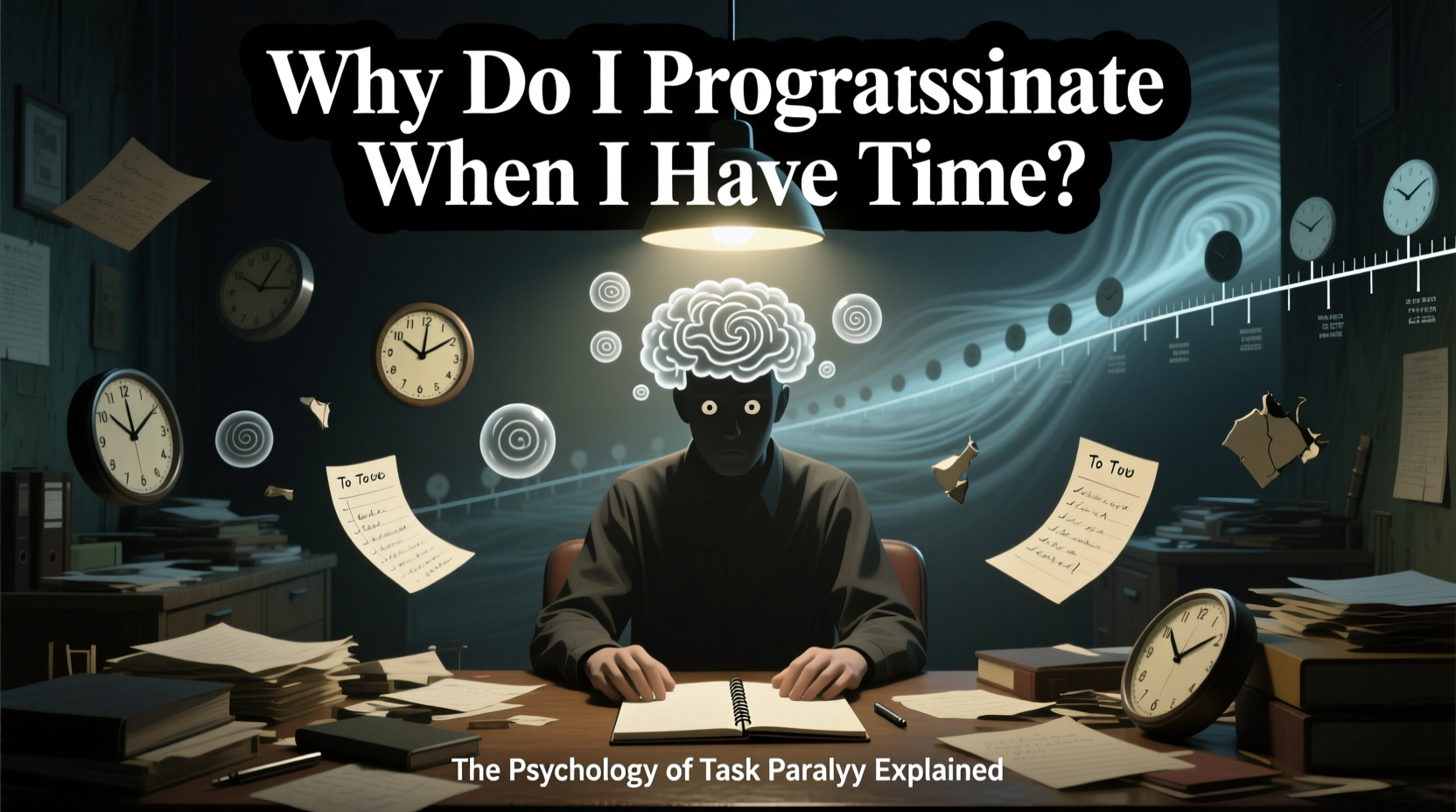
At first glance, procrastination appears irrational. Why delay something important when you know it will only increase stress later? But from a neurological standpoint, the decision makes sense. Your brain is wired to prioritize immediate emotional comfort over long-term gains. When faced with a task that feels overwhelming, boring, or emotionally charged (like fear of failure), your limbic system—the emotional center—reacts faster than your prefrontal cortex, which handles planning and logic.
Dr. Timothy Pychyl, a leading researcher on procrastination at Carleton University, explains: “Procrastination is an emotion regulation problem, not a time management problem.” In other words, you’re not avoiding the task itself; you’re avoiding the negative emotions associated with it—dread, anxiety, self-doubt, or boredom.
“Procrastination is an emotion regulation problem, not a time management problem.” — Dr. Timothy Pychyl, Procrastination Researcher, Carleton University
When you choose short-term mood repair (watching a video, checking messages) over long-term goal progress, your brain rewards you with instant relief. Over time, this creates a feedback loop: the more you avoid discomfort, the stronger the habit becomes.
Why Having Time Makes It Worse
Ironically, having plenty of time can intensify procrastination. With deadlines far off, the urgency signal never fires. Without pressure, the emotional cost of delaying remains low, making avoidance easier. Psychologists call this the “temporal discounting” effect—people value immediate rewards more than future ones, even if the future benefit is greater.
Consider this scenario: You have three weeks to write a 10-page paper. Week one feels safe. You tell yourself, “I’ll start next week.” By week two, anxiety creeps in, but you still rationalize: “There’s still time.” Then, in the final 48 hours, panic sets in, and you work frantically under stress. The cycle repeats because each time, the short-term relief of delay outweighs the distant consequence.
Types of Task Paralysis and Their Triggers
Not all procrastination looks the same. Different psychological triggers lead to distinct forms of task paralysis. Recognizing your type is the first step toward intervention.
| Type of Paralysis | Primary Trigger | Behavioral Pattern |
|---|---|---|
| Overwhelm Paralysis | Task complexity or size | Freezes at the starting line; says, “I don’t even know where to begin” |
| Fear-Based Paralysis | Fear of failure or judgment | Avoids tasks tied to self-worth (e.g., creative work, performance reviews) |
| Boredom-Driven Avoidance | Lack of intrinsic interest | Seeks stimulation elsewhere (e.g., entertainment, busywork) |
| Perfectionism Lock | Unrealistic standards | Delays starting because conditions aren’t “perfect” |
| Decision Fatigue | Too many choices or open-ended tasks | Spends time planning instead of doing |
Understanding which category you fall into helps tailor your response. For example, someone struggling with perfectionism needs different tools than someone overwhelmed by task size.
Mini Case Study: Sarah’s Writing Block
Sarah, a freelance writer, had six weeks to complete a feature article for a major publication. She had no other pressing deadlines and worked from home with full control over her schedule. Yet, three weeks passed with minimal progress. Each morning, she opened her document, stared at the blank page, and closed it after five minutes. She cleaned her inbox, researched tangential topics, and even started learning calligraphy—all activities that felt productive but weren’t.
What was really happening? Sarah wasn’t lazy. She cared deeply about the assignment. But the article touched on a personal experience she hadn’t fully processed emotionally. The task triggered fear of vulnerability. Her brain responded by redirecting attention to safer, less emotionally loaded activities.
Only after identifying the emotional root did Sarah make progress. She began with freewriting—no editing, no structure—just getting thoughts on paper. This lowered the stakes. Within days, she transitioned from paralysis to steady drafting.
Sarah’s story illustrates a key truth: procrastination often masks unaddressed emotional resistance, not lack of discipline.
Science-Backed Strategies to Break Task Paralysis
Overcoming procrastination isn’t about forcing yourself to “just do it.” It’s about redesigning your environment, expectations, and emotional responses. Here are proven techniques grounded in cognitive-behavioral therapy (CBT) and neuroscience.
1. Use the Five-Minute Rule
Tell yourself you’ll work on the task for just five minutes. Often, starting is the hardest part. Once you begin, momentum takes over. The brain shifts from avoidance to engagement once action begins.
2. Reframe the Task Emotionally
Instead of focusing on outcomes (“This has to be perfect”), focus on process (“I’m exploring ideas”). Labeling a task as “challenging but manageable” reduces threat perception in the brain.
3. Reduce Friction
Make starting easier. Prepare your workspace the night before. Open the document. Write a placeholder sentence. Remove barriers like clutter, notifications, or unclear goals.
4. Practice Self-Compassion
Research shows that people who forgive themselves for past procrastination are less likely to repeat it. Shame fuels the cycle; kindness disrupts it.
Step-by-Step Guide to Regain Momentum
When you’re stuck, follow this sequence to restart action:
- Pause and Acknowledge: Name what you’re feeling—stress, boredom, fear. Just labeling the emotion reduces its intensity.
- Identify the Real Barrier: Is it the task’s size? Fear of judgment? Lack of clarity? Be specific.
- Break It Down: Split the task into micro-steps. Instead of “write report,” try “open file and write three bullet points.”
- Set a Timer for 5–10 Minutes: Commit to starting with a time limit. Use a physical timer to create accountability.
- Act—No Editing: Focus on motion, not quality. Let imperfection be part of the process.
- Review and Reward: After the session, acknowledge what you did. Celebrate small wins.
This method leverages behavioral activation—a technique used in treating depression and chronic procrastination. Action precedes motivation, not the other way around.
Checklist: Daily Reset for Procrastinators
- ✅ Identify your top 1 priority for the day the night before
- ✅ Prepare your workspace: close unrelated tabs, silence notifications
- ✅ Write down the first 3-minute action step
- ✅ Schedule a 10-minute “start window” (e.g., 9:00–9:10 AM)
- ✅ After starting, pause and reflect: “How did that feel?”
- ✅ At day’s end, note one thing you moved forward—even slightly
Consistency beats intensity. Small daily actions rebuild confidence and weaken the procrastination habit loop.
FAQ: Common Questions About Procrastination
Is procrastination a sign of low intelligence or laziness?
No. Research consistently shows that procrastinators are not less intelligent. In fact, many high achievers struggle with procrastination because they care deeply about performance. It’s a self-regulation issue, not a character flaw.
Can ADHD explain chronic procrastination?
Yes, in some cases. ADHD involves executive function challenges—difficulty with initiation, focus, and working memory—which can mimic or exacerbate procrastination. However, many without ADHD also struggle due to emotional or environmental factors.
Why do I procrastinate on things I enjoy?
Even pleasurable tasks can trigger avoidance if they’re tied to identity (“If I fail, I’m not a real artist”) or involve uncertainty. Emotional weight—not task type—drives procrastination.
Conclusion: Reclaim Your Agency
Procrastination isn’t a moral failing. It’s a predictable human response to emotional discomfort, poorly structured tasks, and misaligned incentives. The good news? It’s highly treatable. By understanding the psychology of task paralysis, you gain the power to intervene—not with force, but with insight.
Start small. Be kind. Notice patterns without judgment. Every time you choose action over avoidance, even for five minutes, you rewire your brain’s response. Progress isn’t linear, but direction matters. You don’t need more willpower—you need better strategies.




 浙公网安备
33010002000092号
浙公网安备
33010002000092号 浙B2-20120091-4
Comments
No comments yet. Why don't you start the discussion?